
E-mu SP-1200: The 12-Bit Sampler Behind Golden-Era Hip Hop
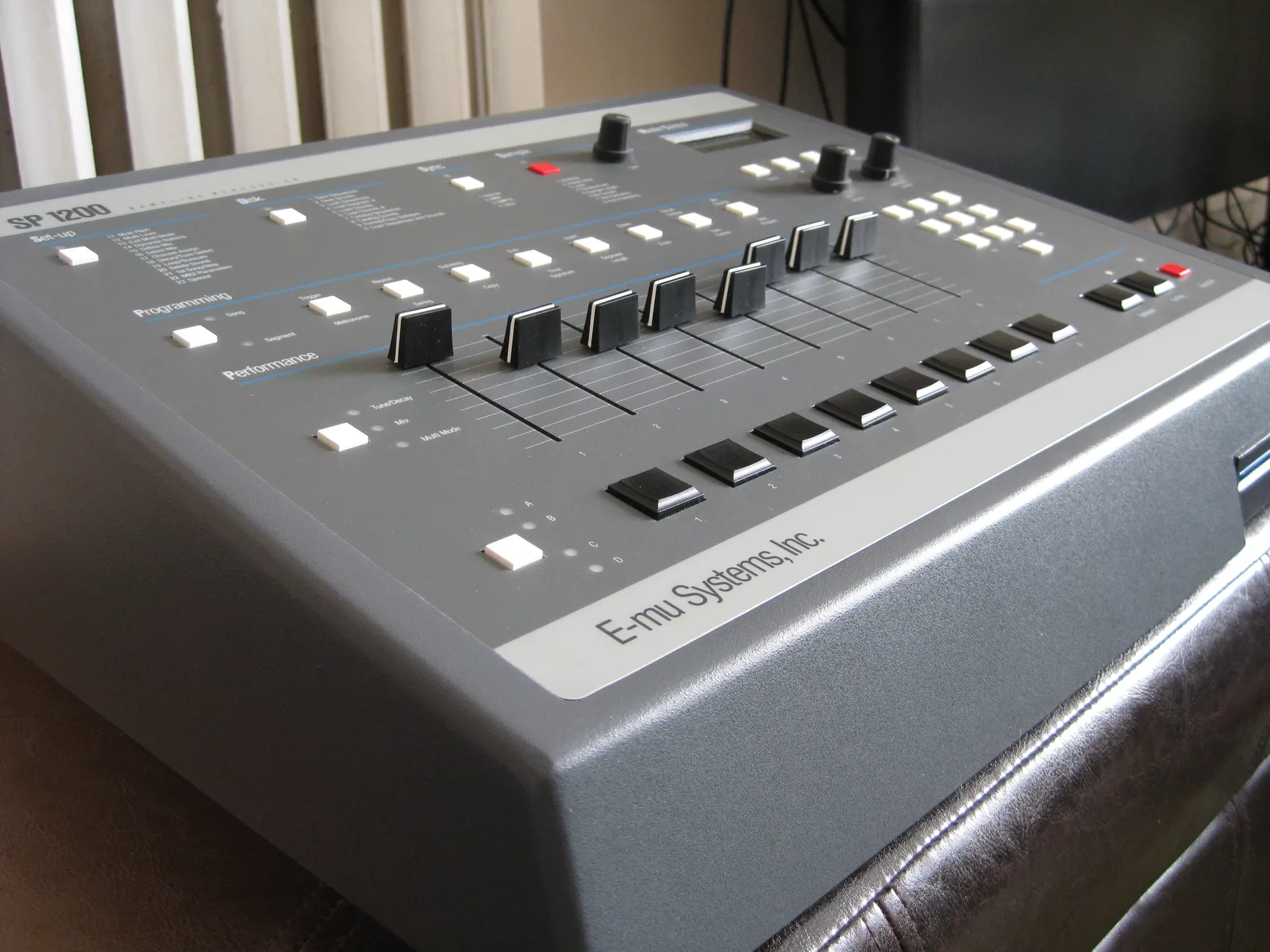
The E-mu SP-1200 had ten seconds of memory, a sample rate well below CD quality and a sequencer you programmed through a two-line display. Producers in New York worked around every one of those limits, and the workarounds became the sound of a decade of hip hop. This guide explains each limit in numbers, then shows how to reproduce them on purpose.
What is the E-mu SP-1200?
The E-mu SP-1200 is a sampling drum machine released by E-mu Systems in August 1987: an 8-voice, 12-bit sampler running at 26.04 kHz, with 10 seconds of total sample memory, eight pads, eight faders, an internal 3.5-inch floppy drive and a pattern-and-song sequencer. It has no built-in drum sounds. You sample your own, from drums, a synth or a record, and sequence them in the same box.
The design was led by Dave Rossum, E-mu’s co-founder, with Marco Alpert working on its functional design. The launch price in the US was $2,995. If you are new to the category, our explainer on what a drum machine is covers the sequencer and voice halves that every model shares; the SP-1200 is the version where the voice half is entirely user sampling.
SP-1200 specifications
These figures come from E-mu’s owner’s manual, Sound On Sound’s October 1987 review, and Rossum Electro-Music’s own product pages.
- Sample format: 12-bit linear at 26.04 kHz. The manual rounds this to 26,000 samples per second for its truncation maths.
- Sample memory: 10 seconds total, split into four 2.5-second zones; no single sample can be longer than 2.5 seconds.
- Sound slots: 32, in four banks of eight pads. The manual’s own arithmetic: 10 seconds shared across 32 sounds averages about 320 ms each.
- Voices and outputs: 8 voices, a mono mix output and eight individual channel outputs split between dynamic filtering, fixed filtering and none.
- Sequencer: 100 segments (patterns) and 100 songs, 5,000 notes of sequence memory, quantize down to 1/32-note triplets, and swing settings of 50, 54, 58, 63, 67 and 71%.
- Pitch: each sound can be tuned about a fifth up or down with its fader, or spread across all eight pads in multi-pitch mode.
- Sync and storage: MIDI and SMPTE sync; double-sided, double-density 3.5-inch floppy disks.
Why the SP-1200 sounds the way it does
The SP-1200 sounds gritty because of four design decisions working together: a low sample rate, 12-bit words, no reconstruction filter after the converter, and a crude pitch-shifting method. None of them was chosen for character. Each was a cost or memory compromise in 1987, and each leaves an audible fingerprint.
A 13 kHz ceiling from the 26.04 kHz sample rate
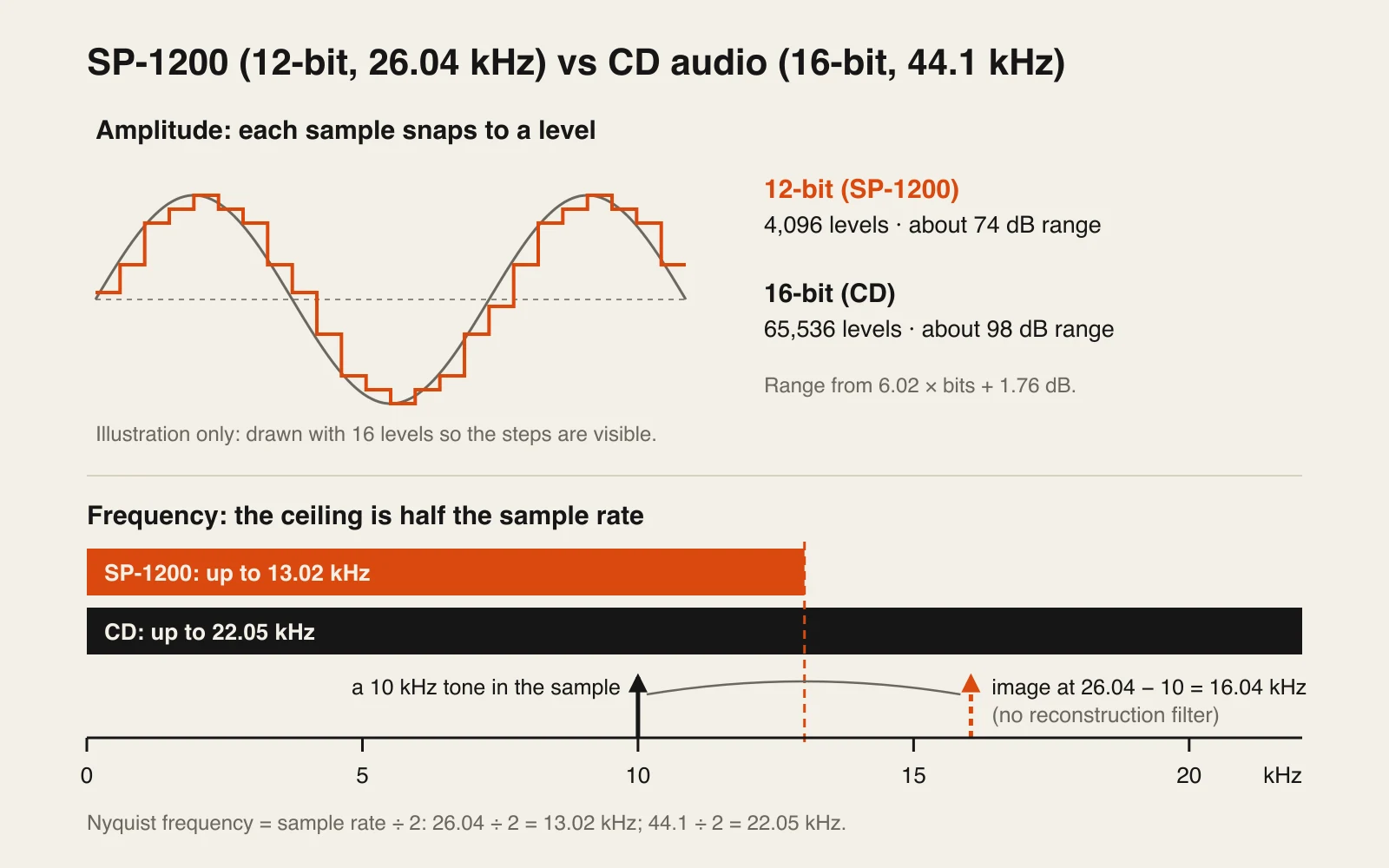
A digital system can only store frequencies below half its sample rate, the Nyquist frequency. At 26.04 kHz that ceiling is 13.02 kHz, against 22.05 kHz for CD audio. Hi-hats, cymbal shimmer and vinyl air above 13 kHz are simply not recorded. E-mu had used the same rate on the Drumulator, and Sound On Sound’s history of the company describes it as a trade between bandwidth and sampling time: every extra kilohertz would have cost seconds the machine could not afford.
12-bit linear resolution
Twelve bits give 4,096 amplitude steps and a theoretical dynamic range of about 74 dB, where 16 bits give 65,536 steps and about 98 dB. On a loud drum hit the difference is small. It shows on decays and quiet material, where the signal is using only the bottom few bits and the rounding error becomes a noisy, slightly ragged tail. E-mu’s manual sold 12 bits as a step up from the 8-bit machines of the day, which it was.
No reconstruction filter
A converter’s output normally passes through a steep low-pass filter that removes the mirror images every digital signal carries above Nyquist. E-mu deliberately left that filter out on the SP-12 and SP-1200. A 10 kHz component in a sample therefore arrives at the output with an image at 16.04 kHz (26.04 minus 10), which is within hearing. That is where some of the machine’s brightness comes from, even though it cannot record anything above 13 kHz.
Drop-sample pitch shifting
To tune a sound, the SP-1200 skips or repeats stored samples rather than interpolating between them. Tuning up drops samples and folds high frequencies back into the audible band as aliasing; tuning down repeats samples and adds a stepped, metallic edge. The manual warns that a tuned cymbal sounds closer to ring modulation than to a cymbal at a new pitch. On drums and chopped loops, producers heard that artefact as texture and leaned into it.
Filtered and unfiltered outputs
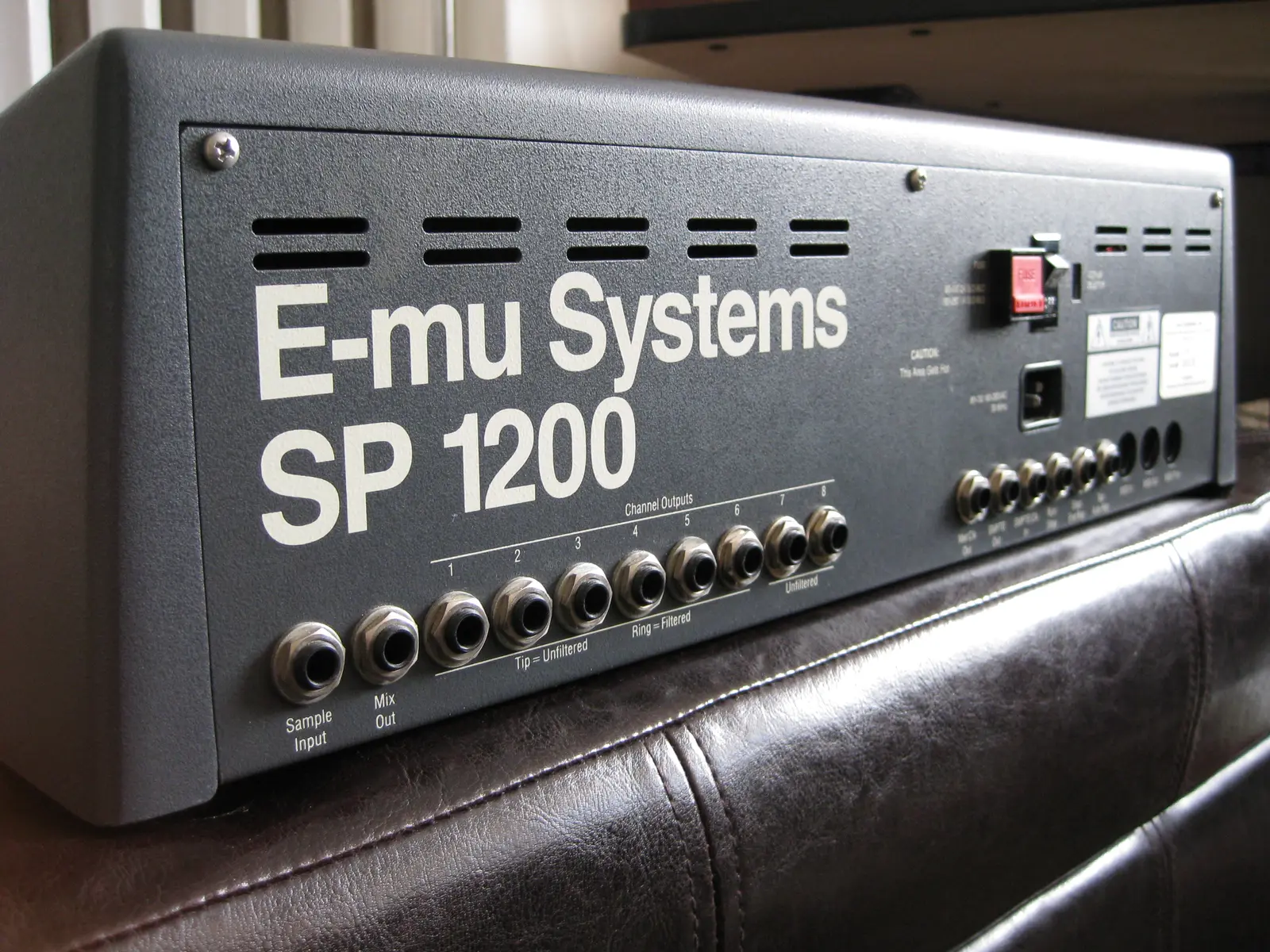

The eight channel outputs are not identical. According to the owner’s manual, channels 1 and 2 have dynamic filters whose cutoff moves over the course of each sound, channels 3 to 6 are filtered by a fixed amount, and channels 7 and 8 are unfiltered. The filters on 1 and 2 are SSM2044 chips, a four-pole analog low-pass that Rossum designed, and the fixed pairs sit at successively higher cutoffs. The filtered channels also tame the images left by the missing reconstruction filter; channels 7 and 8 pass them straight through.
The practical consequence is that the output you choose is a tone control. A bass sample on channel 1 closes down as it decays, which is the murky, filtered low end associated with the machine. A snare on channel 7 keeps every scrap of grit. On outputs 1 to 6, a plain mono jack takes the unfiltered signal; a stereo plug’s ring contact carries the filtered one. The mix output carries the filtered signals, and plugging a mono jack into a channel output takes that channel out of the mix.
Ten seconds of memory, and how producers stretched it
The SP-1200 holds 10 seconds of audio, but not as one pool. The manual describes four 2.5-second zones that a sample cannot cross. Fill each zone with a 2.0-second sound and you have 2.0 seconds free, yet nowhere to put a 1.0-second sample.
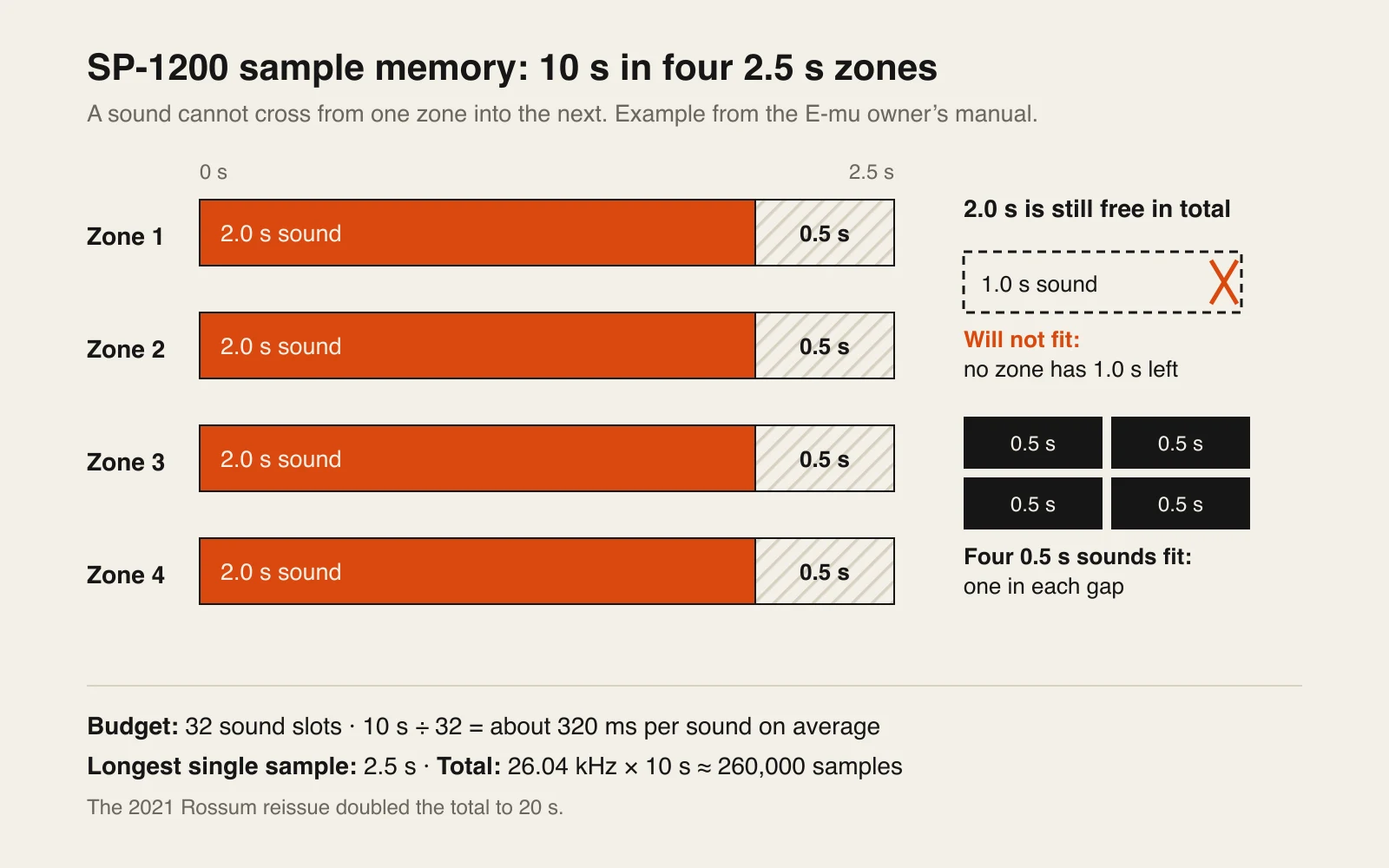
The memory limit is why SP-1200 beats are built from short pieces. A two-bar drum break at 90 BPM lasts about 5.3 seconds, more than twice the longest sample the machine allows. Producers chopped breaks into single hits or half-bar phrases and rebuilt the groove in the sequencer, which is the chopped, re-sequenced feel that defines the style.
The 45 rpm trick
The best-known workaround was to play a 33⅓ rpm record at 45 rpm while sampling, then tune the sample back down on the SP-1200. The speed ratio is 45 ÷ 33⅓ = 1.35, which is about 5.2 semitones. A passage that lasts 3.38 seconds on the record plays in 2.5 seconds at 45 rpm, so it fits inside one zone. Tuned down by 5.2 semitones, it plays for 3.38 seconds again at its original pitch and tempo.
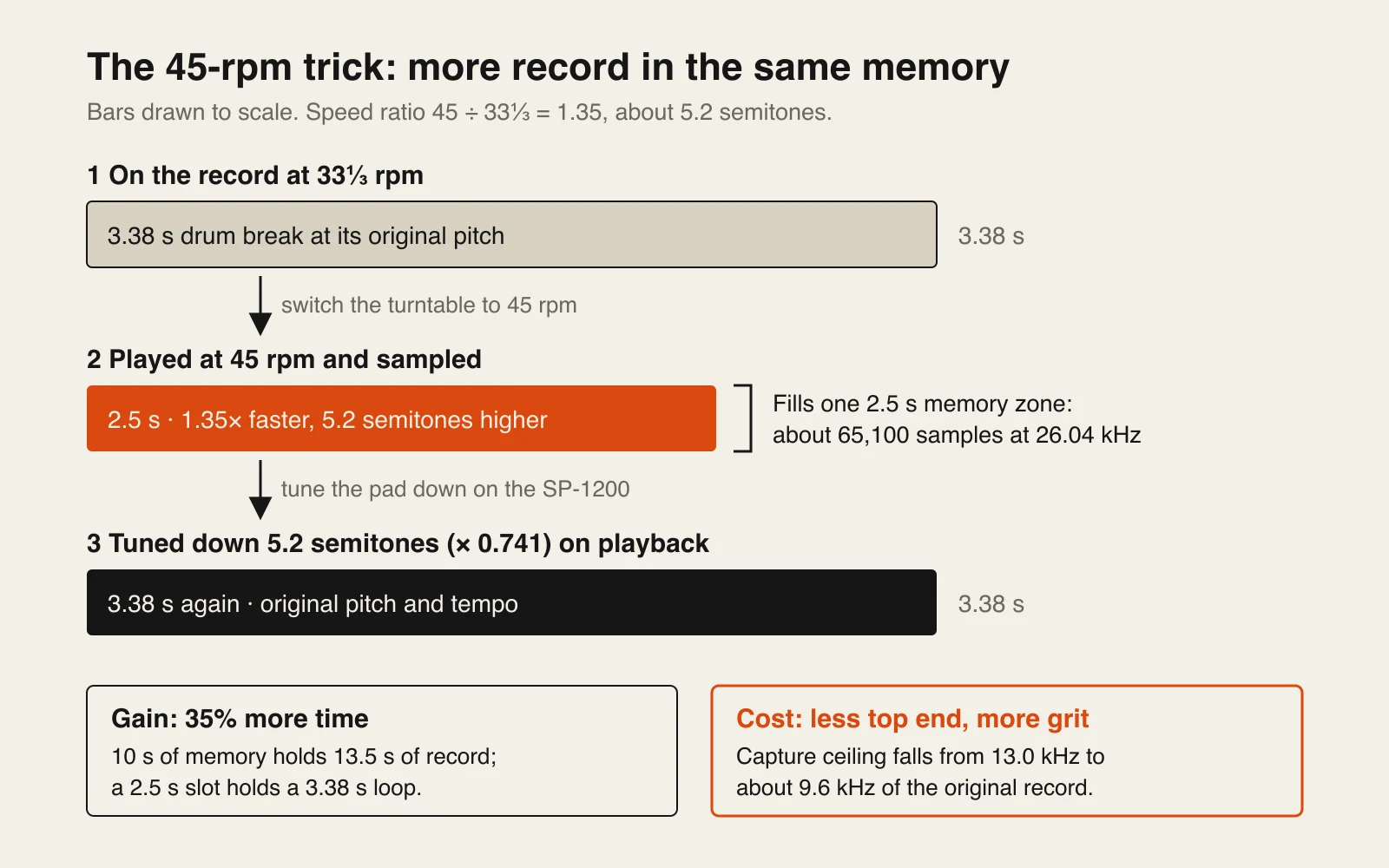
The gain is 35% more music per second of memory: the full 10 seconds holds about 13.5 seconds of record. The price is bandwidth. Everything captured above 13.02 kHz at 45 rpm is lost, and after tuning down that ceiling sits at about 9.6 kHz of the original audio. Add the drop-sample artefacts of a 5-semitone pitch shift and you have the darker, rougher loop that people now call the SP sound. The same logic applies to tape machines and variable-speed turntables at other ratios.
The SP-1200 and golden-era hip hop
The SP-1200 became the standard sampler of East Coast hip hop between the late 1980s and the mid-1990s. Several producers and records are tied to it in interviews, reviews and auction records:
- RZA used his first SP-1200 on Wu-Tang Clan’s Enter the Wu-Tang (36 Chambers) (1993). That signed unit sold at Sotheby’s in July 2023 for $69,850.
- Pete Rock is credited with SP-1200 work on Pete Rock & CL Smooth’s “They Reminisce Over You (T.R.O.Y.)” (1992).
- Easy Mo Bee used it on Miles Davis’s Doo-Bop (1992) and on tracks for The Notorious B.I.G.’s Ready to Die (1994).
- Public Enemy’s It Takes a Nation of Millions to Hold Us Back (1988), produced by the Bomb Squad, is among the earliest albums credited to the machine.
Writing in the Village Voice in 2007, Ben Detrick argued that the machine’s strengths and weaknesses shaped the whole era: the crunchy drums, the chopped samples and the filtered basslines were properties of the box. The swing settings mattered too. A segment set to 54% or 58% pushes the off-beat hits late in a way that reads as human, and the SP-1200 applied that feel to everything in the pattern.
For where the SP-1200 sits among the Roland, Linn and Oberheim boxes that came before it, see our history of vintage drum machines.
From Drumulator to SP-12 to SP-1200
The SP-1200 was the third step in a line of E-mu drum machines. The Drumulator (1983, $995) played back fixed 8-bit drum samples and sold close to ten thousand units in two years. Its successor was first shown as the “Drumulator II” in early 1985 and launched that summer as the SP-12, for Sampling Percussion with 12-bit samples, at $2,745.
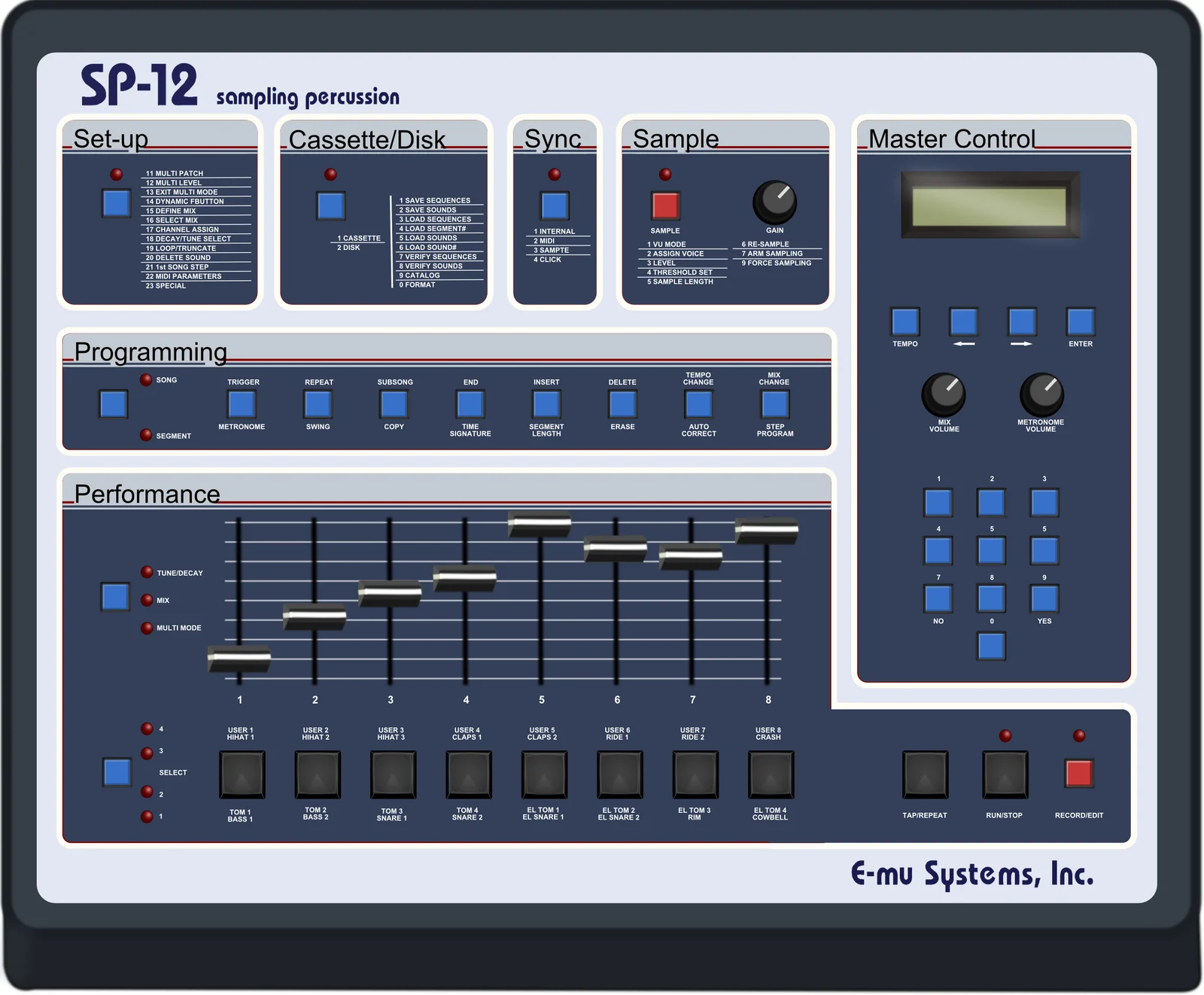

The SP-12 kept a set of ROM drum sounds, supplied by Digidesign according to Sound On Sound, and added user sampling at 26.04 kHz. Its sample memory was small; sources disagree on the figure for the standard unit, but E-mu’s Turbo upgrade raised it to 5 seconds. According to FACT magazine, Rick Rubin used it on “Rhymin & Stealin” from the Beastie Boys’ Licensed to Ill.
The SP-1200 replaced it in August 1987. E-mu removed the ROM sounds, doubled the sample memory to 10 seconds and built in a floppy drive, so a whole kit and its songs could be loaded in one go. Production stopped around 1990, restarted in 1993 in a black case, and ended with a final batch in spring 1998 once the SSM2044 filter chips could no longer be sourced.
SP-12 vs SP-1200 vs MPC60
The SP-1200’s real rival was the Akai MPC60, designed by Roger Linn and released in December 1988. It sampled at a higher rate, held more audio and had a far deeper sequencer, and it went on to found the MPC line. The story of Linn’s machines before it is in our guide to the Linn drum machine and MPC60 lineage.
| E-mu SP-12 | E-mu SP-1200 | Akai MPC60 | |
|---|---|---|---|
| Released | 1985 | August 1987 | December 1988 |
| US launch price | $2,745 | $2,995 | $5,000 |
| Bit depth | 12-bit linear | 12-bit linear | 12-bit |
| Sample rate | 26.04 kHz | 26.04 kHz | 40 kHz |
| Sample time | A few seconds; 5 s with Turbo upgrade | 10 s total, 2.5 s per sound | 13.1 s; 26.2 s with expansion |
| ROM drum sounds | 24, plus user samples | None; 32 user sample slots | — |
| Pads | 8 | 8 | 16, pressure-sensitive |
| Sequencer | 100 songs, 100 patterns, 5,000 notes | 100 segments, 100 songs, 5,000 notes | 99 sequences, 99 tracks, 60,000 notes |
| Storage | No internal drive | Internal 3.5-inch floppy | Floppy disk |
| Designer | Dave Rossum, E-mu | Dave Rossum, E-mu | Roger Linn, for Akai |
| Sound in one line | Gritty, with a ROM kit | Gritty, dark, 13 kHz ceiling | Cleaner, wider band, famous swing |
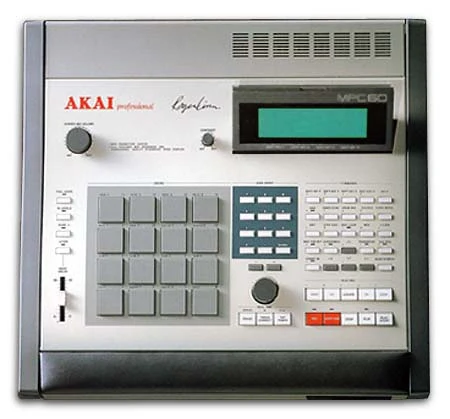

Some producers used both: the MPC60 for its sequencer and longer samples, the SP-1200 for drums they wanted crunchy. Neither is a better sampler in the abstract. The SP-1200 imposes a sound; the MPC60 gets closer to what you fed it.
The Rossum SP-1200 reissues (2020 to 2025)
Dave Rossum’s later company, Rossum Electro-Music, brought the machine back in three stages. None is on sale now.
35th Anniversary Renovation (2020)
Original vintage units stripped and rebuilt, with a new floppy drive plus SD floppy emulator, new capacitors and pots, a metal chassis and a signed plaque. A very small run at $7,500.
SP-1200 reissue (2021 to 2025)
A new build announced in November 2021 at $3,999: the same 12-bit, 26.04 kHz format, 20 seconds of memory, SD card storage, separate filtered and unfiltered jacks and SSI2144 filters with rear-panel cutoff and resonance sliders for channels 1 and 2.
40th Anniversary Edition
The final run: 100 numbered units in black and gold at $4,999, with the same electronics as the standard reissue. Rossum lists it as sold out.
Why production ended
Rossum says the SP-1200 can no longer be built because key parts are gone, the Zilog Z80 processor in particular. The SSI2144 replaced the long-discontinued SSM2044 and is described by Rossum as functionally identical.
How much does an SP-1200 cost?
An original SP-1200 costs roughly $5,000 to well over $10,000 on the used market at the time of writing, depending on condition, service history, the grey or black case, and modifications such as SD drive emulators. Used Rossum reissues also come up for sale, and with production over they are no longer tied to their $3,999 list price. Artist-owned machines sit in a different market entirely; RZA’s went for $69,850 at auction.
Prices are high because no new units will be made, the originals are over 25 years old and need servicing, and demand from hip hop producers has never gone away. Before buying a vintage unit, check that the floppy drive reads (or has been replaced by an emulator), that every pad and fader responds, and that all eight outputs pass sound.
How to get the SP-1200 sound in a DAW
You can get most of the way with stock tools if you recreate the steps in the order the hardware applied them: optional speed-up, sampling at 26.04 kHz with 12 bits, pitching down, then analog filtering. Order matters, because pitching down after the rate reduction is what carries the stepped artefacts into the audible range.
An SP-1200 chain for a drum loop
Speed up → 26.04 kHz → 12 bits → pitch down → low-pass → saturation → swing
- Speed the loop up 1.35× (+5.2 semitones) with varispeed or repitch, not time-stretch, so pitch and tempo rise together. It gets about 26% shorter. Skip this step for one-shots you only want crunchy.
- Reduce the sample rate to 26,040 Hz with a downsampler, not an export setting. In Ableton Live’s Redux, set Rate to about 26 kHz, leave the Post filter off so the images stay in, and switch the Pre filter off for more grit or on for a cleaner capture. A normal sample-rate conversion adds a steep filter that removes the artefacts you want.
- Reduce to 12 bits, linear (Redux Bits 12, Shape 0), with no dither. On a loud loop this is subtle. If it sounds obviously crushed, you have gone below 12 bits or the level is very low.
- Pitch the loop back down 5.2 semitones (× 0.741) in a sampler, choosing its plainest interpolation mode if it has one. It returns to its original tempo and gains the darker, rougher top end. For single hits, tune by ear within about a fifth either way, the range of the SP-1200’s faders.
- Add a four-pole (24 dB per octave) low-pass. For drums, start around 10 to 12 kHz and lower it until the cymbals lose their sheen; for a bass line, use an envelope that closes the filter from around 2 kHz toward a few hundred hertz over each note, as channels 1 and 2 do.
- Add 2 to 4 dB of gentle tape or console saturation on the drum bus. Avoid hard digital clipping at the input: the manual describes it as a splattering, non-musical distortion, and it is not part of the sound.
- Set swing to 54% or 58% on the drum pattern. Those are two of the SP-1200’s six swing settings, and they give the late off-beat feel without drifting into a shuffle.
E-mu never published cutoff frequencies for the fixed-filter channels, so the filter values above are starting points to tune by ear, not measurements of the hardware.
SP-1200-style plugins
If you would rather load one plugin than build a chain, several are made specifically around this machine. This is a map, not a review; we have not tested them against a hardware unit.
- Inphonik RX1200 is a sampler plugin built around the SP-1200: 12-bit at 26.04 kHz, an SSM2044 filter model, the machine’s aliased pitch tuning, and four banks of eight pads. It drops the hardware’s sequencer and its memory limit. VST2, VST3, AU, AAX and Rack Extension formats.
- waveTracing SP950 emulates the SP-1200’s 12-bit, 26.04 kHz conversion and its detune artefacts, and adds a model of the Akai S950’s low-pass filter.
- Low Hiss eSPi is an SP-1200 emulation that recreates its workflow as well as its sound, available on desktop and mobile platforms.
Free boom bap drums to start from
The chain above works best on clean, dry drums, because it adds the dirt itself. Our free boom bap drum kit and free hip hop drum loops are royalty-free WAVs you can run straight through it. Both packs were rendered with our AI sample generator and then auditioned by hand; the generator can also make one-shots from a text prompt if you need a specific kick or snare to chop.
Frequently asked questions
How much does an SP-1200 cost today?
At the time of writing, a used original E-mu SP-1200 typically sells for roughly $5,000 to over $10,000, depending on condition, servicing and modifications. The Rossum reissue listed at $3,999 new and is now discontinued, so it too is only available used. The original launched in 1987 at $2,995.
Why is the SP-1200 so expensive?
Because supply has ended and demand has not. E-mu stopped making it in 1998 when the SSM2044 filter chips ran out, and Rossum ended its reissue in 2025 because the Z80 processor and other parts are no longer available. Its association with 1990s hip hop keeps producers looking for units.
What drum machine did Wu-Tang use?
RZA used an E-mu SP-1200 on Wu-Tang Clan’s debut, Enter the Wu-Tang (36 Chambers), from 1993. His first SP-1200, signed by him, sold at Sotheby’s in July 2023 for $69,850, with RZA confirming it was used on several Wu-Tang releases.
What is the sample rate of the SP-1200?
The SP-1200 samples at 26.04 kHz with 12-bit linear resolution, so the highest frequency it can record is 13.02 kHz. The 2021 Rossum reissue kept the same rate and bit depth and doubled the memory from 10 to 20 seconds.
Is the SP-1200 a drum machine or a sampler?
Both. The SP-1200 is a sampling drum machine: a sampler with pads and a built-in pattern sequencer, designed for drums. It has no preset sounds in ROM, so everything it plays is a sample you recorded or loaded from disk.
Why did producers sample records at 45 rpm on the SP-1200?
To fit more audio into its 10 seconds of memory. Playing a 33⅓ rpm record at 45 rpm speeds it up 1.35 times, so a passage takes 26% less memory; tuning it down about 5.2 semitones on the SP-1200 restores the original pitch and tempo. The trade-off is lost high frequencies and extra pitch-shift grit, which became part of the sound.
Royalty-free WAV
Free sample packs
Royalty-free WAV, play every sample before you download.