
What Is an 808? The Machine, the Kick and the Bass
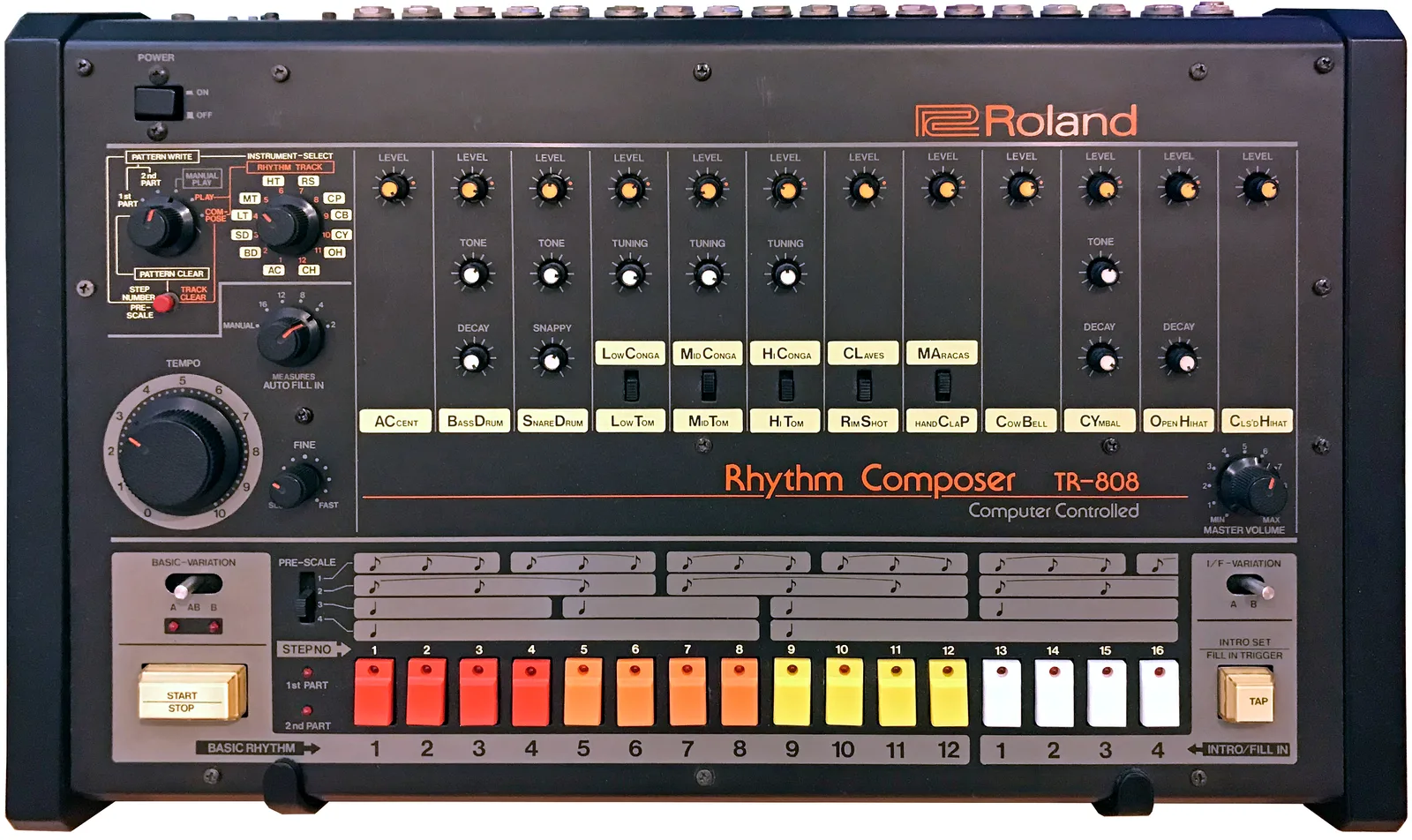
Ask a producer for “an 808” and you might get a drum machine, a kick drum or a bassline. All three answers are right. They are one sound seen at three distances, and the reason a drum became a bass instrument sits in a single knob on a 1980 circuit board.
What is an 808?
An 808 is the Roland TR-808 Rhythm Composer, an analog drum machine released in 1980, and by extension the sounds it made famous. In modern hip hop, trap and drill, “an 808” usually means one specific sound: a long, low, tuned sub-bass note derived from the TR-808’s bass drum, played in a sampler or synth as the bassline of the track.
So the word covers three things, and context tells you which one is meant:
- The machine. The Roland TR-808, built from 1980 to 1983. “Programmed on an 808” means this.
- The kick. The TR-808’s bass drum voice: a round, booming thud with a soft click on top. Electro and Miami bass records use it as a drum.
- The bass. The same kick with its tail stretched out and its pitch changed note by note so it plays a bassline. In trap, “turn the 808 up” means this, and almost nobody producing one today owns the hardware.
The Roland TR-808 (1980)

The TR-808 is a programmable analog drum machine that Roland sold from 1980 to 1983 for US$1,195 at launch, according to its Wikipedia entry, which puts production at roughly 12,000 units. TR stands for Transistor Rhythm. The project was driven by Roland founder Ikutaro Kakehashi, with Tadao Kikumoto leading the engineering team and Hiro Nakamura designing the voice circuits.
None of its voices plays back a recording. Each one is a small analog circuit that produces its sound fresh on every trigger, which is also why it ended so soon: the design relied on a batch of out-of-spec transistors that could no longer be sourced once semiconductor manufacturing improved. Cheap on the used market by the mid-1980s, it was picked up by hip hop and electro producers and never put down.
If you want the wider picture first, what is a drum machine explains the sequencer-plus-voices idea, analog drum machines covers the 808’s peers, and 808 vs 909 compares its circuits with those of the Roland TR-909. This article stays with the one voice that turned into a bass.
How the 808 kick becomes a bass note
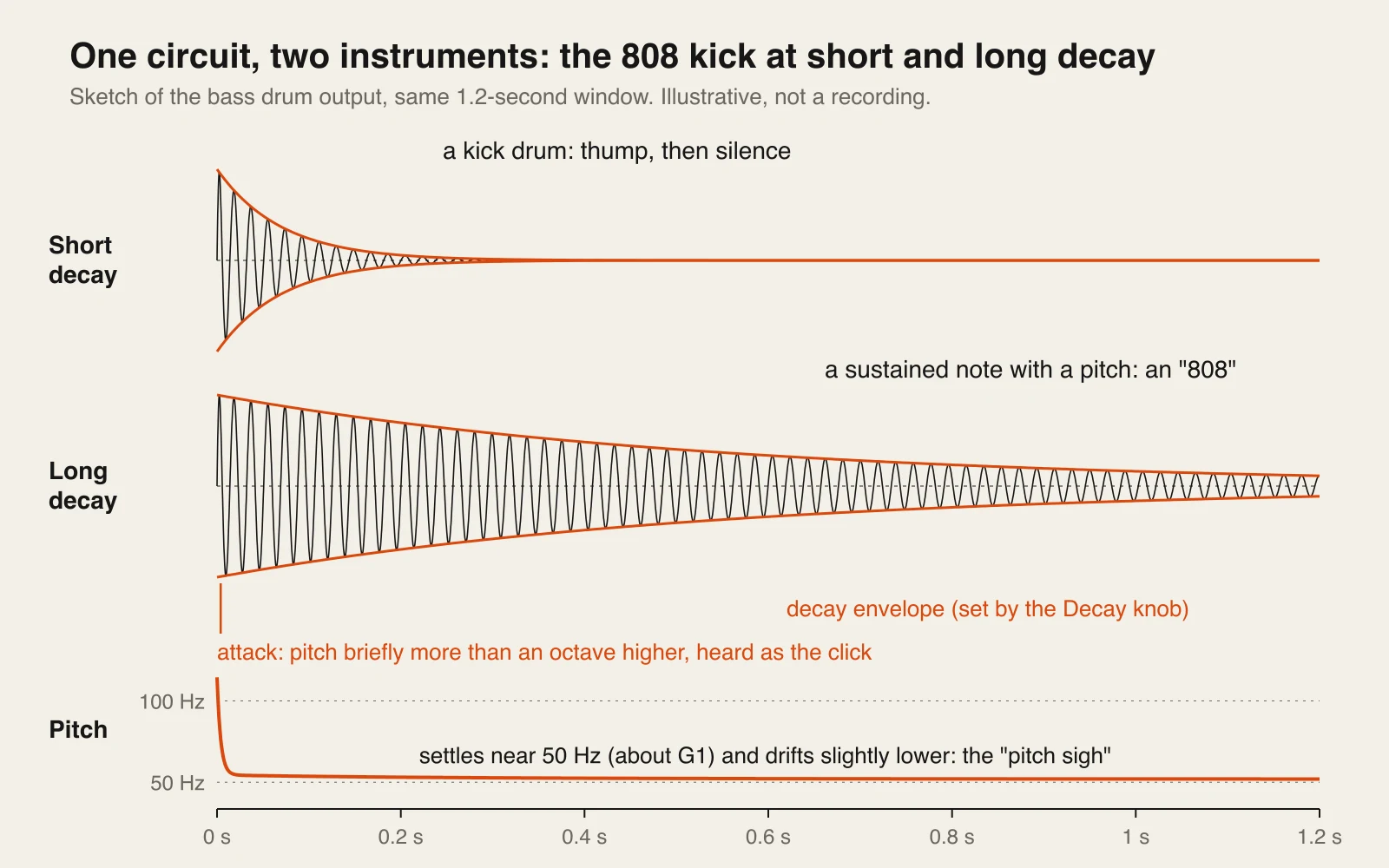
The 808 kick becomes a bass note because its sound is a resonant filter ringing at a fixed low pitch, and the Decay knob decides how long it rings: turn it up and a short thump turns into a sustained, nearly pure tone near 50 Hz. The best technical account is Kurt James Werner, Jonathan Abel and Julius Smith’s circuit analysis presented at DAFx-14, and the steps below follow it.
- A 1 ms pulse. The sequencer fires a pulse about one millisecond long into a pulse shaper.
- A ringing filter. The pulse strikes a bridged-T network, a band-pass filter that rings like a struck object. That ringing is the core of the sound, and it is close to a sine wave. Werner’s calculation from the service-manual component values puts its centre near 49.5 Hz; Roland’s own tuning chart lists 56 Hz. Individual machines differ.
- A pitch jump on the attack. For the first few milliseconds, an envelope pushes the filter’s centre frequency up by more than an octave. Your ear hears that as the attack, not as a pitch.
- A slight sigh. Leakage in the retrigger circuit makes the pitch drift subtly downward as the note dies away. This is separate from the attack jump, and it is part of why a long 808 sounds alive rather than like a test tone.
- Decay through feedback. The Decay knob sets how much of the filter’s output is fed back into it. Less loss in that loop means a longer ring, all the way out to notes several seconds long.
- Tone as a low-pass. The Tone knob is a passive filter on the output that trims how much click comes through.
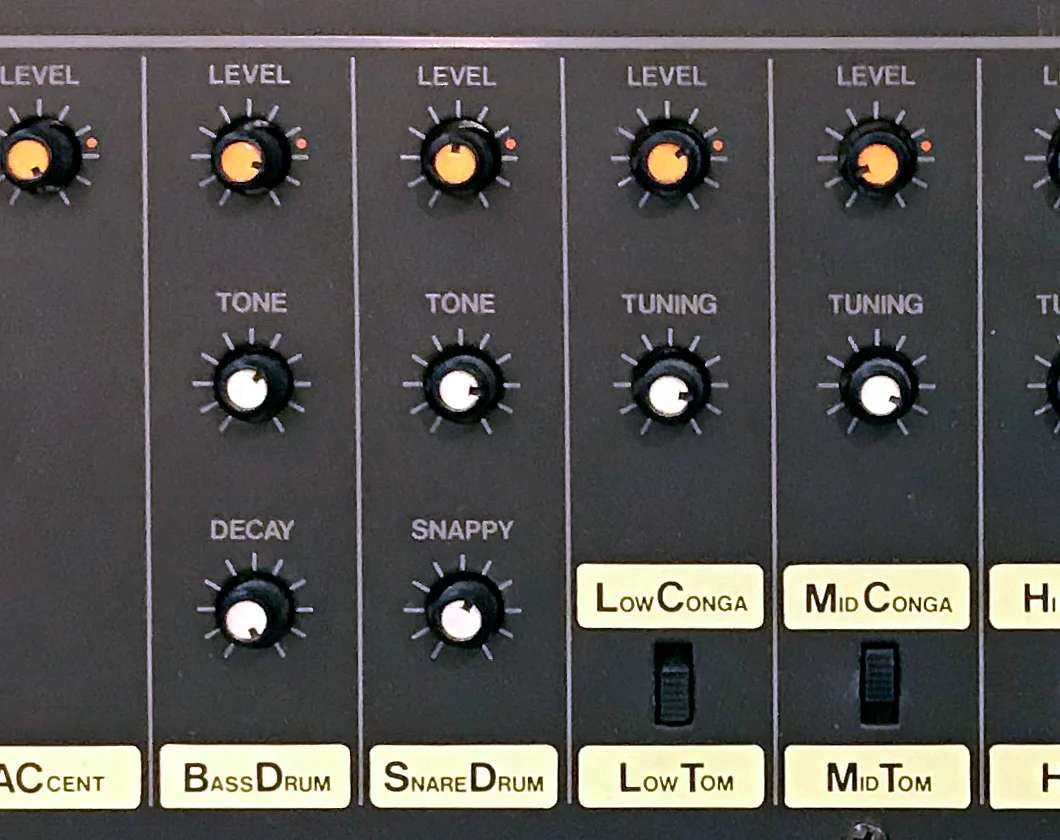
One detail matters a great deal for what came next. The stock bass drum has no tuning control. The pitch is fixed by resistor and capacitor values on the board, somewhere around G1 to A1. Toms and congas on the same panel have Tuning knobs; the kick does not. Playing a bassline on it meant getting the sound into something that could change its pitch.
Why a long 808 works as a bassline
A long 808 works as a bassline because, once the click has passed, it is almost nothing but a fundamental in the same register as a bass guitar’s lowest notes, so the ear reads it as a bass note that happens to start with a drum hit. The low E of a four-string bass is E1, 41.2 Hz; the stock 808 kick rings a little above that.
That gives a producer two jobs done by one sound. The start of every note is a kick, so the rhythm section and the bass move as one instrument with nothing to line up. The tail carries the harmony, so the low end follows the chords. With a separate kick and bass guitar, you spend mixing time keeping them out of each other’s way; with an 808, they are one event by design.
The route from drum to bass ran through samplers. Wikipedia credits Rick Rubin with popularising long, pitched 808 bass drums as basslines. Roland’s own history of the sound, Nothing Sounds Quite Like an 808, points to Florida duo Dynamix II’s 1987 “Just Give the DJ a Break”, where an 808 boom was loaded into a sampler and played chromatically, and follows the technique through Miami bass, UK jungle and Southern hip hop into trap. Kanye West’s 2008 album 808s & Heartbreak took the machine’s name for its title.
In a sampler, pitch is just playback speed: play the 808 two semitones higher and the file plays about 12% faster, so it also ends sooner. That side effect is why producers talk about an 808 “getting shorter” on high notes, and why modern sample-based 808s are rendered long enough to survive it.
808 kick vs 808 bass vs a regular kick
The three differ mainly in pitch and length: a regular kick is short and loosely pitched, a stock 808 kick has one fixed low pitch and an adjustable tail, and an 808 bass is that tail tuned to the song and played as notes.
| Stock TR-808 kick | 808 bass | Regular kick | |
|---|---|---|---|
| Pitch | Fixed by the circuit, near 50–56 Hz | Tuned to the song, changes with each note | Loosely pitched or untuned |
| Length | Short to several seconds, set by Decay | As long as the MIDI note, often a second or more | A fraction of a second |
| Waveform | Near-sine ring with a brief pitch jump on the attack | Near-sine, usually with added harmonics from saturation | Beater click plus a shell tone or a pitch-swept oscillator |
| Where the energy is | Fundamental around 50 Hz, soft click above | Fundamental about 30–65 Hz, harmonics up to a few hundred Hz | Body about 50–100 Hz, click about 2–5 kHz |
| Role | Rhythm | Bassline and kick weight at once | Rhythm and punch |
| How it is played | A trigger on the step grid | Notes in a piano roll, like a bass | A trigger on the step grid |
| Typical genres | Electro, Miami bass, early hip hop | Trap, drill, modern rap and R&B | Nearly all drummed music |
How to make and use an 808 in a DAW
To use an 808 in a DAW, load a long 808 sample into a sampler set to mono, tune the sample so the note you play is the note you hear, write the part on the roots of your chords, add saturation so small speakers can hear it, and keep it out of the kick’s way. The values below are starting points, not rules.
Setting up an 808 from a single sample
Any DAW sampler: Simpler, Quick Sampler, FL Studio’s sampler channel, Kontakt and the like
- Find the key of the song, then pick the register. Most 808 parts sit between about E1 (41.2 Hz) and C2 (65.4 Hz). Much below 35 Hz, many playback systems give you rumble rather than a note; much above C2, the 808 starts to crowd the low mids.
- Measure the sample’s pitch on the tail, not the attack. Put a tuner on the sampler and read it 50–100 ms into the note. The first few milliseconds sit well above the real pitch, as the diagram above shows, and will fool a tuner. Set the sampler’s root note to what you read, and fix the remainder with fine tune in cents.
- Set the sampler to mono, one voice, legato, with glide (portamento) of 40–80 ms. With legato on, the pitch slides only when one note overlaps the next, so you choose where glides happen by overlapping notes in the piano roll.
- Shape the envelope. Attack 0–2 ms keeps the punch. Release 20–80 ms stops the note ending in a click. Turn off one-shot or trigger mode, so the note length in the piano roll decides how long the 808 rings.
- Add saturation with a soft-clipper, tape or tube-style saturator. Increase the drive until you can hear the notes on laptop speakers, then back off slightly. On a send or with the dry/wet mix around 30–60%, the clean sub stays intact under the added harmonics.
- Make room for the kick. Either start each 808 note with the kick and shorten the kick, or sidechain the 808 to the kick: ratio 4:1 or higher, attack 0–1 ms, release 60–120 ms, 3–6 dB of gain reduction.
- Keep the low end mono. Collapse everything below about 100 Hz to mono with your DAW’s utility or bass-mono tool, and high-pass the 808 at about 20–25 Hz to remove energy below the lowest note.
- Check it away from the studio. Listen on phone speakers, earbuds and in a car. If the bassline disappears on a phone, add harmonics. If the car rattles on one note, that note is louder than its neighbours; turn it down or reshape it with EQ.
Pitch-shifting a sample changes its length. If your 808 runs out before the note ends on higher notes, use a longer sample or switch the sampler to a time-stretching mode.
Writing the 808 part
Start on the root of each chord, in the lowest octave you can hear clearly, and let the kick pattern decide the rhythm. Where the chord changes, a short note that overlaps into the next root gives you a glide into the new chord. Keep glides to a few per phrase; a slide on every note makes the bassline blurry.
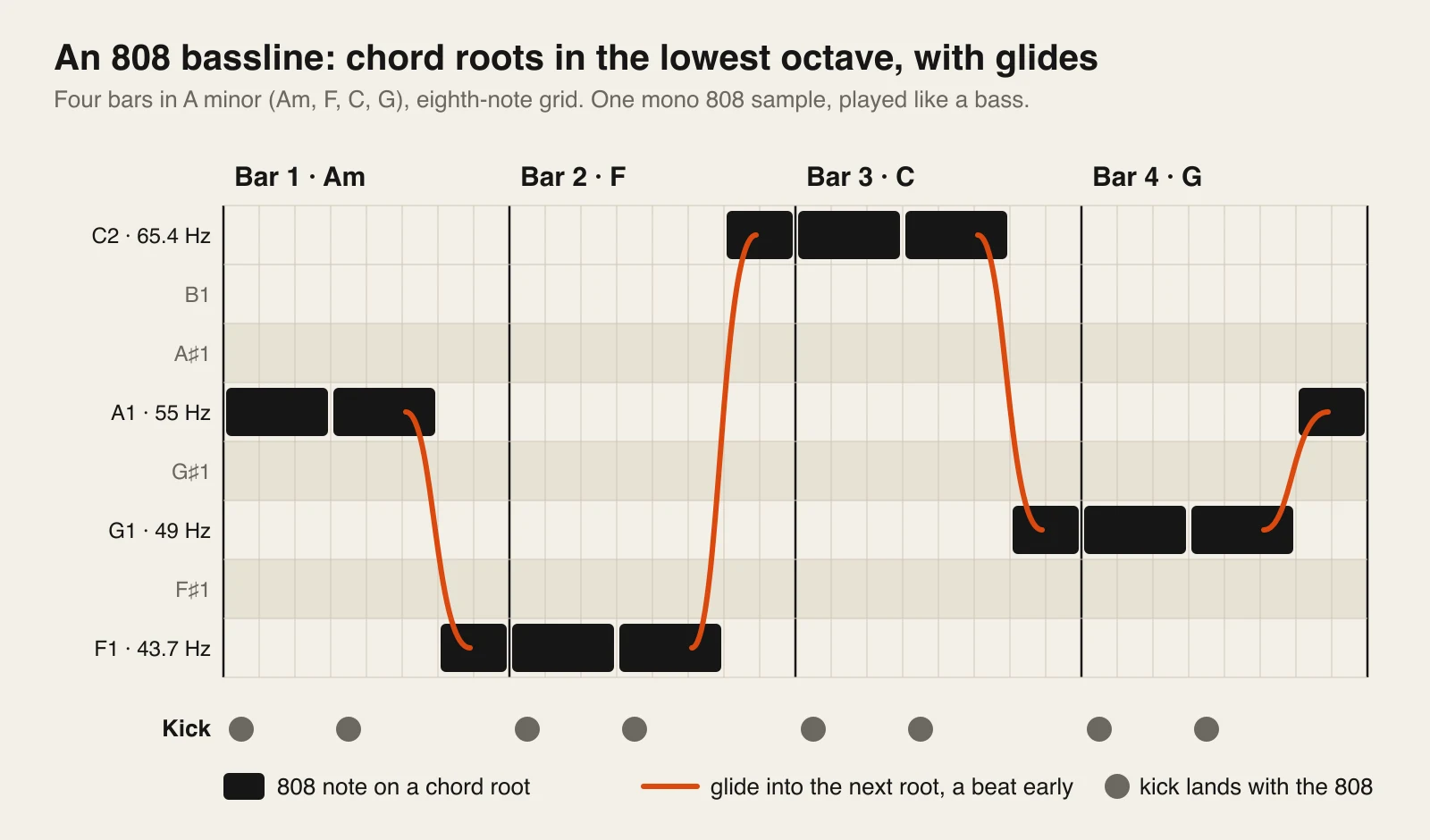
An octave jump is the other standard move: repeat a root one octave up for a single eighth or sixteenth note, often with a glide back down. Because the part is a single mono voice, only one 808 note sounds at a time, the same way a bass player plays one string at a time.
Kick and 808 together
There are three workable arrangements, and most records use one of them. The first is no separate kick at all: the 808’s own attack is the kick, which is how the original machine was used. The second is kick and 808 on the same beat, with a short, tight kick providing click and the 808 providing the low end; tune the kick to the song’s key or keep it clearly above the 808 so the two do not beat against each other. The third is sidechain ducking, where the 808 drops a few decibels for the length of each kick. This is the safest choice when the two fall on different beats.
What does not work is two long, low sounds starting together at different pitches. The result is a wobble where they interfere, and the low end loses definition.
Why distortion makes an 808 audible
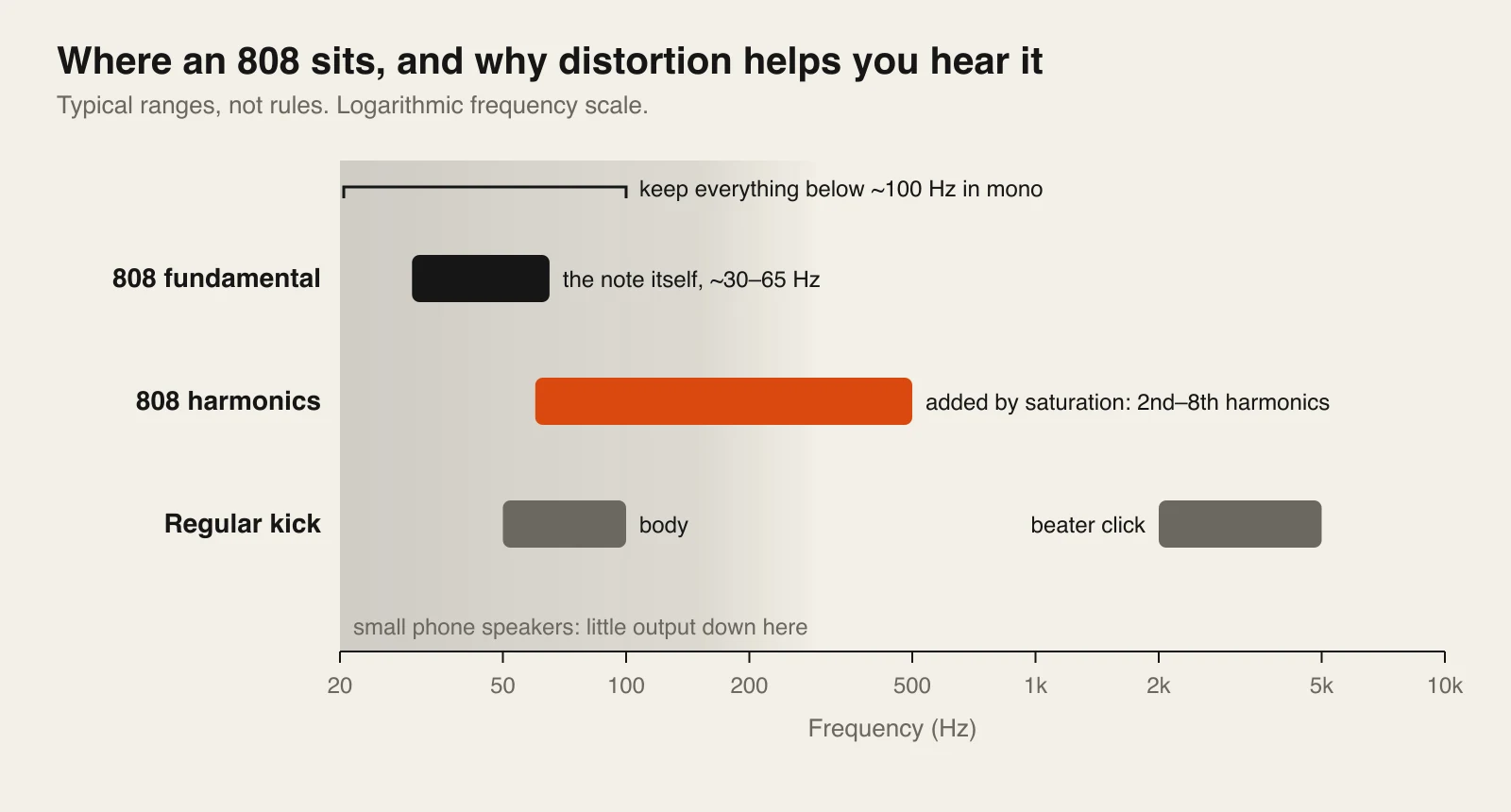
A clean 808 is close to a sine wave, so nearly all of its energy sits at the fundamental, between roughly 30 and 65 Hz. Phone and small laptop speakers produce very little there. Saturation adds harmonics at two, three, four and more times the fundamental, which small speakers can play, and the ear reconstructs the missing low note from that harmonic series. This effect is called the missing fundamental. That is why a distorted 808 can carry a bassline on a phone while a clean one disappears.
Where to get 808 sounds
You can get an 808 from a sample, from a plugin that models the original circuit, or by building one in any synth. Very few producers use the hardware for it.
- Samples. A single long 808 in a stock sampler is how most trap 808s are made. Our free sample packs include 808s as clean single notes with the key stated, royalty-free WAV that you can audition before you download. For the drums around them, the free hip hop drum loops are a match.
- Generated to order. The AI sample generator on this site renders 808 one-shots from a text description, for example “long clean 808, slight distortion”. Key and BPM controls apply to loops only, so tune a generated 808 one-shot in your sampler as described above.
- Plugins. Roland sells its own software TR-808, and several third-party instruments model the circuit. 808 vs 909 introduces the main emulations, and best drum machine VST compares the field in detail, so neither list is repeated here.
- Hardware. Roland’s TR-08 (2017) is a compact reissue with MIDI and USB, and the Behringer RD-8 (2019) is an analog recreation. An original TR-808 is a collector’s item priced accordingly.
- Build your own. Any synth with a sine oscillator, a fast pitch envelope (start one or two octaves up and fall in 5–20 ms) and a long amplitude decay will produce an 808-style note, and you can tune it directly without measuring a sample.
Frequently asked questions
Is an 808 just bass?
Not quite. An 808 is a kick drum and a bass note in one sound: the attack works as the kick and the long tail works as the bassline. In trap and drill it takes the place of both a separate bass instrument and much of the kick’s job, which is why producers treat it as its own category rather than as a plain bass.
Why is the 808 so popular?
Because one sound covers rhythm and harmony at once, with a low end deeper than most acoustic drums produce. The Roland TR-808 became cheap second-hand in the 1980s, which put it in the hands of hip hop, electro and Miami bass producers, and samplers let them play its kick as a tuned bassline. Trap turned that technique into the genre’s foundation.
What does 808 mean in slang?
In music slang, an 808 is the deep, tuned bass sound in hip hop and trap, named after the Roland TR-808 drum machine. Outside music, 808 is the telephone area code for Hawaii, so the number also appears as local shorthand there.
Why was the 808 discontinued?
Roland stopped making the TR-808 in 1983 after about 12,000 units. Its sound depended on a supply of out-of-spec transistors, and improvements in semiconductor manufacturing meant those parts could no longer be restocked. It had also sold poorly next to the sample-based machines of the time.
What key should an 808 be in?
The same key as the song. The 808 plays the bassline, so its notes follow the chord roots in that key, usually between about E1 and C2. Measure the sample’s pitch on its tail rather than its attack, set the sampler’s root note to match, and the notes you play will be the notes you hear.
What is the difference between an 808 and a sub-bass?
A sub-bass is any bass sound whose energy sits mostly below about 60 to 80 Hz, often a sustained sine wave from a synth. An 808 is a particular kind of sub-bass: it has a kick-like attack, a decaying tail rather than a steady sustain, and usually some saturation. Every 808 bass is a sub-bass, but most sub-basses are not 808s.
Royalty-free WAV
Free sample packs
Royalty-free WAV, play every sample before you download.