
Roland TR-909: History, Sounds, Sequencer and Alternatives
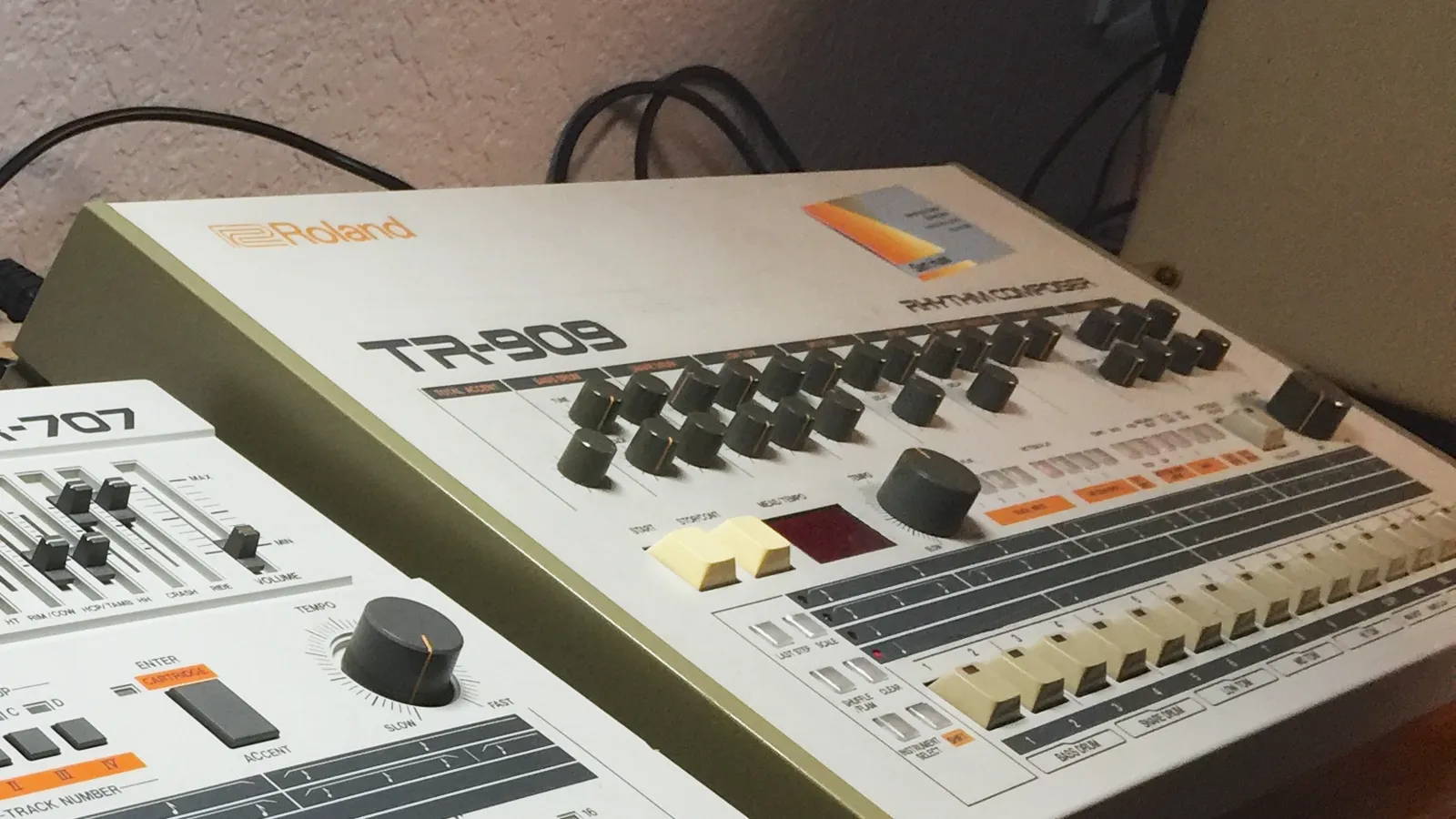
Roland built the TR-909 to sound more like a real drum kit, sold it for about a year, and stopped. It then spent the next decade becoming one of the most copied drum sounds in dance music. This is the whole machine: what is inside, what every control does, how its sequencer thinks, and what to buy if you want one now.
What is the Roland TR-909?
The Roland TR-909 Rhythm Composer is a drum machine released by Roland in 1983. It has eleven drum voices: seven are analog circuits and four play 6-bit digital recordings of real cymbals. A 16-step sequencer with accent, shuffle, flam and MIDI drives them all. It was a commercial failure, went out of production after roughly 10,000 units, and became the standard kick, clap and hi-hat of house and techno once second-hand prices fell.

People say “909” to mean three different things: the original hardware, its sounds as samples, or any modern box or plugin that recreates them. When a producer asks for “a 909 kick” they almost always mean the sound, not the machine. If you are deciding between this and Roland’s earlier machine, our 808 vs 909 comparison puts them side by side; this page stays with the 909 alone.
| Roland TR-909 | |
|---|---|
| Released | 1983; replaced by the TR-707 in 1984 |
| Design team | Tadao Kikumoto (who also led the TR-808 and TB-303), Atsushi Hoshiai (software and cymbal samples), Yoshiro Oue (voice circuits), Makoto Muroi (chief engineer) |
| Voices | 11: bass drum, snare, low, mid and hi tom, rim shot, hand clap, closed and open hi-hat, crash, ride |
| Sound generation | Analog circuits for seven voices; 6-bit ROM samples for hi-hats, crash and ride |
| Sequencer | 1 to 16 steps per pattern, step and tap write, accent, shuffle, flam |
| Memory | 96 patterns and 8 tracks (two banks), up to 896 bars per bank |
| Tempo | 37 to 290 BPM |
| Sync and I/O | MIDI in and two MIDI outs, DIN sync in, tape save and load, M-64C cartridge |
| Outputs | Master out plus 10 individual outs; trigger out on the rim shot track |
| Launch price | US$1,195 per Wikipedia’s sources (Roland’s own history gives $1,300) |
| Units built | About 10,000 |
| Size and weight | 486 × 105 × 300 mm, 4.5 kg |
Why Roland built a hybrid in 1983
Roland made the 909 half analog because its engineers could not get analog cymbals they were happy with. By 1983 the Linn LM-1 and LinnDrum had shown that buyers would pay for recordings of real drums, and memory was still expensive. Atsushi Hoshiai, who wrote the 909’s software, has said in interviews with Roland and Attack Magazine that the team started out all-analog, found the hi-hat, crash and ride unconvincing, and with a deadline close switched only those voices to samples.
The recordings are unusually well documented. Hoshiai, a drummer, brought in his own cymbals: a 14-inch Paiste Sound Edge top over a 14-inch A. Zildjian New Beat bottom for the hi-hat, and one 18-inch Paiste thin crash, struck in two different ways, for both the crash and the ride. They were recorded with a Sony C-38 microphone to a Pioneer reel-to-reel, with no EQ or compression, then digitised at 6 bits and edited on a CP/M-80 computer.
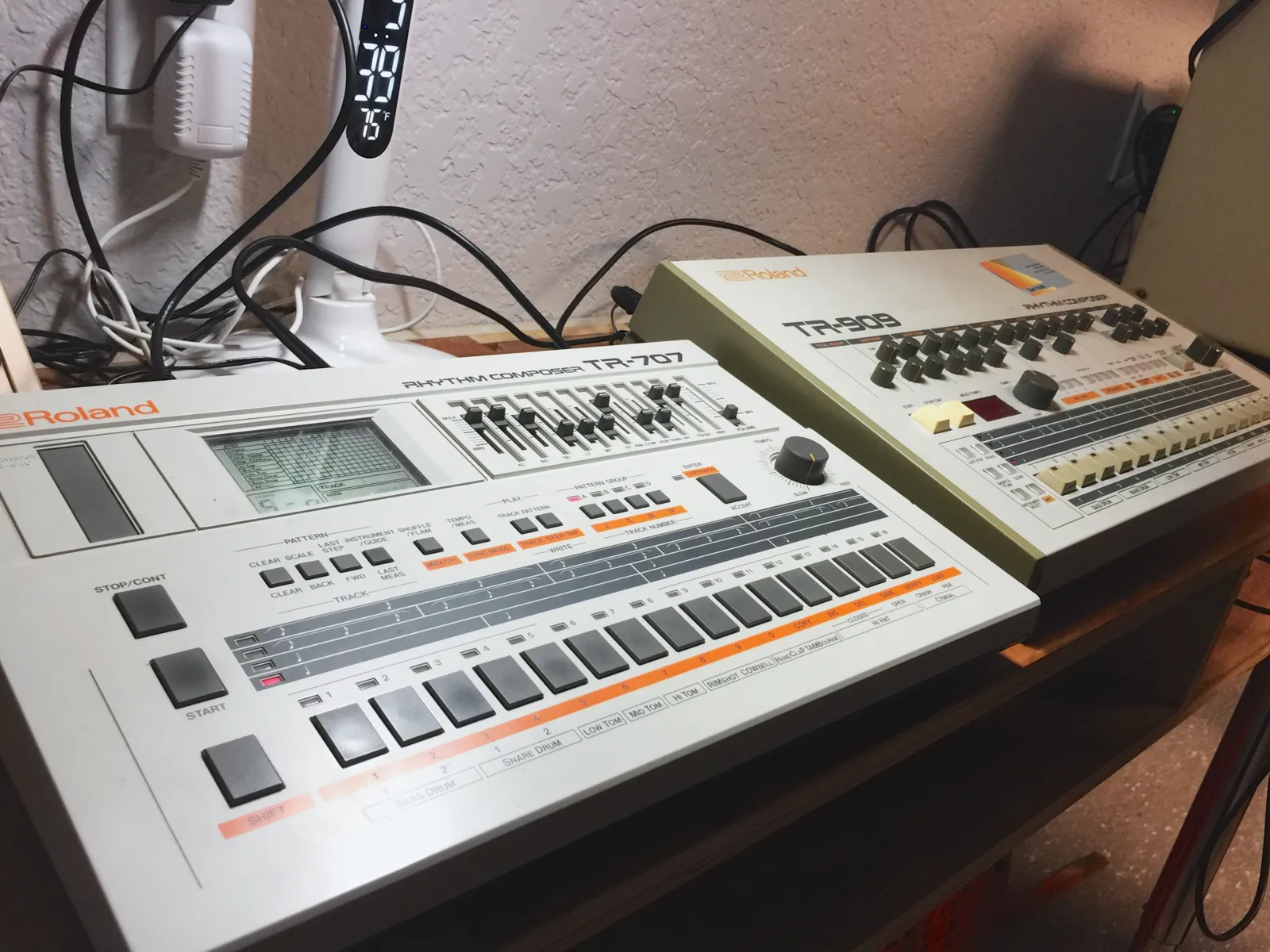
It did not work commercially. Players compared the 909 with sample-based machines and heard it as unrealistic, and Roland stopped making it after about a year. Its successor, the 1984 TR-707, took the opposite route and used samples for every voice. The 909 was also the first Roland drum machine with MIDI. For where the 909 sits among the other machines of the era, see our history of vintage drum machines.
Which voices are analog and which are sampled
Seven TR-909 voices are analog circuits: bass drum, snare drum, low tom, mid tom, hi tom, rim shot and hand clap. Four are digital samples in ROM: closed hi-hat, open hi-hat, crash and ride. That split is the key to the machine, because it decides what each knob can do.
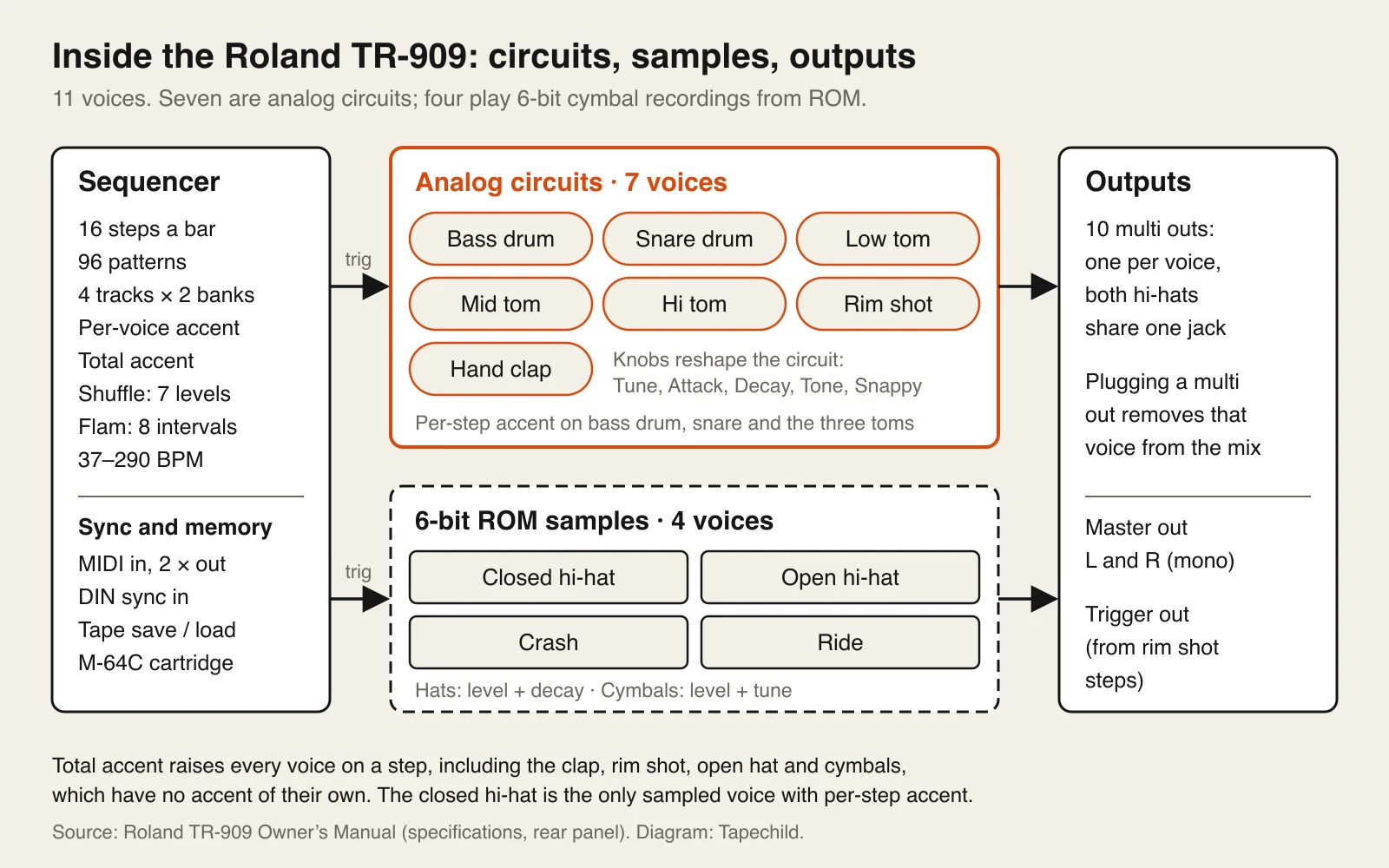
On the analog side, a knob changes a component value in a circuit. Tune, Decay and Attack on the bass drum reshape the oscillator, its envelope and the click at the front of the hit, so the range between settings is wide and every point in between is usable. The same principle drives the snare and toms. If you want the general theory of building a kick or snare from oscillators and noise, our drum synthesis guide covers it, and analog drum machines looks at the circuits across other brands.
On the sampled side, the recording is fixed. Six bits gives 64 possible amplitude levels, so the quantisation noise is loud and bright, and it is part of why the hats sit so clearly on top of a mix. The hi-hats run through an analog level and decay stage, so Decay changes how long you hear them but not their tone. The cymbal Tune knobs change the rate at which the recording is read out, so pitch and length move together. We could not find a sample rate for the ROM in Roland’s documentation, and the figures quoted online disagree, so we do not give one here.
Plugging a cable into one of the individual outputs removes that voice from the master mix, according to the owner’s manual. That is how engineers used the 909 in studios: kick to its own compressor and EQ, hats and cymbals to their own channels, snare into a reverb.
Every TR-909 voice and its controls
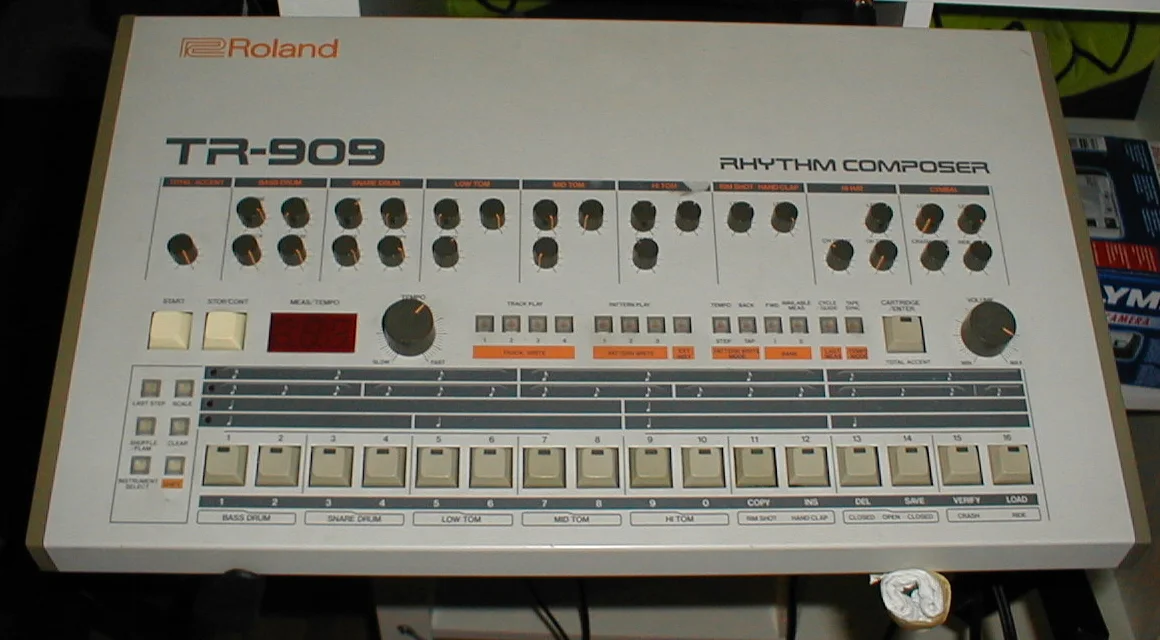
The TR-909 has 27 sound knobs: a Total Accent knob plus between one and four per voice. The table lists them exactly as the owner’s manual and front panel do, with which voices can be accented and flammed on a step.
| Voice | Source | Controls | Per-step accent | Flam |
|---|---|---|---|---|
| Bass drum | Analog | Level, Tune, Attack, Decay | Yes | Yes |
| Snare drum | Analog | Level, Tune, Tone, Snappy | Yes | Yes |
| Low, mid, hi tom | Analog | Level, Tune, Decay (each) | Yes | Yes |
| Rim shot | Analog | Level | Total only | No |
| Hand clap | Analog | Level | Total only | No |
| Closed hi-hat | 6-bit sample | Hi-hat Level (shared), CH Decay | Yes | No |
| Open hi-hat | 6-bit sample | Hi-hat Level (shared), OH Decay | Total only | No |
| Crash | 6-bit sample | Level, Tune | Total only | No |
| Ride | 6-bit sample | Level, Tune | Total only | No |

Bass drum
The kick is the 909’s best-known voice. Attack sets how much click sits on the front of the hit; turned up, it pokes through a loud bass line. Decay sets the length, from a short thud to a long boom, and fully anticlockwise it mutes the drum. Tune moves the pitch, and the manual notes that Decay keeps its setting wherever Tune is, so you can retune without re-balancing the tail. Long decay with low tune gives a heavier, longer kick; short decay with more attack gives a tight one that leaves room for the bass.
Snare drum
Tone brightens the sound, Tune sets the pitch of the drum body, and Snappy sets how much of the noise layer (the wires) you hear. With Snappy fully down, the manual says, you get the drum with its snares removed, a pitched thump that works as an extra tom. The 909 snare is often treated with big reverb and a gate; our gated reverb guide explains how that effect is built and why a short, bright snare like this one suits it.
Toms, rim shot and hand clap
Each tom has Tune and Decay, and Roland’s manual suggests tuning them as melodic toms; with three voices and wide tuning ranges you can play short bass figures on them. The rim shot and hand clap have only a Level knob each and share a panel section. The 909 clap is a layered burst of filtered noise, and because it cannot be tuned or lengthened, you change it in the mix instead: reverb, a short delay, or a second clap layered on top.
Hi-hats and cymbals
Closed and open hat share one Level knob and one individual output, with separate CH Decay and OH Decay controls. They are one voice in practice: a closed hat cuts off a ringing open hat, the way a real hi-hat pedal would. Crash and ride each have Level and Tune.
How the TR-909 sequencer works
The TR-909 sequencer stores patterns of up to 16 steps and plays them in order as tracks. You enter notes in two ways: step write, where you select a voice and light up its steps on the 16 keys while the pattern runs, and tap write, where you play the keys in real time and the machine records what you tap.
- Steps and scale. Last Step sets any pattern length from 1 to 16 for odd meters. The Scale button changes how many steps make up a beat, including triplet settings, so the same 16 keys can hold sixteenths, thirty-seconds or triplets.
- Accent. Press a step key twice in step write and that step plays accented for the bass drum, snare, any of the three toms or the closed hi-hat. A separate Total accent row accents every voice on a step, at a depth set by the Total Accent knob. The manual warns that with Total Accent turned high, per-voice accents become hard to hear.
- Shuffle. Hold Shuffle/Flam and press keys 1 to 7: 1 is straight and 7 is the heaviest swing.
- Flam. Bass drum, snare and toms can be written as flams. Hold Shuffle/Flam and press keys 9 to 16 to choose one of eight flam spacings; the spacing is fixed in time and does not change with tempo.
- Patterns and tracks. Two banks, each with three groups of 16 patterns, gives 96 patterns. Four tracks per bank chain patterns into songs, up to 896 bars per bank shared between the four tracks.
- Storage. Patterns survive power-off on a backup battery, save to ordinary audio tape through the tape jacks, or save instantly to the optional M-64C RAM cartridge.
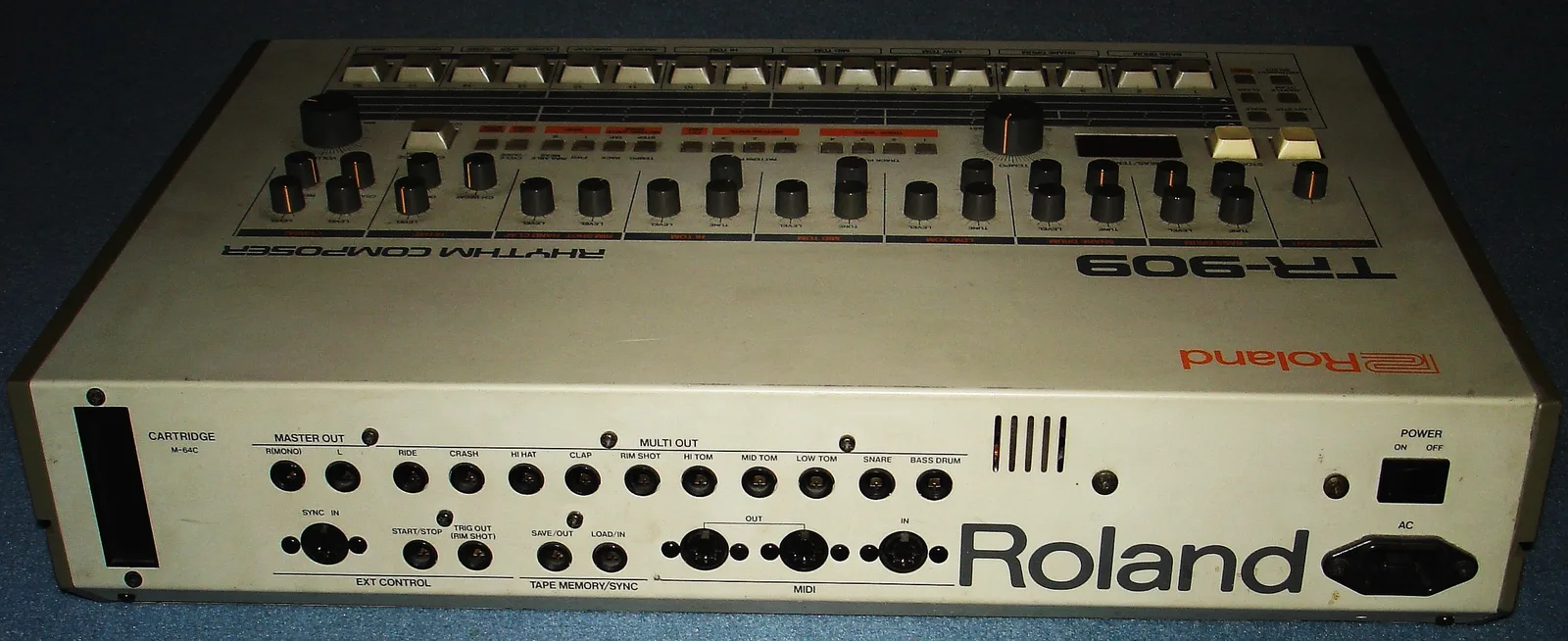

For sync, the 909 has MIDI in and two MIDI outs, and a five-pin DIN sync input carrying Roland’s older clock and run/stop signals. There is also a jack for a start/stop footswitch and a trigger out that fires on every rim shot step, which can clock an arpeggiator or an analog sequencer. In a modern setup the 909 usually follows MIDI clock from the DAW; the DIN sync input lets it follow older Roland gear instead.
How the 909 became the sound of house and techno
The TR-909 became the drum machine of house and techno because it was cheap second-hand when those genres began, and because its kick and hats survive a club sound system. Wikipedia names Derrick May, Frankie Knuckles and Jeff Mills among the Chicago and Detroit producers who bought used units in the late 1980s. Mills has described using its tuning controls to give programmed drums the feel of a live drummer.
Roland’s own history of the machine names Derrick May’s “Strings of Life”, Inner City’s “Big Fun” and Joey Beltram’s “Energy Flash” among the records built on it, and Daft Punk titled a 1997 track “Revolution 909”. Beyond the sound, three features suited club records: the individual outputs let engineers treat the kick separately; accent and shuffle gave a programmed groove movement; and DIN sync let it run in time with Roland’s TB-303 bass synthesizer, the other half of acid house. Our explainer on what an 808 is covers the older machine’s very different route into hip hop and electro.
How to program classic 909 patterns
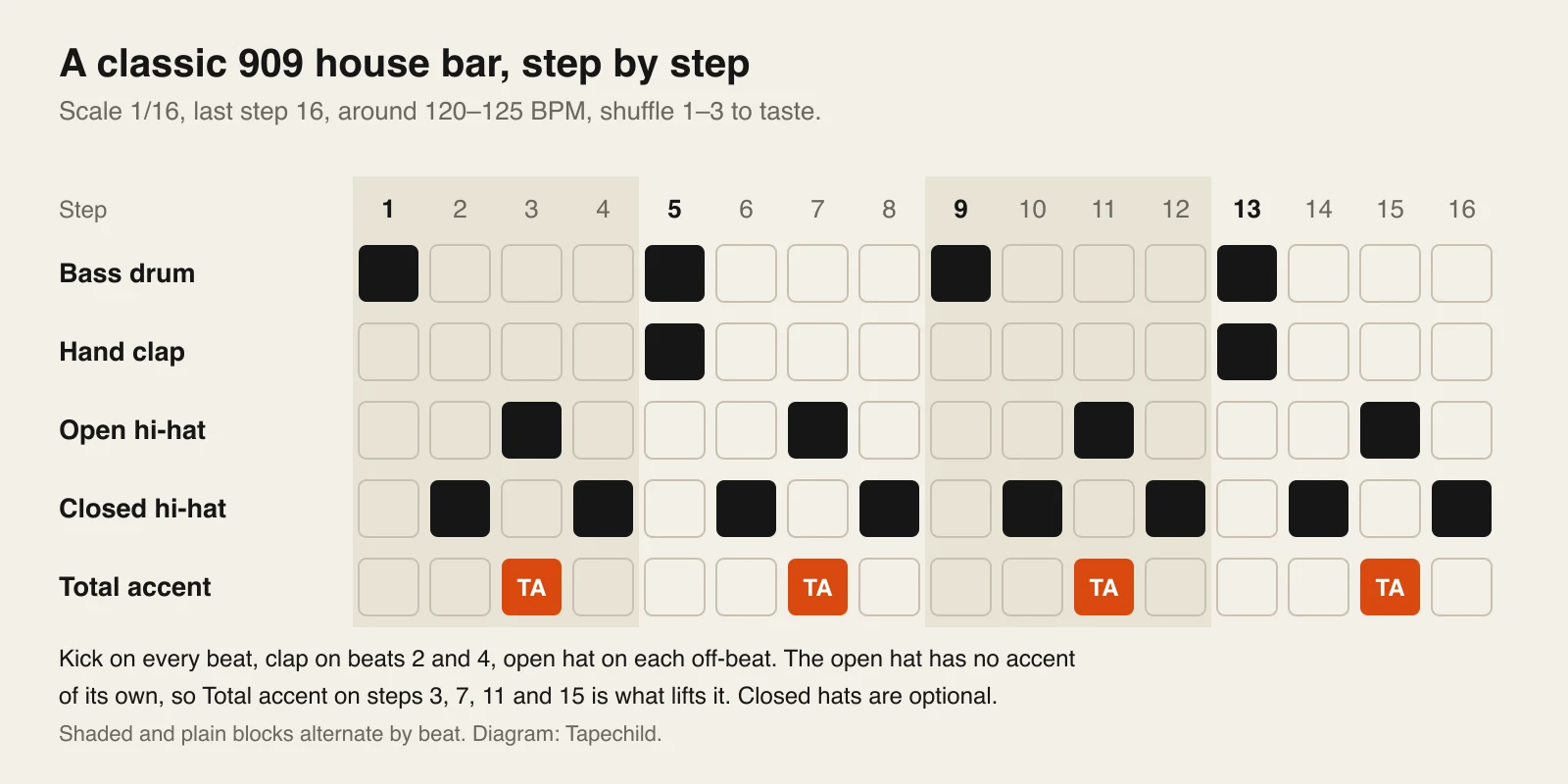
A classic 909 house pattern is a kick on every beat, a clap on beats two and four, and an open hi-hat on every off-beat, with a little shuffle. The grid below shows it in the 909’s own 16 steps, and the recipe after it gives starting knob positions. Knob positions are clock-face starting points, not rules; every machine and emulation differs slightly.
Program a 909 house bar
Works on an original 909, a TR-8S, a TR-09 or a 909 plugin
- Set the tempo to around 122 BPM, Scale to sixteenths and Last Step to 16.
- Start the sounds near these positions: bass drum Tune at 10 o’clock, Attack at noon, Decay at 2 o’clock; OH Decay at 11 o’clock so the open hat has closed before the next kick; Total Accent at noon.
- Select the bass drum and enter steps 1, 5, 9 and 13.
- Select the hand clap and enter steps 5 and 13.
- Select the open hi-hat and enter steps 3, 7, 11 and 15. Add closed hats on the even steps if the groove feels empty.
- Select Total accent and enter steps 3, 7, 11 and 15. The open hat has no accent of its own, so this is how you make the off-beat hit harder.
- Hold Shuffle/Flam and press key 2 or 3 for a light swing. Past 4 it starts to sound like a shuffle rather than house.
- Copy the pattern to the next slot and vary it: a flammed snare on step 15, or the kick decay turned up for the last bar of every four.
On the TR-8S and most plugins the step keys and accent work the same way; names for shuffle and flam settings vary.
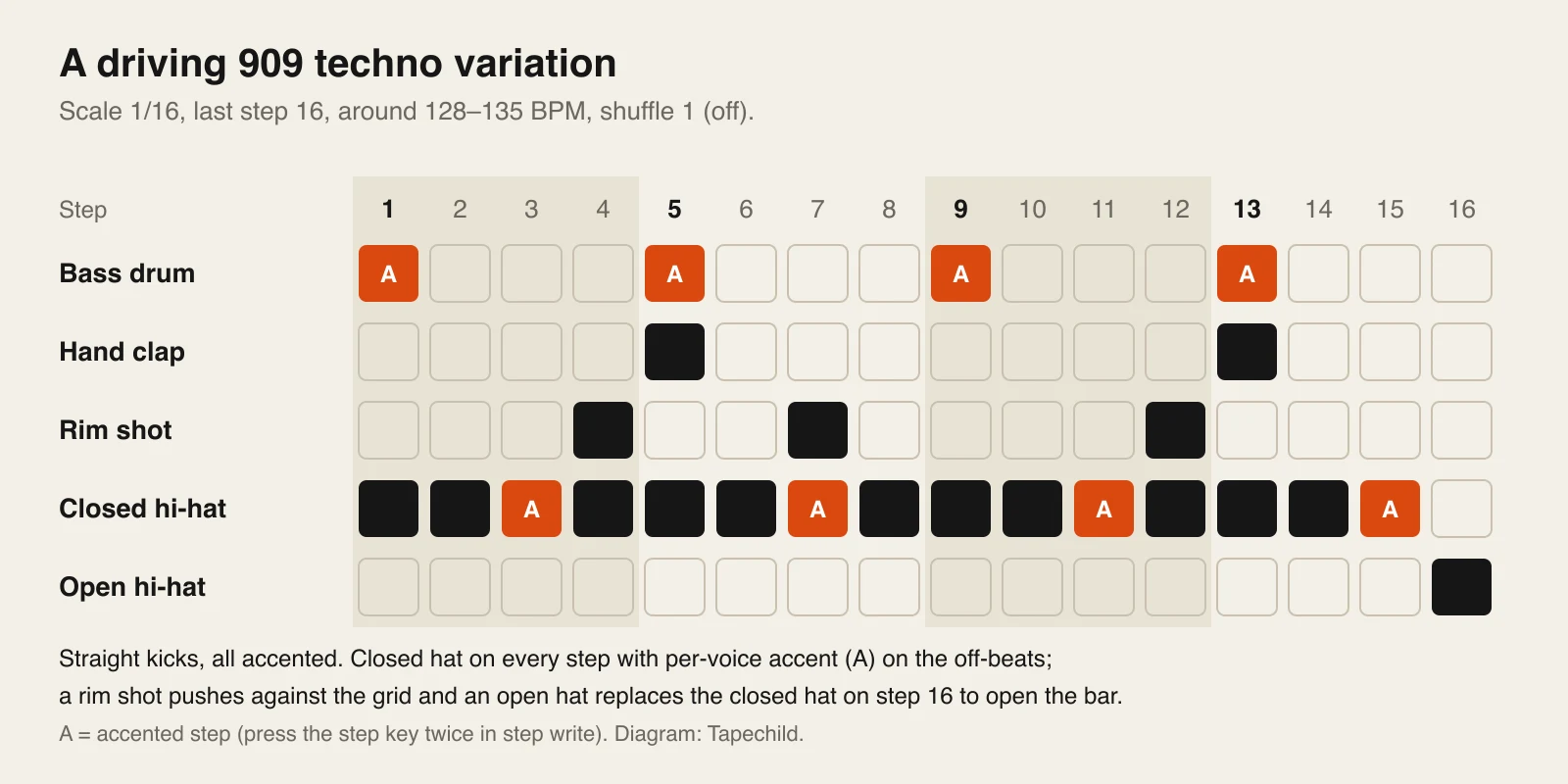
For techno, keep the four-on-the-floor kick, accent it on every beat, and lose the swing. A closed hat on each step with per-voice accent on the off-beats gives a row of sixteenths a push-and-pull that a flat row lacks. A rim shot placed against the grid and an open hat on the last step to lead into the next bar complete it. Play it at 128 to 135 BPM and try turning the kick’s Decay up while it runs.
What a used TR-909 costs
At the time of writing, a working original TR-909 generally sells for somewhere between about US$4,500 and $9,000, depending on condition, service history and whether the seller is a dealer. The listings we could check in 2026 fell inside that band, and exceptionally clean or modified units ask more. Launch price was around $1,200, so the 909 has risen several times over in nominal terms.
If you are buying one, test every voice through the master out and through its individual output, check that both hi-hats and both cymbals play cleanly (the sampled voices depend on the digital board), confirm that MIDI in and out and DIN sync work, and ask whether the memory backup battery has been replaced. A seller who can show a recent service is worth paying for. If none of that appeals, the modern options below cost a fraction of the price.
TR-909 alternatives: hardware and plugins
You can get the 909 sound today from Roland’s own hardware, from third-party analog recreations, or from plugins. The table is a map of the main options still on sale or easy to find used, checked against each maker’s page at the time of writing; for a wider view of software, see our best drum machine VST roundup.
| Option | Type | How the 909 is made | Status |
|---|---|---|---|
| Roland TR-1000 | Hardware | 16 analog circuits recreated from 808 and 909 designs, plus modelled, FM, PCM and sample engines | Current; announced in 2025 at US$2,699 |
| Roland TR-8S | Hardware | Roland ACB circuit modelling of the 909 and other TR machines; user sample import | Current |
| Roland TR-09 | Hardware (Boutique) | ACB modelling in a compact 909 layout with step and tap write | Discontinued; used market |
| Behringer RD-9 | Hardware | Analog drum voices with sampled hats and cymbals, in the 909’s layout | Current; shipping since 2021 |
| Roland Cloud TR-909 | Plugin | ACB modelling with the original cymbal ROM | Current; subscription or lifetime key |
| D16 Drumazon 2 | Plugin | Circuit modelling of all 11 voices, with extra per-voice processing | Current; €119 list |
| AudioRealism ADM | Plugin | Modelled 606, 808 and 909 voices in one instrument | Current; version 1.6 |
Roland hardware: TR-1000, TR-8S and TR-09
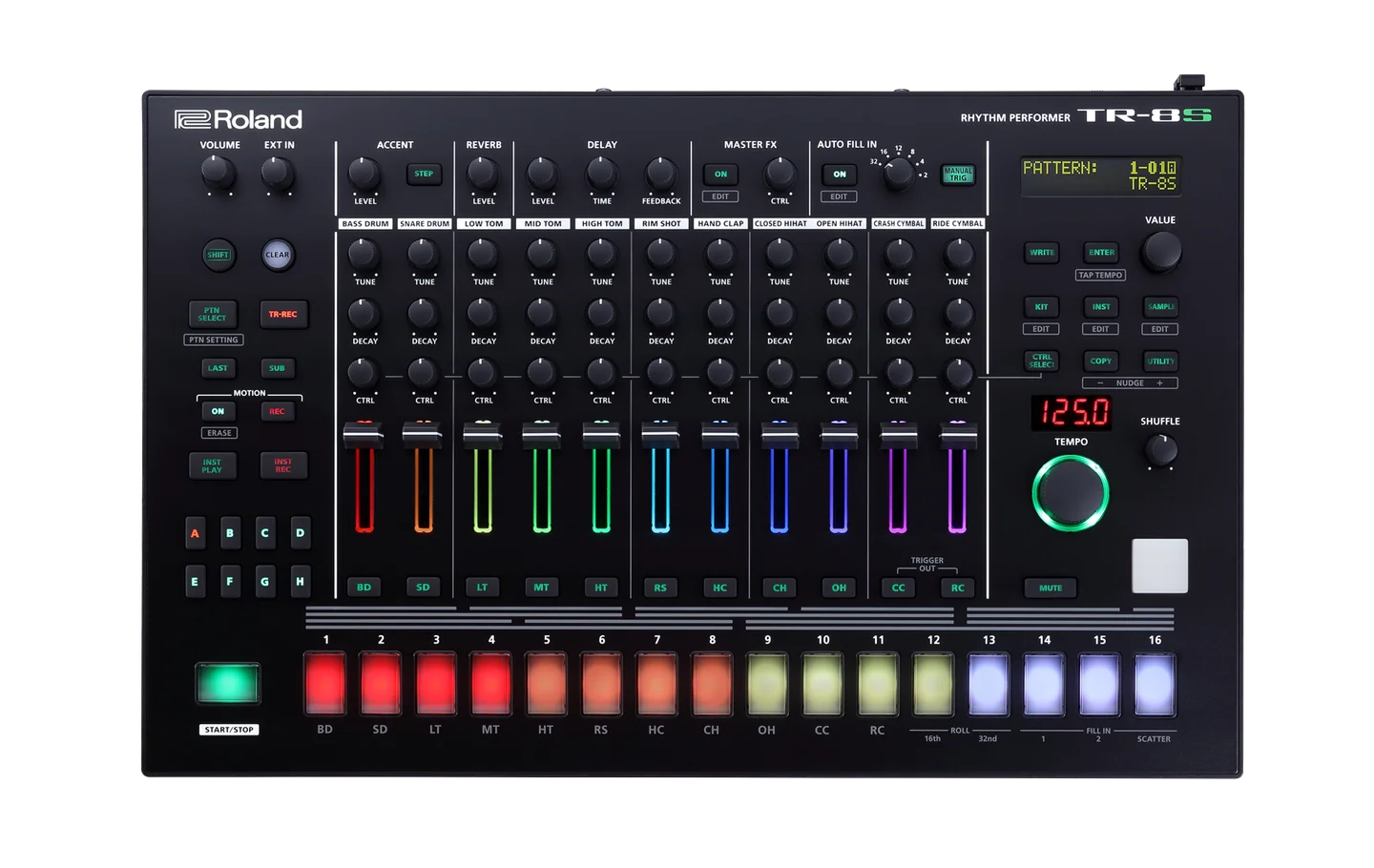
Roland’s current hardware splits two ways. The TR-1000, which Roland calls its first drum machine with a true analog engine in over 40 years, rebuilds 16 circuits from the 808 and 909 alongside digital engines, and is priced like a flagship. The TR-8S models the 909 digitally with Roland’s ACB technology, adds eight assignable outputs, sample import and a variation-based sequencer, and costs far less. The TR-09 Boutique was the closest to the original’s workflow, with the 909’s step and tap write in a small box, but it is discontinued and now a used-market buy.
Behringer RD-9
The RD-9 is the budget analog route: analog drum voices, sampled cymbals, a 909-style panel, individual outputs and USB MIDI, at a price closer to a plugin bundle than to an original. It adds features the 909 never had, such as per-step probability and an Enhanced mode with extra controls. It is a recreation by a different company, not a Roland product.
Plugins: Roland Cloud TR-909, Drumazon 2 and ADM
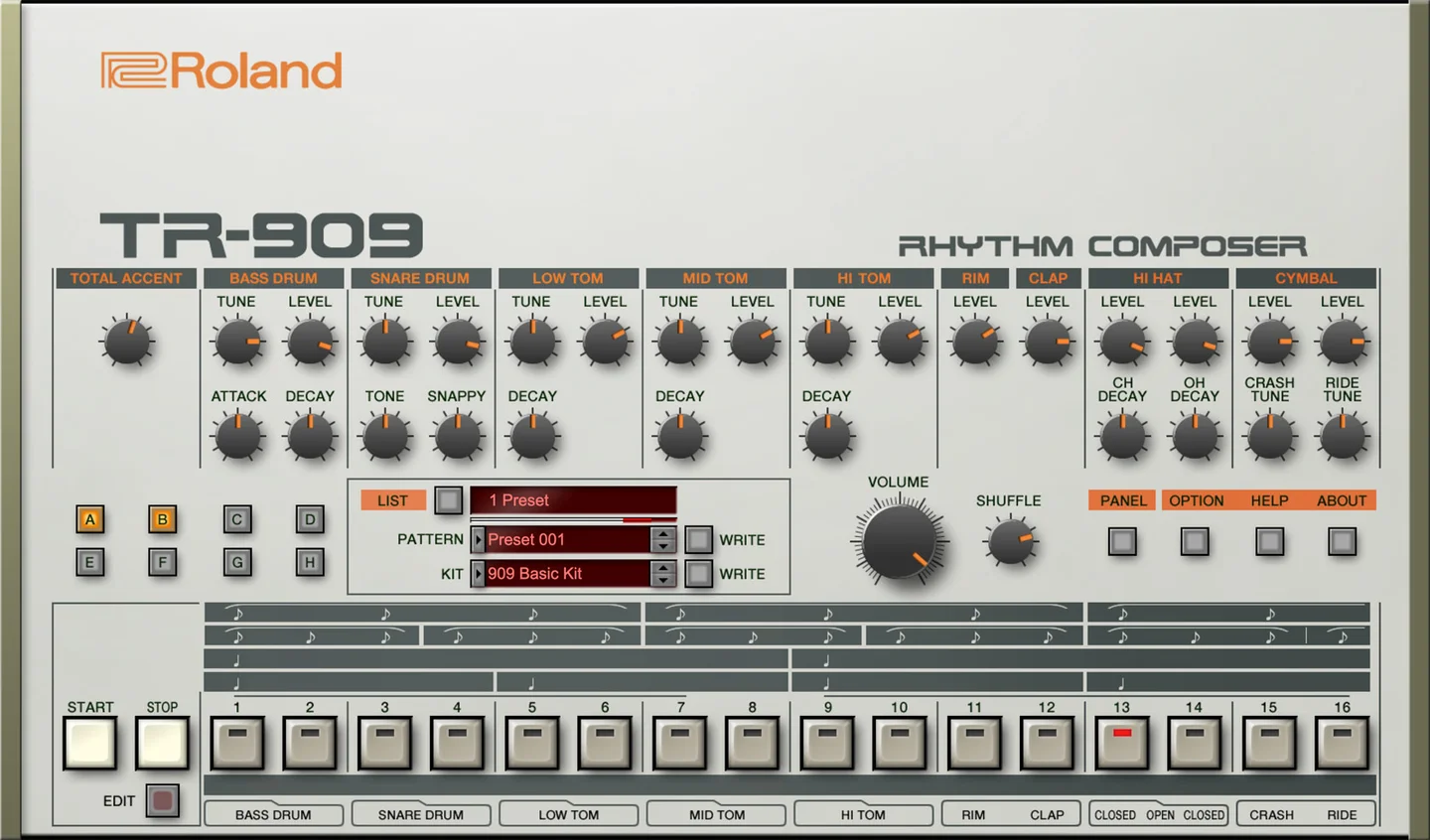
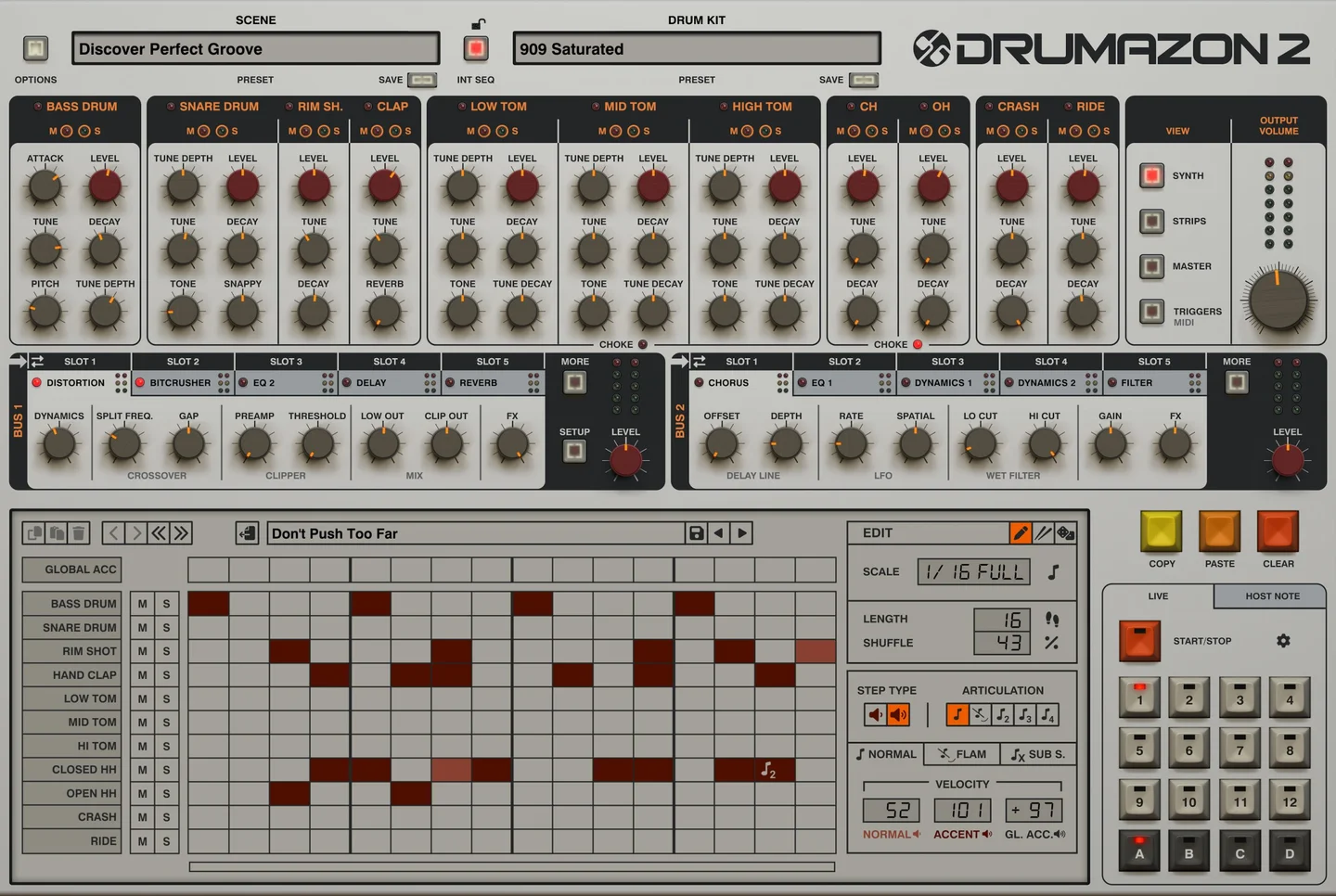
Roland’s own TR-909 plugin uses ACB modelling for the analog voices and the original cymbal ROM, and extends the sequencer with per-instrument lanes, sub-steps, flam types and eight variations; it runs as VST3, AU and AAX, by Roland Cloud membership or a lifetime key that lists at about $149 and is often discounted. D16 Drumazon 2 models all eleven voices with added channel strips and effects, at €119. AudioRealism ADM puts 606, 808 and 909 voices in one plugin with a 32-step sequencer, which suits anyone who wants all three in one window.
Our product: Tapechild makes UDS-16, a drum synthesizer plugin. It is not a 909 emulation and will not give you the 909’s kick, clap or cymbal samples; its voices come from Soviet percussion synthesizer circuits and it has no step sequencer. If you want a 909, pick from the list above.
If all you need is a handful of 909-style hits for a sampler, our free sample packs include royalty-free drum one-shots and loops you can load into any DAW.
Frequently asked questions
What year did the Roland TR-909 come out?
Roland released the TR-909 in 1983, three years after the TR-808. It was in production for only about a year and was replaced by the all-sample TR-707 in 1984.
How many Roland TR-909s were made?
About 10,000. Both Wikipedia’s sources and Atsushi Hoshiai, who wrote the machine’s software, give that figure. The short production run is part of why originals are expensive now.
How much is a Roland TR-909 worth?
At the time of writing, a working original usually sells for roughly US$4,500 to $9,000, depending on condition and service history. It launched at around $1,200. A Roland TR-8S, a Behringer RD-9 or a plugin gives you the sound for far less.
Is the TR-909 fully analog?
No. Seven of its eleven voices are analog circuits: bass drum, snare, three toms, rim shot and hand clap. The closed hat, open hat, crash and ride are 6-bit recordings of real cymbals stored in ROM, which is why the machine is called a hybrid.
What famous songs use the Roland TR-909?
Roland’s own history of the machine names Derrick May’s “Strings of Life”, Inner City’s “Big Fun” and Joey Beltram’s “Energy Flash”. Wikipedia lists Adamski’s 1990 single “Killer”, and Daft Punk named a 1997 track “Revolution 909”. The 909 is on a large share of house and techno records from the late 1980s onward.
What is a 909?
“909” is short for the Roland TR-909 drum machine, and by extension its sounds. A “909 kick” or “909 hats” means those sounds, whether they come from the original hardware, a sample pack, a modern Roland unit, a clone or a plugin.
Royalty-free WAV
Free sample packs
Royalty-free WAV, play every sample before you download.