
Gated Reverb: What It Is and How to Get the 80s Drum Sound
Gated reverb is a drum effect in which a long, dense reverb is cut off by a noise gate a fraction of a second after each hit, so the drum sounds as if it was struck in a huge room but stops dead instead of fading. It came out of a London studio in 1979, it defined the snare drum of the 1980s, and it is still one of the few ways to make a drum sound enormous without filling the space around it.
What is gated reverb?
Gated reverb is reverb with its natural decay removed: a noise gate lets roughly the first 100–250 ms of a long reverb through at almost full level, then shuts. Instead of a tail that fades away, you get a short, dense burst of room that stops with a hard edge.
The whole point is a trade that should not work: the drum inherits the scale of a huge reflective room, but none of the ringing that normally comes with it. The snare sounds enormous, and the bar it sits in stays clean.
There are two ways to build it. The classic studio method puts a reverb and then a gate on a send, with the gate triggered by the dry snare. The other uses a reverb whose own algorithm stops abruptly, the approach the AMS RMX16 made famous. The gated snare recipe further down gives starting values for both.
You have heard it even if you have never named it: the drums that crash into Phil Collins’s In the Air Tonight, the snare on Born in the U.S.A. and on David Bowie’s Let’s Dance. The song table below lists well-documented examples and where in each track to listen.
What gated drums sound like
A gated drum sounds big and short at the same time. The hit itself is unchanged — the crack of the stick is still there at the front — but immediately behind it sits a dense, loud block of room sound that is as wide as a hall and then simply ends, usually within a tenth to a fifth of a second. There is no fade. The tail is at full volume one moment and gone the next, so each snare reads as a solid rectangular slab of sound rather than a spike with a trailing wash.
In a mix, that gives three recognizable tells. First, the snare seems to come from a much larger space than the rest of the kit, which often stays comparatively dry. Second, the space between backbeats is quiet — the room does not smear into the hi-hats or the next hit the way an ordinary reverb would. Third, at the classic settings the cut-off itself is audible as a faint “chop” at the end of every hit, a hard edge the ear picks out as artificial and, by now, as distinctly 1980s. Toms treated the same way turn into cannon shots: a huge boom with a clean stop. That combination — the size of a big room with the discipline of a dry drum — is what people mean by the gated drum sound.
Where it came from: Townhouse Studios, 1979
Gated reverb was discovered by accident in late 1979 at the Townhouse, Virgin’s studio in Shepherd’s Bush, London, during sessions for Peter Gabriel’s third album, produced by Steve Lillywhite and engineered by Hugh Padgham. Studio 2 there had a stone-walled live area, the Stone Room, and one of the first Solid State Logic 4000-series consoles.
That console had a listen mic: a talkback microphone hung in the studio so the control room could hear the musicians, run through a very heavy built-in compressor so a voice across the room came through clearly. When Phil Collins played drums with it open, the compressor dragged the room’s ambience up to a violent, unnatural level. The listen mic was never meant to be recorded, so Padgham had its output wired into an ordinary console channel, where it could be printed to tape and sent through that channel’s noise gate, which shut the room off the moment the drums paused.
Gabriel built Intruder around a Collins drum pattern played that way, and asked him to leave the cymbals out. The track came out in May 1980 and is the release usually credited as the first to put the sound at the center of a song. Lillywhite has said he had tried similar tricks earlier, on Siouxsie and the Banshees’ The Scream (1978) and the Psychedelic Furs’ Sister Europe, so treat “first” as “first to make it the point”.
Collins took the sound to his own record. In the Air Tonight, released as a single on 9 January 1981 and co-produced by Collins and Padgham, spends most of its length over a Roland CR-78 drum machine before the live kit arrives about three and a half minutes in. That entrance did more to spread the technique than any manual could have. By the middle of the decade it was the default ambition for a snare drum, and by the end it was a period marker.


Worth knowing: The original was compressed room microphones through a gate, not a reverb unit through a gate. Modern “gated reverb” usually means the latter, because a plugin reverb is what most people have. The two are not identical — heavy compression on real room mics contributes a density a clean algorithmic reverb does not — which is why adding a compressor before your gate gets you noticeably closer to the records.
From a room trick to a preset: the AMS RMX16
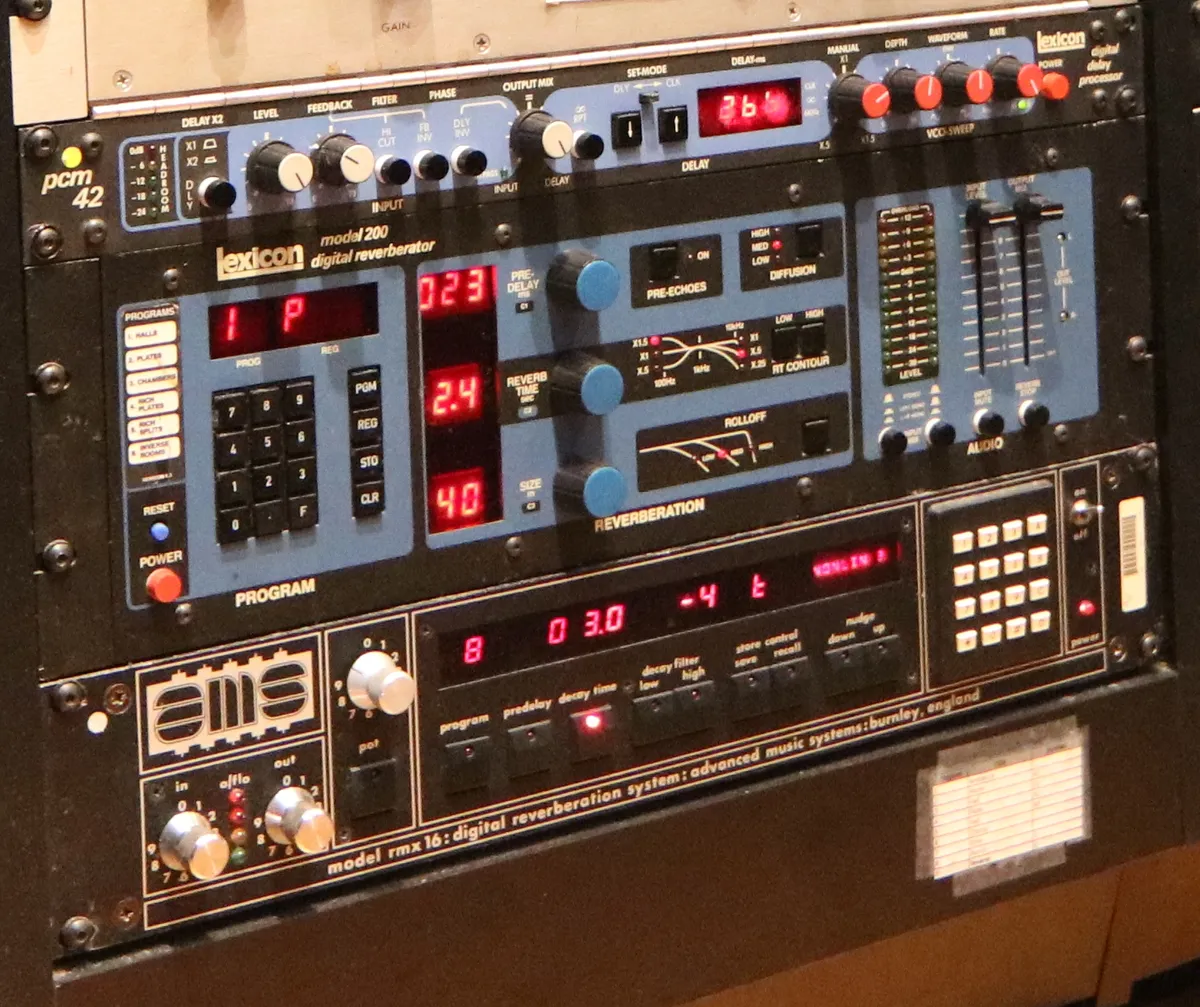
The Townhouse method needed a big live room and a console like that one. In 1981 Advanced Music Systems of Burnley, England, released the RMX16, one of the first microprocessor-controlled digital reverbs, and its NonLin 2 program removed both requirements. Rather than gating a reverb, NonLin 2 generates a tail with a shaped, nonlinear envelope — it stays dense and then drops away — so the effect became a program any studio could recall. The version heard on many mid-1980s records is this algorithm rather than a gate.
Genesis’s Mama (1983), co-produced by Padgham, is a clear example: its Linn LM-1 drum-machine pattern was fed through an RMX16 on the gated setting and then into a guitar amplifier, and blended with the direct Linn. By 1985 Yamaha’s SPX90 multi-effects unit shipped with Gate Reverb and Reverse Gate presets, which put the sound in much smaller studios.
Songs that use gated reverb
The technique spread through a small number of producers and engineers — Padgham and Lillywhite in London, Bob Clearmountain and Toby Scott at the Power Station in New York — and once it existed as a reverb program it no longer needed a stone room at all. The table keeps to tracks where how the drum sound was made is documented, and says where to listen.
| Song | Artist | Year | Where you hear it |
|---|---|---|---|
| Intruder | Peter Gabriel | 1980 | The drum pattern that runs through the whole track: Phil Collins on drums, no cymbals, Hugh Padgham engineering, Steve Lillywhite producing. |
| In the Air Tonight | Phil Collins | 1981 | The live drums that enter about three and a half minutes in, after the CR-78 pattern. The single most famous example of the effect. |
| Let’s Dance | David Bowie | 1983 | The snare throughout. Recorded at the Power Station in late 1982, co-produced by Nile Rodgers with engineer Bob Clearmountain. |
| Mama | Genesis | 1983 | The opening drum-machine pattern: a Linn LM-1 through an AMS RMX16 gated program and a guitar amp. |
| Born in the U.S.A. | Bruce Springsteen | 1984 | Max Weinberg’s snare from the first bar. Engineer Toby Scott ran the snare mic through a broken plate stuck at a four-second decay, then into a Kepex gate. |
| Shout | Tears for Fears | 1984 | The slow, heavy drums that carry the whole song, produced by Chris Hughes. |
| Some Like It Hot | The Power Station | 1985 | Tony Thompson’s snare and toms, engineered by Jason Corsaro. Accounts differ on exactly how the cut was made, but the gated sound is the record’s signature. |
| No Son of Mine | Genesis | 1991 | A late example from Collins’s own band, released when most records had moved back to natural-sounding drums. |
Two things are worth noticing in that list. The effect belongs to a five-year window, roughly 1980 to 1985, after which it was everywhere and stopped being remarkable. And the treatment was never only for acoustic kits: Mama is a drum machine, and sample-based machines such as the LinnDrum and LM-1 were routinely sent to the same gated programs, as were analog drum machines. A gate does not care whether the source was hit with a stick. Our overview of vintage drum machines covers the boxes those records were made with.
If you want that decade’s drums to work with rather than to rebuild, our free 80s & 90s pop drum loops pack has royalty-free WAV loops in that style, gated snares included. It is one of the free sample packs we publish alongside these guides.
What is actually happening
Three stages, in this order. Getting the order wrong is the most common reason the effect does not appear.
01 · The drum arrives
A snare hits. Its transient and body are sent, untouched, to a return track. The dry drum on the main channel is never processed — that is what keeps the attack sharp.
02 · The room explodes
A fully wet reverb turns that single hit into a dense field of reflections. Decay is set long deliberately, so the reverb is still at full strength a fifth of a second later.
03 · The gate slams
A gate opens instantly with the hit, holds the room at full level for a fixed time, then closes almost instantly. The tail never gets to fade — it is amputated.
The key idea
A reverb’s decay control makes the tail get quieter. A gate makes it stop. That flat, sustained burst ending in a hard edge is the entire effect — and why shortening a reverb’s decay never reproduces it.
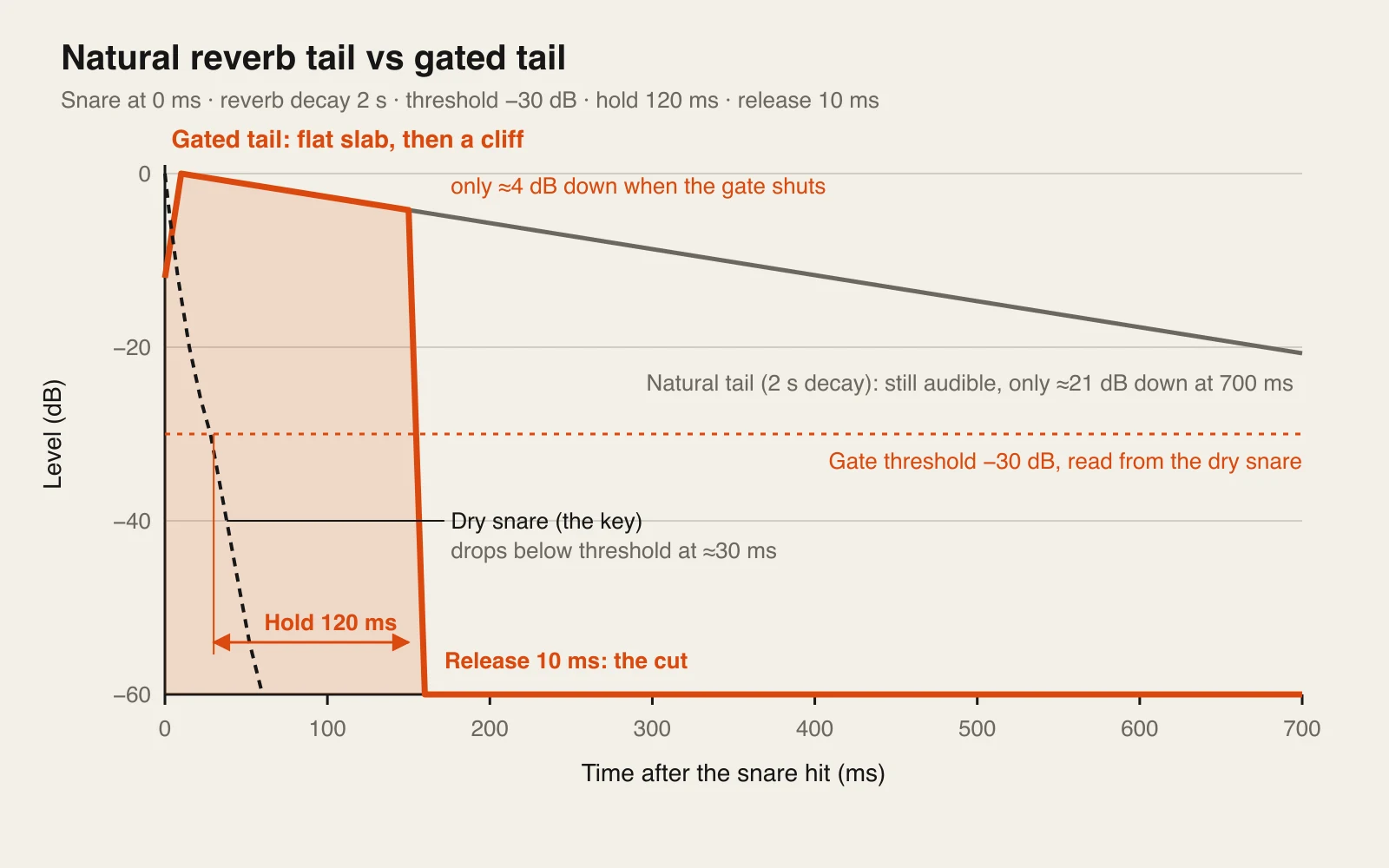
The numbers explain why the long decay matters. A reverb with a 2-second decay time falls by 60 dB over two seconds, which is only about 3 dB every 100 ms. So when the gate shuts at around 150 ms, the room is still within roughly 4 dB of its peak: the burst you hear is nearly flat, and the drop at the end is a cliff of 50 dB or more. Set the decay to 0.3 s instead and the tail is already fading hard before the gate does anything.
Gated reverb vs a noise gate on drums (drum gating)
The two get confused because they use the same plugin. Drum gating means putting a noise gate directly on a drum channel to cut what happens between hits: bleed from the rest of the kit, room rumble, a ringing tom, the tail of a sample that runs too long. The gate is closed by default, opens when the drum hits, and shuts again as soon as the level falls. Its purpose is subtraction. A well-gated snare track sounds cleaner and drier than the raw recording, and ideally you should not notice the gate at all.
Gated reverb uses the same device on the reverb, not on the drum. The dry drum is left alone. A reverb is added — far more of it than you would normally tolerate — and the gate then throws most of it away, keeping only the first hundred milliseconds or so. Its purpose is addition with a hard limit. The result is meant to be heard: the drum sounds bigger than the room it was recorded in, and the cut is part of the character.
| Drum gating (noise gate on the drum) | Gated reverb | |
|---|---|---|
| Gate sits on | The drum channel itself | A reverb return fed by the drum |
| What it removes | Bleed, noise, ringing between hits | The natural decay of an added reverb |
| Effect on the dry hit | Trims its tail; can clip the attack if too fast | None — the dry drum is untouched |
| Sounds | Drier, tighter, cleaner | Bigger, denser, with an audible stop |
| Typical hold | As short as the drum allows | Roughly 60–250 ms, set for the tempo |
| Goal | Not to be noticed | To be noticed |
The two are often used together on the same snare. Gate the drum channel first so bleed does not trigger the reverb on every hi-hat, then send the cleaned-up hit to the gated reverb return. On the original Townhouse recordings the distinction was blurrier, because the “reverb” was the room microphones and the gate was on those — which is why some engineers still describe the sound as gated drums rather than gated reverb. In a DAW, where the room is a plugin, the two are cleanly separable.
How to make a gated snare
To make a gated snare, send the dry snare to a 100% wet room or plate reverb with a long decay, put a noise gate after the reverb, key that gate from the dry snare, and set a fast attack, a hold of about one sixteenth note and a release of around 10 ms. The alternative is a reverb with a built-in nonlinear or gated algorithm on the same send, which needs no gate at all.
Two methods, and when to use each
| Gate on the return, keyed from the dry snare | Nonlinear or gated reverb algorithm | |
|---|---|---|
| What cuts the tail | A noise gate after the reverb | The reverb’s own envelope |
| Length set by | Gate hold and release, plus the few milliseconds the snare stays above threshold | The program’s length or decay control |
| Follows dynamics | Yes: soft ghost notes can stay below threshold and stay dry | No: every hit gets the same shape, ghost notes and bleed included |
| Shape of the burst | The reverb’s natural slope, then a hard cut | Flat or even swelling, then a drop; some let you draw it |
| Setup | Two plugins and a sidechain route | One plugin |
| Closest to | The Townhouse room-mic sound of 1979–81 | The AMS RMX16 NonLin 2 sound on many mid-80s records |
Pick the keyed gate when the snare part has dynamics you want to keep — a ghost-note groove where only the backbeats should explode. Pick the algorithm when you want every hit identical, or when your DAW’s stock gate has no sidechain input or no hold control. Logic’s Space Designer and FL Studio’s Fruity Convolver both let you draw the volume envelope of an impulse response, so a flat line that drops to zero after 150 ms turns either into a nonlinear reverb.
The keyed-gate recipe, step by step
Gated snare starting values
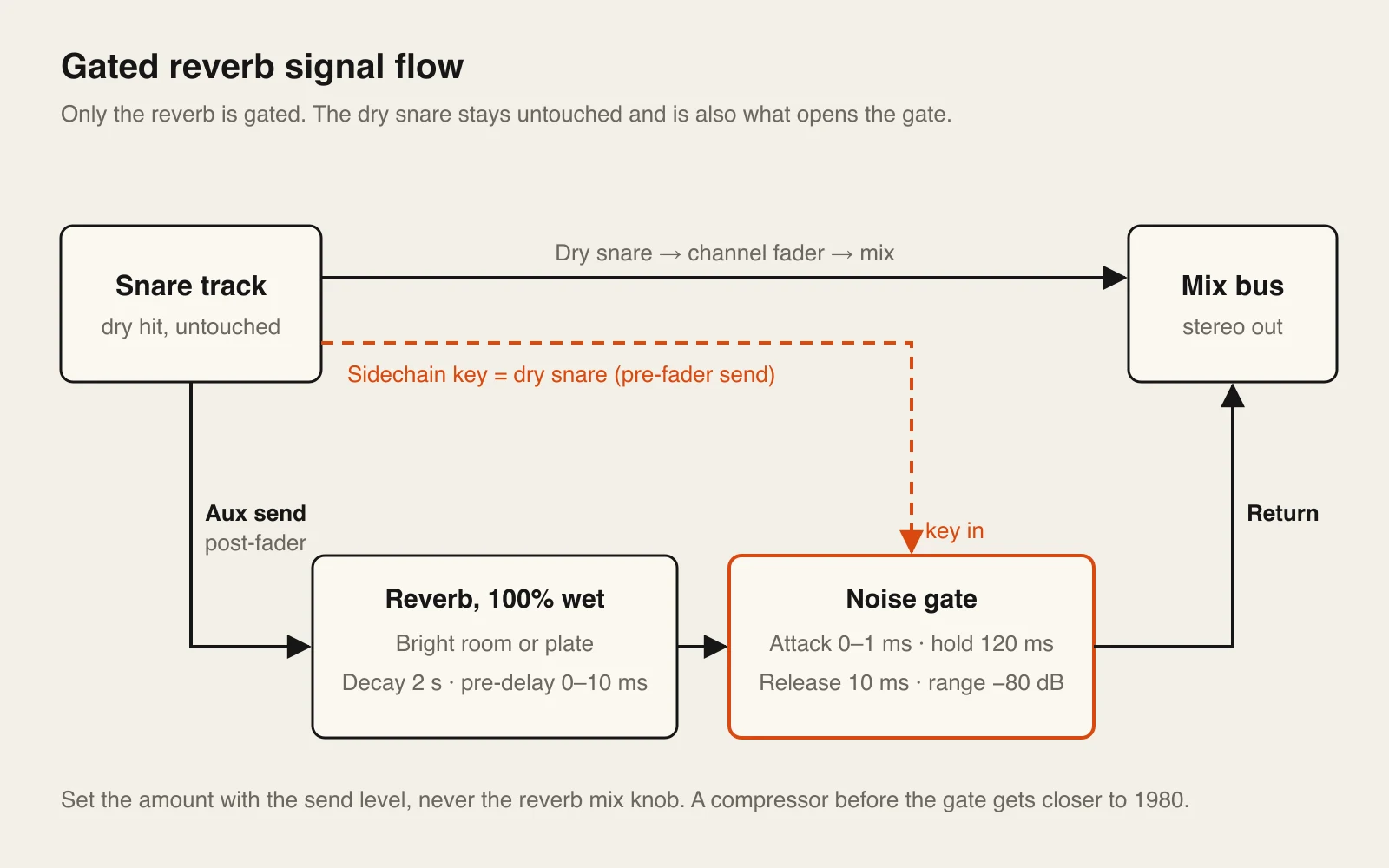
Send → Reverb (100% wet) → Gate, keyed from the dry snare
- Routing: create a return track and send the snare to it post-fader, starting around −10 dB. Then give the gate on that return a sidechain input fed from the snare, pre-fader, so moving the snare fader does not move the gate’s timing.
- Reverb: 100% wet. A bright room or plate, not a hall. Decay 2 s (anything from 1.5 to 2.5 s works), pre-delay 0–10 ms. Start at zero; add a few milliseconds only if the transient gets dull.
- Gate attack: 0–1 ms, so the gate is fully open by the time the reverb builds. If the gate offers look-ahead, 1–2 ms of it keeps the first reflections intact.
- Gate threshold: start about 20–30 dB below the snare’s peak, then raise it until ghost notes and hi-hat bleed stop opening the gate while every backbeat still does.
- Gate hold: 120 ms at 100–120 BPM, which sits between the tight and the big versions. This is the length of the effect; the tempo table below gives values for other speeds.
- Gate release: 10 ms, anywhere from 5 to 40 ms. Faster than about 5 ms can click on some gates; slower than about 50 ms starts to sound like a fade rather than a chop.
- Gate range (or floor): fully closed, −80 dB or lower, for the classic sound. Set it to −15 to −25 dB if you want a trace of tail left behind the burst.
Set the amount with the send level from the snare channel, never with the reverb’s dry/wet control, so the dry hit stays exactly as it was. High-passing the return around 150–250 Hz keeps the room from muddying the kick.
The settings that matter
Hold matters most, then reverb decay and release; the rest are set once and left alone. Ranges below assume a mid-tempo track around 100–120 BPM. Treat them as a starting position to move away from, not a preset.
| Control | Starting point | Why |
|---|---|---|
| Reverb type | Bright room or plate | The 1980s sound came from a live, reflective room, not a long hall. A dense early-reflection field is what survives the gate; a smooth, slow-building hall tail mostly gets thrown away. |
| Reverb decay | 1.5 – 2.5 s | Counter-intuitive but important: you set a long decay and then cut it short. A long decay guarantees the reverb is still at full density when the gate slams shut. |
| Pre-delay | 0 – 10 ms | Short or zero. Pre-delay separates the reverb from the transient, but the gated sound wants the room fused to the hit so the two read as a single, bigger drum. |
| Gate attack | 0 – 1 ms | Anything slower softens the front of the reverb burst and weakens the sense of the room arriving with the stick. |
| Gate threshold | 20–30 dB below the snare peak, then up | Decides which hits trigger the room. Too low and bleed opens it; too high and quieter backbeats come through dry. |
| Gate hold | 60 – 250 ms, by tempo | The actual length of the effect and the single most audible control. Short holds read as a tight, punchy snare; longer holds swallow the space before the next backbeat. |
| Gate release | 5 – 40 ms | Fast. A near-instant release is the definitive gesture. Past roughly 100 ms the effect turns into an ordinary short reverb and the character disappears. |
Matching hold to tempo
The burst you hear lasts longer than the hold setting. A keyed gate starts its hold timer when the dry snare falls back below threshold — typically 20–40 ms after the hit — and the release adds a little more. So the audible burst is roughly 30 ms plus hold plus release. A sixteenth note lasts 15,000 ÷ BPM milliseconds, and aiming the burst at a sixteenth gives a tight modern snare; aiming it at an eighth note gives the full 1985 version.
| Tempo | Sixteenth note | Hold for a tight snare | Eighth note | Hold for the big 80s version |
|---|---|---|---|---|
| 90 BPM | 167 ms | 125 ms | 333 ms | 295 ms |
| 100 BPM | 150 ms | 110 ms | 300 ms | 260 ms |
| 120 BPM | 125 ms | 85 ms | 250 ms | 210 ms |
| 140 BPM | 107 ms | 65 ms | 214 ms | 175 ms |
| 160 BPM | 94 ms | 55 ms | 188 ms | 150 ms |
If you only adjust one control, make it hold, and check it against the hi-hat: the burst should clear before the next off-beat you want the listener to hear cleanly.
Step by step, in your DAW
Stock plugins only — no purchase required in any of these. Device names shift between versions, so match the function rather than the exact label if yours differs.
Ableton Live
Reverb → Gate, sidechained from the snare
- Create a return track and put the stock Reverb on it, with Dry/Wet at 100%.
- Set Decay Time around 2 seconds, Predelay near zero, and a Size and diffusion setting that sound like a dense, bright room.
- Add the Gate device after the Reverb, on the same return.
- Open the Gate’s Sidechain section, enable it and choose the snare track in Audio From.
- Set Attack to its minimum, Hold to roughly 120 ms, Release to about 10 ms and Floor fully down, then set Threshold so every backbeat opens the gate.
- Send the snare to the return and balance the send level, not the reverb Dry/Wet.
Ableton’s Gate also has a control called Return. It is not the release: it is hysteresis, the gap between the opening and closing thresholds. A few dB of it stops the gate from chattering on a tail that hovers around the threshold.
Logic Pro
ChromaVerb or Space Designer → Noise Gate
- Create an aux, add ChromaVerb or Space Designer, and set the mix to 100% wet.
- Choose a room or plate algorithm and push decay to around 2 seconds.
- Insert Noise Gate after the reverb in the same channel strip.
- Open the side chain menu at the top of the Noise Gate window and choose the snare track (or a bus the snare feeds pre-fader).
- Set Attack near 0 ms, Hold around 120 ms, Release about 10 ms, Reduction fully down, then set Threshold so every backbeat opens it.
- Drive the effect with the send amount from the snare channel.
Space Designer is the better choice when you want a real recorded room as the source, and its volume envelope can shape the impulse into a nonlinear, gate-free version of the effect. ChromaVerb is faster to shape when you are chasing density rather than a specific space.
FL Studio
Fruity Reeverb 2 → Fruity Limiter noise gate
- Route the snare to a mixer insert, then add a send from it to a spare insert that will act as the return.
- On the return, add Fruity Reeverb 2 with the dry signal fully down and the wet up, a large room size, decay around 2 seconds and pre-delay at zero.
- Add Fruity Limiter after it and find its Noise Gate section.
- Turn the gate’s GAIN fully down so the closed gate is silent, and set REL short.
- Raise THRES until the burst is as short as you want it.
- Adjust the send level from the snare insert to taste.
Fruity Limiter’s gate has no hold control and no sidechain input: it listens to the reverb itself, so the threshold sets the length. With a 2-second decay the tail loses about 3 dB every 100 ms, so a threshold roughly 4 dB below the tail’s peak gives a burst of around 130 ms — and louder hits run longer. For identical bursts on every hit, draw a flat-then-zero volume envelope on a room impulse in Fruity Convolver instead.
Get closer to the records: Add a compressor between the reverb and the gate, and drive it hard. The original sound came from a compressed room path, and that stage is the one most bedroom versions of this effect leave out.
Why it is not working
Using a hall instead of a room
A hall builds slowly and reaches full density after the gate has already closed. You end up gating near-silence. Reach for a bright room or a plate with strong early reflections.
A slow gate release
The effect is defined by an abrupt stop. Any audible fade at the end of the tail reads as a short reverb, not a gated one.
The gate chatters
If the end of the burst flutters open and shut, the gate is reading a tail that hovers around its threshold. Key it from the dry snare, or add hysteresis — Ableton calls it Return, Logic calls it Hysteresis.
Reverb on the channel, not a send
On an insert you are stuck balancing dry and wet with one control. On a return you can gate only the reverb and keep the dry transient completely intact.
Ignoring tempo
A 200 ms tail at 90 BPM is dramatic; the same 200 ms at 160 BPM smears into the next hit. Check that the tail clears before the following backbeat.
Gating a snare with no body
The effect magnifies whatever it is fed. A thin source produces a loud, thin room. A hard-edged drum-machine snare like the Roland TR-909’s takes the treatment well; a soft, papery one tends to vanish under it.
Applying it to the whole kit
The classic records gate the snare and toms while the kick and hats stay comparatively dry. Gating everything collapses the depth contrast.
Beyond the 1980s snare
Used at the settings that made it famous, gated reverb is a period signature and everyone hears it as one. That is a legitimate choice — synthwave and retro pop want exactly that. But the underlying idea, which is size without duration, is far more general than the era it belongs to.
Pull the send level down until the effect is barely conscious and it stops reading as a reference. A techno clap gains weight without a tail that fights the next bar. An industrial tom sounds like it was struck in a much larger space. A hi-hat with a very short gated room gets a sense of place a dry sample never has.
Two variations are worth knowing. Reverse gate, where the reverb swells up after the hit and then cuts, was the companion effect of the same era; Yamaha’s SPX90 carried a preset for each. And keying the gate from a different source — a hi-hat pattern while the reverb comes from the snare — turns the effect into a rhythmic device rather than a static one.
Gating a drum you designed yourself
Everything above treats the drum as fixed and the room as the variable. You take a snare that already exists and make it bigger. That is the normal order of operations, and for a recorded kit it is the only one available.
Synthesized drums allow the opposite. If the hit is generated rather than replayed, its pitch envelope, noise balance and decay are still live parameters when you choose the gate time — so instead of enlarging a finished sound, you tune the drum and its room against each other as one object. Shortening the drum’s own decay to match the gate hold is a move that simply does not exist when the source is a sample.
That is the workflow Tapechild built into UDS-16, which is our own product and the reason this guide exists. It is a 16-voice drum synthesizer with a Gated Reverb stage built into the instrument, alongside a Tape stage; the gate section has just Size, Hold and Mix, so it is a quick in-instrument version of the effect rather than a replacement for a keyed gate with full controls. Nothing in this article requires it — the send-and-gate method works with stock plugins in any DAW.
Both versions are synthesized at playback time — no sample library. Press play, then switch between them: the loop keeps running, so you hear the gate engage at the same point in the bar.
Frequently asked questions
What does a gated reverb do?
It gives a drum the size of a large, reflective room without the long tail that normally comes with one. The reverb plays at close to full level for a set time after each hit, usually between a tenth and a quarter of a second, and is then silenced by a noise gate or by the reverb’s own nonlinear envelope. The drum sounds huge but the rhythm stays clean.
What songs use gated reverb?
Peter Gabriel’s “Intruder” (1980) is usually credited as the first, and Phil Collins’s “In the Air Tonight” (1981) made it famous. Other documented examples include David Bowie’s “Let’s Dance” (1983), Genesis’s “Mama” (1983), Bruce Springsteen’s “Born in the U.S.A.” (1984), Tears for Fears’ “Shout” (1984) and The Power Station’s “Some Like It Hot” (1985).
What do gated drums sound like?
Like a drum hit in a huge stone room that stops the instant you would expect the echo. The stick attack is unchanged, then a loud, dense wash of room sound lasts for roughly 80–250 ms and ends with an audible chop. Snares sound like a slap with a wall of noise behind it, and toms turn into short, booming cannon shots.
What is a snare gate?
A snare gate is a noise gate placed on the snare channel so it only passes sound while the drum is actually being hit, removing hi-hat bleed, room noise and ring between hits. It is a clean-up tool meant to be inaudible. In gated reverb the gate sits on the reverb return instead, and it is meant to be heard; many engineers use both on the same snare.
How do you do gated reverb?
Send the snare to a 100% wet room or plate reverb set to about a two-second decay with no pre-delay. Follow it with a noise gate keyed from the dry snare, with attack near 0 ms, hold around 120 ms at 100–120 BPM, release about 10 ms and the range fully closed. Balance it with the send level. Alternatively, use a reverb with a nonlinear or gated program on the same send.
Why is my snare so echoey?
Usually because a reverb with a long natural tail is ringing into the next hit, or because room sound and bleed on the snare mic are being lifted by compression. Shorten the tail with a gate on the reverb return rather than by lowering the decay, gate or edit the snare track itself to remove room noise between hits, and cut the low mids on the reverb return.
What are the four main types of reverb?
Room, hall, plate and spring are the four most often listed; chamber and convolution reverbs are common additions. For gated reverb a room or a plate works best, because both build density quickly, and nonlinear programs such as the AMS RMX16’s NonLin 2 are a separate category built specifically for the effect.
Is gated reverb still used today?
Yes, though usually more subtly than in 1985. It remains standard in synthwave and retro-leaning pop, and shorter, quieter versions are common in techno, industrial and pop production, where a gated room makes a snare or clap feel bigger without adding a tail that clutters the track.
Royalty-free WAV
Free sample packs
Royalty-free WAV, play every sample before you download.