
Linn Drum Machine: The LM-1, LinnDrum and 9000 Explained
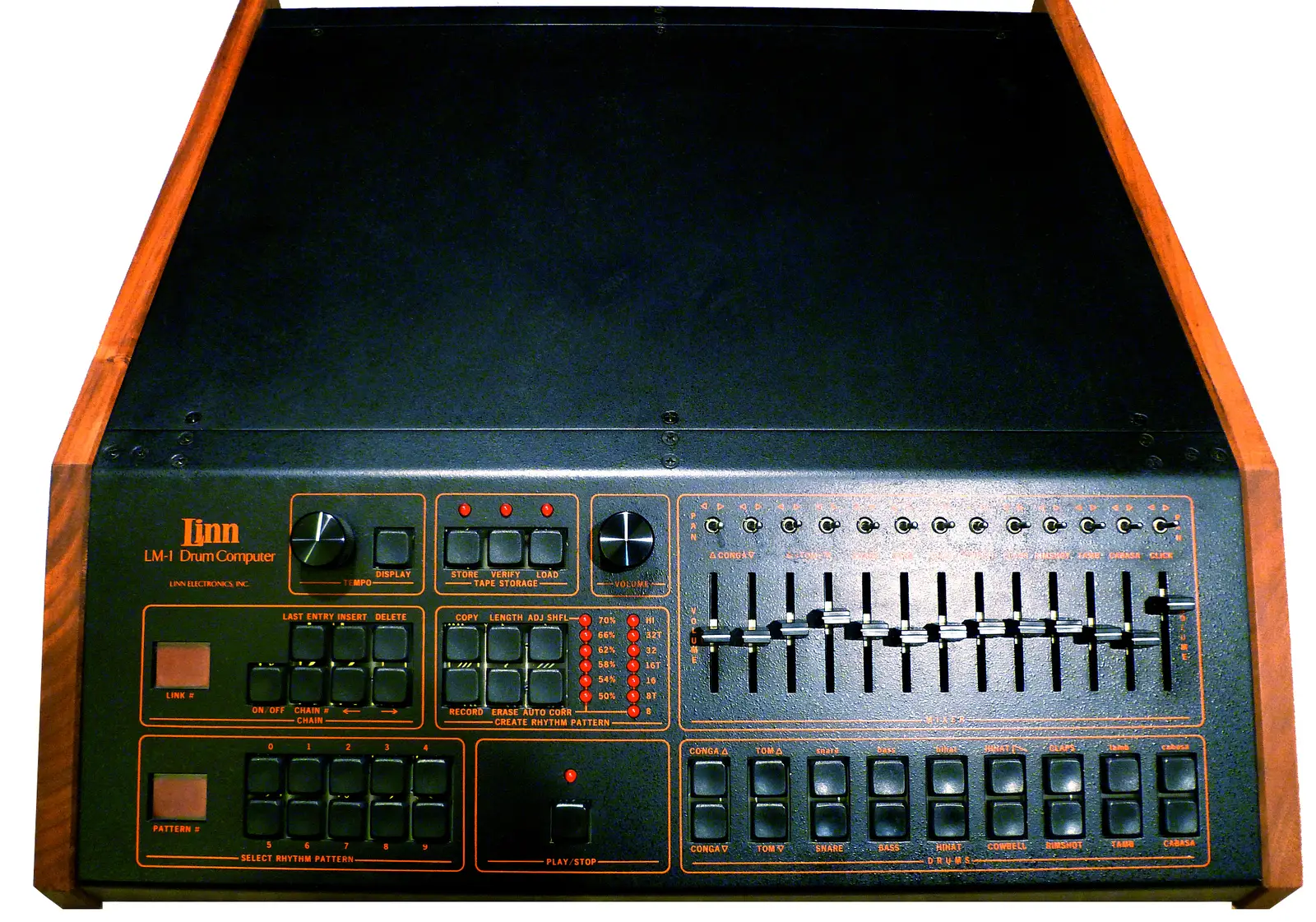
Before 1980 a drum machine sounded like a drum machine. Roger Linn’s first product sounded like a drummer, and within three years his machines were on records by Prince, The Human League and Frankie Goes to Hollywood. This is the story of the three boxes, how they worked inside, and what they are worth now.
What is the Linn drum machine?
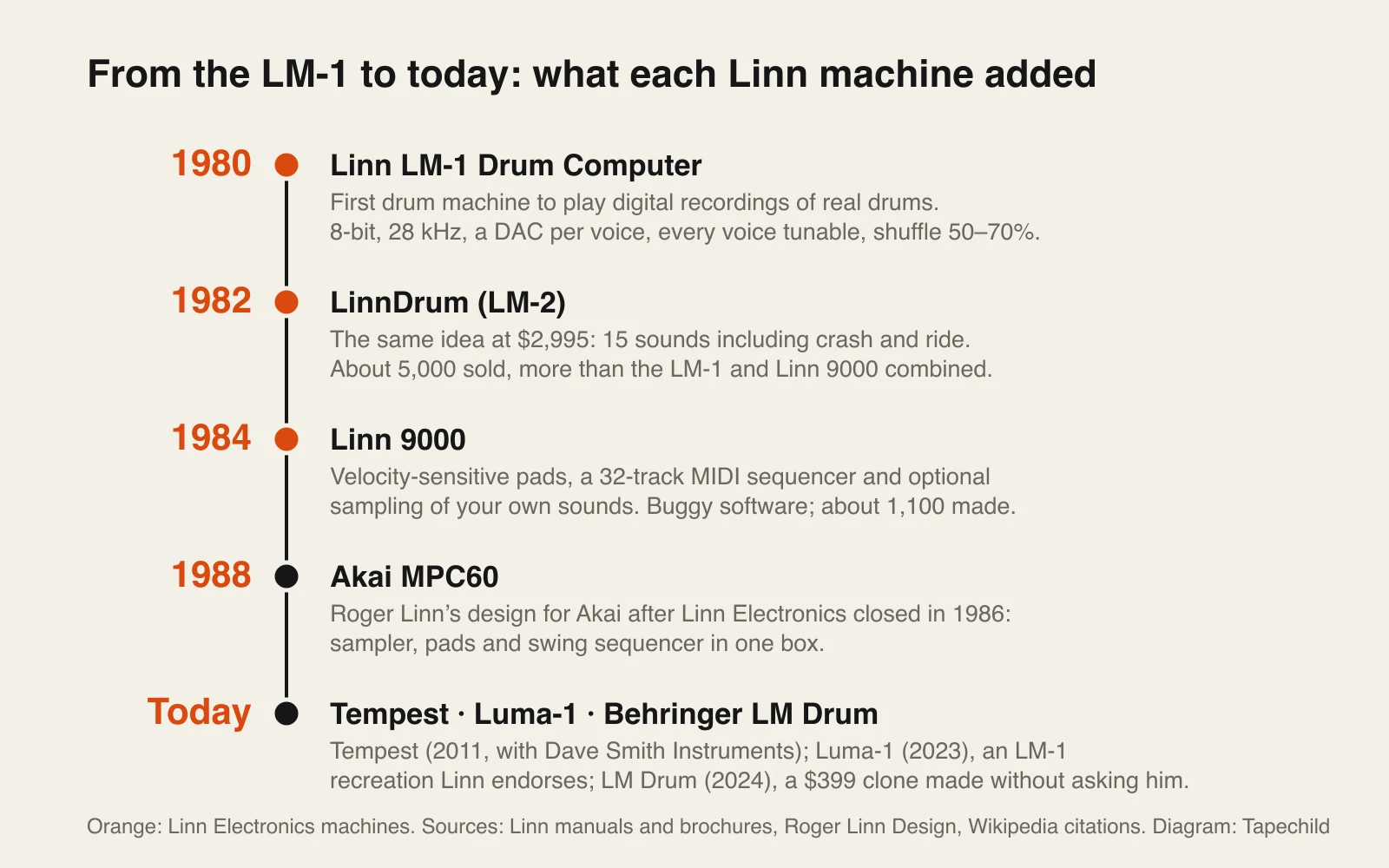
A Linn drum machine is one of the drum machines designed by Roger Linn and made by his company, Linn Electronics, between 1980 and 1986: the LM-1 Drum Computer (1980), the LinnDrum (1982) and the Linn 9000 (1984). The LM-1 was the first drum machine to play digital recordings of a real drum kit instead of synthesizing drum sounds with analog circuits, and it was also the first with programmable swing.
When people say “the Linn drum” without a model number they almost always mean the LinnDrum, which is often listed as the LM-2. It was the cheaper follow-up, it sold in far larger numbers than the other two, and it is the one on most of the mid-80s pop records that people associate with the name.
Linn LM-1 Drum Computer (1980)
The LM-1 was a sample-playback machine built at a time when memory was very expensive. Instead of recording whole drum grooves, Linn stored one short, dry hit per sound — kick, snare, hi-hat, toms, congas, cowbell, claps and a few more, twelve in all — and let a sequencer decide when each one played. Session drummer Art Wood played the kit; the claps came from Tom Petty and the Heartbreakers. There were no cymbals. A ringing crash would have needed far more memory than a kick drum, and memory was the most expensive part of the machine.
Inside, the samples are 8-bit words at a 28 kHz sample rate, stored in EPROM chips. They were not played out through an ordinary linear converter. The LM-1 used companding DACs of the kind telephone systems used, built around the µ-law curve, which spends its 256 steps unevenly: fine steps for quiet signals, coarse ones for loud. That squeezes something like 12 bits of usable dynamic range out of 8-bit data, and it is also why the tail of every Linn sound has a slightly gritty, stepped quality as it fades.
The other design decision that shaped the sound: each voice had its own DAC and its own sample-rate clock, built from 555 timer chips, as Roger Linn describes it on his own site. Tuning a voice changes that clock. A snare tuned down plays back slower, so it gets lower and longer at the same time, exactly like slowing down a tape. Every LM-1 voice has its own tuning knob, a small pot above each fader.
It cost about $5,000 at launch (Wikipedia gives a retail price of $5,500) and only around 525 were built. Early owners were studios and wealthy artists: Leon Russell, Peter Gabriel, Stevie Wonder, Fleetwood Mac. By 1981 it was driving The Human League’s Dare, Herbie Hancock’s Magic Windows and John Carpenter and Alan Howarth’s Escape from New York score. Prince played the LM-1 on “1999” (1982) and on “When Doves Cry” (1984), where it carries the whole track with no bass part.
Swing and error correct: why Linn records feel human
The LM-1 was the first drum machine to offer both swing and quantize on recording, and that pairing, more than the samples, is what made Linn programming feel like a player. You could tap a part in by hand, let the machine snap it to a grid, then push part of that grid late by a set amount.
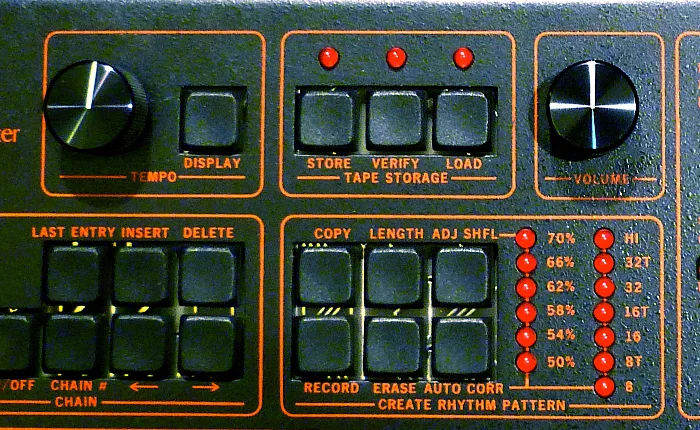

Linn’s swing works on pairs of 16th notes. The setting says what share of each 8th note the first 16th gets. At 50% both halves are equal, so the beat is straight. At 66% the first 16th gets two-thirds and the second lands on a perfect triplet, which is a full shuffle. Everything in between delays only the even-numbered 16ths — the “e” and the “a” — and leaves the beat and the “and” exactly where they were. The LM-1 panel prints six settings, 50% to 70% in 4% steps. Quantize, which Linn called auto correct, snaps entries to 8ths, 16ths or 32nds, straight or triplet, or can be switched off with the HI setting.
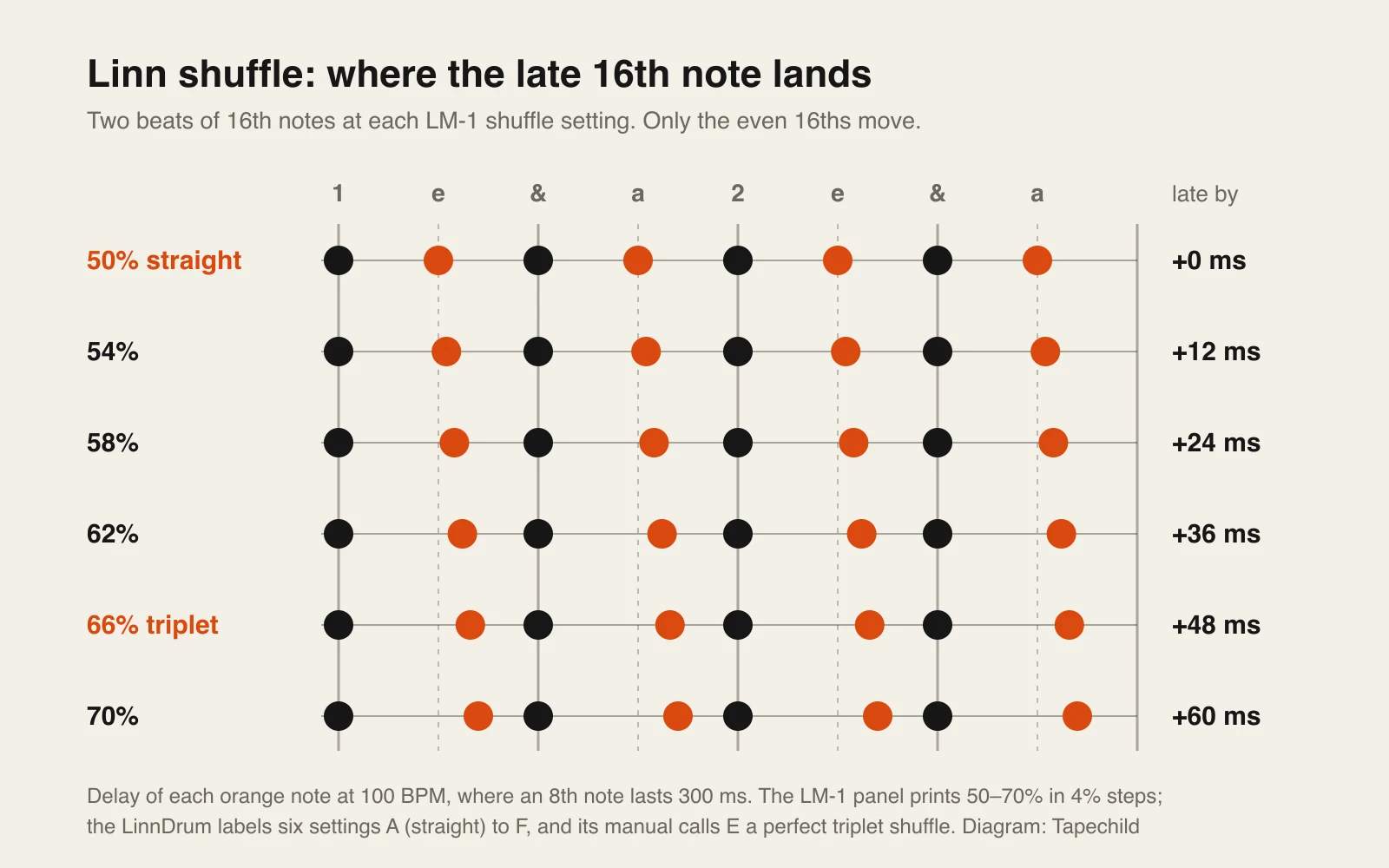
The steps are smaller than they look. At 100 BPM an 8th note lasts 300 ms, so each 4% step moves the late note by 12 ms. At 54% it is only 12 ms behind the grid, which is not enough to hear as swing but is enough to stop a straight 16th-note hat from sounding mechanical. Roger Linn has said as much in interviews: 54% loosens a straight beat without sounding swung, and at 90 BPM a groove can feel looser at 62% than at a mathematically perfect 66%.
The LinnDrum manual makes the same point from the other side. It explains that drummers tend to play their 16ths somewhere between even and shuffled, labels its six timing settings A (straight) to F, and notes that although E is a perfect triplet shuffle, many people prefer C or D. It also lets different parts of one pattern carry different settings: its own example records the hi-hat, cabasa and tambourine each with a different amount of swing, so every part sits slightly differently against the beat. That per-part timing is the detail most modern recreations skip.
LinnDrum (1982)
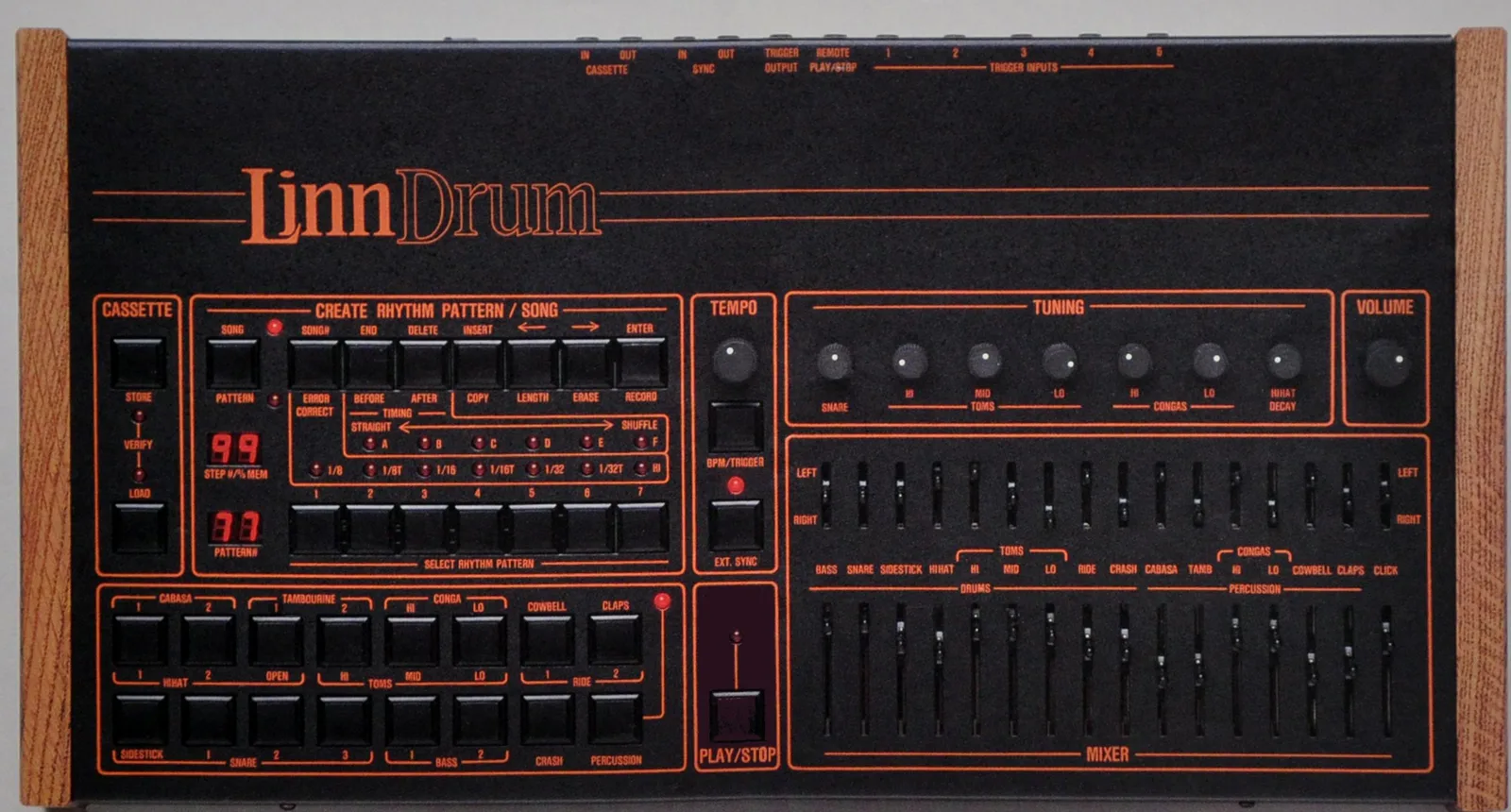

The LinnDrum kept the LM-1’s approach and cut the price to $2,995. It was built from 1982 to 1985 and about 5,000 were sold, more than the LM-1 and the Linn 9000 put together. That volume is why the LinnDrum, not the LM-1, became the default drum sound of mid-80s pop.
What changed was mostly in the voice section. The LinnDrum has 15 sounds: bass, snare, sidestick, hi-hat, three toms, ride, crash, cabasa, tambourine, two congas, cowbell and claps. The crash and ride cymbals were new, and twelve sounds can play at once. The samples are still 8-bit, now at 28 to 35 kHz. Tuning was cut back: only the snare, sidestick, the three toms and the two congas have tuning knobs, each with about an octave of range, plus a decay knob for the closed hi-hat that you can ride while a pattern plays to imitate pedal pressure. Every sound has its own level and pan slider and its own output jack at the back.
Dynamics came from separate buttons rather than velocity. The snare has three volume levels; bass, hi-hat, cabasa, tambourine and ride have two each. Patterns are stored in memory (56 user and 42 preset) and chained into 49 songs, with cassette dump for backup. There was no MIDI at launch. Sync came from DIN sync and a tape-sync tone, plus five trigger inputs for pads, and MIDI was added later by third-party retrofit kits. Linn also sold alternate sound chips: a dealer fitted a changeable socket, and owners could swap in a different snare or kick, so the LinnDrum on a given record is not always the stock kit.
Well-documented LinnDrum records include Frankie Goes to Hollywood’s “Relax” (1983), where Trevor Horn programmed the LinnDrum alongside a Fairlight and layered a sampled bass note over the Linn kick, and a-ha’s “Take On Me” (1985), whose credits list LinnDrum programming by Pål Waaktaar. Wikipedia’s list of users adds Mark Knopfler, George Michael, Naked Eyes, Justin Hayward and the Stock Aitken Waterman team.
Linn 9000 (1984)
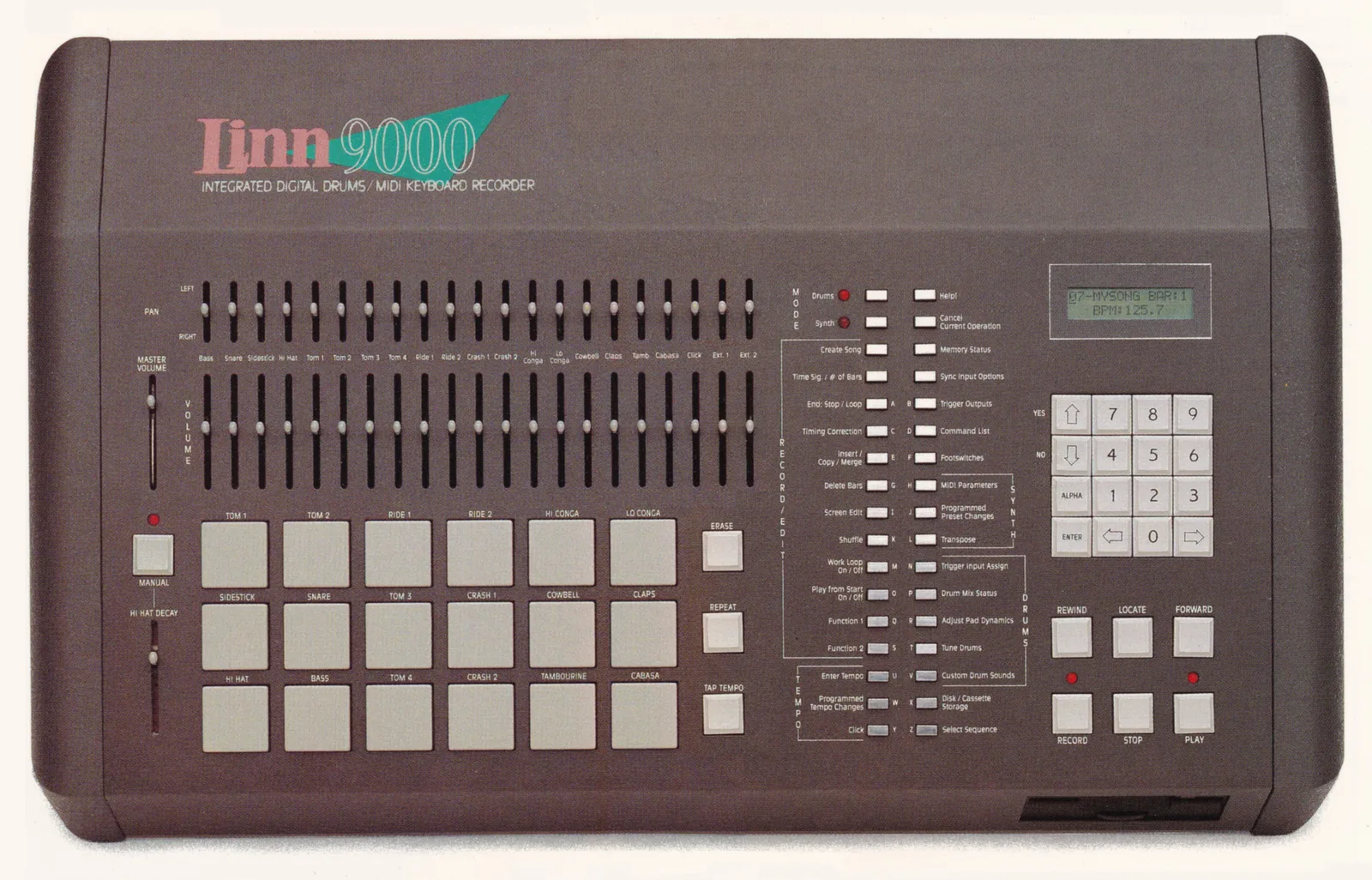

The Linn 9000 was an attempt to put a whole production studio in one box. It had 18 velocity- and pressure-sensitive rubber pads instead of buttons, 18 sampled sounds including two crashes and two rides, a 32-track MIDI sequencer that could record keyboards as well as drums, and an optional sampling upgrade for up to four sounds of your own. It cost $5,000, or about $7,000 fully expanded, and around 1,100 were made.
It was also unreliable. The operating system was written largely in the Forth language, and it crashed and lost data often enough to become the machine’s reputation. Linn has blamed early technical problems, the cost of re-engineering, strong competition and a lack of investment for what happened next: Linn Electronics stopped trading in February 1986, weeks after showing a new LinnDrum Midistudio. Forat Music and Electronics bought the assets, fixed the 9000’s bugs and sold it as the Forat F9000 from 1987.
The 9000 still made records. Stacey Q’s “Two of Hearts” (1986), Eric Carmen’s “Hungry Eyes” (1987) and Rick Astley’s “Together Forever” (1987) all used one, and its pads-plus-sequencer layout is the direct ancestor of the MPC.
LM-1 vs LinnDrum vs Linn 9000
| Linn LM-1 | LinnDrum | Linn 9000 | |
|---|---|---|---|
| Released | 1980 | 1982 (built to 1985) | 1984 |
| Launch price | About $5,000 | $2,995 | $5,000; about $7,000 fully expanded |
| Units made | About 525 | About 5,000 | About 1,100 |
| Sounds | 12, no cymbals | 15, adds crash and ride | 18, two crashes and two rides; optional user sampling |
| Samples | 8-bit, 28 kHz, companding DAC per voice | 8-bit, 28–35 kHz | 8-bit, 11–37 kHz |
| Tuning | Every voice | Snare, sidestick, toms, congas; hi-hat decay | Per sound, from a Tune Drums function |
| Swing and quantize | Swing 50–70%; quantize to 1/32 triplet or off | Six timing settings, A–F; same quantize options | Shuffle and timing correction |
| Sequencer | Patterns and chains, buttons | Patterns and songs, buttons | 32-track MIDI sequencer, 18 pads |
| MIDI | No | No; third-party retrofits | Yes |
| Records | The Human League, Dare (1981); Prince, “When Doves Cry” (1984) | Frankie Goes to Hollywood, “Relax” (1983); a-ha, “Take On Me” (1985) | Stacey Q, “Two of Hearts” (1986); Rick Astley, “Together Forever” (1987) |
Why the Linn sound defined early-80s pop
The Linn machines defined early-80s pop because they were the first boxes that producers could put on a record instead of a drummer without the record sounding like a demo. Until then, programmable rhythm machines such as the Roland CR-78 synthesized their drums, and they sounded like it. The LM-1 gave you a real kit that never drifted, and four qualities made that kit sit in a mix differently from a miked drummer.
- Dry and short. Every hit was recorded close with no room, and cut as short as memory allowed. There was no ambience to fight, so a producer could add exactly the space they wanted, usually a big gated reverb on the snare and nothing on the kick.
- Tunable by varispeed. Because tuning slowed the playback clock, a snare dropped a few steps also got fatter and longer. That low, thick Linn snare is a pitch trick, not a different sample.
- Separate outputs. Every voice had its own jack, so each drum could get its own EQ, compression and effects on the desk, the way a miked kit would.
- Swing you could set. Patterns could sit anywhere from straight to fully shuffled in fine steps, which suited funk and R&B as much as synth-pop.
Synth-pop
The Human League’s Dare (1981) is built on the LM-1: dry, clipped machine drums under synthesizers, with no attempt to hide that a box is playing.
Funk and R&B
Prince’s “1999” (1982) and “When Doves Cry” (1984) put the LM-1 in front of the mix, often retuned and processed, with its swing standing in for a drummer’s feel.
Big 80s pop
Trevor Horn’s LinnDrum on “Relax” (1983) and a-ha’s “Take On Me” (1985) show the machine layered with samplers and synths rather than heard raw.
Film and jazz-funk
John Carpenter and Alan Howarth’s Escape from New York score and Herbie Hancock’s Magic Windows, both 1981, used the LM-1 outside pop entirely.
The Linns were not alone for long. Oberheim’s DMX played the same kind of 8-bit companded samples for far less than an LM-1, and our Oberheim DMX guide covers the machine that went on to anchor early hip hop. For the wider field of the period, see our overview of vintage drum machines; for how sample-based and analog machines differ at the level of the voice, see what a drum machine is.
After Linn Electronics: the MPC, Tempest and the clones
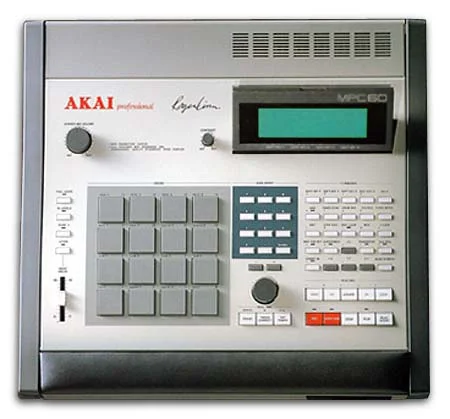

Roger Linn’s next drum machine was not a Linn. The Akai MPC60, released in 1988, was his design for Akai, and it drew heavily on the Linn 9000: pads, sampling and a sequencer in one box, with the same swing. It led to the MPC3000 and a product line that became central to hip-hop production, alongside samplers such as the E-mu SP-1200. The MPC’s famous swing is the LM-1’s shuffle, carried forward.
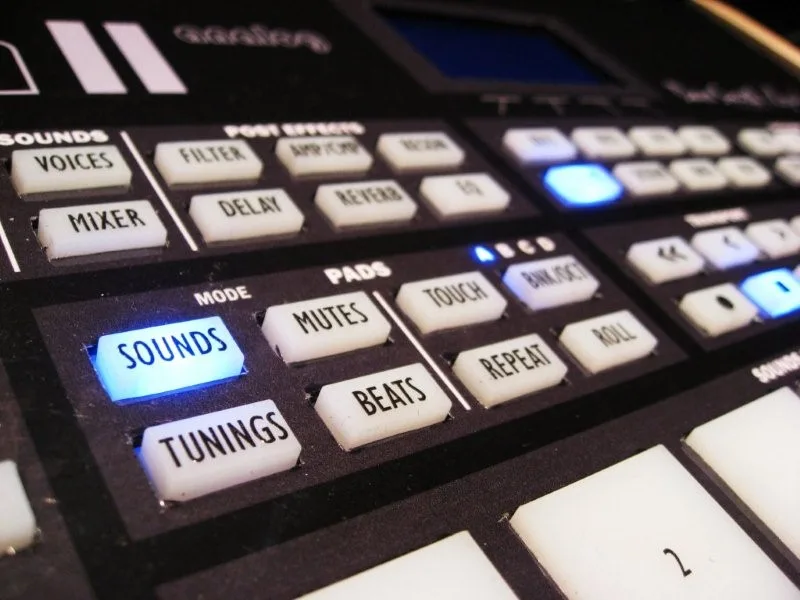

Linn founded Roger Linn Design in 2001. He announced a LinnDrum II in 2007 and showed a prototype at NAMM in 2008; it was released in 2011, co-developed with Dave Smith Instruments, as the Tempest, an analog drum machine rather than a sample player. The same year he received a Technical Grammy Award. Since 2014 his company’s main product has been the LinnStrument, an expressive MIDI controller, not a drum machine.
Two recent hardware machines revive the originals. The Luma-1, designed by Joe Britt, recreates the LM-1 circuit with the same kind of vintage DACs, runs the unmodified LM-1 software and adds loadable sounds, USB and MIDI; Roger Linn endorses it on his own site, and units are built by Deft Audio. It opened for pre-orders in 2023 at a target price close to the original’s. The Behringer LM Drum, released in December 2024 at $399, borrows the LinnDrum’s look and includes sounds from the LM-1, LinnDrum and Linn 9000, with a 64-step sequencer, 8- and 12-bit sampling of your own sounds and an analog filter per voice. Linn did not authorise it; on his site he wrote, “I’d have preferred for Uli to ask my permission.”
Buying a Linn drum machine today
For most buyers the realistic original is a LinnDrum: there are thousands of them, parts and service still exist, and the sound is the one people want. An LM-1 is a collector’s purchase, and a Linn 9000 only makes sense if you know exactly whose software it runs and who will fix it.
Prices at the time of writing, from public listings rather than a price index: a fully refurbished LinnDrum was listed by a US vintage dealer at $4,499 in 2024, and gearnews reported LinnDrums at around £4,500 and up on eBay the same year. Expect low-to-mid four figures, with serviced, MIDI-retrofitted units at the top. LM-1s change hands rarely and in five figures; one listing on Reverb in 2024 asked €35,000. Linn 9000 prices vary too much to quote; the software version and the state of the pads matter more than the case.
Checking a used LinnDrum
Based on the service work listed for a refurbished unit and the original manual
- Ask about the power supply. One dealer’s refurbishment replaced it outright, and a supply more than forty years old is the first suspect when a unit glitches or resets. Get it checked before anything else.
- Test memory retention. Program a short pattern, switch off for a minute, switch on. If the pattern is gone, the memory backup battery is dead; replacement is routine, but budget for it.
- Press every button. There are dozens. Dead or double-triggering switches usually need cleaning, sometimes replacing.
- Move every slider. The level and pan sliders get scratchy and drop out. Replacement slider kits exist; a dealer’s refurbishment will often have swapped the whole set.
- Sweep the tuning knobs. Each of the six tunable voices should move smoothly across about an octave with no jumps. Check the hi-hat decay knob too.
- Check the sound chips and MIDI. Ask whether the voice chips are stock or alternates, and whether a MIDI retrofit is fitted. Both change what the machine is worth and how you will use it.
- Listen to every individual output. The rear jacks are how the machine was recorded on most records; a dead output is a real fault.
Have a technician who knows 1980s digital gear quote any repair before you pay. For a new machine, the Luma-1 covers the LM-1 and the Behringer LM Drum covers the LinnDrum look and sounds on a budget.
LinnDrum VST and samples
If you want the sound rather than the hardware, samples get you most of the way, because the originals were sample players to begin with. Our LinnDrum VST and samples guide compares the libraries and plugins that reproduce the LM-1 and LinnDrum. The part a sample pack cannot supply is the behaviour covered above, so here is how to rebuild that in a DAW.
Getting the Linn feel from samples
Any DAW with a drum sampler and a groove or swing control
- Tune by resampling, not by pitch-shifting. Set the sampler to repitch (varispeed) mode so a snare dropped two or three semitones also gets longer, as it did on the hardware. A formant-preserving shift sounds wrong here.
- Swing each part separately. Start with hats around 58%, a shaker or cabasa around 54%, and leave kick and snare straight. That is the LinnDrum manual’s own trick of different timing per instrument.
- Stay below the triplet. For a straight pop groove stay at 50–58%; for funk, try 62% before 66%.
- Keep each drum on its own channel. Treat them like the individual outputs: no reverb on kick or hats, a gated room on the snare only.
- Sketch from a loop if you are in a hurry. Our free 80s and 90s pop drum loops are royalty-free WAVs in this style.
Our own plugin, UDS-16, is a drum synthesizer with no samples, so it is not a way to get the Linn sound.
Frequently asked questions
How much did a LinnDrum cost originally?
The LinnDrum sold for $2,995 when it came out in 1982. The LM-1 before it cost about $5,000 (Wikipedia gives $5,500 retail), and the Linn 9000 cost $5,000, or about $7,000 with every expansion fitted. Serviced LinnDrums now sell for more than their original price.
Who invented the Linn drum machine?
Roger Linn, an American musician and engineer, designed the LM-1 Drum Computer and founded Linn Electronics to build it. It was released in 1980 as the first drum machine to play digital samples of real drums. He later designed the Akai MPC60 and co-developed the Tempest with Dave Smith Instruments.
What songs use the LinnDrum?
Frankie Goes to Hollywood’s “Relax” (1983) and a-ha’s “Take On Me” (1985) credit the LinnDrum. The earlier LM-1 is on The Human League’s *Dare* (1981) and Prince’s “1999” (1982) and “When Doves Cry” (1984). The Linn 9000 is on Stacey Q’s “Two of Hearts” (1986) and Rick Astley’s “Together Forever” (1987).
What drum machine did Prince use on Purple Rain?
The credits for “When Doves Cry”, the lead single from *Purple Rain* (1984), name the Linn LM-1. Prince had also used the LM-1 on “1999” in 1982. He often retuned and processed its drums, so they do not always sound like the stock samples.
Is the Behringer LM Drum the same as a LinnDrum?
No. The Behringer LM Drum, released in December 2024 at $399, copies the LinnDrum’s styling and includes samples of Linn machines, but it is a new design with a 64-step sequencer, user sampling and an analog filter per voice. It was made without Roger Linn’s involvement. A LinnDrum is the original 1982 Linn Electronics hardware.
Where can I buy a LinnDrum?
Only second-hand, since production ended in 1985. They appear on Reverb, eBay and at vintage synth dealers, often refurbished with a new power supply, battery and sliders. At the time of writing a serviced unit typically costs in the low-to-mid four figures in US dollars.
Royalty-free WAV
Free sample packs
Royalty-free WAV, play every sample before you download.