
Oberheim DMX: The Drum Machine Behind Early Hip Hop
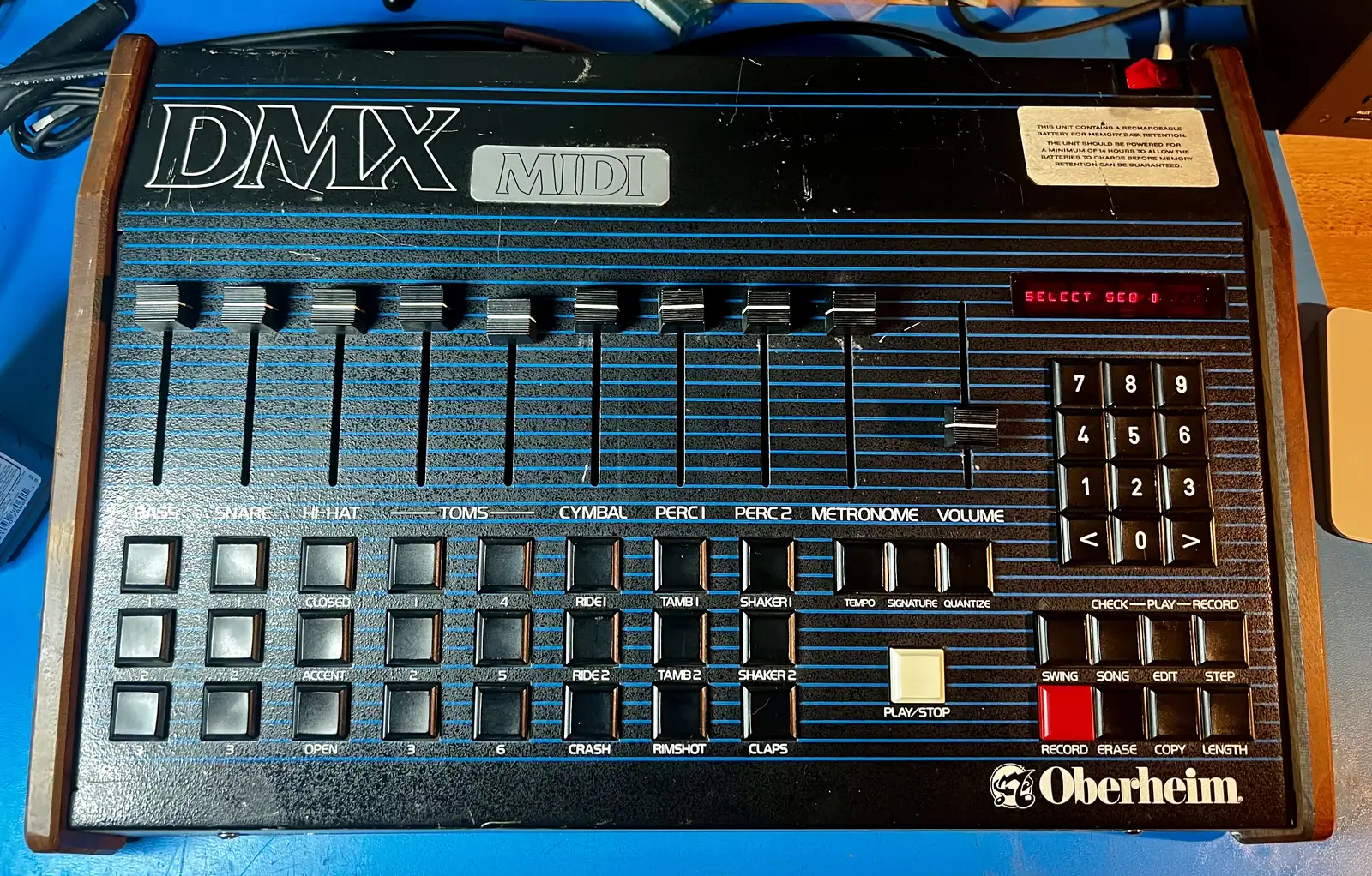
The Oberheim DMX is the drum machine on Run-D.M.C.’s first single and on New Order’s “Blue Monday”. It sounds hard and a little grainy for reasons you can trace to the hardware: eight removable sample cards, 8-bit chips, a tuning trim on every card and a swing setting borrowed from the Linn school. This is how it works, what it is on, and how to get it now.
What is the Oberheim DMX?
The Oberheim DMX is a programmable digital drum machine made by Oberheim Electronics that plays short 8-bit recordings of real drums from EPROM chips on eight removable voice cards. It was introduced at the turn of 1980 and 1981 at a list price of US$2,895 and was the second sample-based drum machine on the market, after the Linn LM-1.
Sources disagree on the year. Wikipedia and Vintage Synth Explorer give 1980; GForce, the company that makes the licensed plugin, refers to the machine’s 1981 launch. Either way it sits in the same short window as the LM-1, the Roland TR-808 and, a year later, the LinnDrum, which is why it is usually discussed with them. Our overview of what a drum machine is places those machines on one timeline.
Tom Oberheim has told the story of how it started. Having heard that Roger Linn had built a programmable drum machine, he proposed that Oberheim manufacture it and pay Linn a royalty. Linn declined and founded Linn Electronics instead, so Oberheim built its own. Tom Oberheim later called the DMX the company’s most popular and most successful product, in a lecture for the Red Bull Music Academy. We could not find a reliable public credit naming the individual engineers who designed it, so this article credits the company.
How the DMX makes its sounds
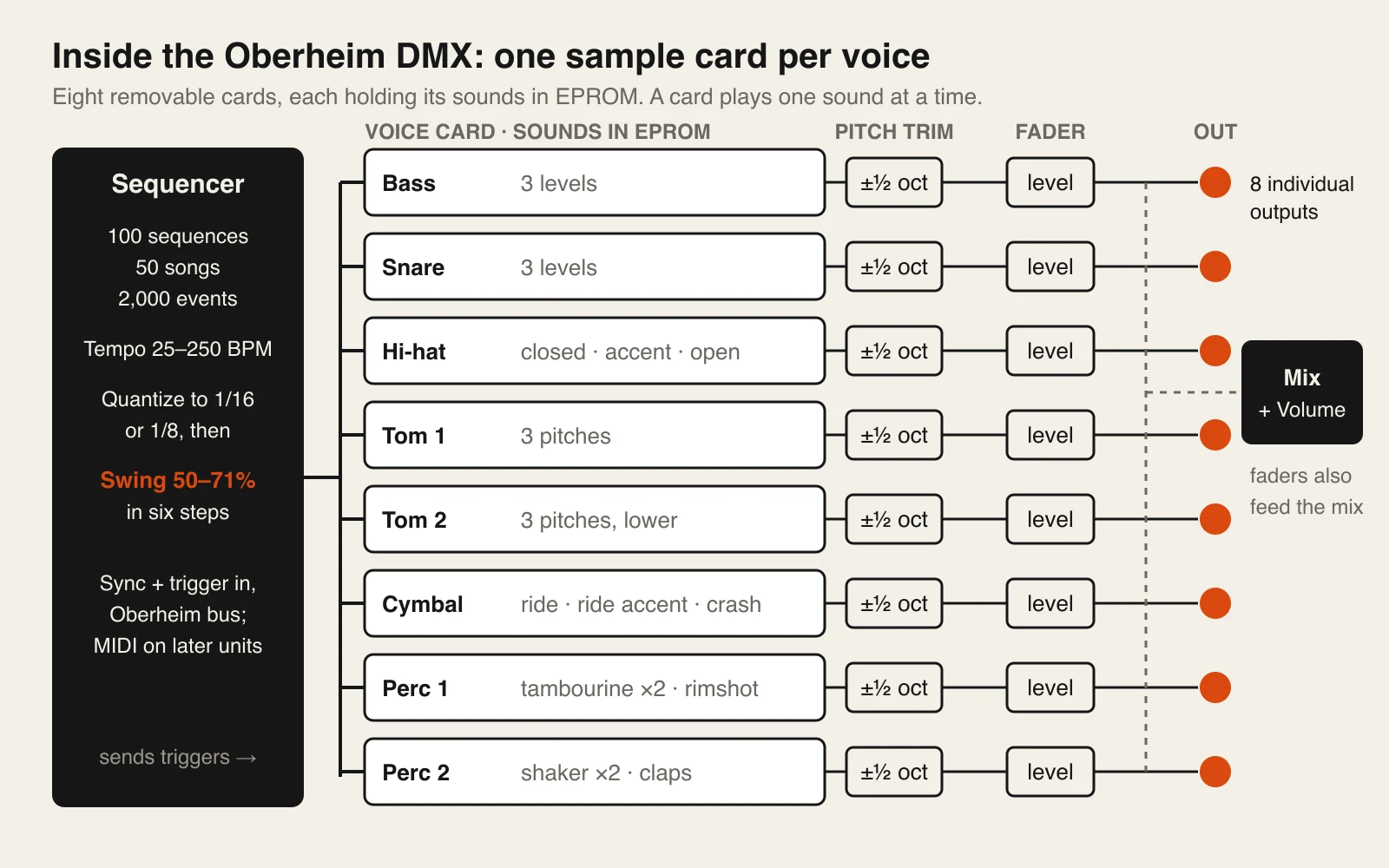
Each DMX sound is a short digital recording stored in an EPROM chip on one of eight plug-in voice cards, and each card is one voice: it can play one of its sounds at a time. That single fact explains most of the machine’s behaviour.
Eight cards, 24 sounds
The owner’s manual lists 24 sounds across the eight cards. Bass and snare each have three loudness levels. The hi-hat card holds closed, accented and open hats. Tom 1 and Tom 2 each have three pitches. The cymbal card holds two ride sounds and a crash. Perc 1 is two tambourines and a rimshot; Perc 2 is two shakers and hand claps. Wikipedia, citing Attack Magazine, says the 24 are derived from 11 original samples, which suggests that the three snare levels, for example, are one recording played at three volumes.
Because a card is one voice, sounds on the same card cut each other off. A closed hat chokes an open hat, which is what a real hi-hat does. Less obviously, a rimshot cuts a ringing tambourine and claps cut a shaker, so a busy percussion part on the DMX has gaps a sampler would not. Programmers worked around it or used it.
8-bit, companded, at different rates
The samples are 8-bit words stored with companding, a logarithmic encoding from telephone systems that spends more of the 8 bits on quiet detail and fewer on loud peaks. Played back through the matching expander, the result has a dynamic range closer to 12-bit audio. The LinnDrum, the E-mu Drumulator and Sequential’s drum machines used the same trick. Electrongate, the DMX service specialist, puts the sample rates between about 16,000 and 32,000 samples per second depending on the voice, with the longest sounds, the cymbals, taking 32 KB of EPROM each.
That is where the grain comes from. A sound stored at 16,000 samples per second cannot contain anything above 8 kHz, and the companding adds a faint noisy haze to quiet decays. The manual quotes a frequency response of 10 Hz to 16 kHz and an 80 dB dynamic range: respectable for 1981, audibly short of a CD.
Tuning, faders and eight outputs
Every card has a pitch trim that tunes its voice up or down by about half an octave. On the DMX it is inside the case, on top of each card, which means you set a kit once rather than riding it. A rear-panel CV input lets a pedal or control voltage bend pitch from outside. Each voice has a front-panel fader and its own output jack, so studios could send the kick and snare to separate console channels and compress, gate or reverb them individually. On 1980s records that separate processing is a large part of what people call the DMX sound.
Changing the sounds
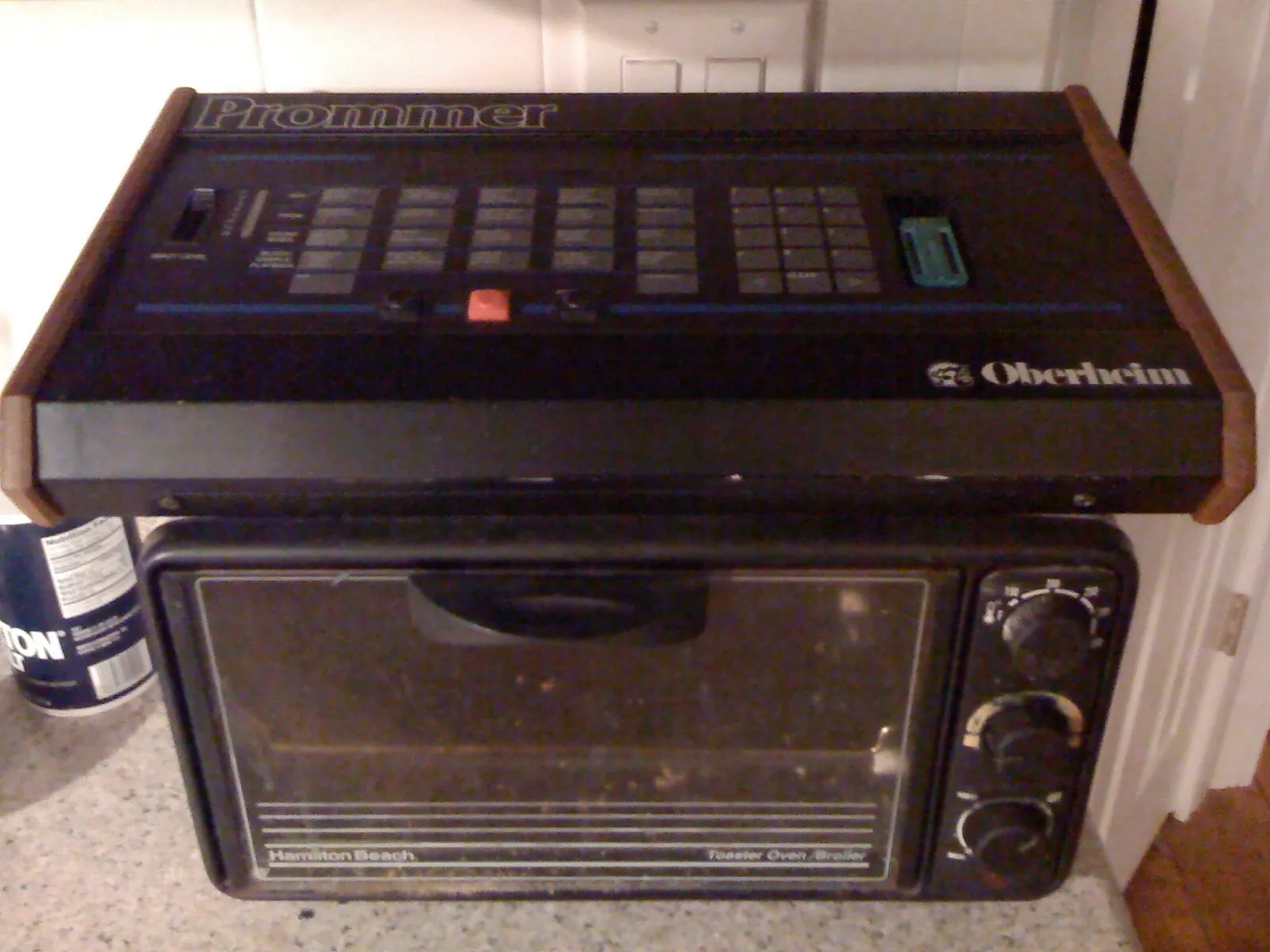
Since sounds are chips, new sounds meant new chips. Oberheim revised the factory set around 1983, and third parties sold replacement EPROMs. Oberheim’s own Prommer, sold from about 1983, could sample a sound and write it to an EPROM for a DMX, Linn, Simmons or Sequential machine.
The DMX sequencer and its swing
The DMX sequencer stores 100 sequences and 50 songs, records in real time or step by step, and applies swing between 50% and 71% in six steps. Those numbers, from the owner’s manual, are close to the settings on the Linn LM-1, and Attack Magazine notes that the swing values on the LM-1, the DMX, the Drumulator and the E-mu SP-12 and SP-1200 are nearly the same.
- Memory. 100 sequences, 50 songs, up to 2,000 events, each able to fire all eight voices at once. An expanded-memory version doubled the sequence count.
- Tempo. 25 to 250 BPM, stored with each sequence and song.
- Quantize. From quarter notes down to 32nd notes, applied as you record.
- Swing. 50% is straight; each step lengthens the first half of every beat pair, up to 71%. It works with eighth- or sixteenth-note quantize and is written into the recording, not applied on playback.
- Sync. Clock and trigger inputs and Oberheim’s own parallel bus for its synths and sequencers, which predates MIDI. Later units shipped with factory MIDI, and specialists have long sold retrofit kits.
That swing is a big part of why the machine suited hip hop. At 58% to 62% on sixteenths, the second sixteenth of each pair lands late, which gives a straight grid a bounce without programming each hit off the grid by hand. Our guide to vintage drum machines compares how other boxes of the era handled timing.
Oberheim DX: the cheaper sibling
The Oberheim DX is a cut-down DMX introduced in 1983 at US$1,395, less than half the DMX’s price. It keeps the panel layout and the swing but drops to six voices and 18 sounds, and puts its sound chips on the main board instead of on separate cards.
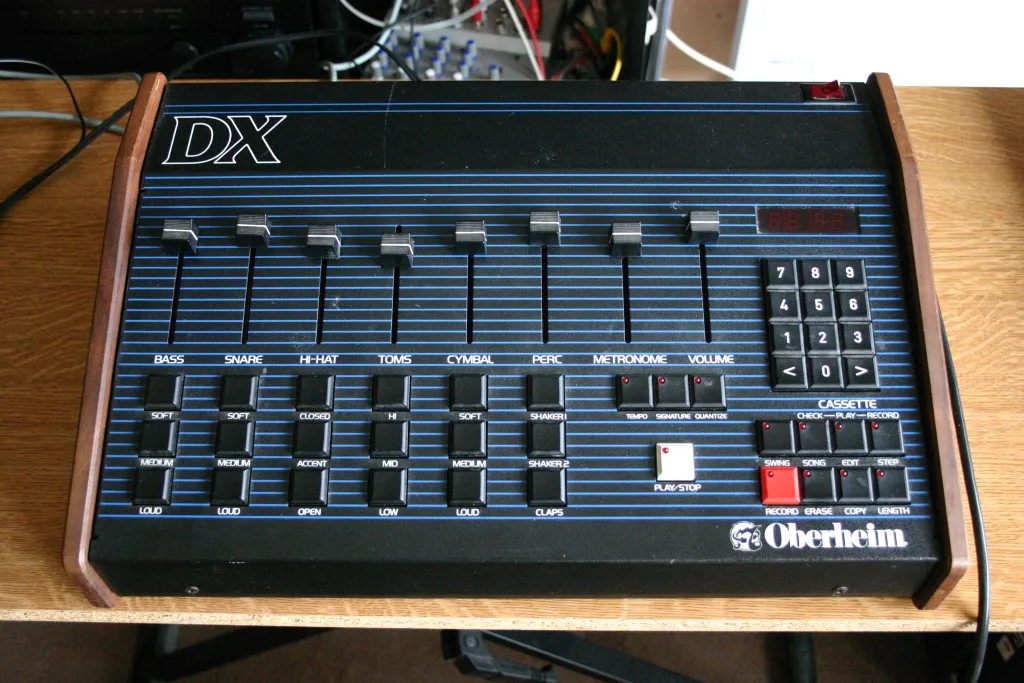

- Voices: six instead of eight; toms share one voice with three pitches, and the percussion channel covers shakers and claps.
- Tuning: knobs on the back panel instead of trims inside, which is easier to reach mid-session.
- Display and memory: a four-digit numeric LED instead of a 16-character display, and 8K of memory against 24K on the DMX.
- MIDI: factory MIDI on the DXa model.
- Stretch DX: a bolt-on expansion that added four more voices with their own faders.
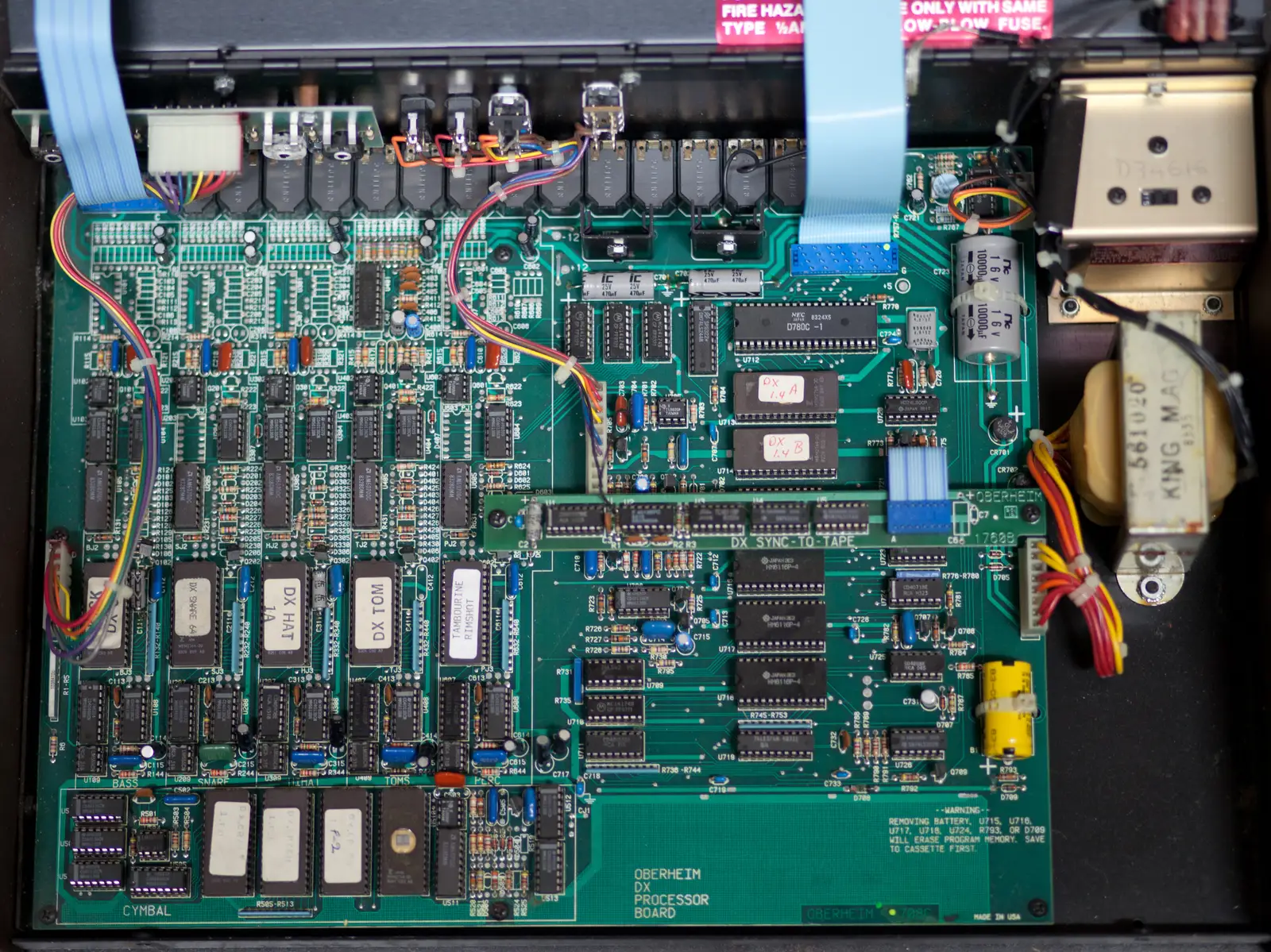

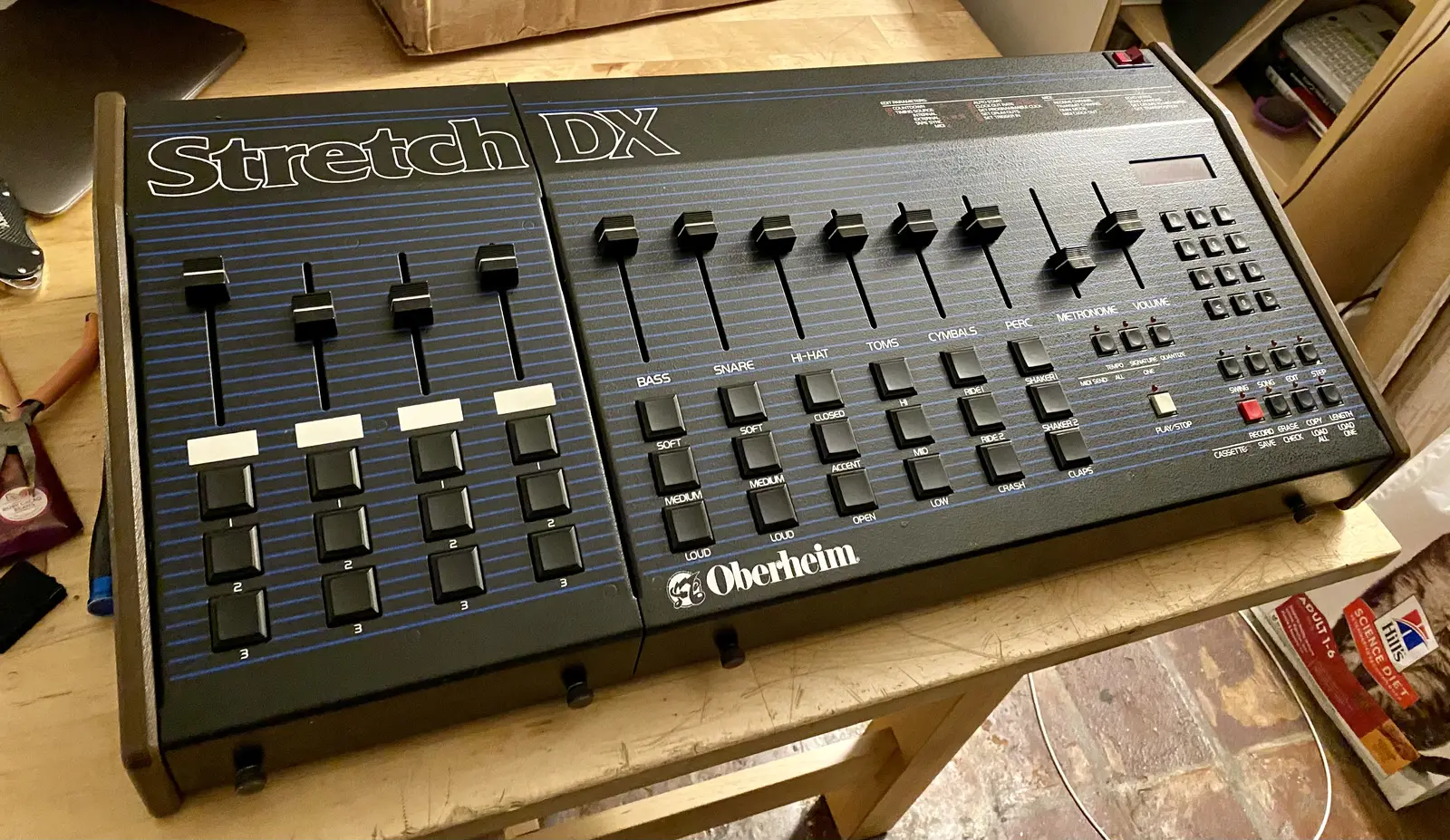

The DX sounds come from the same family and it was cheaper, so in practice a lot of the “DMX” heard on mid-1980s rap and dancehall could equally be a DX. Wikipedia notes both machines were popular with early hip hop producers and in dancehall reggae.
Why the DMX became a sound of early hip hop
The DMX became a hip hop sound because it was on the record that reset the genre: Run-D.M.C.’s 1983 debut single “It’s Like That” backed with “Sucker M.C.’s”. Both sides were built on DMX programming rather than a band, and on “Sucker M.C.’s” a loud DMX, a few scratches and two voices are close to the whole arrangement. Critics treat that single as the start of new-school rap, and its stripped, drum-machine-led template carried through the mid-1980s.
By most accounts Larry Smith, who co-produced the early Run-D.M.C. tracks, took a drum pattern from his band Orange Krush and rebuilt it on a DMX; that rhythm became the “Krush Groove” series of songs. Davy DMX, the Orange Krush guitarist and DJ, took his name from the machine, and so, later, did the rapper DMX and the electro producer DMX Krew.
Outside rap, the best-documented DMX record is New Order’s “Blue Monday” (1983). Stephen Morris programmed its drums on a DMX, and the band has described losing a whole day of programming when a power lead was pulled out mid-session. The same machine turns up across 1980s synth-pop and in dancehall, where the DMX and DX stayed in use long after rap moved on to sampling breaks.
The hardware explains the rest. Eight individual outputs let engineers compress and EQ each drum hard. Three fixed loudness levels on kick and snare made accents easy to program without velocity. The lower sample rates left kicks and snares dry, with little high-frequency detail to compete with a vocal. When hip hop moved to sampling machines such as the E-mu SP-1200, producers kept the dry, gritty drums and the swing.
DMX vs LinnDrum vs Drumulator
The three machines used the same basic method, 8-bit samples in ROM with a swing-capable sequencer, and differ in voice layout, tuning and price. The table uses list prices and specifications from the sources named; where sources disagree we have said so.
| Oberheim DMX | LinnDrum | E-mu Drumulator | |
|---|---|---|---|
| Maker | Oberheim Electronics | Linn Electronics (Roger Linn) | E-mu Systems |
| Introduced | 1980–81 (sources differ) | 1982 | 1983 |
| List price at launch | US$2,895 | US$2,995 | US$995 |
| Sample format | 8-bit companded, about 16–32 kHz by voice | 8-bit, about 28–35 kHz | 8-bit |
| Sounds | 24 on 8 removable cards | 15 | 12 |
| Voices at once | 8, one per card | Up to 12 | 8 channels |
| Tuning | Every voice, ±½ octave, internal trims | Snare, toms and congas only | Samples essentially fixed; levels only |
| Mixing and outputs | Fader and individual out per voice, plus mix | Level and pan per sound | 8 individual outs plus mix |
| Pattern memory | 100 sequences, 50 songs | 56 user patterns, 42 presets, 49 songs | 36 patterns, 8 songs |
| Swing | 50–71% in six steps | Yes, Linn-style | Yes, near-identical settings |
| MIDI | Later units, and retrofits | Third-party retrofit | Later units |
In sound and feel the difference between the DMX and the LinnDrum comes down to sample rate and tuning. The LinnDrum sampled at higher rates and has front-panel pan per sound, so its kits tend to sound more polished, which suited the 1980s pop it is heard all over; the LinnDrum guide covers it on its own. The DMX lets you retune every voice, including kick and hats, and its lower-rate samples sound drier and more aggressive. Both swing in much the same way, and both reward individual outputs. The Drumulator is what brought the method under US$1,000, with a smaller set of sounds that could hardly be changed without new chips.
The Oberheim DMX today: plugin, clone and samples
Today you can get the DMX sound three ways: GForce’s licensed plugin, Behringer’s BMX hardware clone, or multisampled libraries loaded into a sampler. None of them is the original, and each gives something up.
GForce Oberheim DMX plugin (2024)
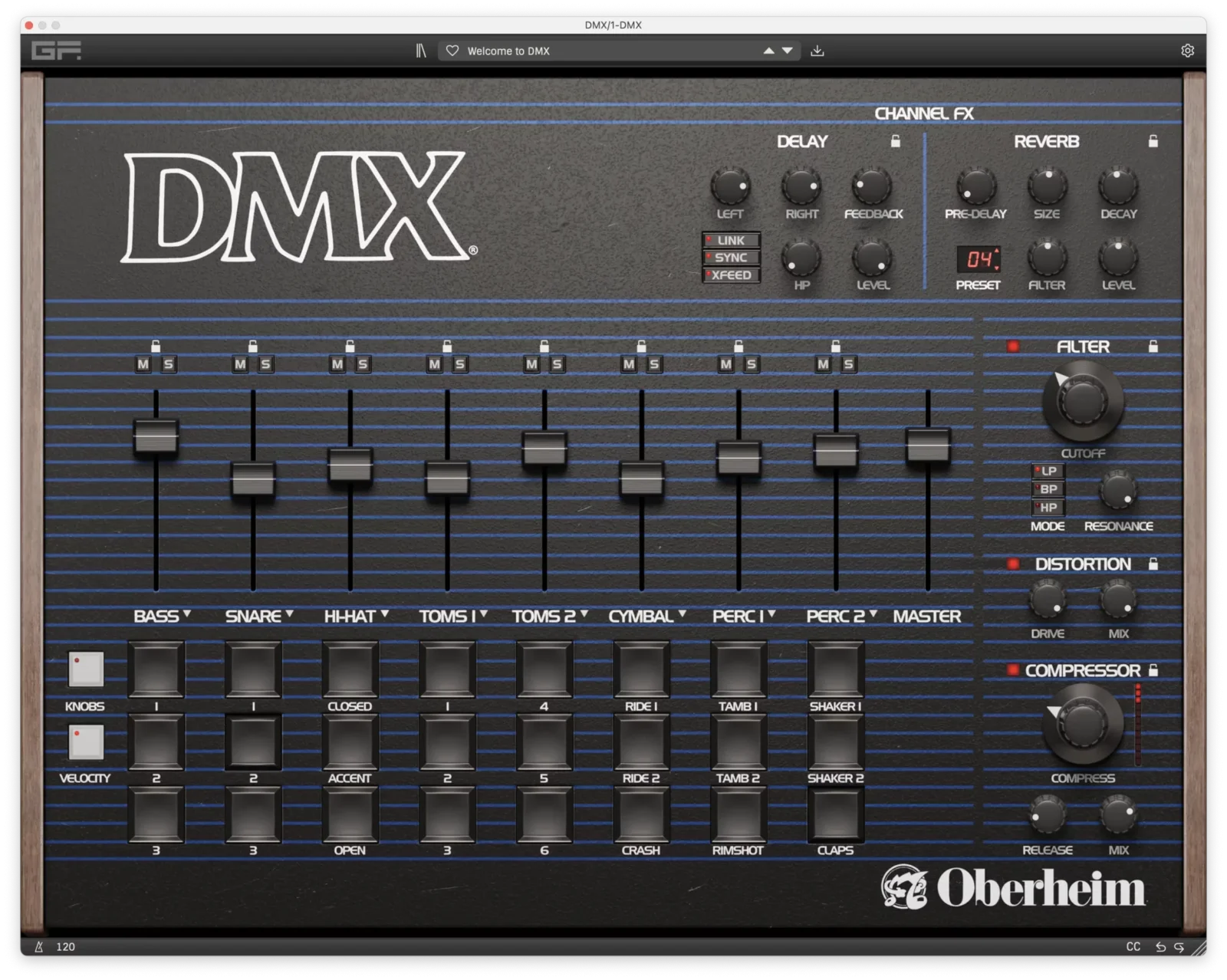
GForce Software released its Oberheim DMX plugin in spring 2024, developed in association with Oberheim. It carries the original 1981 sounds, the revised set from around 1983 and the DX sounds, 288 in all across more than 60 preset kits, plus some Sequential DrumTraks kits. It keeps the eight-channel layout and adds per-channel pitch, decay, pan and effect sends, an SEM-style filter, distortion, compression, delay and reverb. Version 1.1 added multiple outputs, so you can process channels separately as studios did with the hardware.
It has no built-in pattern sequencer: you play it from your DAW, and it ships with over 85 MIDI files of patterns. It runs as VST, VST3, AU and AAX and as a standalone app, and at the time of writing costs under US$100 at full price. We have not tested it ourselves; our best drum machine VST guide places it among the other emulations.
Behringer BMX (2026)
Behringer announced the BMX in February 2026 at US$459, and it reached shops in spring 2026. It is a new instrument built around the DMX idea rather than a copy of the circuit board: it includes the original DMX and DX sounds with an 8/12-bit engine and analog filters, plus a 64-step sequencer with swing, 24 velocity-sensitive pads, MIDI over DIN and USB, and eight individual outputs. For a hardware box with DMX sounds and modern connections it is the cheap option. We have not used one.
Sample packs and the original hardware
Multisampled libraries recorded from original units, such as Samples From Mars’ DMX From Mars, load into any sampler. They are the most direct route to the sound, and you keep your DAW’s swing and velocity.
Original units change hands for roughly US$3,000 to US$5,000 in listings we have seen in 2025 and 2026, depending on condition, servicing and whether MIDI has been fitted. Treat that as a rough band. A DMX is now about 45 years old: budget for the memory battery, the display and a service. The DX usually sells for less.
Our own product, briefly: Tapechild makes UDS-16, a drum synthesizer plugin with no samples and no sequencer, whose circuits descend from Soviet drum machines. It does not reproduce DMX sounds and is not a substitute for the options above. Our free hip hop drum loops are also not DMX recordings; they are useful for sketching a hip hop beat, not for the exact DMX sound.
How to program a DMX-style hip hop beat
A DMX-style beat is a sparse one-bar pattern of dry kick, snare with clap and eighth-note hats, with swing on the sixteenths and accents made from fixed loudness levels rather than velocity. The steps below work on the GForce plugin, the BMX, a sample pack in any DAW or an original DMX. It is a starting point in the style, not a transcription of any record.
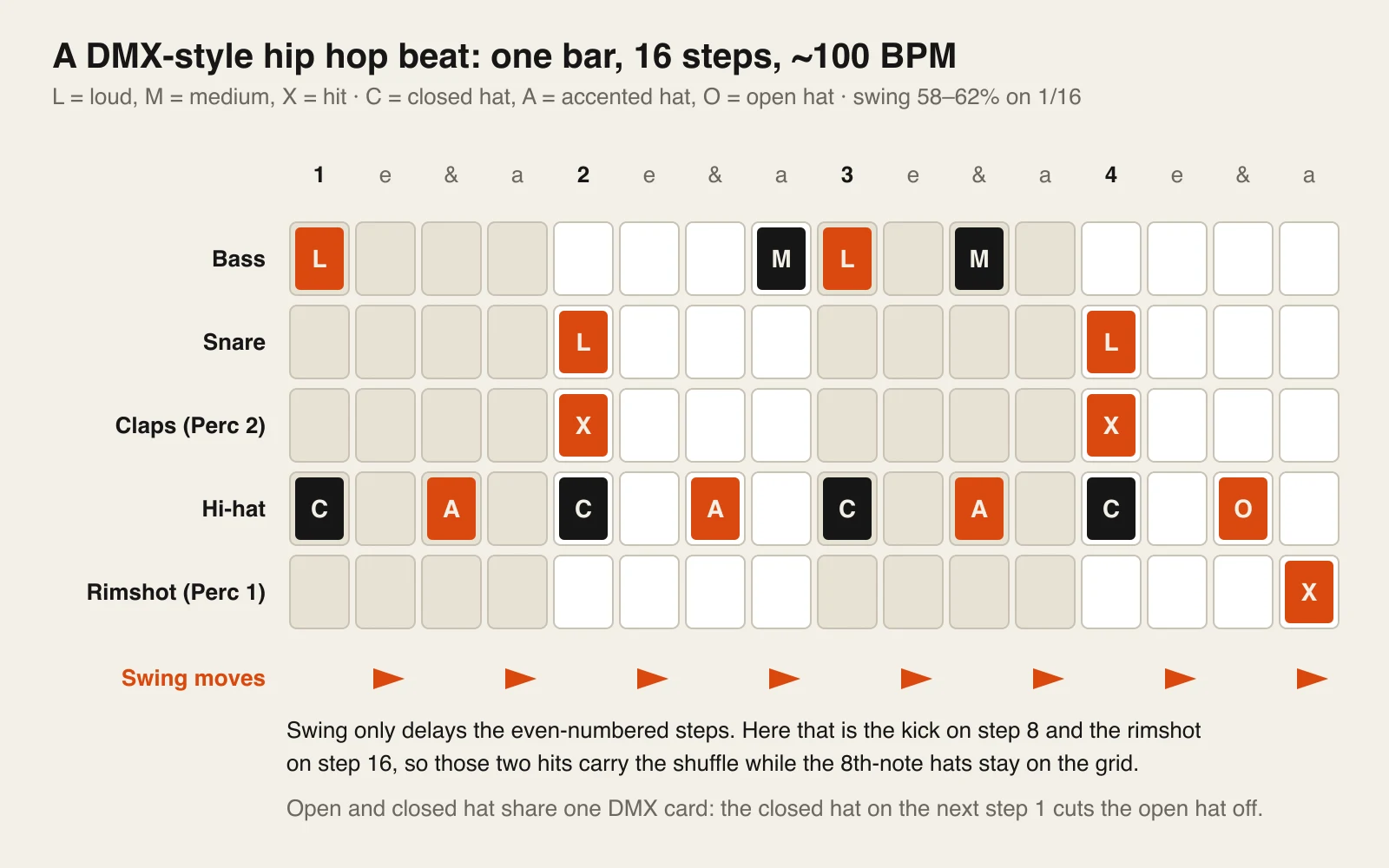
DMX-style hip hop beat in 16 steps
About 100 BPM · 4/4 · one bar · swing 58–62% on sixteenths
- Set tempo and grid. 100 BPM, a one-bar loop, sixteen steps. On a DAW set the grid to 1/16 and swing to 58%; on an original DMX choose sixteenth quantize and the third swing step (58%) before you record.
- Kick. Loud kick on steps 1 and 9, medium kick on steps 8 and 11. On a DMX-style kit “medium” is the middle of the three bass buttons; in a DAW use velocity around 90 against 127. The step-8 kick is on an even step, so swing pushes it late, which is where the bounce comes from.
- Snare plus claps. Loud snare on 5 and 13, with claps on the same steps. Leave the shakers off: on DMX-style kits they share a voice with the claps and would cut them.
- Hats. Closed hat on 1, 5, 9 and 13; accented hat on 3, 7 and 11; open hat on 15. The closed hat on the next bar’s step 1 chokes the open hat. In a sampler put all three hats in one choke group to copy the card.
- Rimshot pickup. A rimshot on step 16. It sits on an even step, so swing drags it toward the downbeat and it leads into the next bar.
- Tune. Drop the kick about two semitones and raise the snare one or two. That is well within the half-octave range of a DMX card trim.
- Process separately. Route kick and snare to their own channels. Compress the kick with a slow attack to keep the click, give the snare a short plate or room reverb, and roll the hats off above about 12 kHz if the kit is too clean.
- Vary it. Copy to four bars and change only bar four: move the step-11 kick to 12 and add a tom 1 hit on 14. Keep everything else fixed; repetition is part of the style.
For a harder mid-1980s feel raise swing to 62%, or set it back to 50% for straight electro. On an original DMX swing is applied as the part is recorded, so choose it before you record.
Frequently asked questions
What is the Oberheim DMX?
The Oberheim DMX is a programmable digital drum machine from Oberheim Electronics, introduced around 1980–81 at US$2,895. It plays 8-bit companded recordings of real drums from EPROM chips on eight removable voice cards, with a tuning trim, fader and output for each card, and a sequencer with swing.
What famous songs used the Oberheim DMX?
The best-documented are Run-D.M.C.’s 1983 debut single “It’s Like That” with “Sucker M.C.’s”, and New Order’s “Blue Monday” from the same year, whose drums Stephen Morris programmed on a DMX. The machine and its cheaper sibling, the DX, were used widely in mid-1980s hip hop and in dancehall reggae.
How much does an Oberheim DMX cost today?
Working original units have sold for roughly US$3,000 to US$5,000 in listings we have seen in 2025 and 2026, with serviced units and MIDI-equipped ones at the top of that range. The DX is usually cheaper. The GForce plugin costs under US$100 at full price and Behringer’s BMX hardware clone launched at US$459.
What is the difference between the Oberheim DMX and DX?
The DX, from 1983, is a cheaper DMX with six voices instead of eight and 18 sounds instead of 24. Its sound chips sit on the main board instead of removable cards, its tuning knobs are on the back panel, it has a four-digit display and less memory, and the DXa added factory MIDI.
Is the Oberheim DMX still used in music production?
Yes, mostly through software and samples. GForce’s licensed plugin from 2024 carries the original DMX and DX sounds, Behringer’s BMX from 2026 puts them in new hardware, and multisampled libraries are widely used in samplers. Original units are still used, but their age and price make them a studio collector’s choice.
Does the GForce Oberheim DMX have a sequencer?
No. The GForce plugin has no built-in pattern sequencer; you play it from your DAW’s piano roll or step editor. It ships with more than 85 MIDI pattern files to start from, and version 1.1 added multiple outputs so each drum can be processed on its own channel.
Royalty-free WAV
Free sample packs
Royalty-free WAV, play every sample before you download.