
What Is a Drum Machine? How It Works, Types & Uses
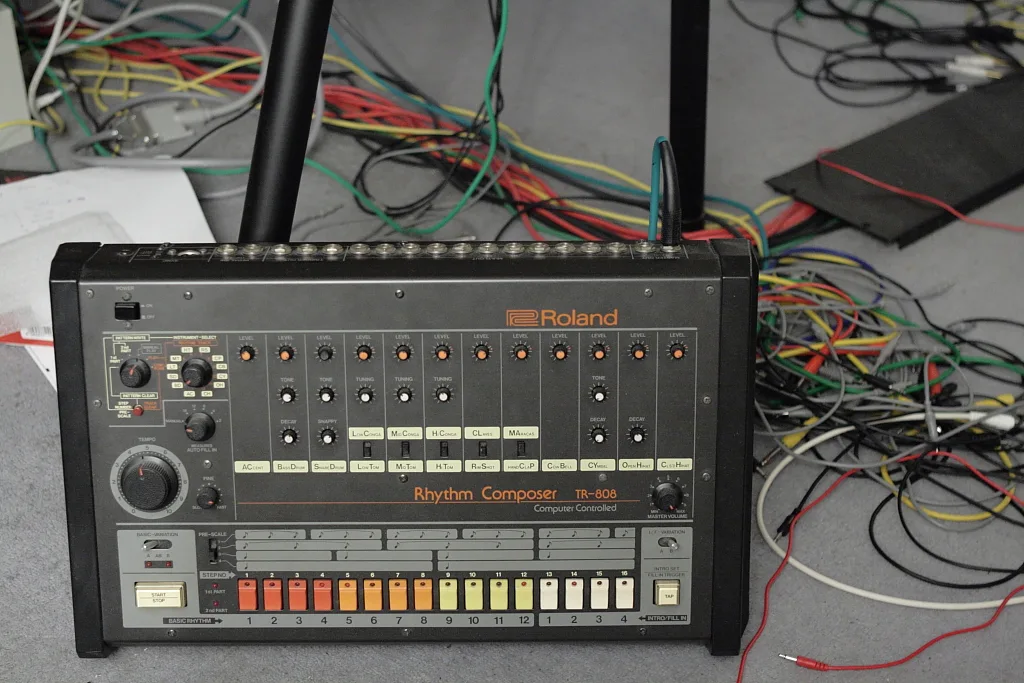
A drum machine is an electronic instrument that plays drum and percussion sounds in a programmed rhythm. Its sequencer decides when a hit plays; its sound engine supplies the drum sound, using synthesis or recorded samples. It can be a hardware box or software in your DAW.
The short answer
A drum machine combines a sound source — analog circuits, digital synthesis or recorded samples — with a sequencer that stores patterns and triggers each sound at the right moment. Drum machines are used to replace a drummer, to produce rhythms a drummer would not play, and as the rhythmic backbone of electronic music.
The term covers hardware boxes with pads and buttons as well as software that does the same job inside a DAW. What makes something a drum machine rather than a sampler or a synthesizer is the pairing: percussion sounds plus a built-in way to sequence them.
Try a one-bar drum pattern
Set a 16-step sequencer to 4/4 at 100 BPM. Each step is a sixteenth note. Add the hits below, then press play: the kick marks the beats, the snare makes the backbeat, and the hats divide the bar into eighth notes.
| Voice | Steps to switch on | What to listen for |
|---|---|---|
| Kick | 1, 5, 9, 13 | Four evenly spaced beats |
| Snare or clap | 5, 13 | The backbeat on beats two and four |
| Closed hi-hat | 1, 3, 5, 7, 9, 11, 13, 15 | Eight notes filling the spaces |
Now remove kicks 5 and 13, lower every second hi-hat, or move one snare a step. The sounds stay the same, but the rhythm and emphasis change. Swap the snare sample and you change the sound while keeping the rhythm. Those are the two jobs of a drum machine.
To practice with audio instead of programming from scratch, preview our free boom bap breaks, 80s pop drum loops and drum and bass samples. These are generated audio files: chop a hit into your sampler or trim a phrase into a loop. Downloading a loop does not give you a sequencer or a plugin.
How does a drum machine work?
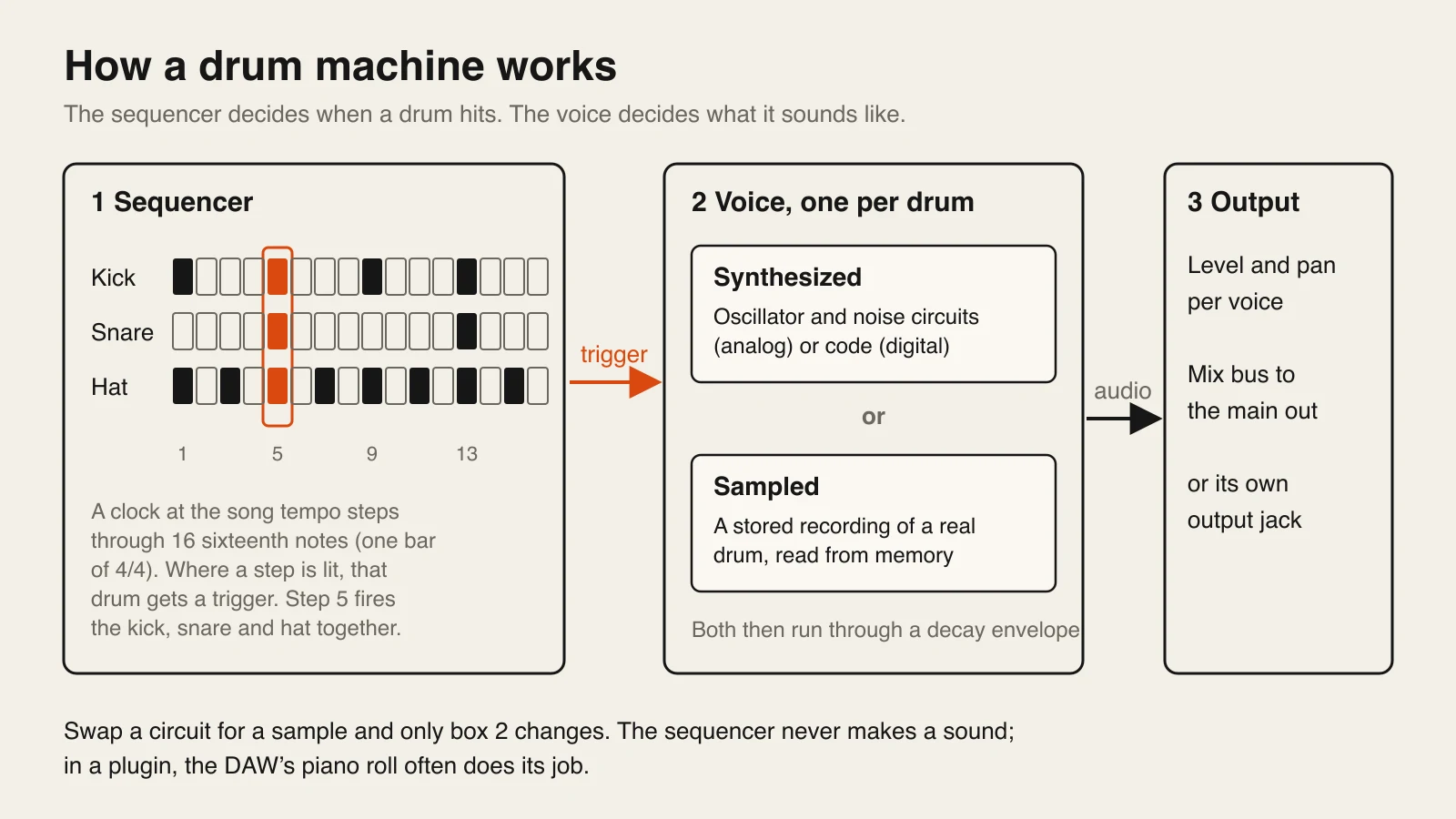
A drum machine works by running a sequencer that sends a trigger to each drum voice on the steps where that drum should play, and each voice turns its trigger into sound. The voices are either synthesized, by analog circuits or digital algorithms, or sampled, by playing back a stored recording of a real drum. The two systems only meet at the trigger: one half decides when, the other decides what it sounds like.
The sequencer: pattern memory and the clock

The sequencer is a clock running at the song tempo, divided into steps. On most machines a bar of 4/4 is sixteen steps of a sixteenth note each. For every drum voice the sequencer stores a row of on/off states — this step fires the kick, that step fires the hi-hat — and stores several such rows as a pattern. Patterns are chained into songs. Roland popularised the sixteen-button layout on the TR-808; it is still the default view in every DAW drum editor.
Later machines added per-step accent, velocity, swing, flams, rolls, probability and parameter locks. All of these are data attached to a step. The sequencer never makes a sound; it sends a trigger.
The voices: trigger to sound to output
A trigger is a short pulse. It arrives at a voice — one channel dedicated to one drum — and the voice turns it into audio. Almost every drum voice, whatever the technology, follows the same path:
- Trigger. A pulse from the sequencer, a pad hit or a MIDI note starts the voice.
- Sound source. An analog oscillator, a noise generator, a digital synthesis algorithm or a stored sample begins to play. A kick is typically a sine or triangle wave whose pitch drops fast; a snare is a tone plus filtered noise; a hi-hat is several square waves or metallic noise through a high-pass filter.
- Envelope. An amplitude envelope, usually with no sustain, shapes the hit — near-instant attack, then a decay set by a knob. Pitch and filter envelopes may run at the same time.
- Output. The voice goes to a level control, optionally to per-voice tuning and tone, then to a mix bus or its own output jack.
On a sample-based machine step two is a playback head reading memory. On an analog machine it is a physical circuit. The trigger, envelope and output stages are near identical across both, which is why a player can move between them without relearning anything. If you want the circuit-level version of how kicks, snares and hats are built from tone and noise, our drum synthesis guide goes through each one.
Types of drum machines
The types below are defined by how the voice half makes sound and by whether a sequencer is included. Most modern units blur at least one line.
| Type | Example | How it makes sound | Sequencer |
|---|---|---|---|
| Analog | Roland TR-808 (1980), Arturia DrumBrute | Discrete transistor or op-amp circuits per voice: bridged-T oscillators, noise generators, filters. No stored audio. | Built in |
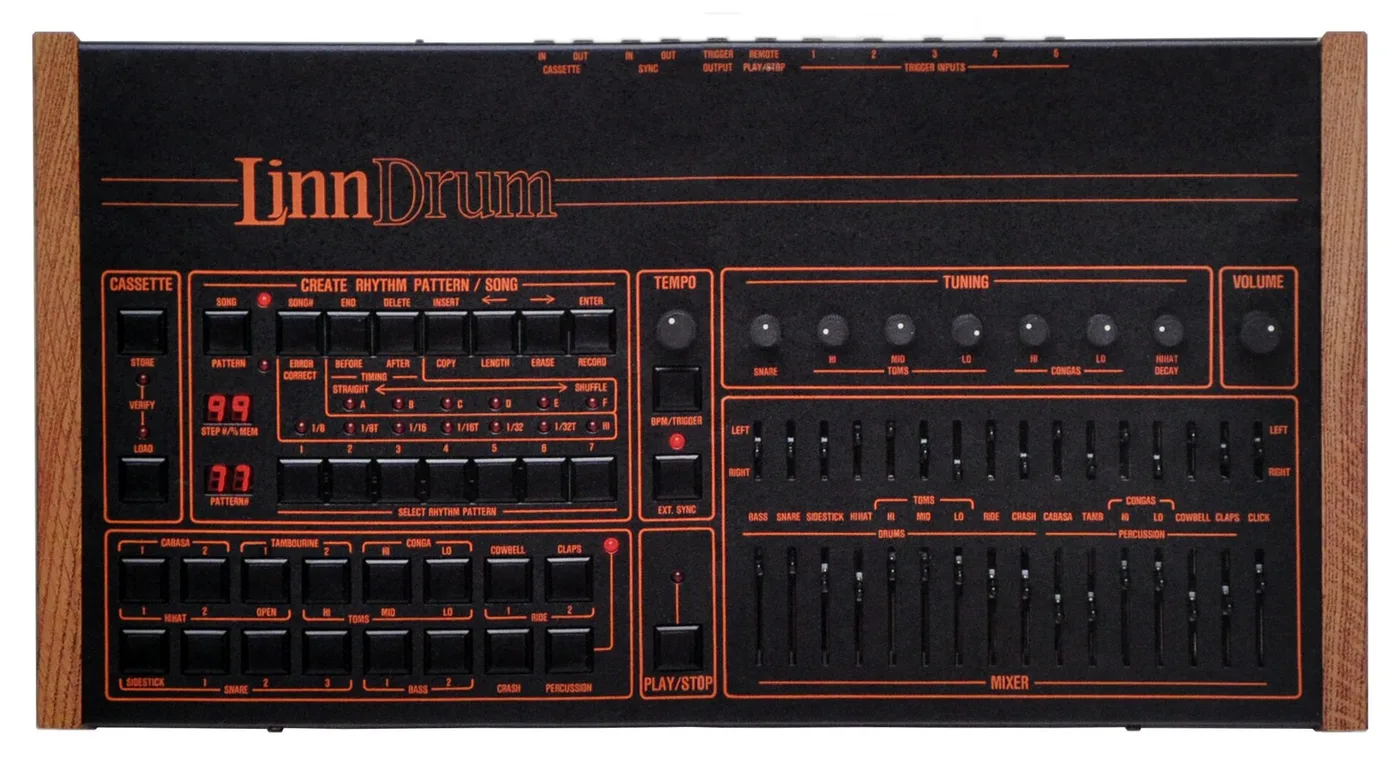
| Digital / sample-based | LinnDrum (1982), Oberheim DMX | Short recordings of real drums stored in ROM, replayed on trigger, usually with tuning and level per voice. | Built in |
| Sampling drum machine | E-mu SP-1200, Akai MPC series | Records its own samples and plays them from pads. The line into a sampler is thin; the pads and sequencer are what make it a drum machine. | Built in |
| Hybrid | Roland TR-8S, Elektron Analog Rytm | Analog or modelled circuits alongside sample playback, often on the same voice. | Built in |
| Groovebox | Elektron Digitakt, Roland MC-series | Samples or synthesis, plus enough sequencing and effects to make a whole track, not only drums. | Built in, multi-track |
| Software / VST | Drum machine plugins and emulations | Code models the circuit or plays samples; runs inside the DAW. | Usually built in, or driven by the DAW |
| DAW-native | Ableton Drum Rack, Logic Drum Machine Designer | Sample players or synth cells mapped to pads; sequenced by the DAW’s own piano roll or step editor. | The DAW is the sequencer |
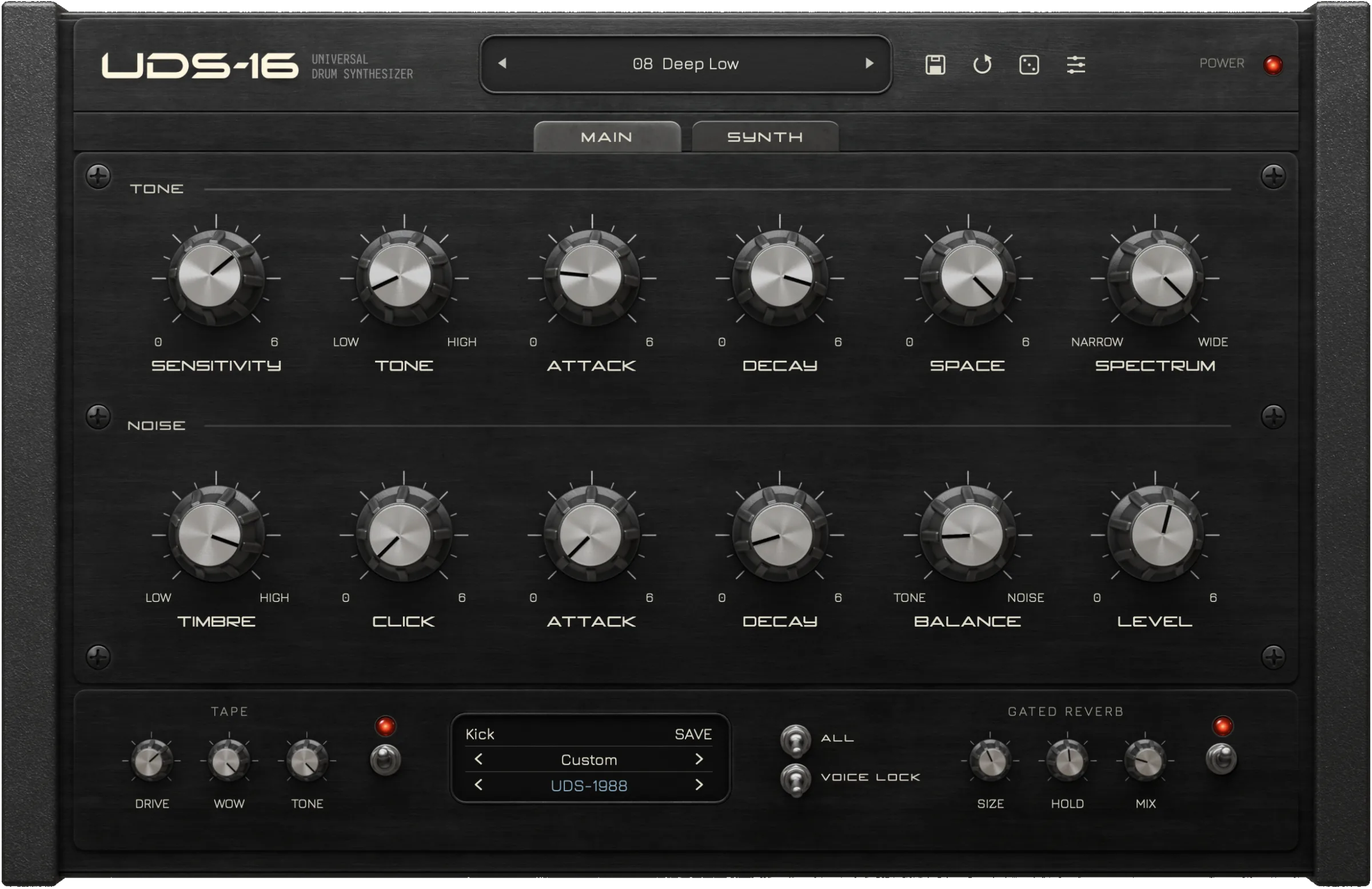
| Drum synthesizer (no sequencer) | Simmons SDS-V, Vermona DRM1, Tapechild UDS-16 | Synthesizes each hit on trigger. Played from pads, MIDI or the DAW; no pattern memory of its own. | None — external |
The last row is where most of the confusion around the word lives. A drum synthesizer with no sequencer is half of a drum machine: still an instrument, but it needs something else to tell it when to play. We cover the full field of analog units in analog drum machines, and the sequencer-less synth category in best drum synth plugins.
A short history
Dates below are the ones that are well documented. The list is a spine, not a complete catalogue; our guide to vintage drum machines covers the classic hardware one machine at a time.
1959 · Wurlitzer Sideman
A vacuum-tube unit sold as an accompaniment for home organs. A rotating mechanical disc selected preset rhythms — waltz, foxtrot, tango. It is usually named as the first commercial drum machine.
1967 · Ace Tone Rhythm Ace
Ikutaro Kakehashi’s preset rhythm box, transistorised and compact. Its analog voice circuits were the direct ancestors of what Kakehashi would later build at Roland.
1978 · Roland CR-78
The first Roland rhythm unit that let the player store their own patterns instead of choosing from presets. Its sounds turn up on late-1970s and early-1980s pop records.
1980 · Linn LM-1
Roger Linn’s machine was the first commercial drum machine built around digital samples of real drums. Expensive, and heard on a large share of early-1980s pop.
1980 · Roland TR-808
Analog, programmable, and a commercial disappointment at the time because its synthesized drums did not sound real. That was later the point: hip-hop, electro, house and Miami bass were built on it.
1981–82 · Oberheim DMX and LinnDrum
Sample-based machines that put the LM-1 idea within reach of more studios. The DMX became a hip-hop staple; the LinnDrum is all over 1980s pop and rock.
1983 · Roland TR-909
Analog kick, snare and toms with sampled hi-hats and cymbals, and MIDI. The kick and open hat define house and techno.
1987–88 · E-mu SP-1200 and Akai MPC60
The sampling era. Both let producers chop their own drum breaks and sequence them from pads. The MPC line, again designed with Roger Linn, became the standard hip-hop production tool.
1990s onward · Software
Drum machines moved into computers: trackers, then DAWs with built-in drum sequencers, then plugin emulations of the classic hardware. In the 2010s Roland, Elektron, Arturia and others brought hardware back, now often with USB and DAW integration.

What drum machines are used for today
The original sales pitch — a drummer for people without one — is still true and the least interesting use. In practice the boxes do four jobs.
- Genre foundations. Hip-hop, house, techno, electro, drum and bass, synth-pop and most of their descendants are drum-machine music by definition. The sounds are the genre; a live kit would be a stylistic choice, not the default.
- Live performance. A hardware sequencer is a performable instrument. Muting voices, changing patterns and turning knobs on the fly is a live set for many electronic acts, and a hardware box needs no laptop on stage.
- Songwriting and sketching. A loop running while you write is faster than programming every hit, and cheaper than booking a drummer to find out whether a song works.
- Complementing a drummer. Bands layer an 808 kick under a real kick, run electronic percussion alongside an acoustic kit, or trigger drum voices from pads on the drummer’s rack.
The one job they rarely do now is the one the Sideman was sold for: standing in for a jazz or ballroom drummer. Edited, humanised sampled drums in a DAW do that better.
Drum machine vs sampler vs drum synth
The three overlap and get sold in the same shops, so the distinction is worth stating plainly.
| Drum machine | Sampler | Drum synth | |
|---|---|---|---|
| Sound source | Fixed set of drum voices (circuit or samples) | Any audio you load or record | Synthesized on each trigger, no audio stored |
| Sequencer | Built in | Often, but not the point | Usually none |
| Sounds available | The ones in the box, tunable | Unlimited, whatever you sample | A wide range within one circuit’s character |
| Best for | Patterns fast; a known sound | Chopping breaks; using real recordings | Sound design; hits that never repeat exactly |
A sampler is more general: it can be a drum machine if you load drums into it, and most modern ones have pads and a step sequencer for that reason. A drum synth is more specific: it does one thing, generates percussion, and hands timing to whatever is driving it. If you are choosing software, we keep two lists — best drum machine VST plugins for the full sequencer-plus-voices instruments, and best drum synth plugins for the voice-only ones.
Do drum machines sound like real drums?
Sample-based ones can, up to a point. A sampled kit plays a real recording, so a single hit is a real drum by definition. What gives it away is repetition: the same recording at the same level, hit after hit. Modern libraries fight this with round-robin (several recordings of each hit, cycled) and many velocity layers, and the best are hard to tell from a recorded kit in a mix.
Analog and synthesized drum machines do not sound like real drums, and that is why they survived. The 808’s kick is a decaying sine wave; no acoustic drum makes that sound. Its failure to imitate a kit made it a new instrument rather than a substitute. If you want realism, buy a sampled kit and program it with variations in timing and velocity. If you want an 808, nothing acoustic will do.
Software drum machines and plugins
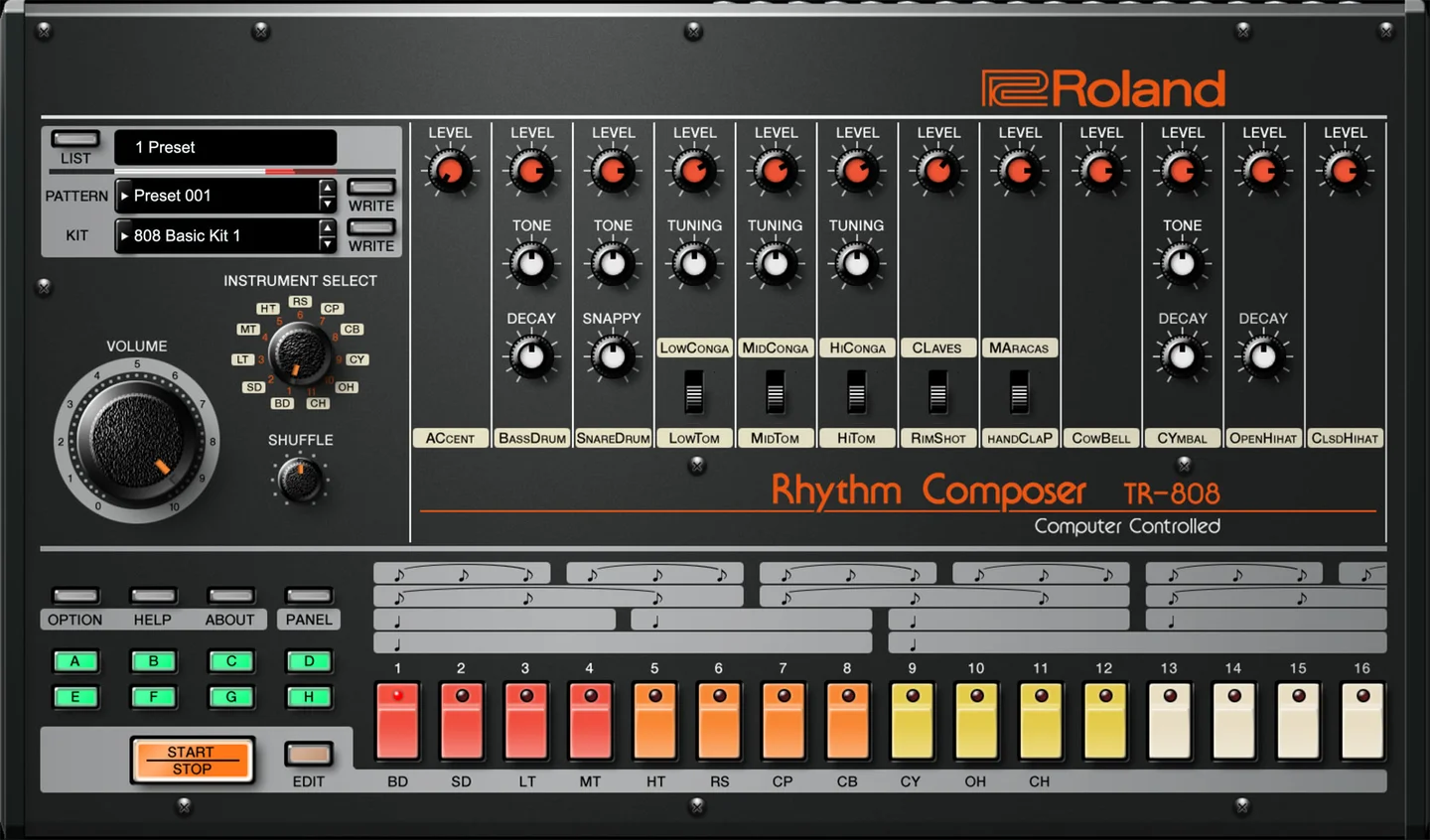
Most drum machines in use today are software. The categories mirror the hardware: emulations of specific classic units, sample-based kits with a built-in sequencer, and drum synthesizers played from the DAW. Every major DAW also ships a native drum instrument — Ableton’s Drum Rack, Logic’s Drum Machine Designer, FL Studio’s channel rack — which is a sample player with the DAW itself as the sequencer.
The practical difference from hardware is that the sequencer half is often the DAW’s: a plugin may carry its own step sequencer, but most people program the pattern in the piano roll and use the plugin for its voices. Our best drum machine VST roundup covers the current options by type and price.
Where Tapechild UDS-16 fits
Our product: This section is about our own instrument. Skip it if you are here for the definition.
UDS-16 is the voice half only. It is a 16-voice drum synthesizer plugin (VST3, AU, standalone) that computes every hit in real time — there are no samples inside — using four models: two built from the circuit of the Soviet Lel UDS percussion synthesizer, one from Formanta Rockton schematics, and Tapechild’s own UDS-16 engine. It has no step sequencer. Timing comes from the DAW, a MIDI controller or pads, which puts it in the last row of the table above with the SDS-V and the DRM1 rather than alongside an 808. The Soviet drum machines it descends from have their own article.
Free drum machine samples
If you want drum-machine sounds without buying anything, our free sample packs are royalty-free WAV files, sorted by genre. For the classic machine-driven era, the 80s and 90s pop drum loops pack is the closest match to the LinnDrum and gated-snare records discussed above; there are also hip-hop, boom bap and drum and bass packs. Drop them into any DAW drum rack and you have a sample-based drum machine.
Frequently asked questions
Are drum machines still used?
Yes, heavily. Hip-hop, house, techno, pop and most electronic genres are built on drum machine sounds, from hardware or from software that models it. Hardware revived in the 2010s with Roland’s TR-8 line, Elektron and Arturia, and every DAW ships a drum machine of its own. What changed is that the sequencer half is now often the DAW rather than the box.
What is the point of a drum machine?
Three things. It gives a producer drums without a drummer, a kit or a recording space. It produces sounds and patterns no acoustic kit can — the 808 kick, a perfectly quantised sixteenth-note hat — which became genres in themselves. And it is a fast way to sketch a rhythm while writing, or to perform one live without a laptop.
Can I use my iPad as a drum machine?
Yes. Several DAWs and dedicated drum machine apps run on iPad, including software versions of classic Roland and Korg units, and the touchscreen works well as a sixteen-step grid or a set of pads. Over USB or Bluetooth MIDI an iPad can also sequence an external hardware drum synth.
Is there a drum machine that sounds like real drums?
Sample-based drum machines and plugins play recordings of real drums, so individual hits are real. Realism across a whole performance depends on variation: multiple recordings per hit (round-robin), many velocity layers and small timing changes. Well-programmed sampled kits pass as recorded drums in a mix. Analog and synthesized drum machines are not trying to sound real; they are instruments in their own right.
Who invented the drum machine?
No single person. The Wurlitzer Sideman of 1959 is usually named as the first commercial drum machine. Ikutaro Kakehashi built the transistorised Rhythm Ace at Ace Tone in 1967 and later the Roland CR-78, TR-808 and TR-909. Roger Linn designed the first sample-based drum machine, the LM-1, in 1980, and later co-designed the Akai MPC.
What is a beat machine?
An informal name for the same thing. “Beat machine” or “beat maker” usually means a drum machine or a pad-based sampler such as an MPC, and sometimes a beat-making app on a phone or tablet. There is no technical difference: if it stores rhythm patterns and plays percussion sounds on each step, it is a drum machine.
Royalty-free WAV
Free sample packs
Royalty-free WAV, play every sample before you download.