
Vintage Drum Machines: Eras, Sounds and What to Buy Today
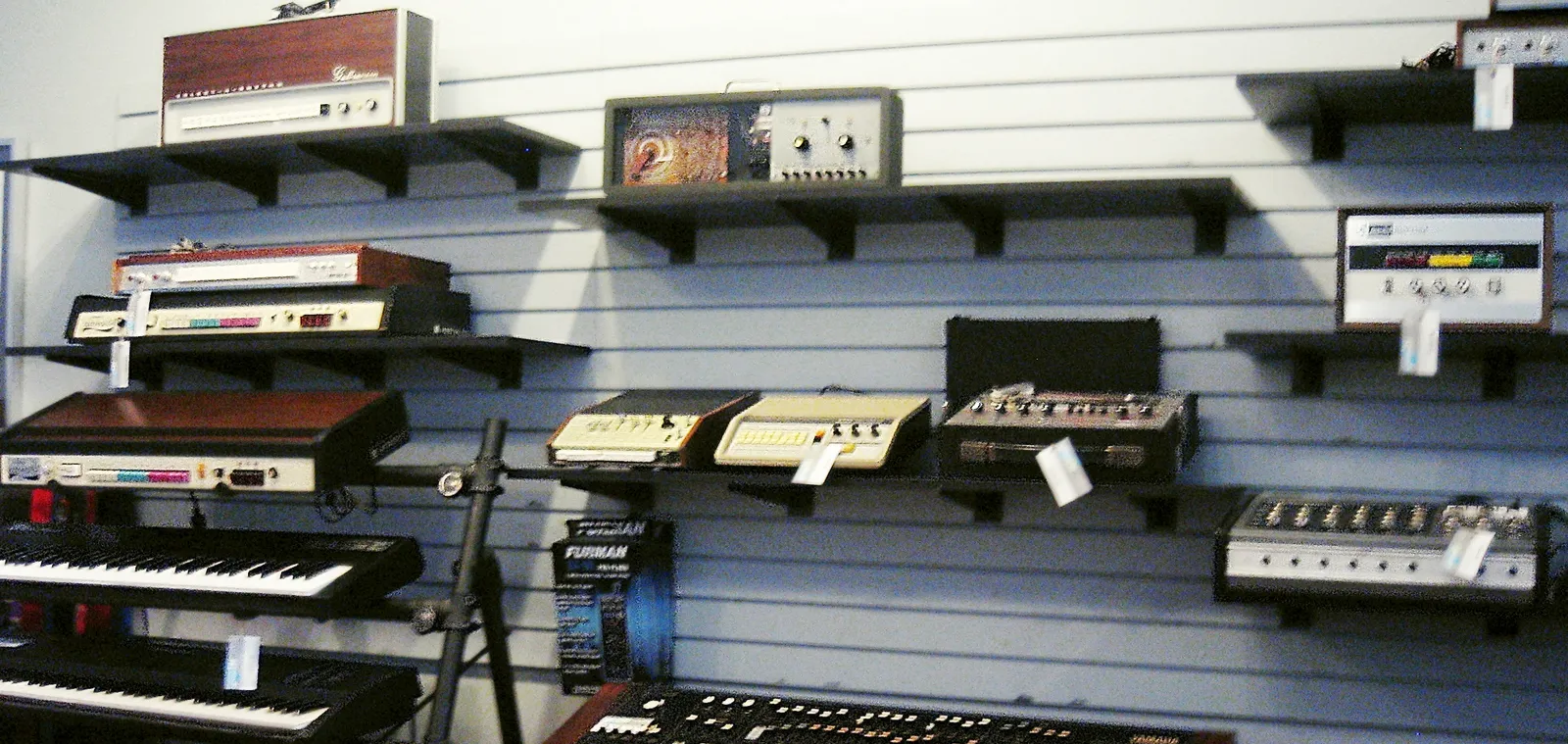
Producers chase vintage drum machines for their sound, not their patterns, and that sound is a direct print of the technology in each box. This guide sorts the classic machines by how they make a drum hit, explains what each technology does to the audio, then covers what fails when you buy one and how to get the sound without the hardware.
What is a vintage drum machine?
A vintage drum machine is a rhythm machine built before the 1990s, from the tube-powered Wurlitzer Sideman of 1959 to 12-bit sampler-sequencers such as the E-mu SP-1200 (1987) and Akai MPC60 (1988). Their appeal is that the technology fixes the sound: analog circuits that never fire quite the same way twice, or short digital samples stored at a resolution low enough to add grit no modern converter would.
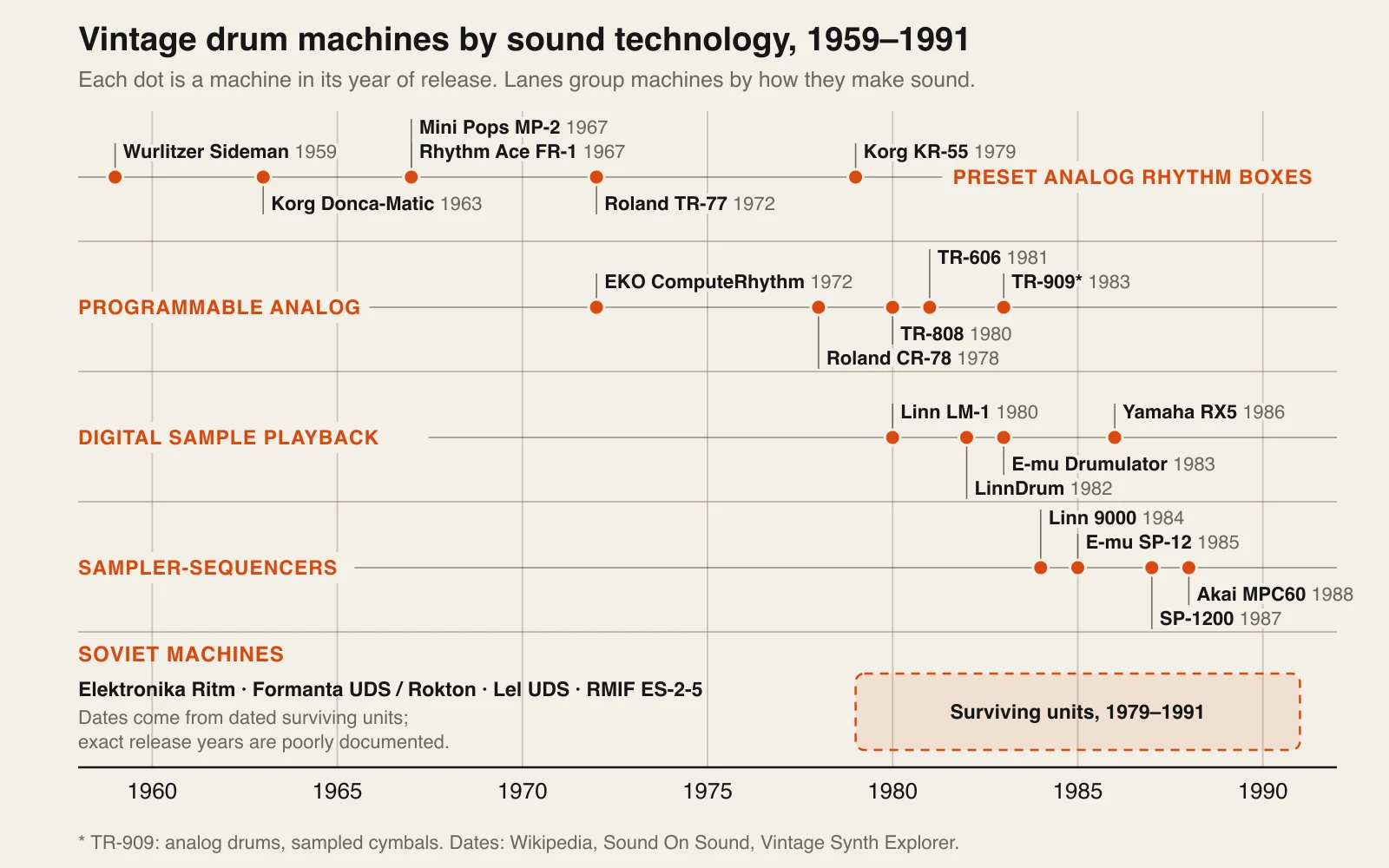
“Retro” and “classic” get used for the same boxes. The useful way to sort them is not age but sound source, and that is how the chart below and the rest of this page are organized. For the basics of how any drum machine works, sequencer plus voices, start with what a drum machine is; this page picks up from there, family by family and machine by machine.
The five families of vintage drum machines
Vintage drum machines fall into five families by sound source: preset analog rhythm boxes, programmable analog machines, early digital sample players, sampler-sequencers, and machines built outside the Western market, most of them Soviet. The families overlap in time. What separates them is what happens between the trigger and the output jack.
Preset analog rhythm boxes (1959 to the late 1970s)

The first family was sold to organists, not producers. Each box held a fixed menu of dance rhythms — waltz, bossa nova, rock — and the player chose one with a button and set the tempo with a knob. The voices were a handful of simple circuits: noise bursts for brushes and maracas, a damped oscillator for the bass drum, a ringing filter for claves and wood blocks. Wurlitzer’s Sideman fired vacuum-tube voices from a motor-driven disc of contacts; Korg’s Donca-Matic (1963), Ace Tone’s Rhythm Ace FR-1 (1967) and Korg’s Mini Pops series moved to transistors and shrank until they sat on top of the organ.
Their value now is their thinness. A preset-box kick has little low end and the hats are closer to hiss than to a cymbal, so a pattern sits under a mix without competing with it. On some of them, the Rhythm Ace FR-1 and the Mini Pops among them, pressing two rhythm buttons at once combines the patterns into grooves no single preset contains.
Programmable analog (1972 to 1983)
Programmable analog machines kept the circuits and let the player write the pattern. The EKO ComputeRhythm of 1972 used a push-button matrix; Roland’s CR-78 (1978) was the first to store user patterns with a microprocessor; the TR-808 (1980) put a sixteen-step grid on the front panel. The voices also grew knobs for tuning, decay and tone, so the sound became something to shape rather than just select.
The result is full-range analog: kicks that are a tuned, decaying resonance, snares built from oscillators plus noise, hats from clusters of square waves. The TR-909 (1983) closes the family, with analog drums and sampled cymbals. Our guide to analog drum machines takes the voice circuits apart one at a time.
Early digital sample playback (1980 to the late 1980s)
Sample-playback machines replaced circuits with short recordings of real drums stored on ROM chips. The Linn LM-1 (1980) played 8-bit samples at 28 kHz; the Oberheim DMX, the LinnDrum and E-mu’s Drumulator followed within three years, and the entry price fell from $4,995 for the LM-1 to $995 for the Drumulator. Memory was expensive, so samples were short and coarse, and both limits are audible: a noise floor under every decay, cymbals cut short, and an attack that sounds already compressed.
Sampler-sequencers (1984 onward)
Sampler-sequencers let the owner record their own sounds and play them from pads. The Linn 9000 (1984) offered sampling as an option; the E-mu SP-12 (1985) and SP-1200 (1987) sampled at 12 bits and 26.04 kHz; the Akai MPC60 (1988), designed by Roger Linn, sampled at 12 bits and 40 kHz. Hip-hop producers used them to chop breaks from records, and the limits — seconds of memory, a low sample rate, crude pitch-shifting — became the texture of boom bap.
Soviet and other non-Western machines
Machines built in the USSR used the same technologies with different parts and far smaller runs. Collector listings describe the Elektronika Ritm as a preset analog box with slider-controlled voices. The Formanta UDS, later sold as the Rokton and made at the Kachkanar plant that also built the Polivoks synthesizer, paired seven analog drum channels with sixteen built-in rhythms. The Lel UDS was a two-channel percussion synthesizer played from pads. Release years for all of them are poorly documented, which is why the chart shows a range drawn from dated surviving units instead of dots.
What the technology does to the sound
Analog voices vary from hit to hit and unit to unit; digital voices repeat exactly but carry the limits of their memory. That is most of the audible difference between the families, and it is why two machines playing an identical pattern sound nothing alike.
Analog: tolerance, temperature and age
An analog voice is rebuilt by the circuit on every trigger. Component tolerances mean no two units of one model are identical, and temperature moves tuning and decay slightly as a machine warms up. Age adds its own layer: capacitors dry out over decades, which shifts filters and power rails. So a used analog machine can sound different from the one on the record you love, because it was recalibrated, or because it was not.
Digital: bit depth, sample rate and grit
A digital voice replays the same numbers every time, so its character is set at the factory by two limits. Bit depth is how finely each sample’s level is measured, and each bit is worth about 6 dB of dynamic range: an 8-bit sample has roughly 48 dB between full level and its noise floor, against 96 dB for 16-bit. You hear it in the tail of a hit, where a decaying snare turns to grainy fizz as it nears the floor. Sample rate caps the highest frequency a sample can hold at half the rate, so the LM-1’s 28 kHz tops out at 14 kHz and the SP-1200’s 26.04 kHz at about 13 kHz. Cymbals lose their air and everything sounds darker and closer.
Designers worked around the limits in ways that are now part of the sound. The Oberheim DMX stored 8-bit samples with μ-law companding, which spends its steps unevenly and gets close to 12-bit quality from 8-bit memory. The SP-1200 changes pitch by skipping or repeating samples rather than interpolating between them, which adds aliasing when a sound is tuned up; that is a large part of why its pitched drums sound the way they do.
| Machine | Bit depth | Sample rate | Dynamic range | Top frequency |
|---|---|---|---|---|
| Roland TR-909 cymbals | 6-bit | — | about 36 dB | — |
| Linn LM-1 | 8-bit | 28 kHz | about 48 dB | 14 kHz |
| E-mu Drumulator | 8-bit | — | about 48 dB | — |
| Oberheim DMX | 8-bit, μ-law companded | — | close to 12-bit, about 72 dB | — |
| Roland TR-707 | 8-bit (cymbals 6-bit) | — | about 48 dB | — |
| E-mu SP-12 and SP-1200 | 12-bit | 26.04 kHz | about 72 dB | 13 kHz |
| Yamaha RX5 | 12-bit | — | about 72 dB | — |
| Akai MPC60 | 12-bit | 40 kHz | about 72 dB | 20 kHz |
| Alesis HR-16 | 16-bit | — | about 96 dB | — |
Read down the table and the machines get cleaner as the decade goes on. That is why a 16-bit HR-16 sounds closer to a modern sample pack than a 1980 LM-1 does, and why producers after grit still reach for the 8- and 12-bit boxes.
The classic machines, one by one
Short entries on the machines that matter most to producers and collectors now. Where a machine has its own full guide on this site, the entry links to it and stays brief.
Wurlitzer Sideman (1959)
Sold as an accompaniment unit for home organs, the Sideman turned a disc of electrical contacts with a motor, each contact firing one of its vacuum-tube drum voices, and a slider sped the disc up or slowed it down. Surviving units sit in collections such as the Swiss Museum for Electronic Music Instruments and Canada’s National Music Centre. It matters as the template: a box that keeps time by itself.
Korg Mini Pops (from 1967)
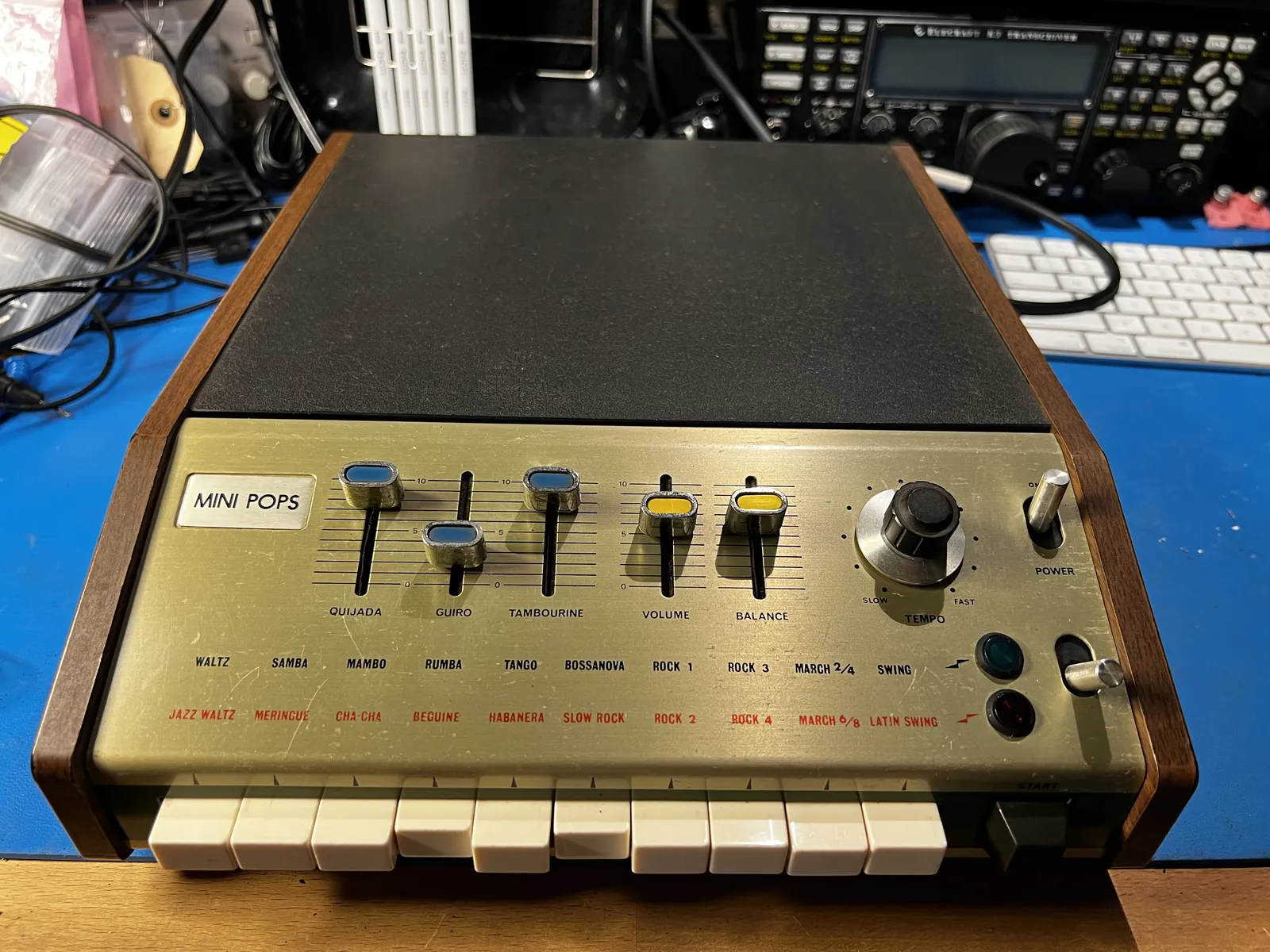

Korg’s Mini Pops boxes date from the late 1960s — Sound On Sound gives 1967 for the MP-2 — and some were sold in the US under the Univox name. The Mini Pops 7 is the famous one: 20 presets, a few voice sliders, and a thin, clicky kit that Jean-Michel Jarre layered by taping two rhythm keys down on Oxygène (1976). Aphex Twin later named a track “minipops 67 [120.2]” after it.
Maestro Rhythm King (early 1970s)
Sly Stone’s drum machine on There’s a Riot Goin’ On (1971) was a Maestro Rhythm King MRK-2, a preset box that cannot be programmed. Its dry, boxy pulse under “Family Affair” gave Sly & the Family Stone what Wikipedia records as the first number-one pop single to use a drum machine. It is the reference for anyone who wants a preset box to sound like soul rather than lounge music.
Korg KR-55 (1979)
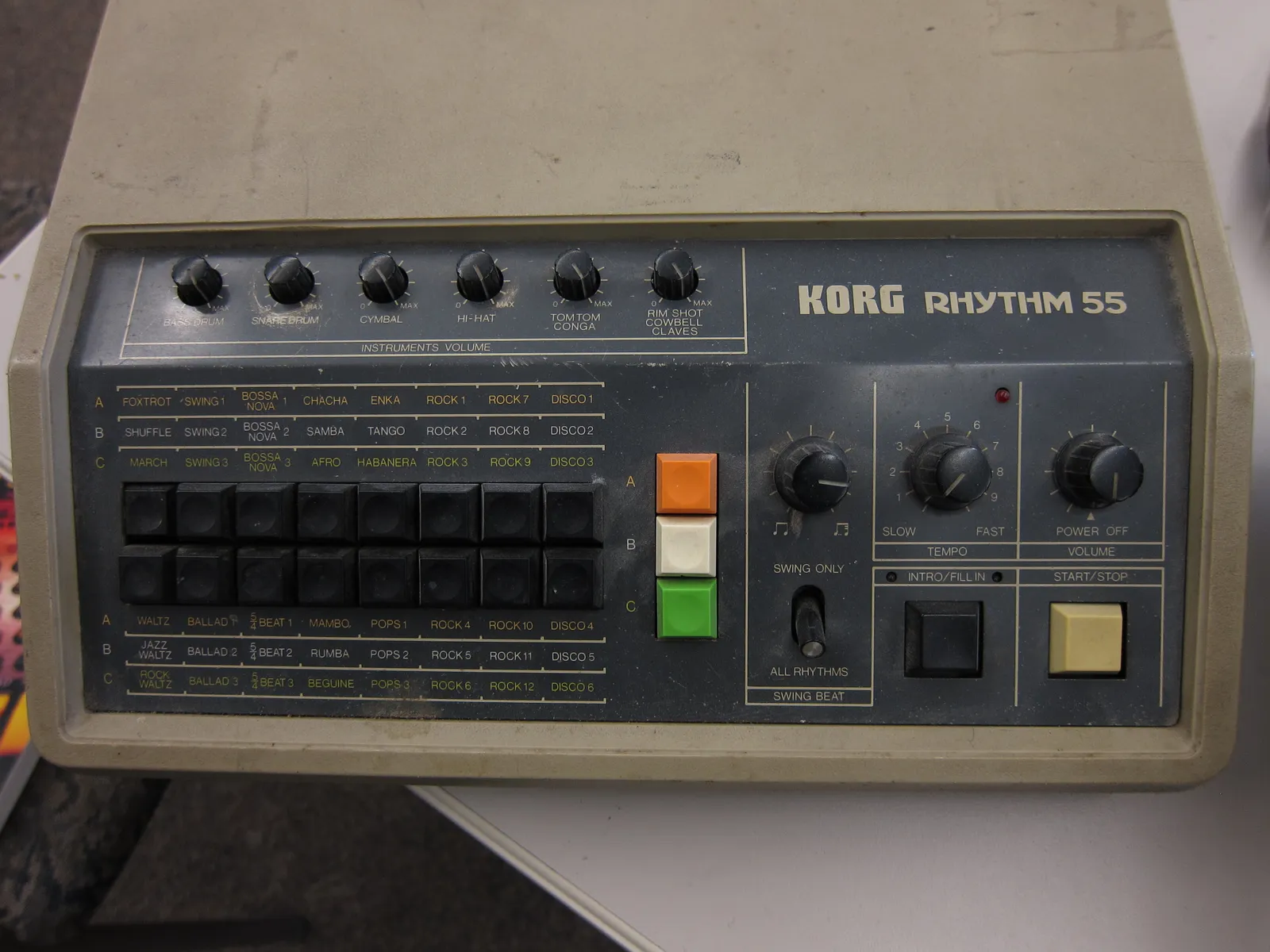
The KR-55 replaced the Mini Pops line, and Sound On Sound credits it with analog voices far more realistic than the thumps and hisses of Korg’s earlier boxes. It still cannot store a pattern: you get 48 presets, intro and fill-in buttons, and a volume knob per instrument group. That makes it one of the cheaper ways to own a working 1970s analog kit today; an improved KR-55B followed in 1982.
Roland CR-78 (1978)
The first drum machine whose owner could write, save and replay their own patterns. Its soft kick, woody percussion and ticking hats are on Phil Collins’ “In the Air Tonight” and Blondie’s “Heart of Glass”, and it now exists as a Behringer clone and a Roland plugin. Full guide: Roland CR-78.
Roland TR-808 (1980)
Fully analog, a commercial failure at launch with fewer than 12,000 sold, and later used on more hit records than any other drum machine. Its long, tunable kick turned into trap’s bass instrument. Full guides: what an 808 is and 808 vs 909.
Roland TR-606 Drumatix (1981)
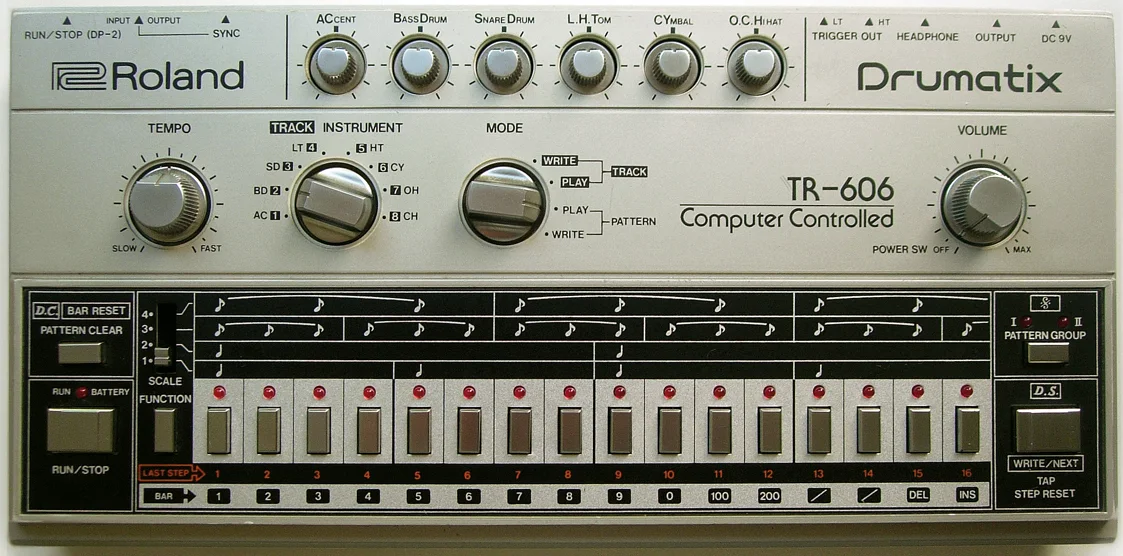

Built as the partner to the TB-303 bass synthesizer, with matching size and DIN sync, the 606 has seven analog voices, 32 pattern memories and a level knob per voice. There are no tuning or decay controls, so the sound is fixed: a tight kick, a snappy snare, thin sizzling hats. That smallness is why it turns up on records by Big Black, Autechre and Aphex Twin, where it sits under a mix instead of filling it. Roland sells the TR-06 Boutique (2020) and a Roland Cloud plugin; Behringer’s RD-6 (2020) is an analog clone.
Simmons SDS-V (1981)
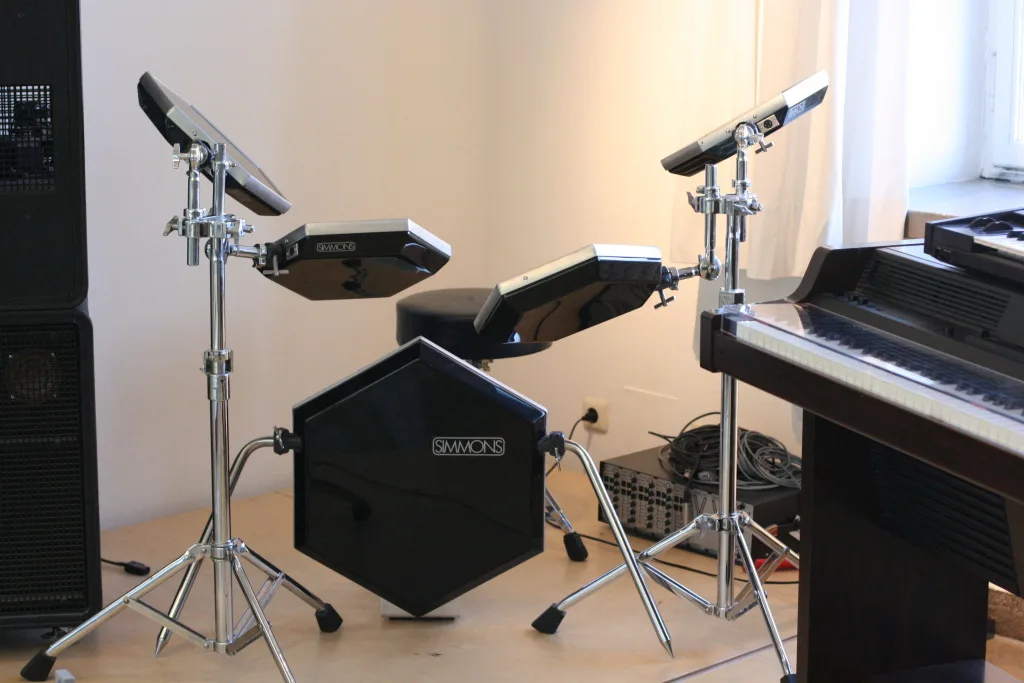

Not a drum machine at all: a rack of analog drum-synth modules played from hexagonal pads, with no sequencer. It belongs on this list because its synthetic toms defined the early-1980s electronic kit, first on Landscape’s album and Spandau Ballet’s “Chant No. 1”, both recorded with it by Richard James Burgess. Later Simmons kits moved to samples, starting with the SDS7 in 1984.
Linn LM-1 (1980) and LinnDrum (1982)
Roger Linn’s LM-1 was the first commercial drum machine built on digital samples: twelve 8-bit sounds at 28 kHz, each with its own tuning and output, at $4,995. About 525 were made, and Prince used his across 1999 and Purple Rain. The LinnDrum cut the price to $2,995 and added a crash cymbal. Full guide: Linn drum machines; for software versions, see LinnDrum VST.
Oberheim DMX (1980)
Introduced at $2,895 (some histories date it to 1981), with 24 sounds derived from 11 companded 8-bit samples and eight separate outputs. Its heavy kick and snare made it a staple of early hip-hop, Run-DMC included. Full guide: Oberheim DMX.
Roland TR-909 (1983)
Analog kick, snare, toms, rim shot and clap with 6-bit sampled hats and cymbals, plus MIDI, at $1,195. Roland built 10,000 before stopping after a year, and house and techno were built on the ones that reached the used market. Full guide: Roland TR-909.
E-mu Drumulator (1983)
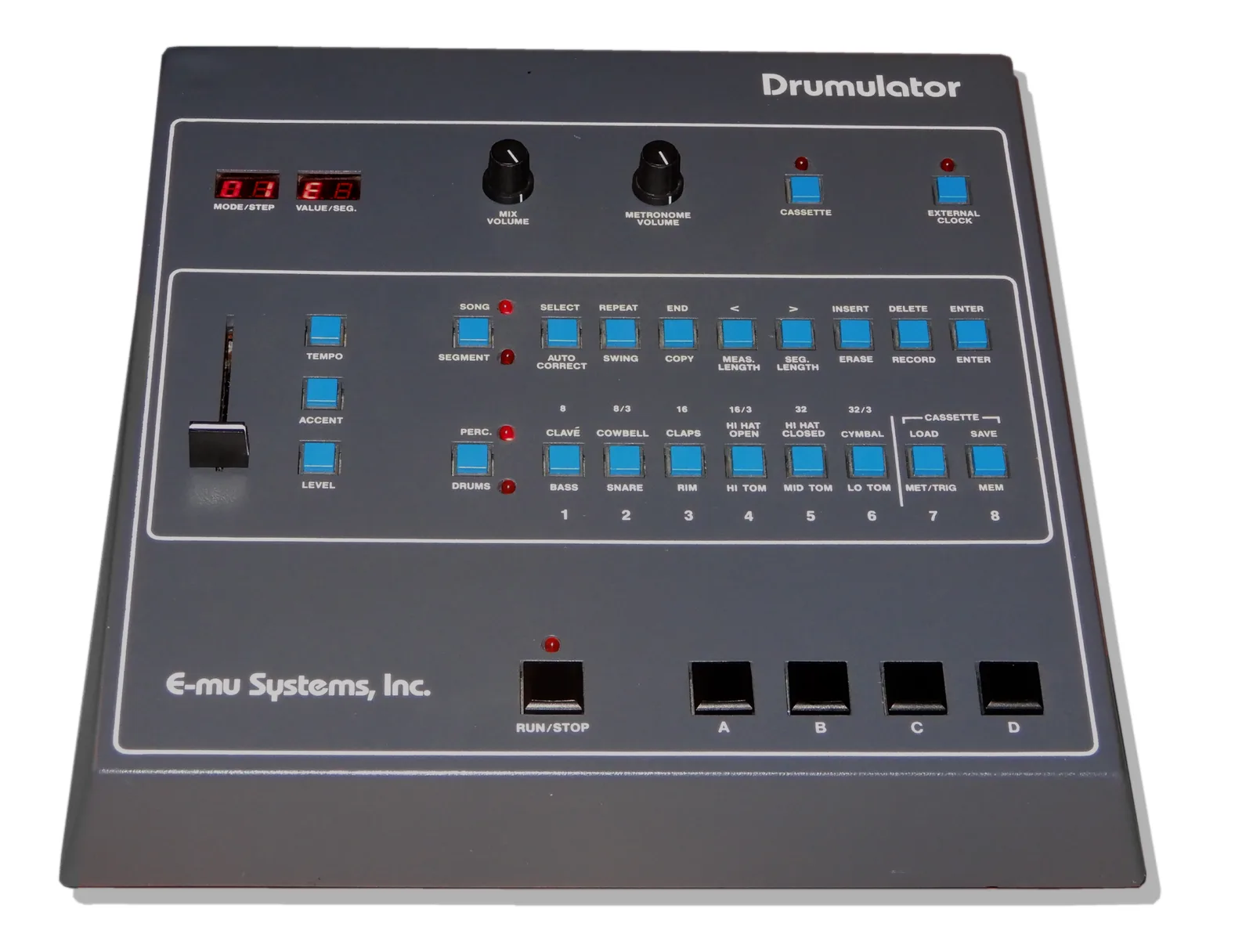

E-mu’s answer to the LinnDrum at a third of its price: $995 for twelve 8-bit sampled sounds, and more than 10,000 sold in two years. The low price put sampled drums on synth-pop and Italo disco records that could never have paid for a Linn; Depeche Mode, Cocteau Twins and Tears for Fears all used one. The sounds live on swappable EPROM chips, and alternative sets were sold from 1984, so check which chips a used unit carries.
Roland TR-707 and TR-727 (1984–85)
Roland’s first drum machine built entirely on samples: 8-bit sounds with 6-bit cymbals, a resolution low enough to squash the dynamics and stretch the sustain of every hit. It was a staple of early house and acid house, and the TR-727 swapped the kit for Latin percussion. Sources give 1984 or 1985 for the 707; both are now Roland Cloud plugins.
E-mu SP-12 (1985) and SP-1200 (1987)
Both sample at 12 bits and 26.04 kHz; the SP-1200 has ten seconds of memory and sold for $2,995. The low rate, drop-sample pitching and analog filters give it the dark, gritty sound of boom bap. Rossum Electro-Music reissued it in 2021 with 20 seconds of memory and SD storage. Full guide: E-mu SP-1200.
Alesis HR-16 (1987)
Forty-nine 16-bit sampled sounds at a low price, which makes it the cleanest-sounding machine on this list and one of the cheapest to buy used. Vintage Synth Explorer lists Orbital, Autechre and The Grid among its users. Reach for it when you want a late-1980s kit without the low-bit grit.
Akai MPC60 (1988)
Designed by Roger Linn for Akai and priced at $5,000, it sampled at 12 bits and 40 kHz — a wider bandwidth than the SP-1200 — with 13 seconds of memory as standard. It became the default hip-hop production tool, and Akai still makes MPCs, so the workflow survives even where the original sound does not.
Elektronika Ritm, Formanta UDS and Lel UDS

The Soviet machines are rare outside former Soviet countries and each surviving unit differs, so treat any single recording as one example rather than the sound of the model. Kino’s 1982 debut, 45, was made with a drum machine because the band had no drummer. The circuits, and how the Formanta and Lel designs differ from a Roland, are in our guide to Soviet drum machines.
Our product: Tapechild’s UDS-16 plugin takes two of its four models from the Lel UDS channel and one from the Formanta Rokton. It is a software drum synthesizer with no samples and no step sequencer, not a reissue of either machine.
Classic drum machines at a glance
The table lists 26 vintage drum machines with maker, year, sound source, the music they are known for, and whether you can buy the sound new today.
| Machine | Maker | Year | Sound source | Known for | Status today |
|---|---|---|---|---|---|
| Sideman | Wurlitzer | 1959 | Vacuum-tube voices fired by a contact disc | Organ accompaniment | Originals only, mostly in collections |
| Donca-Matic DA-20 | Keio-Giken (Korg) | 1963 | Vacuum-tube voices, mechanical pattern wheel | Korg’s first product | Originals only |
| Rhythm Ace FR-1 | Ace Tone | 1967 | Transistor voices, 16 presets | Organ accompaniment; built into Hammond organs | Originals only |
| Mini Pops 7 | Korg | Series from 1967 | Transistor voices, 20 presets | Jean-Michel Jarre, Oxygène | Originals only |
| Rhythm King MRK-2 | Maestro | Early 1970s | Transistor voices, 18 presets | Sly & the Family Stone | Originals only |
| ComputeRhythm | EKO | 1972 | Analog voices, programmable button matrix | One of the first programmable machines | Originals only |
| KR-55 | Korg | 1979 | Analog voices, 48 presets | Replaced the Mini Pops line | Originals only |
| CR-78 | Roland | 1978 | Analog, programmable | New wave and pop | Behringer RD-78; Roland CR-78 plugin |
| TR-808 | Roland | 1980 | Analog | Hip-hop, electro, trap | Roland TR-08, TR-8S, TR-1000; Behringer RD-8; Roland Cloud |
| LM-1 | Linn Electronics | 1980 | 8-bit samples, 28 kHz | Early-1980s pop, Prince | Originals only (about 525 made) |
| DMX | Oberheim | 1980–81 | 8-bit companded samples | Early hip-hop, synth-pop | Originals only |
| SDS-V | Simmons | 1981 | Analog drum synth, pads, no sequencer | New romantic, synth-pop | Originals only |
| TR-606 | Roland | 1981 | Analog | Acid, industrial, IDM | Roland TR-06; Behringer RD-6; Roland Cloud |
| LinnDrum | Linn Electronics | 1982 | Samples | 1980s pop and rock | Behringer LmDrum; plugins |
| TR-909 | Roland | 1983 | Analog drums, 6-bit sampled cymbals | House, techno | Roland TR-09, TR-8S, TR-1000; Behringer RD-9; Roland Cloud |
| Drumulator | E-mu | 1983 | 8-bit samples | Synth-pop, Italo disco | Originals only |
| Linn 9000 | Linn Electronics | 1984 | Samples, optional sampling | 1980s studio production | Originals; Forat F9000 reissue |
| TR-707 | Roland | 1984–85 | 8-bit samples, 6-bit cymbals | Early house, acid house | Roland Cloud |
| SP-12 | E-mu | 1985 | 12-bit sampling, 26.04 kHz | Early hip-hop | Originals only |
| RX5 | Yamaha | 1986 | 12-bit samples | Yamaha’s flagship of 1986 | Originals only |
| SP-1200 | E-mu | 1987 | 12-bit sampling, 26.04 kHz | Boom bap hip-hop | Rossum Electro-Music reissue (2021) |
| HR-16 | Alesis | 1987 | 16-bit samples | Techno and electronica | Originals only |
| MPC60 | Akai, designed by Roger Linn | 1988 | 12-bit sampling, 40 kHz | Hip-hop production | The MPC line is still made |
| Elektronika Ritm | Soviet state industry | Units dated from 1979 | Analog voices, presets | Soviet rhythm box | Originals only |
| Formanta UDS / Rokton | Formanta, Kachkanar | 1978 or 1986 (sources differ) | Seven analog channels, 16 rhythms | Soviet stage kit | Originals only |
| Lel UDS | Lel | Late 1980s | Two-channel analog percussion synth | Soviet drum synth | Originals only |
Buying a vintage drum machine today
Buying a vintage drum machine means buying electronics that are roughly 35 to 70 years old, and the parts that fail are predictable: the memory battery, the power supply, and everything your fingers touch. None of these is a reason not to buy; they are the things to price in.
- Backup batteries. Programmable machines keep their patterns alive with an internal battery. An old one can leak corrosive electrolyte onto the board and kill the machine without warning, so ask when it was last replaced and budget for a technician if nobody knows.
- Power supplies and capacitors. Electrolytic capacitors dry out with age, and the first thing to suffer is the supply’s ability to deliver clean, steady voltage, which the voice circuits depend on. Hum, resets and voices that wander are the signs. Check which mains voltage the unit is set for, too.
- Buttons, pads and sliders. Tactile switches wear into double triggers or dead steps, and sliders and knobs collect dirt and corrosion that crackles when you move them.
- Memory chips, displays and drives. EPROMs holding sounds or firmware can degrade, displays fail, and floppy drives on late-1980s samplers are a common casualty.
- Sync. Machines from before MIDI use DIN sync or their maker’s own clock, and even DIN sync differs: Roland used 24 pulses per quarter note, Korg 48. Make sure you have a way to clock the box from your DAW before you buy it.
Checking a used drum machine before you pay
About ten minutes, with headphones
- Switch it on from cold and let a pattern run for ten minutes. Listen for hum, and for tuning or decay that wanders as it warms up.
- Solo every voice at full level, then at low level. A dead or very quiet voice is usually a failed part, not a setting.
- Press every step button and pad several times. Missed or doubled hits mean worn switches.
- Move every slider and knob end to end while a pattern plays. Crackle or dropouts mean dirty or worn controls.
- Write a pattern, switch the machine off for five minutes and switch it back on. If the pattern is gone, the backup battery is flat.
- Clock it from your DAW over MIDI or DIN sync and let it run for a few minutes to check it holds time.
Buying remotely? Ask for a video that solos each voice and a photo of the circuit board around the battery.
Prices move, so treat these as bands at the time of writing. The famous Rolands and the early sampling machines sell well into four figures on the used market. Preset rhythm boxes and late-1980s digital machines are the cheap end: a KR-55 or an HR-16 often sells for a small fraction of an 808. For scale, launch prices were $1,195 for a TR-808 or a TR-909, $2,895 for a DMX, $4,995 for an LM-1, $995 for a Drumulator, $2,995 for an SP-1200 and $5,000 for an MPC60.
Getting the vintage sound without the hardware
You can get most vintage drum machine sounds without an original: from reissues and clones, from plugins, or from samples. Each route gives up something different — a clone gives up the aged parts, a plugin the physical circuit, a sample every control except level and pitch.
Reissues and clones
Roland’s small Boutique TR-08 and TR-09 (2017) and TR-06 (2020) recreate the originals digitally, and the TR-8S covers several machines in one box. The TR-1000, announced in 2025 at $2,699, rebuilds 16 TR-808 and TR-909 voice circuits in analog alongside digital engines. Behringer sells lower-priced clones: the RD-8, RD-9, RD-6, the RD-78 ($199 at launch) and the LmDrum. For the SP-1200, Rossum Electro-Music’s 2021 reissue kept the original’s sound and doubled its sampling time.
Plugins
Roland Cloud sells plugin versions of the TR-606, TR-707, TR-727, TR-808 and TR-909, and added the CR-78 in January 2026; third-party circuit models and sample-based instruments cover most of the other machines here. Our best drum machine VST roundup compares the paid options, and best free drum machine VST covers the ones that cost nothing.
Samples, and making them sound old
Samples give you the exact recorded hit and nothing else, which is less of a loss for the digital machines, since they only ever replayed samples. Our free sample packs are royalty-free WAVs; the 80s and 90s pop drum loops sit closest to the LinnDrum era and the free boom bap drums to the sampler-sequencer one. To push a clean sample toward a 12-bit or 8-bit machine, a bit-crusher gets you most of the way.
Make a clean drum sample sound like a 12-bit sampler
Any DAW with a bit-crusher
- Put a clean, full-range drum loop or one-shot on its own track.
- If you want the sound pitched, transpose it first, so the reduction acts on the pitched audio the way a fixed-rate sampler would.
- Insert a bit-crusher and set the bit depth to 12. For LM-1 or Drumulator territory, go down to 8.
- Set sample-rate reduction to about 26 kHz for the SP-1200, 28 kHz for the LM-1 or 40 kHz for the MPC60. If the plugin reduces by a factor, divide your session rate by the target: at 48 kHz, 48 ÷ 26 ≈ 1.85.
- Compare against a record made on the machine at matched loudness, and back the settings off if the tails turn to noise too early.
This imitates quantization and bandwidth only. The analog filters and output stages of the original hardware are not modeled by a generic bit-crusher.
Frequently asked questions
What is the most iconic drum machine of all time?
The Roland TR-808. It sold poorly when it came out in 1980, fewer than 12,000 were built, and it has since been used on more hit records than any other drum machine. Its kick, snare, clap and cowbell are the foundation of hip-hop, electro and trap, and many producers use “808” to mean a long, tuned bass kick.
What were the most famous drum machines of the 1980s?
The Roland TR-808 and TR-909, the Linn LM-1 and LinnDrum, the Oberheim DMX, the E-mu SP-1200 and the Akai MPC60. The first two are analog or partly analog; the Linn machines and the DMX play back 8-bit samples of real drums; the SP-1200 and MPC60 let producers sample their own sounds. The Simmons SDS-V electronic kit is often listed alongside them, although it has no sequencer.
What was the first song to use a drum machine?
Wikipedia names Robin Gibb’s “Saved by the Bell” (1969) as the first major pop hit to use one; it reached number two in Britain. Sly & the Family Stone’s “Family Affair”, with a Maestro Rhythm King, was the first number-one pop single to use one, and Kingdom Come’s *Journey*, recorded in November 1972 with a Bentley Rhythm Ace, is cited as the first album on which a drum machine played all the percussion.
What drum machine did Steely Dan use?
Wendel, a sampling drum machine built by the band’s engineer Roger Nichols because Walter Becker and Donald Fagen wanted perfectly placed, full-frequency drums. It played the basic beats on tracks from *Gaucho* (1980) such as “Hey Nineteen”, with live drummers adding fills. When the album sold a million copies, Wendel received its own platinum record.
Are vintage drum machines worth money?
Some are worth a great deal. At the time of writing the TR-808, TR-909 and early sampling machines such as the SP-1200 sell well into four figures, and working condition, a recently replaced battery and original sound chips all raise the price. Preset rhythm boxes and late-1980s digital machines like the Alesis HR-16 are much cheaper, which makes them the easiest way into vintage hardware.
Can I get the vintage drum machine sound without the original hardware?
Yes. Roland and Behringer sell reissues and clones of most classic Roland machines and the LinnDrum, Rossum Electro-Music reissued the SP-1200, and plugins model most of the rest. For the digital machines, good samples plus a bit-crusher set to 8 or 12 bits get very close, because the originals were replaying samples too.
Royalty-free WAV
Free sample packs
Royalty-free WAV, play every sample before you download.