
Roland CR-78: Presets, Sounds and the Records It Made
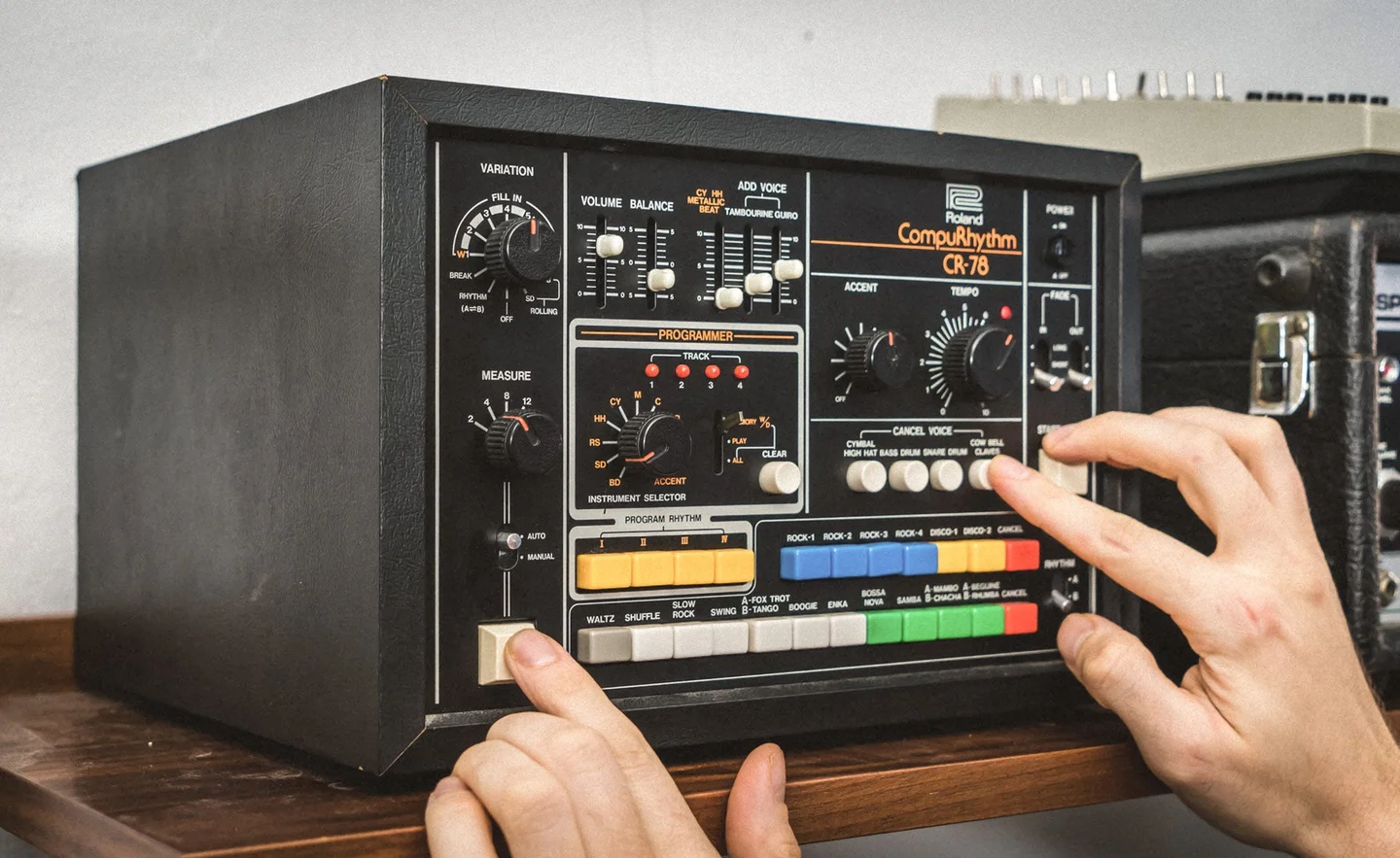
Before the 808, the Roland drum machine on the radio was a wooden-sided box with ballroom presets. The CR-78 was built to accompany an organist, and it ended up under Blondie, Ultravox, Phil Collins and Hall & Oates. Here is what is actually inside it, read from Roland’s own manuals, and how to get the sound now.
What is the Roland CR-78?
The Roland CompuRhythm CR-78 is an analog drum machine Roland released in 1978. It plays 34 preset rhythms on 14 analog percussion tones, and a microprocessor lets it store four rhythm patterns of the player’s own, kept alive by a backup battery when the power is off.
Its sounds are made by circuits; there are no samples in it. The microprocessor does the bookkeeping: it holds the user patterns, switches presets and fills at the start of the next bar, and counts time at 48 pulses per bar. Roland’s own history of the machine puts production at 8,000 units, ending in 1981, with around 2,000 of the optional WS-1 programmers made alongside.
Why the CR-78 matters
The CR-78 matters because it is where a drum machine first came with a computer memory for the player’s own beats, and because its pop hits arrived before the TR-808’s did. The “first” is worth stating carefully. Sound On Sound’s history of Roland, and most reference works that follow it, call it the first drum machine built around a microprocessor and the first that let users write, save and replay their own patterns.
It was not the first programmable rhythm machine of any kind. The Eko ComputeRhythm of 1972 and the PAiA Programmable Drum Set of 1975 both let users set their own patterns earlier. What changed in 1978 was the method: the patterns lived in memory run by a microprocessor, the arrangement nearly every drum machine since has used. Roland’s current product copy settles on “one of the first programmable rhythm machines,” which is the safe version.
The name spells it out. Roland’s account says CompuRhythm refers to the NEC microprocessor inside. Two years later the same company built the TR-808 around a 16-step grid; our guide to the 808 picks up the story from there.
Presets, variations and the Cancel Voice buttons
Most of the CR-78’s panel exists to play and vary presets, not to program them. There are 17 rhythm buttons and an A/B switch, and each button holds two patterns, which is where the manual’s count of 34 comes from.
The top row holds Rock 1–4 and Disco 1–2. The bottom row holds Waltz, Shuffle, Slow Rock, Swing, Boogie, Enka, Bossa Nova and Samba, plus three shared buttons: Fox Trot/Tango, Mambo/Cha-cha and Beguine/Rhumba, where A plays the first style and B the second. That gives 20 style names on 17 buttons, and it explains why published counts vary between 17, 20 and 34 depending on what the writer counted. Hold two buttons at once and the machine plays both patterns layered.
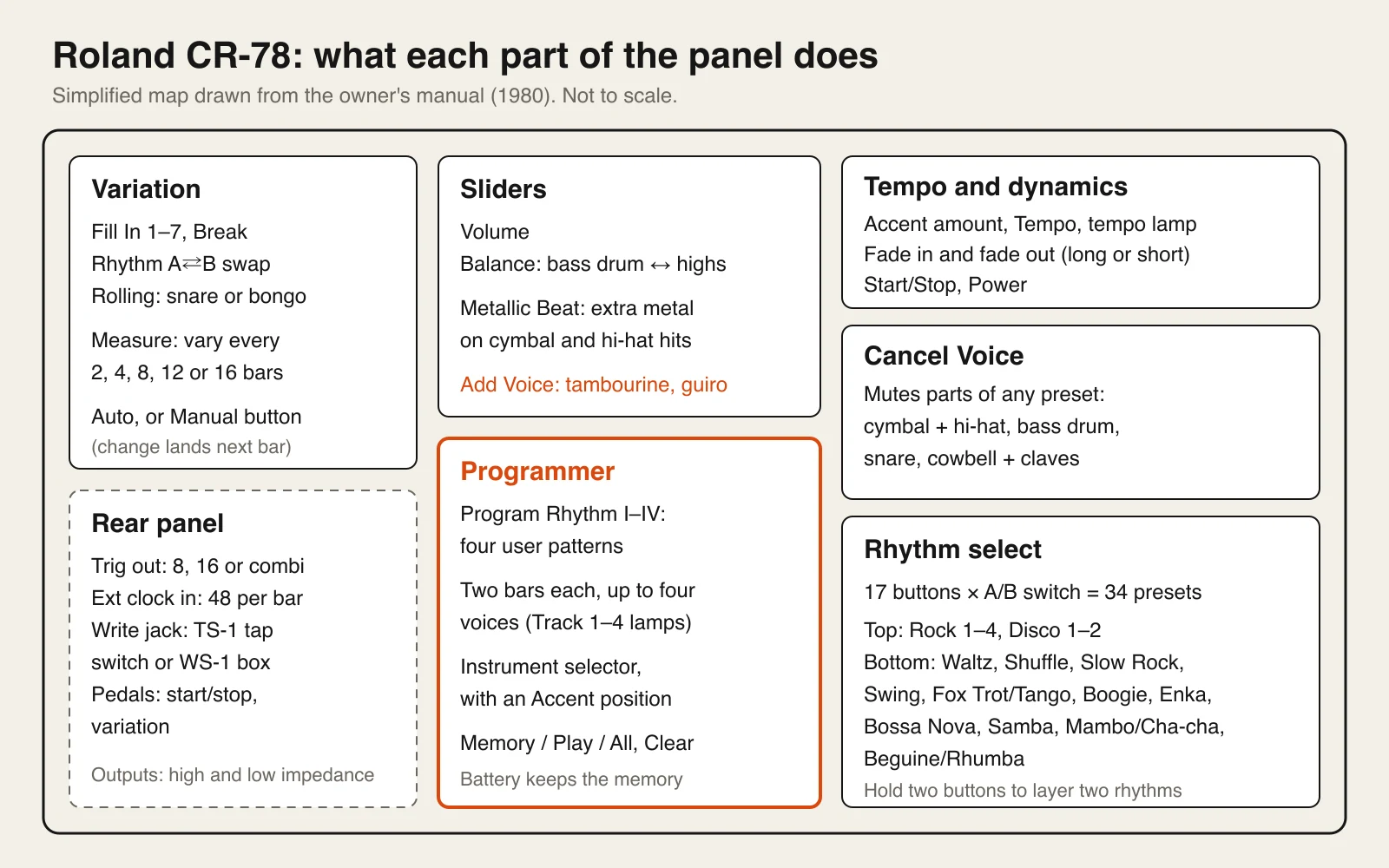
The Variation knob decides what happens on the bars that break the loop: one of seven fill-ins, a Break (a bar of rhythm, then a bar of rest), a swap from pattern A to B, or a roll on snare or high bongo. The Measure knob sets how often: every 2, 4, 8, 12 or 16 bars in Auto mode. In Manual mode a button triggers the variation, and the processor holds it until the downbeat of the next bar so the change always lands in time.
Cancel Voice has four buttons that mute parts of any preset: cymbal with hi-hat, bass drum, snare, and cowbell with claves. That is more useful than it looks. Knock the bass drum out of a Latin preset and you have a percussion loop to put under your own kick. Phil Collins described much the same idea: a pattern taken off the machine, with sounds you could eliminate and a bass drum part he programmed himself.
The rest of the performance controls are organ-box conveniences: a global Accent knob, Tempo with a lamp that flashes on the downbeat, and Fade In and Fade Out switches with long and short settings, so a song could start and end without anyone touching the volume.
Where the preset layout came from
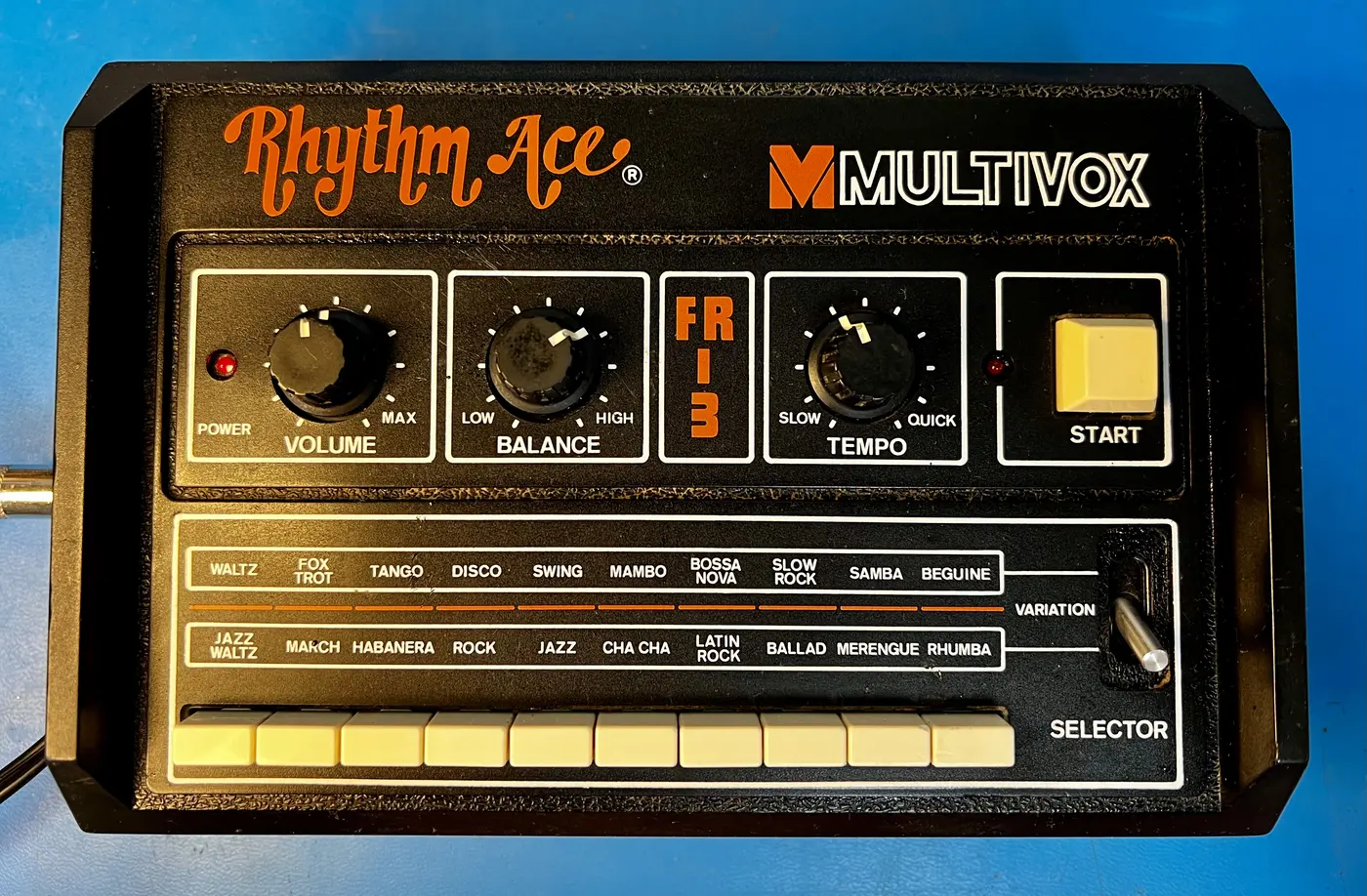
The ballroom style names, the Balance control and the variation switch were already standard on rhythm boxes sold to sit on top of a home organ. Roland’s founder, Ikutaro Kakehashi, had built them at Ace Tone before starting Roland. The CR-78 kept that front end and put a microprocessor behind it, which is why Sound On Sound’s Gordon Reid notes that it first looked like just another organ-style preset box and drew little attention at launch.

The CR-78’s sounds
The CR-78 has 11 main percussion voices, two extra “Add Voice” instruments and a Metallic Beat layer, all analog; Roland counts them as 14 tones. The owner’s manual lists the main sound source as:
- Drums: bass drum, snare drum, rim shot.
- Metal: hi-hat and cymbal, plus the Metallic Beat slider that adds a harder metallic edge on the same hits.
- Hand percussion: maracas, claves, cowbell, high bongo, low bongo, low conga.
- Add Voice: tambourine and guiro, each on its own level slider.
The two Add Voice instruments are the oddity. The manual says they keep a fixed rhythm that has no relation to the preset, so raising the tambourine slider lays a steady part over whatever is playing. Metallic Beat, by contrast, follows the preset’s cymbal and hi-hat hits; if those are cancelled, it plays an eight-beat pattern of its own that ignores the preset.
There are no per-voice knobs. The only tone control is the Balance slider, which tilts the whole kit between the bass drum and the high percussion (cymbal, hi-hat, maracas). Cherry Audio’s documentation for its emulation describes the cymbal and hi-hat as resonant band-pass-filtered noise, and the Metallic Beat as three square waves at unrelated pitches, distorted and filtered. The TR-808 later took the square-wave idea much further, using six oscillators for its metal.
How the programmer and the WS-1 work
The CR-78 stores four user patterns, selected with the Program Rhythm buttons I–IV. Each is two bars long (96 clock counts) and can hold up to four voices, one per Track lamp, plus accents, which have their own position on the Instrument Selector. That selector covers ten of the voices; cowbell, tambourine, guiro and Metallic Beat cannot be programmed.
There are two ways to write. The machine came with the TS-1, a small tap switch that plugs into the Write jack on the back. You pick a voice, press Start, and tap along in real time; the two-bar loop keeps cycling, so a missed beat can be added on the next pass. The manual suggests hitting the switch with a drumstick for tighter timing, which says a lot about how precise tapping was in practice.
The optional WS-1 Write Switch replaced tapping with stepping. Its manual says it divides a bar into 8, 12, 16, 24 or 48 steps and writes one step at a time, clocking the CR-78 through its external clock input. Because a user pattern is two bars and each pass through the step selector covers one, every voice is written twice. With only about 2,000 made, a CR-78 that still has its WS-1 is the more sought-after package.
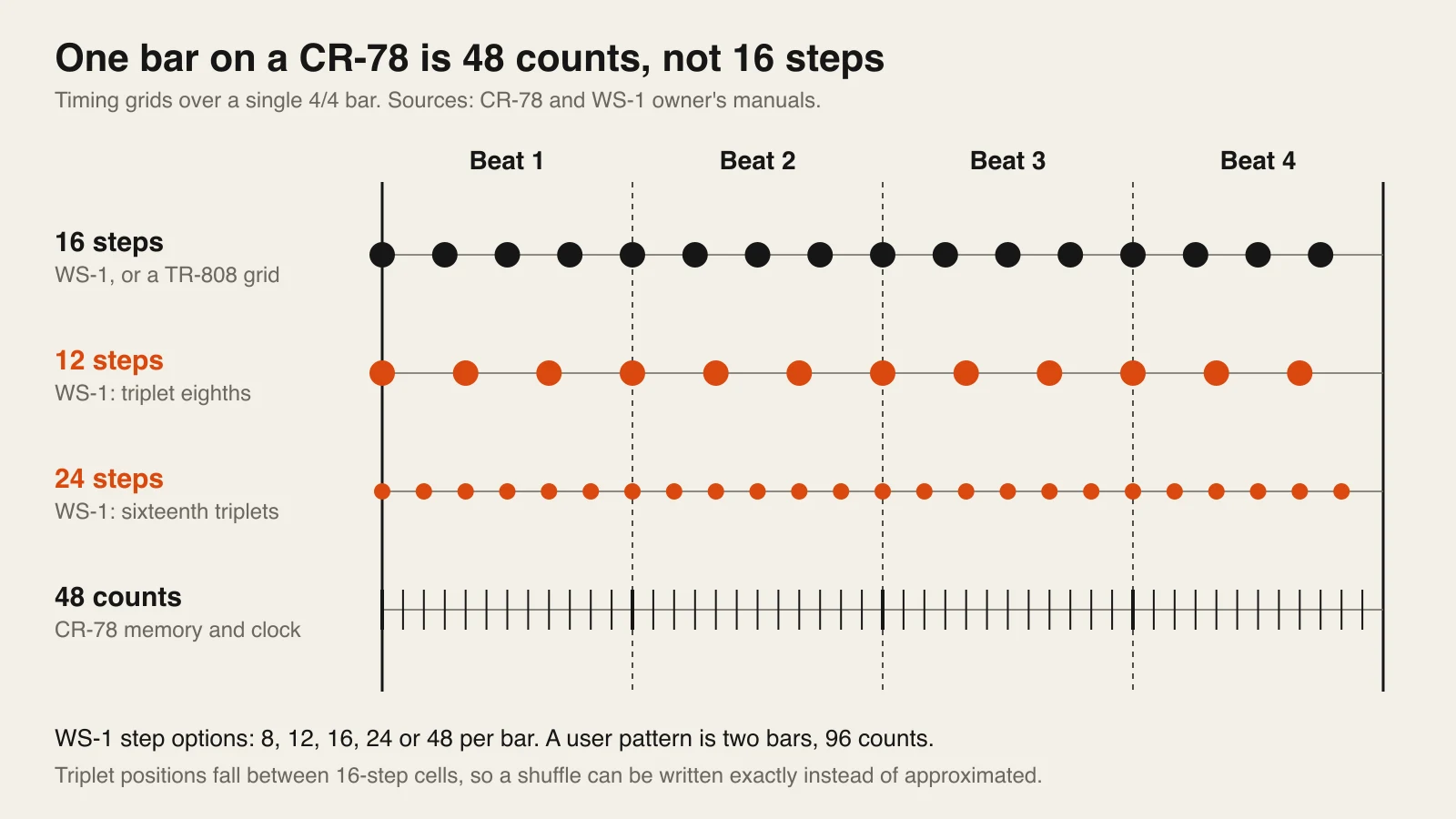
That timing resolution is the practical difference from a 16-step grid. At 48 counts a bar, triplet eighths and triplet sixteenths fall on exact clock positions, so a shuffle or a swing pattern is written as it is played rather than squeezed into the nearest sixteenth.
The rear panel was built for studios as much as organists. A trigger output sends a pulse on every eighth, every sixteenth, or on the combined bass drum and high bongo pattern, and an external clock input accepts 48 pulses per bar at +5 to +15 V, so a sequencer or a synthesizer’s arpeggiator could be locked to it.
Songs that use the CR-78
The CR-78 is on several of the best-known records of 1978–1981. Each credit below is checked against an interview or a documented source; the preset names come from Roland’s own history of the machine.
| Record | Year | What is documented | Source |
|---|---|---|---|
| Blondie, “Heart of Glass” | 1978 (single 1979) | Built on a CR-78 pattern, one of the first CR-78 songs; Roland says its trigger output was part of the production | Deborah Harry in The Guardian (“this little Roland drum machine”); BBC Radio 2’s The Record Producers; Roland |
| Ultravox, “Vienna” | 1980 (single 1981) | The song grew from a drum-machine pattern Warren Cann made on the CR-78; Roland names Rock 4 | The Independent’s “Story of the Song”; Roland |
| Phil Collins, “In the Air Tonight” | 1981 | A pattern taken off the machine, with Collins’s own bass drum part programmed in; Roland names Disco 2, variation A | Collins in Mix magazine’s Classic Tracks; Roland |
| Daryl Hall & John Oates, “I Can’t Go for That (No Can Do)” | 1981 | Hall pressed the Rock 1 preset and wrote the bassline over it; the loop runs through the record | Daryl Hall in The Guardian (2018); Mix Classic Tracks; Roland |
“In the Air Tonight” is also the record most people connect with a quite different sound: the drums that crash in near the end are a real kit, famous for their gated reverb. The CR-78 plays the restrained first half; the contrast between its small, dry pattern and that explosion is much of the song’s effect.
Roland’s history also names Chris de Burgh’s “The Lady in Red” (the Enka rhythm) and John Foxx’s Metamatic. The machine’s Wikipedia entry lists OMD’s “Enola Gay” and Radiohead’s live shows. For how the CR-78 sits among the other boxes of the era, see our guide to vintage drum machines.
CR-78 vs TR-808
The CR-78 is a preset machine with a memory added; the TR-808 is a programming machine with no presets at all. Everything else follows from that. The 808, released in 1980, puts a 16-step grid across the front panel and gives most voices their own level, tone or decay knobs, and a kick you can stretch into a long bass note. The CR-78 gives you a style button, a Balance slider and an Accent knob, and a kick whose length you cannot change.
The presets explain the soft feel people describe. They were written to accompany a player, so the weight sits in hand percussion (maracas, bongos, conga, claves, guiro, tambourine) rather than a loud kick and snare, and accents come from one global knob rather than per-step dynamics. MusicRadar summed it up as lacking the 808’s “floor-shaking rumble”; what it has instead is a busy, ticking middle that leaves room for a song. The 808 vs 909 comparison covers what came after.
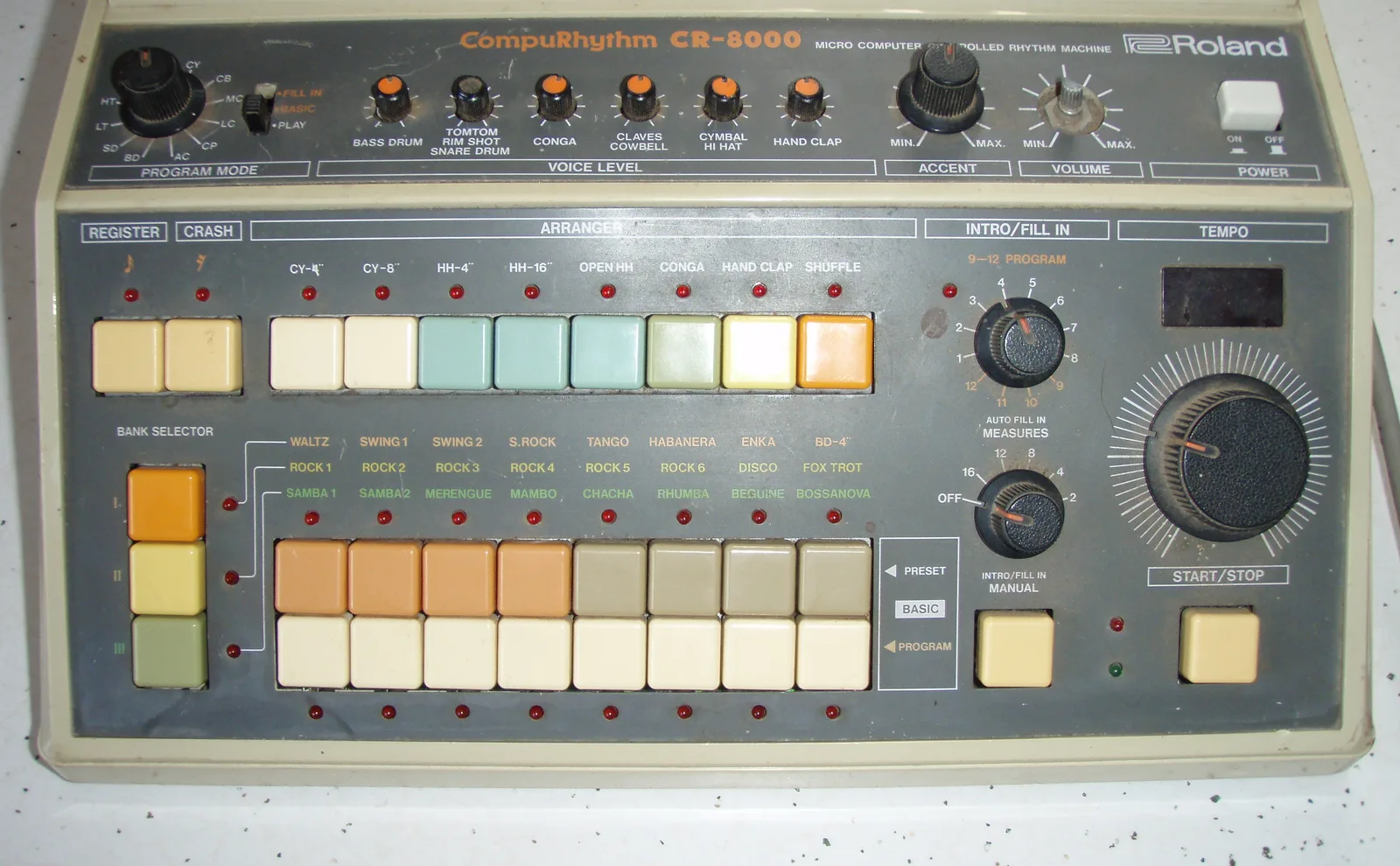

| Roland CR-78 | Roland TR-808 | Roland CR-8000 | |
|---|---|---|---|
| Released | 1978 | 1980 | 1980 or 1981 (sources differ) |
| Presets | 34 (17 buttons, A/B each) | None | 24, in three banks, plus an Arranger for extra parts |
| User memory | 4 patterns, 2 bars each, up to 4 voices | 32 patterns, chained into songs | 8 patterns |
| How you program | Tap in real time (TS-1) or step with the optional WS-1 | Step buttons on the panel | Front-panel step entry |
| Voices | 11 plus tambourine, guiro and Metallic Beat | 16 sounds on 11 instrument channels | About 13, including toms and hand clap |
| Per-voice controls | None (Balance, Accent, three sliders) | Level on all, tone, tuning or decay on several | Six voice-group level knobs |
| Sync | Trigger out, external clock in at 48 per bar | DIN sync in and out | DIN sync, trigger out |
| Sound source | Analog | Analog | Analog |
The CR-8000 is the easiest way to see what Roland learned from the CR-78: it kept the preset-first layout, doubled the user patterns to eight, and added the hand clap and toms that pop productions wanted. For how circuits like these make their sounds, our analog drum machines guide walks through the voice designs.
How to program a CR-78-style groove
A CR-78 groove is busy on top and light underneath: eighth-note hats, a sixteenth-note shaker part, a modest kick and a snare on the backbeat, with a hand-percussion voice filling the gaps. The grid below is our own pattern in that style, drawn for any 16-step sequencer or piano roll.
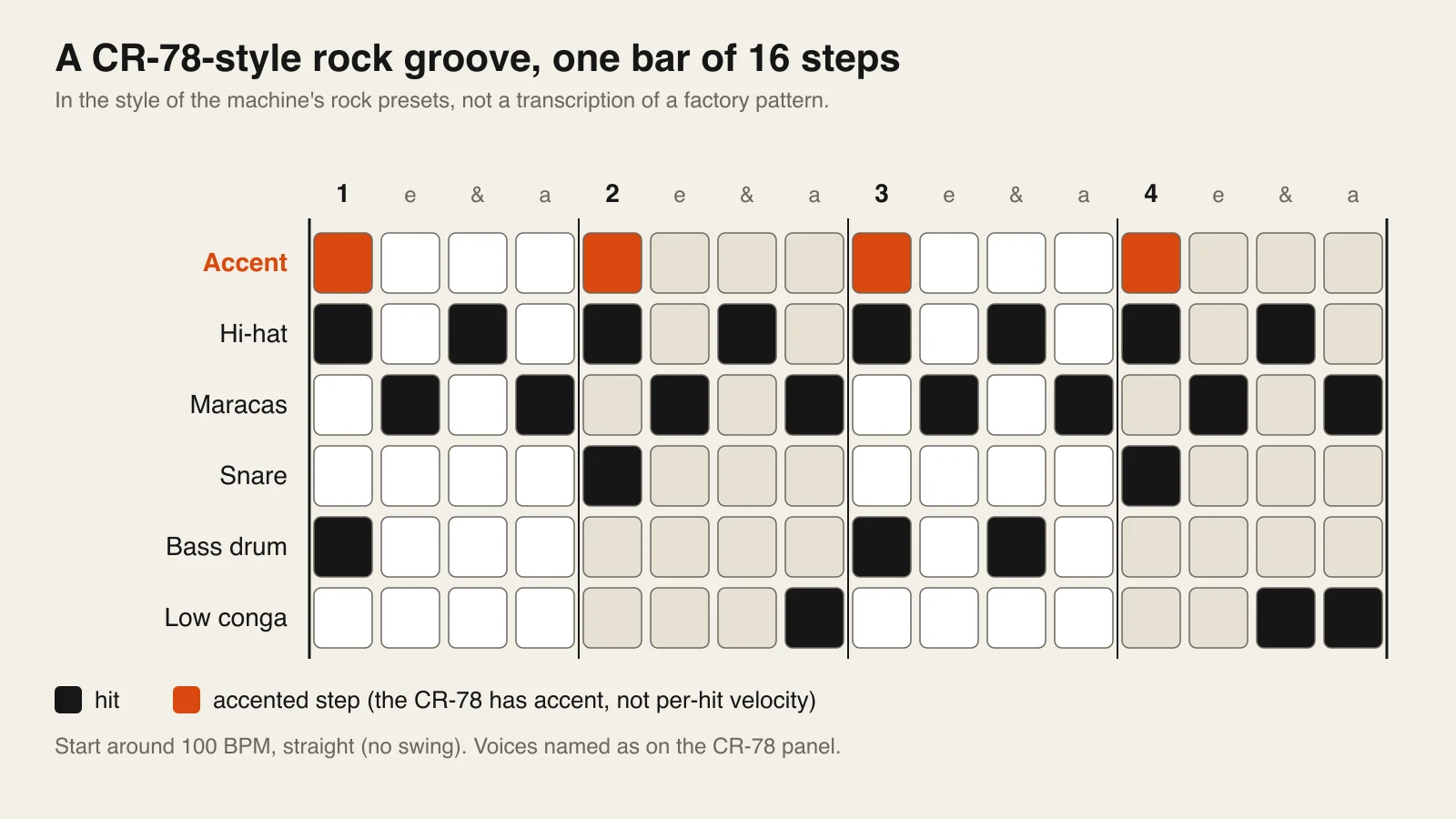
CR-78-style rock groove
1 bar · 16 steps · about 100 BPM
- Set the tempo to 100 BPM with swing at 0%. Loop one bar of 16 sixteenth-note steps.
- Load a CR-78 kit (Roland Cloud, a TR-8S or TR-6S, Cherry Audio’s emulation, or CR-78 samples) and use five voices: hi-hat, maracas, snare, bass drum and low conga.
- Hi-hat on steps 1, 3, 5, 7, 9, 11, 13 and 15. Maracas on the even steps, 2 through 16, about 6 dB quieter than the hat.
- Snare on 5 and 13. Bass drum on 1, 9 and 11. Low conga on 8, 15 and 16 as a pickup into the next bar.
- Accent steps 1, 5, 9 and 13 across every voice that plays there: about 4 dB louder, or velocity 127 against 96 elsewhere. That imitates one global accent rather than per-hit dynamics.
- Tilt the kit instead of mixing each voice: a low shelf at 150 Hz, ±3 dB, does what the Balance slider did. Keep the kick short; the CR-78 has no decay control.
- Every fourth bar, replace the last beat with a snare roll on steps 13–16, or mute bar four entirely for a Break, which is what the Measure knob set to 4 would do.
On the original, a user pattern holds four voices, so this groove would need one voice dropped to fit in memory. For a triplet shuffle, switch your sequencer to 12 or 24 steps per bar, the grids the WS-1 offered.
Getting the “In the Air Tonight” feel: Collins started from the machine’s own pattern and added a bass drum part he programmed, rather than building a beat from scratch. Start from a CR-78 disco-style loop, mute its kick, program a sparse bass drum of your own, and put the whole machine through a long, dark reverb. Keep the gated sound for the real drums when they arrive.
How to get the CR-78 sound today
There are four routes: Roland’s own software, Roland’s current hardware, third-party emulations and samples, and an original. This is a map of what exists, not a hands-on review; we have not tested these side by side.
- Roland Cloud CR-78. Roland’s plugin (VST3, AU, AAX), modeled at component level with its Analog Circuit Behavior technology. It adds what the hardware never had: a 16-step sequencer across 11 instrument parts, sub-steps, shuffle, and per-voice tuning, decay and pan. Sold as a Lifetime Key or included with a Roland Cloud Ultimate membership, with a 30-day trial at the time of writing.
- TR-8S and TR-6S. Roland added a CR-78 model to both in September 2023 (TR-8S firmware 3.0, TR-6S firmware 2.0) as a free update, with the original tones and patterns. If you already own one, you already have it.
- Cherry Audio CR-78. A third-party emulation, not a Roland product, modeled on a unit owned by The Cars’ Greg Hawkes. It offers 16- or 24-step programming, a song mode and built-in effects, at $49 at the time of writing.
- An original. At the time of writing, working units usually sell somewhere between the high hundreds and around two thousand US dollars; serviced machines and those with a WS-1 sit at the top. Ask about the memory backup battery: the manual warns that a neglected one can swell and leak, so check whether it has been replaced.
Samples are the cheapest route and a good one for a machine with no per-voice controls, since a clean recording of each voice captures most of what there is. For loops with a period feel rather than CR-78 hits specifically, our free 80s and 90s pop drum loops are royalty-free WAVs you can audition on the page.
A note on our own product, so read it as such: UDS-16 is not a CR-78 emulation. It is a drum synthesizer whose circuits descend from Soviet machines rather than Roland ones, it has no step sequencer and no presets of rhythms, and it will not reproduce CR-78 tones. It is relevant only if you want another analog-style voice set to program from your DAW.
Frequently asked questions
How many Roland CR-78s were made?
Roland’s own history of the machine says it made 8,000 CR-78s between 1978 and 1981, and around 2,000 of the optional WS-1 step programmers. That makes a CR-78 with its WS-1 much less common than the drum machine alone.
What drum machine did Phil Collins use on “In the Air Tonight”?
A Roland CR-78. Collins told Mix magazine the song started as a pattern he took off the machine, with a bass drum part he programmed himself. Roland identifies the preset as Disco 2 in its A variation. The big drum entrance near the end is a real kit, not the CR-78.
Was the CR-78 the first programmable drum machine?
No. The Eko ComputeRhythm (1972) and the PAiA Programmable Drum Set (1975) were programmable earlier. The CR-78 is usually credited as the first drum machine built around a microprocessor and the first to let users write, store and replay their own patterns from memory.
Is the Roland CR-78 analog?
Its sounds are. Every voice, from the bass drum to the guiro, is generated by analog circuits, with no samples. The timing, pattern memory and preset switching are handled digitally by a microprocessor, which is what the CompuRhythm name refers to.
What drum machine did Sly Stone use?
Not a CR-78. On *There’s a Riot Goin’ On* (1971), Sly Stone used a Maestro Rhythm King MRK-2, a preset-only rhythm box from before microprocessors. It is one of the records that made the drum machine a sound in its own right, several years before the CR-78 existed.
Does the Roland TR-8S have CR-78 sounds?
Yes. Firmware 3.0 for the TR-8S and 2.0 for the TR-6S, released free in September 2023, added a CR-78 model with the original tones and patterns. It is built with the same circuit-modeling approach as Roland’s CR-78 plugin.
Royalty-free WAV
Free sample packs
Royalty-free WAV, play every sample before you download.