
808 vs 909: Kick, Hi-Hats, Sound and Which to Choose
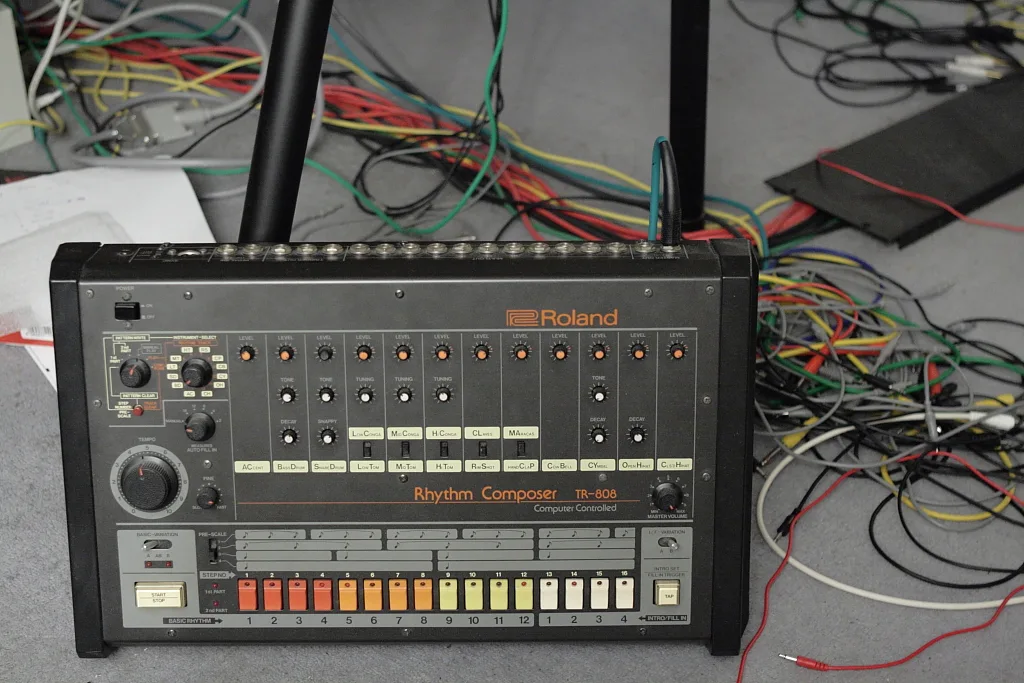
Two Roland drum machines, three years apart, that between them account for most of the drum sounds in electronic music. They are usually spoken of as a pair. Inside the box they are built on different ideas, and that is where the difference in sound actually comes from.
The short answer
The Roland TR-808 (1980) is a fully analog drum machine: every voice, including the hi-hats and cymbal, is generated by circuits. The Roland TR-909 (1983) is a hybrid: its kick, snare, toms, rim shot and clap are analog circuits, but its hi-hats, crash and ride are short digital samples played from ROM.
In one line: the 808 is round, deep and synthetic; the 909 is hard, punchy and closer to a real kit. The 808 became the sound of hip hop, electro and later trap. The 909 became the sound of house and techno. Neither is better. They were designed to solve different problems and ended up defining different genres.
808 vs 909: side by side
| Roland TR-808 | Roland TR-909 | |
|---|---|---|
| Released | 1980 | 1983 |
| Synthesis | Fully analog | Analog drums, sampled hi-hats and cymbals |
| Sequencer | 16 steps, pattern chaining, no MIDI | 16 steps, shuffle, flam, MIDI |
| Kick | Resonant bridged-T circuit; long, round | Oscillator with pitch envelope and click; hard, punchy |
| Snare | Oscillators plus noise; soft, papery | Oscillators plus noise; sharper, drier |
| Hi-hats | Six square-wave oscillators; metallic, buzzy | Sampled cymbals with analog decay; crisp |
| Clap | Analog noise bursts | Analog noise bursts, slightly harder |
| Genres | Hip hop, electro, Miami bass, trap, R&B | House, techno, acid, trance |
| Original price | Around one thousand US dollars at launch | A similar bracket at launch |
| Used price today | Well into four figures, often five | Four figures, usually below the 808 |
Hear the difference: a listening checklist
Start with the audio and video demos on Roland’s official TR-808 page and TR-909 page. These are manufacturer demonstrations of the software recreations, not a level-matched recording of two vintage units. They make the voice differences audible; they are not a controlled A/B test.
- Kick: listen past the first transient. The 808’s long low tail can occupy the bass line; the 909’s attack is useful when the kick must speak through a busy arrangement. Decay and processing can change either result.
- Hi-hats: compare the metallic buzz of the 808 with the sampled cymbal texture of the 909. Lower the volume before deciding which is brighter; louder often sounds better.
- Your track: audition the same rhythm at the same tempo and similar perceived level, first solo and then with your bass. Choose the version that needs less correction in context.
For a ready-made rhythm to chop while you learn, audition our free boom bap drum breaks or free drum and bass samples. These are AI-generated drum patterns, not recordings of a TR-808 or TR-909. For designing individual synthesized hits instead, explore UDS-16, which is inspired by Soviet percussion circuits rather than Roland emulation.
Roland TR-808 (1980)

The TR-808 was released in 1980 as a programmable rhythm box for musicians who could not afford a drummer. It sold poorly, was discontinued within a few years, and found a second life on the used market once it was cheap. Roughly twelve thousand were built.
Everything in it is analog; there is no sample memory anywhere. The bass drum is a resonant filter knocked into ringing by a pulse. The snare is two pitched oscillators with a filtered noise layer. Toms and congas share circuitry. The hi-hats and cymbal are six square-wave oscillators run into band-pass and high-pass filters, which is why they sound like buzzing metal rather than a recording of a cymbal.
Each voice has a few knobs, and they change the circuit rather than a playback parameter. Decay on the bass drum lets the filter ring for longer; Snappy on the snare raises the noise. A two-second kick was never intended, but the circuit allows it.
The sequencer is a 16-step grid with pattern chaining. Our guide to analog drum machines goes through the voice circuits in more detail.
Roland TR-909 (1983)
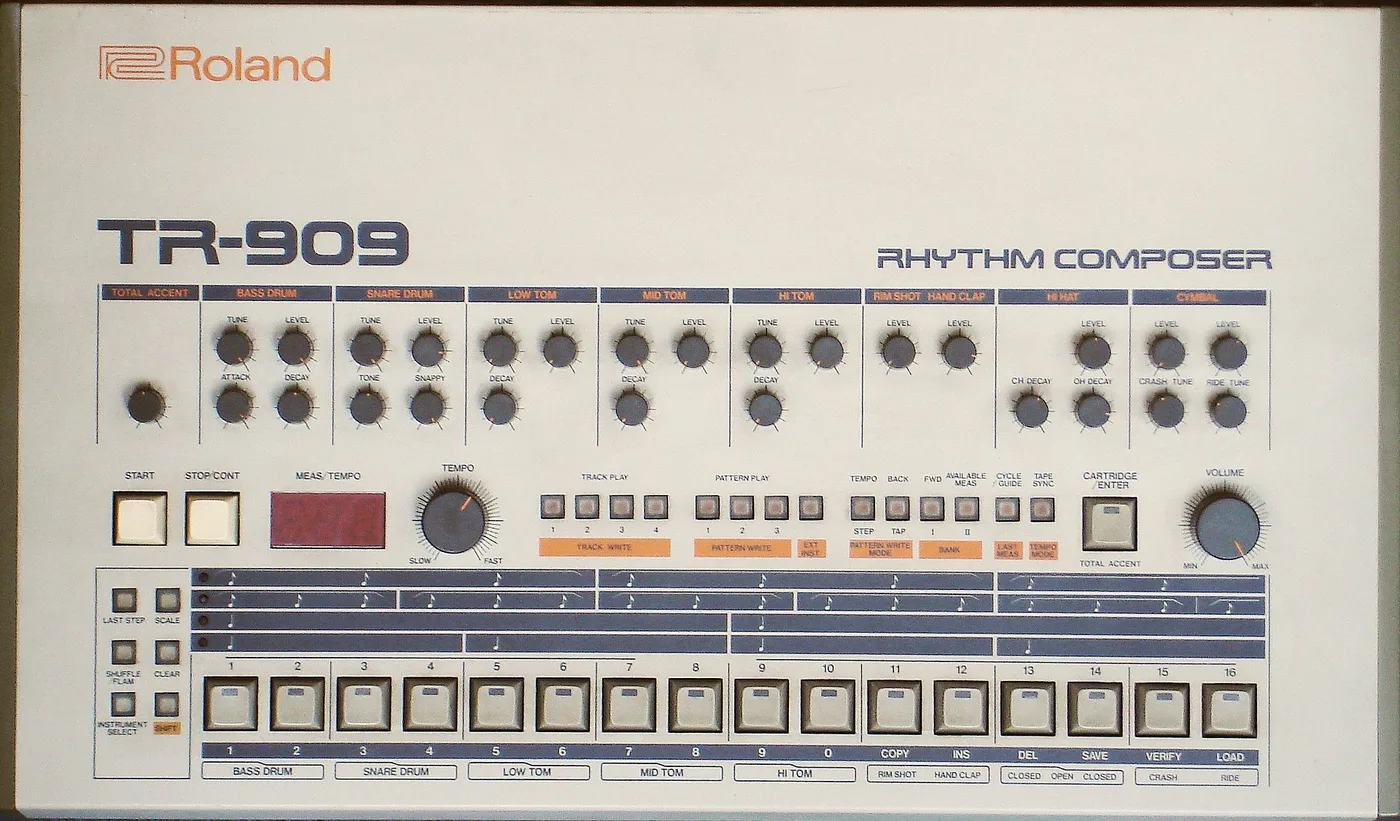

The TR-909 arrived in 1983 with a different brief. Sampling machines such as the LinnDrum were selling on realism, and Roland wanted something closer to a kit. The answer was circuits for the drums, where analog still gave a stronger, more tunable sound, and samples for the metal, where analog synthesis had always struggled.
So the 909 is analog where it counts for weight and digital where it counts for realism. Kick, snare, three toms, rim shot and hand clap are circuits. Closed and open hi-hat, crash and ride are short, low-resolution samples of real cymbals, passed through analog envelopes so the decay knob works, but the tone of the cymbal itself is fixed.
The 909 also added MIDI, a shuffle control, flams and a per-step accent. Roughly ten thousand were made, and like the 808 it became a defining instrument only after second-hand prices had fallen. Our Roland TR-909 guide covers the machine on its own, beyond the comparison.
808 vs 909 kick
This is the difference most people are really asking about. It comes down to two ways of making a low sound.
The 808 kick is a bridged-T network: a filter tuned to resonate around 50 to 60 Hz. A pulse hits it and it rings, the way a struck object rings. The Decay knob controls feedback around the network, so it decides how long the ringing lasts. A fast downward pitch sweep at the start supplies the beater. The note is close to a sine wave with a soft attack, and with Decay turned up it becomes a bass note with a stated pitch, which is how trap uses it.
The 909 kick is an oscillator with a pitch envelope, so the sweep from high to low is a designed feature rather than a side effect. A separate click transient gives the front of the hit its snap, and the Attack knob sets how much of it you hear. Because the sweep is stronger and the attack harder, the 909 kick cuts through a dense mix at club volume in a way the 808 does not without help.
808 vs 909 snare
Both snares use the standard analog recipe: two pitched oscillators for the shell, filtered noise for the wires, each with its own envelope. The 808 has Tone and Snappy; the 909 adds Tune.
They sound different because of proportions. The 808 snare has a soft attack and a wide, hissy noise layer, so it reads as a synthetic clap-snare hybrid. The 909 snare has a harder transient, a shorter noise tail and a more prominent pitched component, so it reads as an aggressive, dry snare. The 909 takes distortion and gated reverb well; the 808 tends to disappear under both.
Hi-hats: why the 909’s sound different
The largest audible gap between the two machines is the hi-hats, because they are made in completely different ways.
The 808 makes its hi-hats by running six square-wave oscillators at unrelated frequencies into a band-pass filter, then a high-pass filter, then an envelope. The result is inharmonic, which is right for metal, but unmistakably synthetic: a buzzing tick closer to a tone than to a cymbal. Open and closed hats share the same source with different envelope lengths.
The 909 plays back a short, low-resolution digital recording of a real hi-hat. The coarseness is part of the sound, but it is a recording of metal rather than a synthesis of it. Open and closed are separate samples with an analog decay control; crash and ride are recordings too.
That is why a 909 hat pattern sounds crisp and driving, and why 808 hats work so well rolled and pitched in trap: a synthetic tone tolerates 32nd-note retriggering far better than a sample does.
Which one for hip hop, house, techno and trap
Hip hop and electro: 808
Afrika Bambaataa’s “Planet Rock” and Marvin Gaye’s “Sexual Healing”, both 1982, put the 808 on records everyone heard. Electro and Miami bass were built on its kick and cowbell.
House and techno: 909
Chicago house and Detroit techno leaned on the 909 because its kick and hats hold up on club systems. Four-on-the-floor kick, open hat on the off-beat and a 909 clap is still the shape of a house pattern.
Trap: 808 as bass
Modern trap uses “808” to mean a long, pitched sub-bass note derived from the 808 kick at full decay, usually sampled and tuned to the key of the track rather than played from the machine. More on that in what an 808 is in trap and hip hop.
Acid and rave: both
Acid house used both alongside the TB-303, and plenty of rave records layer an 808 kick under a 909 kick for depth and punch in one hit. Layering the two is a legitimate answer.
808 and 909 plugins and free VSTs
The options fall into three groups: Roland’s own software, third-party circuit models, and sample-based kits. This is a map, not a review; our best drum machine VST guide covers the field in detail, and best drum synth plugins covers instruments that synthesize their own drums rather than emulating a specific box.
Roland Cloud TR-808 and TR-909
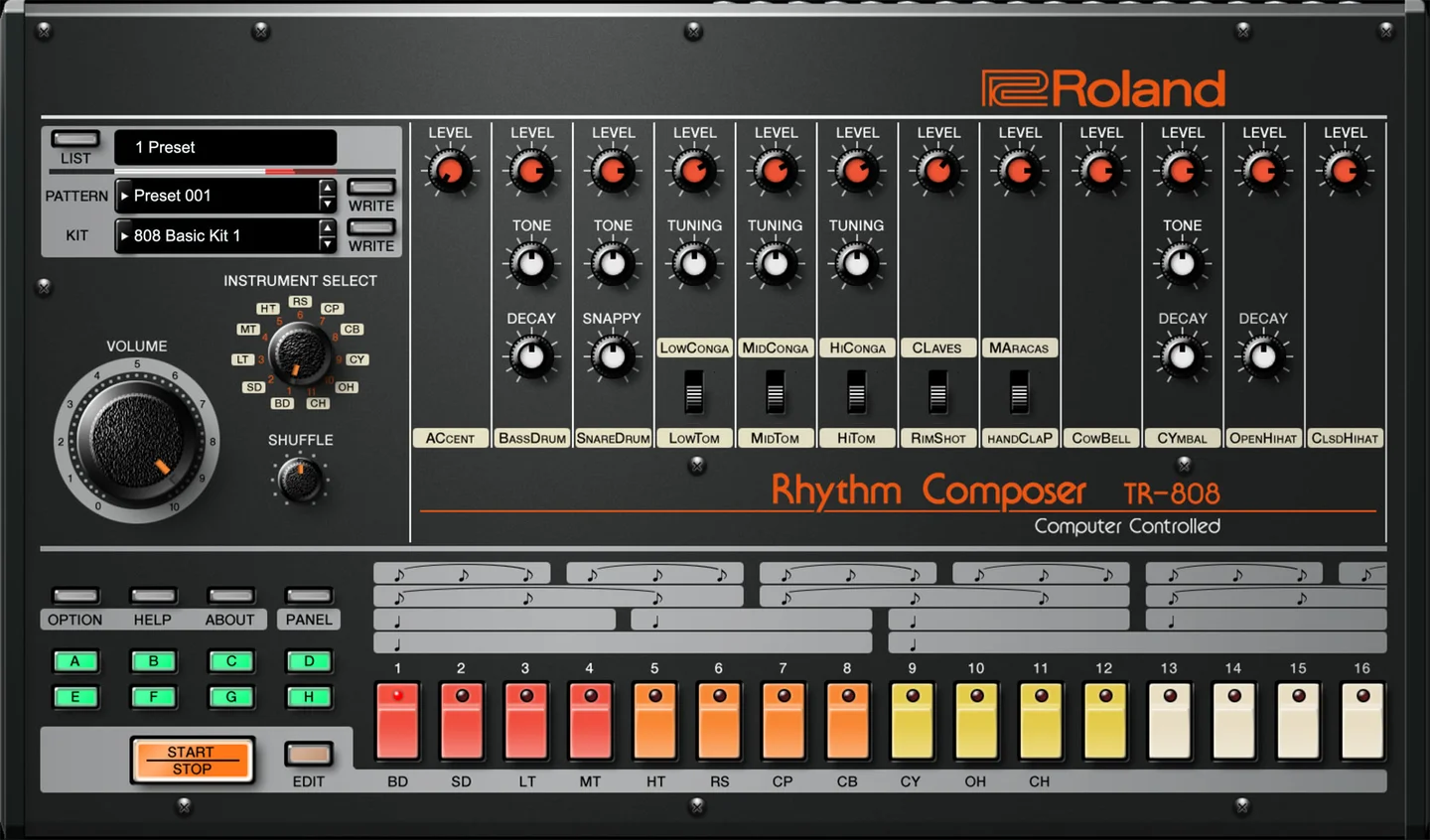
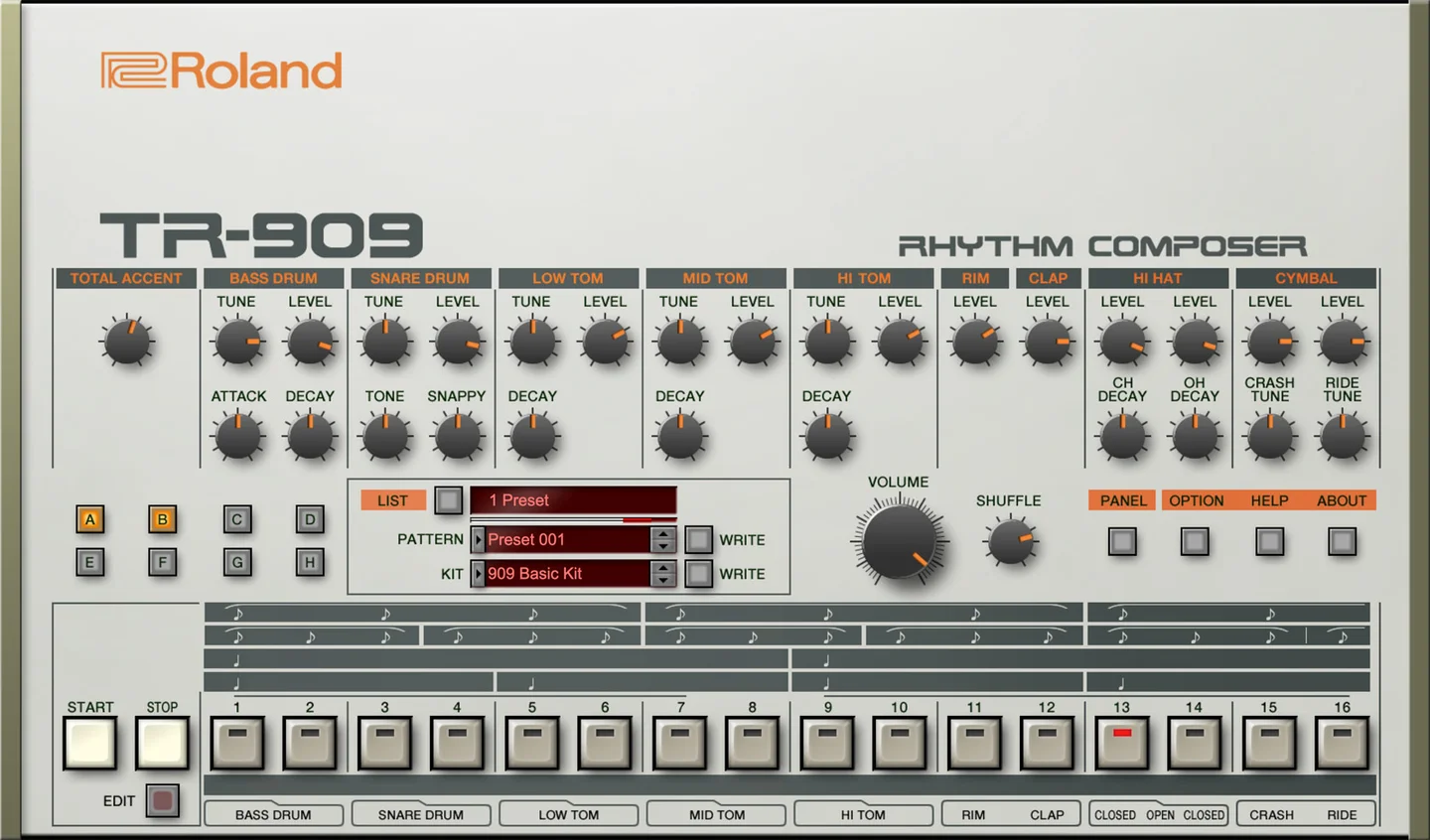
Roland sells plugin versions of both machines through Roland Cloud, built on its own circuit modelling, by subscription and, at the time of writing, as lifetime keys for individual instruments. If you want the maker’s own version, this is the reference point.
D16 Nepheton 2 and Drumazon 2
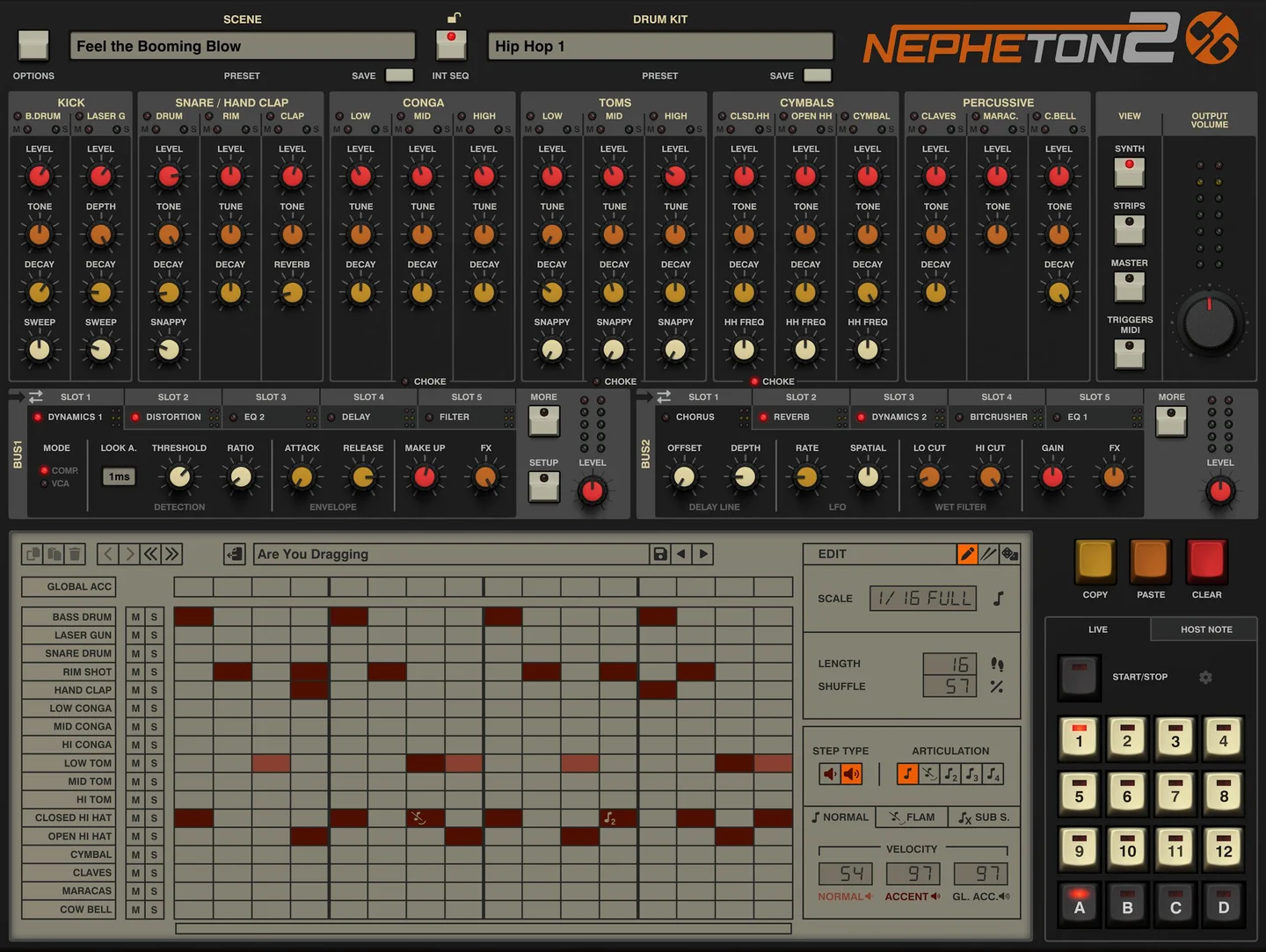
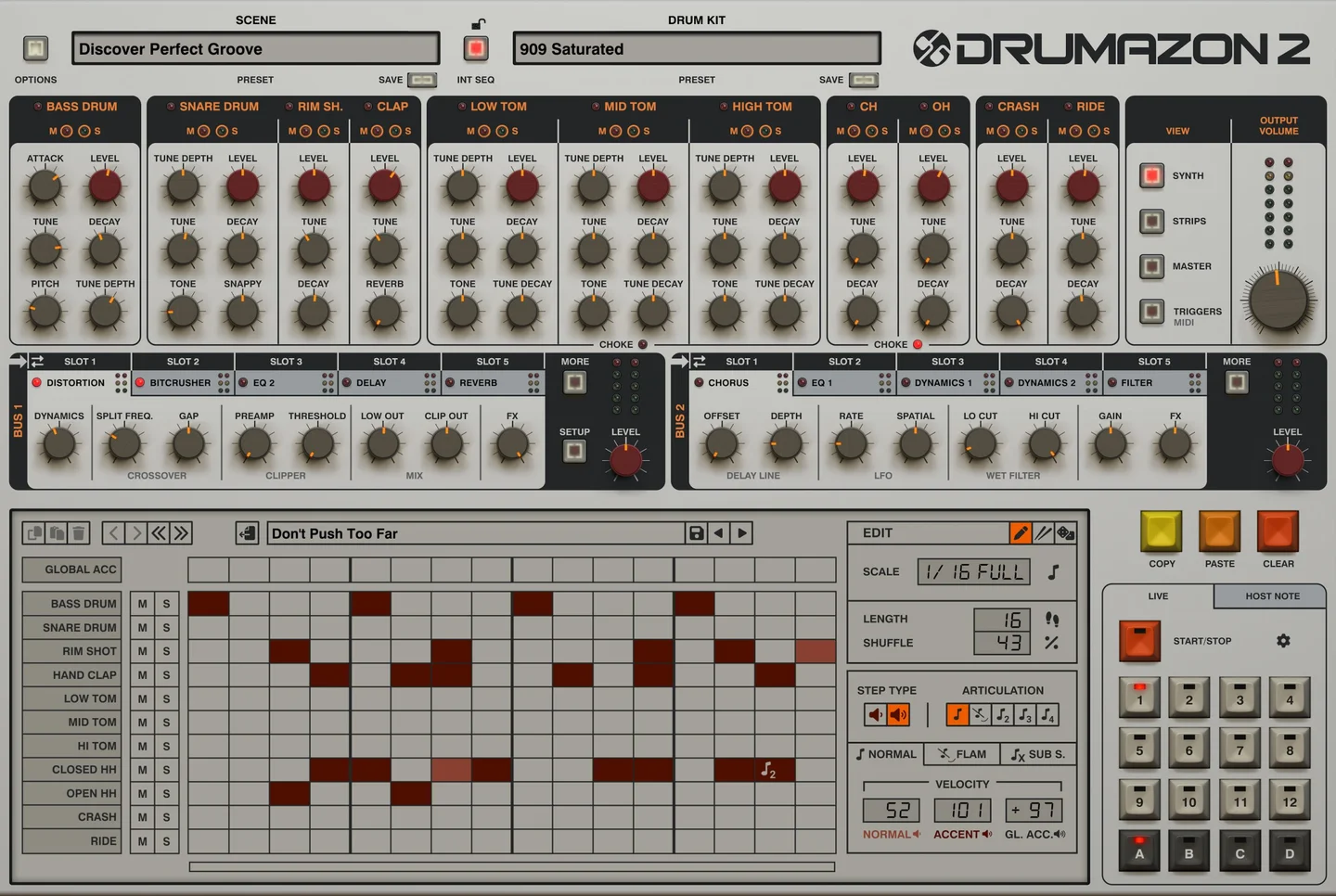
D16 Group’s Nepheton (808) and Drumazon (909) have been around for well over a decade and were rebuilt as version 2 with expanded sound-shaping and per-voice effects. They are circuit models rather than sample sets, and both go beyond the original machines’ ranges.
AudioRealism ADM
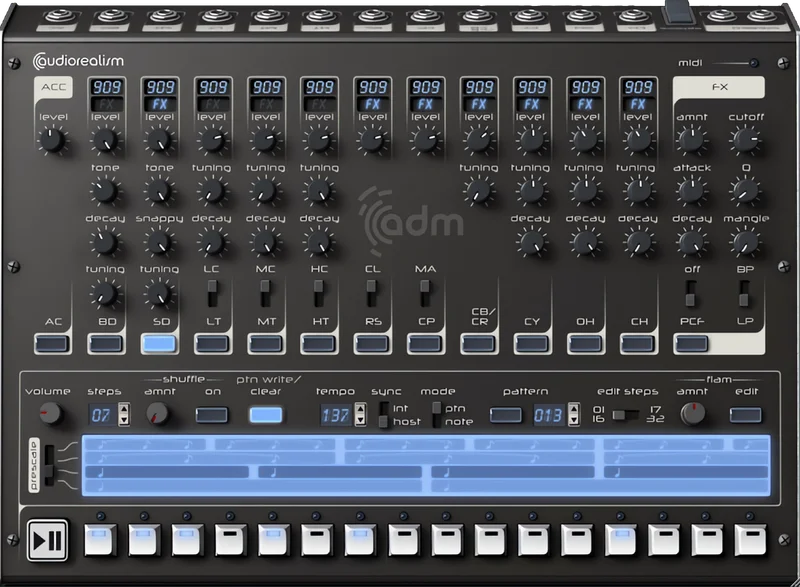
AudioRealism Drum Machine models the 808, 909 and 606 in one plugin with a step sequencer. It is a long-standing, comparatively inexpensive option for people who want both machines in one window.
Free 808 and 909 VSTs
Most things advertised as a free 808 VST are sample players loaded with 808 recordings, or a stock DAW kit. That is not a criticism: a well-recorded 808 kick, pitched in a sampler, is how most trap 808s are actually made, and every major DAW ships with an 808-style kit.
Free circuit emulations exist but come and go, so check that any you find is still maintained for your OS and plugin format before building a template around it. If what you need is the long, tuned 808 bass note, a stock sampler and a good sample will do it.
Tapechild UDS-16: a different lineage
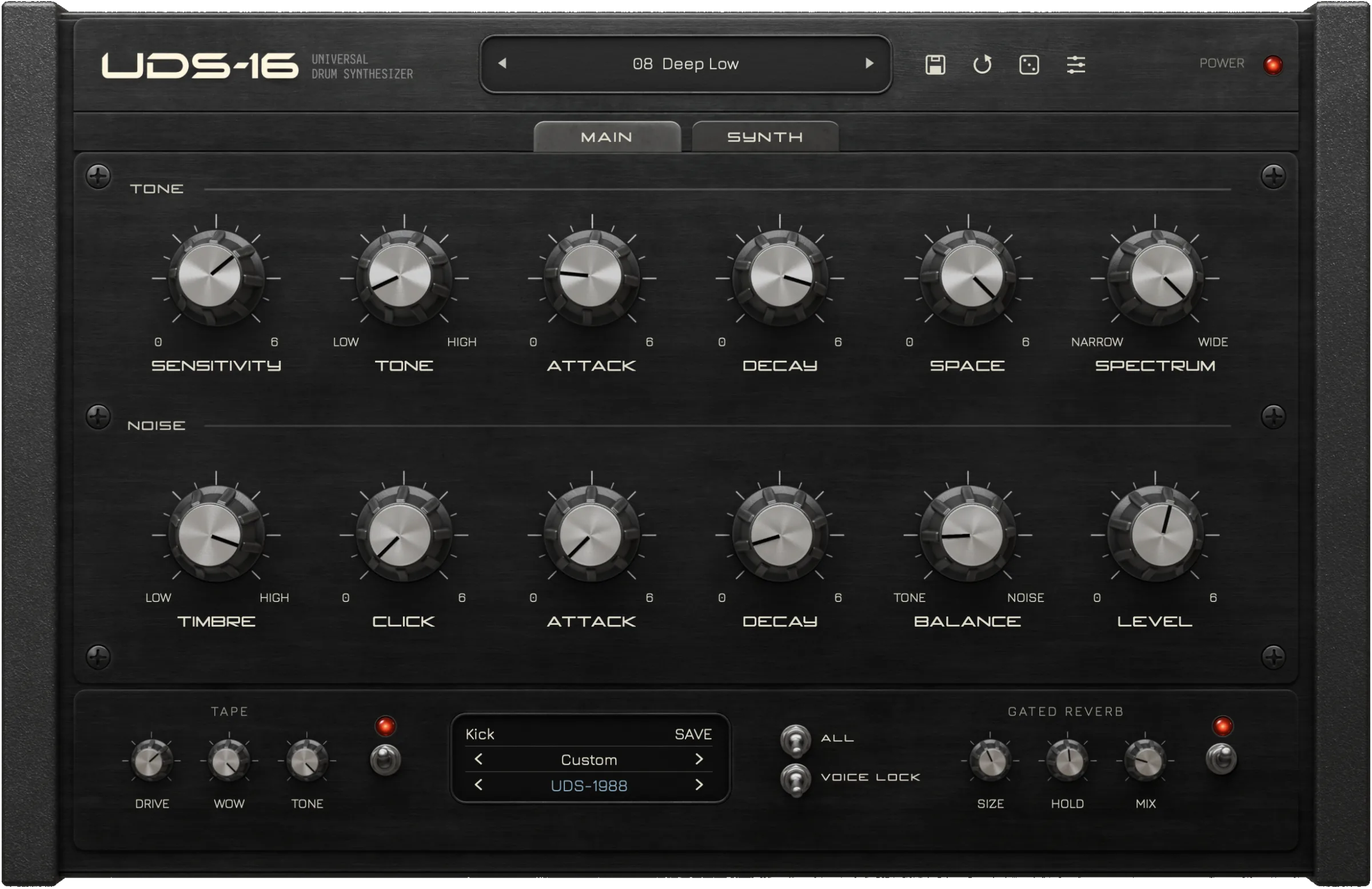
This section is about our own product, so read it as such. UDS-16 is a drum synthesizer, not an 808 or 909 clone, and it will not give you their kick or hats. Its circuits come from a different lineage: the Soviet Lel UDS and the Formanta Rockton, covered in our guide to Soviet drum machines.
It has no step sequencer; timing comes from your DAW, and every hit is synthesized at playback with no samples. If you already own an 808 and a 909 emulation and want a voice with a character neither has, that is the case for it. If you want the Roland sounds, the plugins above are the right answer.
Free 808 samples
Our free sample packs hub lists 808s alongside drum loops and one-shots: long sub-bass hits with a stated key, so you can drop one into a sampler and write a bassline from a single file. Everything is royalty-free WAV, playable on the page before you download.
Frequently asked questions
Is the 808 analog?
Yes, completely. Every voice in the Roland TR-808, including the hi-hats and cymbal, is generated by analog circuits; there is no sample memory in the machine. That is why its knobs change the character of a sound and why the kick can be stretched into a long bass note.
Is the 909 analog or digital?
Both. The TR-909’s kick, snare, toms, rim shot and hand clap are analog circuits. Its hi-hats, crash and ride are short digital samples of real cymbals stored in ROM, played through analog envelopes. It is usually described as a hybrid drum machine.
Why is the 808 so popular in trap?
Because the 808 kick, with its decay turned up, becomes a long, clean, near-sine-wave note with a definite pitch. Trap producers sample that note, tune it to the key of the track and play it as the bassline, so kick and bass become one instrument. The synthetic 808 hats also tolerate fast rolls better than sampled cymbals do.
Is there a free 808 VST?
Most free options are sample-based: a sample player or your DAW’s stock sampler loaded with 808 recordings, which are widely available at no cost. Free circuit emulations appear from time to time but are not always maintained. For typical trap use, a good 808 sample in a stock sampler does the job, and free sample packs, including ours, include tuned 808s.
What is the difference between 808 and 909 hi-hats?
The 808 synthesizes its hi-hats from six square-wave oscillators through band-pass and high-pass filters, giving a buzzing, synthetic tick. The 909 plays low-resolution samples of a real hi-hat through an analog decay control, giving a crisper, more realistic cymbal. 808 hats suit fast, pitched rolls; 909 hats suit driving off-beat house and techno patterns.
Royalty-free WAV
Free sample packs
Royalty-free WAV, play every sample before you download.