
Analog Drum Machines: What’s Truly Analog and Which to Buy
An analog drum machine synthesizes every hit from circuits at the moment it is triggered; nothing is read back from memory. The Roland TR-808, CR-78, Simmons and the Soviet UDS family qualify. The TR-909 is a hybrid, and the LinnDrum and Oberheim DMX are digital sample players that only look the part. Here is the test, applied machine by machine, then applied again to the nine machines you can buy new today, from a Korg Volca Beats under $200 to Roland’s TR-1000.
Reading time · 19 min
Tapechild
An analog drum machine synthesizes every hit from circuits at the moment it is triggered; nothing is read back from memory. The Roland TR-808, CR-78, Simmons and the Soviet UDS family qualify. The TR-909 is a hybrid, and the LinnDrum and Oberheim DMX are digital sample players that only look the part. Here is the test, applied machine by machine, then applied again to the nine machines you can buy new today, from a Korg Volca Beats under $200 to Roland’s TR-1000.
01 / The test
What makes a drum machine analog: the voice, not the box
A drum machine pairs a sequencer with a set of drum voices; if you want the basics first, start with what a drum machine is. This page is about the voices, and about which machines really build them from circuits.
“Analog” is a claim about the voice circuits, not about the enclosure, the wood cheeks or the year on the badge. A drum machine earns the word when each hit is produced by an oscillator, a resonant filter or a noise source that starts from nothing at the trigger and is shaped by envelopes while it plays. If the hit is read out of memory, however short the recording and however crunchy the converter, the voice is a sample player, and no amount of analog output circuitry changes that.
That test sorts the famous machines cleanly. The TR-808 passes on every voice. The TR-909 passes on kick, snare, toms, rim and clap and fails on hats and cymbals. The LinnDrum and Oberheim DMX fail on every voice, and were designed to; their selling point was that they sounded like a drummer. Modern hardware splits the same way, which is why the tables further down list what each machine does per voice instead of handing out one verdict per box.
The rest of this article follows the signal from the trigger pulse to the output jack, applies the test to eleven classic and modern machines, then compares the analog and hybrid machines you can buy new today on voices, sequencer, outputs and price. After that come analog drum synths, why two vintage units from the same production run sound different, and the question that matters in a studio built around a DAW: whether you want a modeled instrument, a sample pack or a box on the desk.
02 / Signal path
The five-stage signal path inside every analog drum voice
Five stages, in order. The whole event is usually over in less than half a second.
A pulse from a sequencer, pad or clock says “now,” and nothing else.
That pulse strikes a sound source: a tuned oscillator, a resonant filter or a burst of noise.
Envelopes bend pitch and level over the first few dozen milliseconds. This is where a hit becomes a drum.
Filtering decides how bright, hollow or metallic the result reads.
A voltage-controlled amplifier sets the final level and closes the gate.
Each panel control maps onto one of these stages, which is a useful way to read an unfamiliar machine. Tune and Decay on a kick belong to stage 03: they set the pitch contour and how long the resonant loop is allowed to ring. Tone on a snare is stage 04. Level is stage 05. Accent is stage 01 reaching forward: on many machines the accent line raises the trigger voltage, so an accented hit is excited harder and comes out slightly fuller as well as louder. Nothing on the panel addresses a stored waveform, because there is none.
The consequence is worth sitting with. Because every stage is a live circuit rather than a file, nothing about the sound is settled in advance. You can turn the kick decay while the pattern loops and hear the tail grow under your hand. Samplers also offer envelopes and tuning. The distinction is whether you shape a generated source or process an existing recording.
It also explains why analog machines have so few controls. There is not much to expose: pitch, decay, tone, level. Four knobs is often the entire vocabulary of a voice, and the range between the extremes is the whole instrument.
03 / Voice by voice
Kick, snare, hi-hat: which circuit makes which drum
The famous kick is the clearest case. A resonant network tuned somewhere near 50 to 60 Hz gets knocked by a pulse and rings, the way a struck object rings. Feedback around that network controls how long the ringing lasts, which is what the Decay knob is doing when a TR-808 kick stretches into a sustained tone. A fast downward pitch bend at the very start supplies the beater impact. Take the bend away and you have a bass note. Leave it in and the ear reads a drum.
Snares work by division of labour: pitched oscillators for the shell, filtered noise for the wires underneath, each with its own envelope. The control usually labelled Snappy adjusts the noise component. Hi-hats and cymbals are the hard part, because metal is inharmonic and noise on its own sounds like a hiss rather than a struck alloy. Roland’s answer in the 808 was six square-wave oscillators running together into band-pass and high-pass filtering, a solution that is closer to controlled interference than to imitation.
Kick
Ringing resonant circuit
A network tuned near 50 to 60 Hz is knocked into oscillation. Feedback controls how long it rings; a fast downward pitch bend supplies the beater.
Snare
Two tones plus noise
A pair of detuned oscillators gives the shell, filtered noise gives the wires. The Snappy control adjusts the noise component.
Hi-hat
Clashing square waves
Metal is inharmonic, so noise alone sounds wrong. The TR-808 answer was six square-wave oscillators run together into band-pass and high-pass filters.
Clap
Retriggered noise
One noise source, an envelope fired several times in quick succession, then a longer decaying tail. It imitates a room of hands that never quite agree.
Tom
Kick circuit, tuned up
Same ringing body, higher tuning, deeper pitch sweep, sometimes a little noise for the stick. Push the sweep and it stops being a tom.
None of these circuits is trying to reproduce a specific acoustic drum, and that is why they aged well. A sampled 1983 snare sounds like 1983. A ringing filter sounds like whatever you tune it to. The full breakdown of each voice, envelope by envelope, sits in our guide to drum synthesis.
04 / The label problem
Which classic drum machines are actually analog?
Fewer than forty years of marketing suggest. Of the machines that get called “classic analog drum machines” in the same breath, only the Roland CR-78, the TR-808 and the percussion synthesizers are analog on every voice. The TR-909, probably the second most cited machine in electronic music, is a hybrid: its kick, snare, toms, rim and clap come from circuits, while its hi-hats, crash and ride are short 6-bit samples held in ROM. That is audible in use. The low end takes tuning and decay changes happily; the cymbals do what they were recorded doing and nothing else.
The LinnDrum and the Oberheim DMX belong in the other column entirely. Both played digital recordings of real drums and were sold on exactly that, which is the opposite of the pitch an 808 makes. If you are shopping for a plugin, the two searches lead to genuinely different instruments, and the difference is not nostalgia. It is whether a knob can still change the sound after the hit begins.
| Machine | Voices | Rhythm source | Verdict | What it tells you |
|---|---|---|---|---|
Roland CR-78 (1978)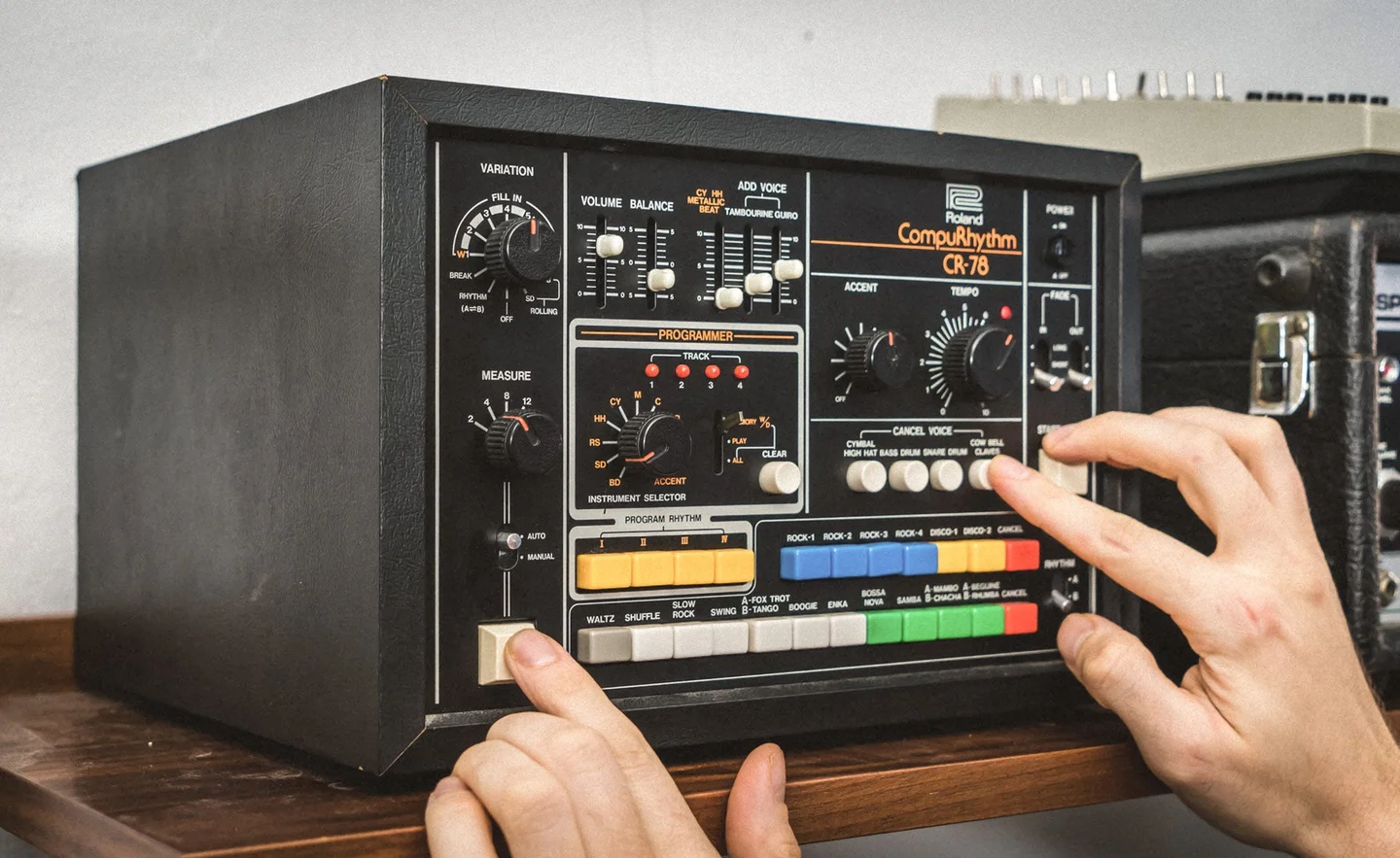 | Analog | Preset patterns, limited user memory | Analog | Analog voices arriving with the rhythm still mostly decided for you. |
Roland TR-808 (1980)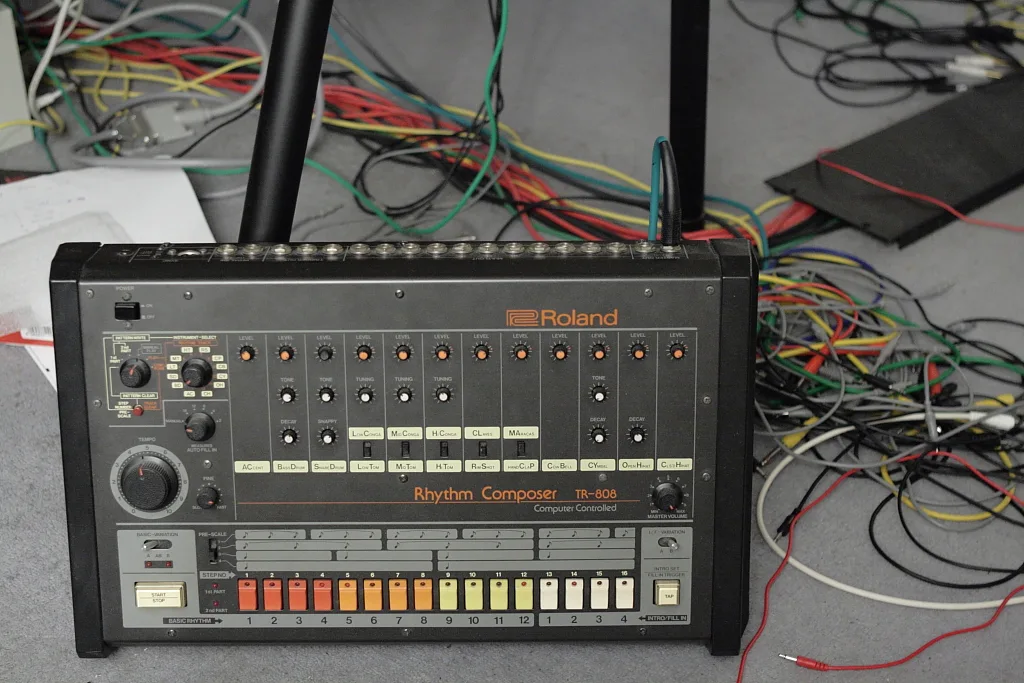 | Analog on every voice | Step sequencer | Analog | The reference point for what “analog drum machine” means to most people. |
Oberheim DMX (1981)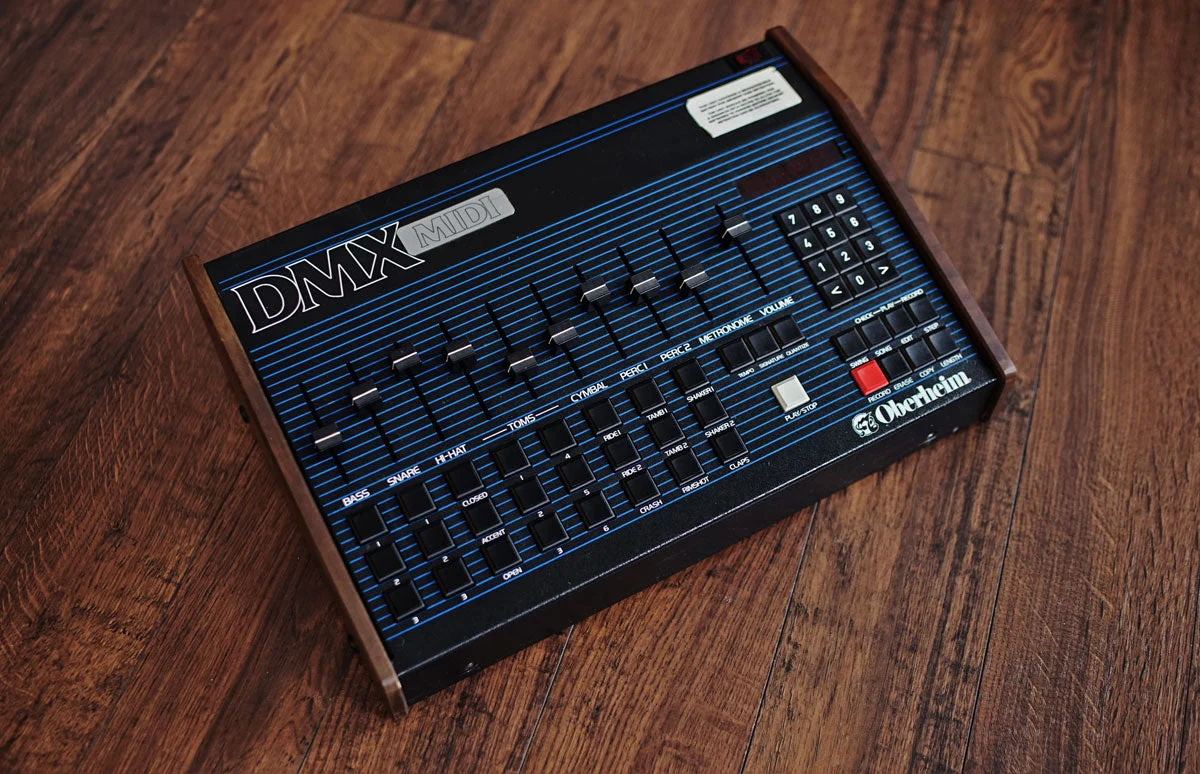 | 8-bit digital samples | Step sequencer | Digital | The machine under a great deal of early hip-hop. Sounds gritty, not analog. |
Simmons SDS-V (1981)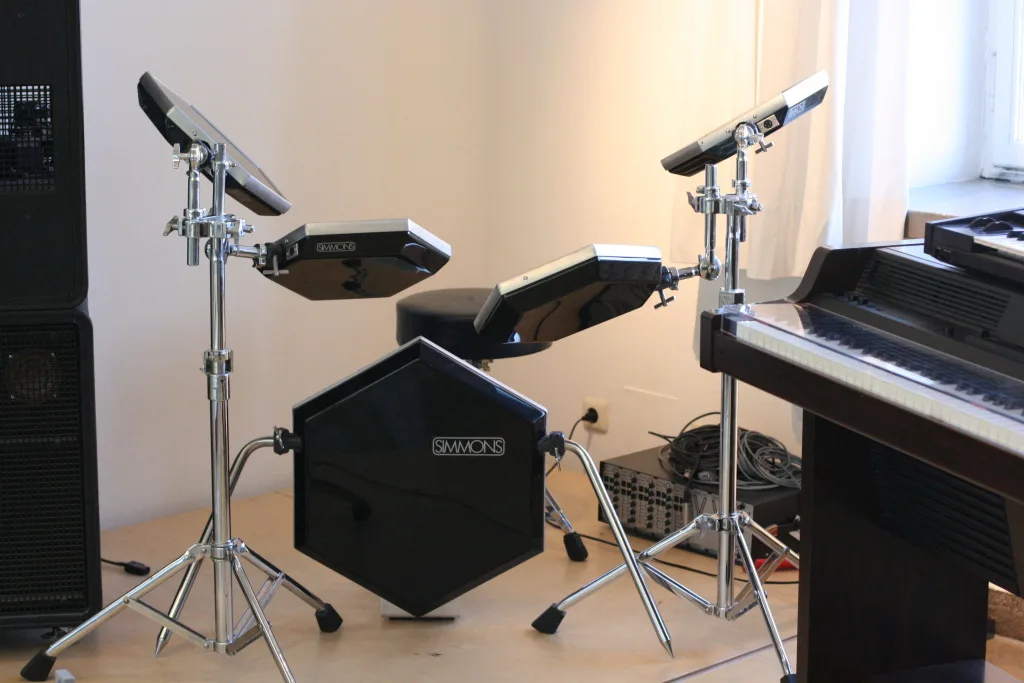 | Analog | None; pads and triggers | Analog percussion synth | A percussion synthesizer played by a drummer rather than programmed. |
Linn LM-1 / LinnDrum (1980–82)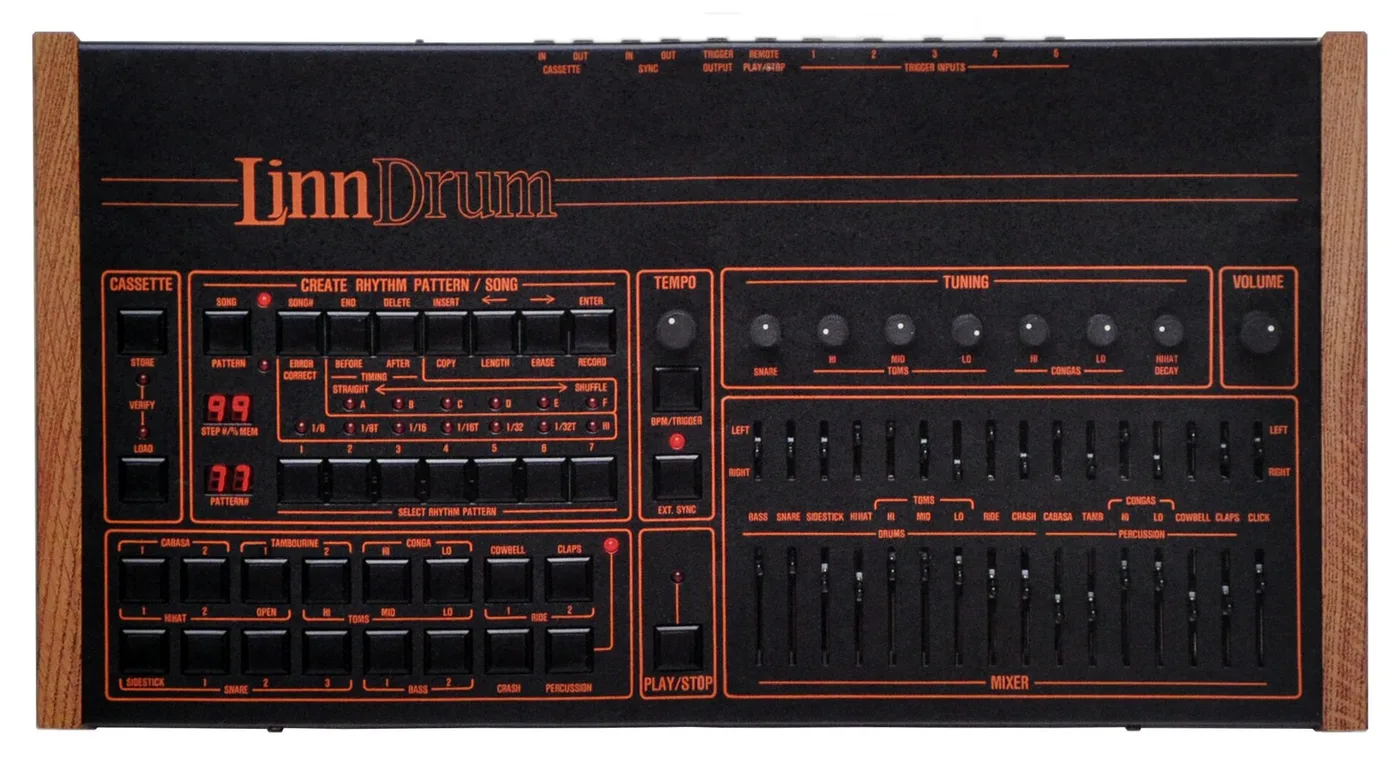 | Digital samples | Step sequencer | Digital | Sold specifically on not sounding synthetic. Not analog in any useful sense. |
Roland TR-909 (1983)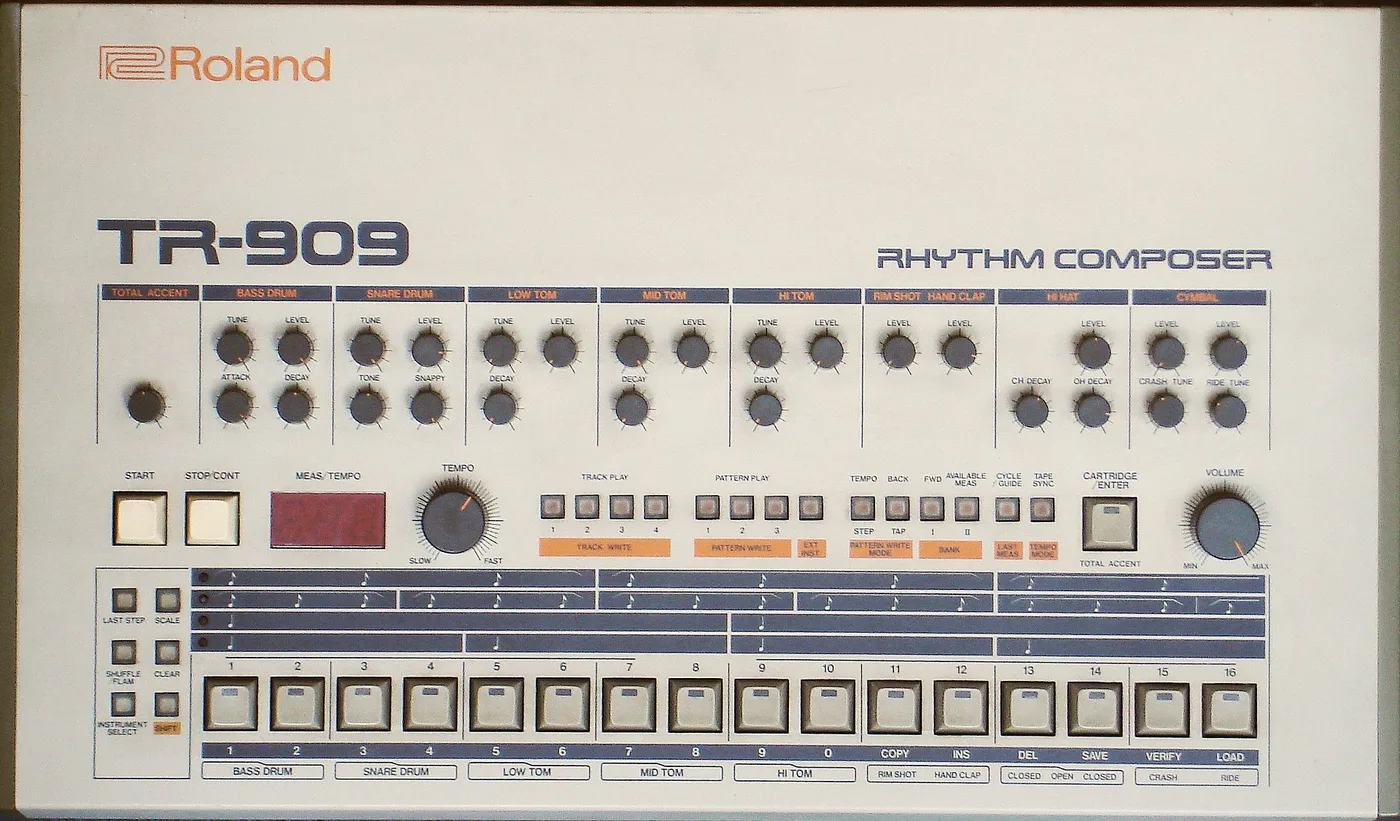 | Analog kick, snare, toms, rim, clap; sampled hats and cymbals | Step sequencer | Hybrid | Kick, snare and toms are circuits. Hats, crash and ride are 6-bit samples in ROM. |
Formanta Rockton, Lel UDS (1980s) | Analog | Pads and external pulses; Rockton adds preset patterns | Analog percussion synth | The Soviet reading of the same idea, with the synthesis left on the panel. |
Elektron Analog Rytm (2014)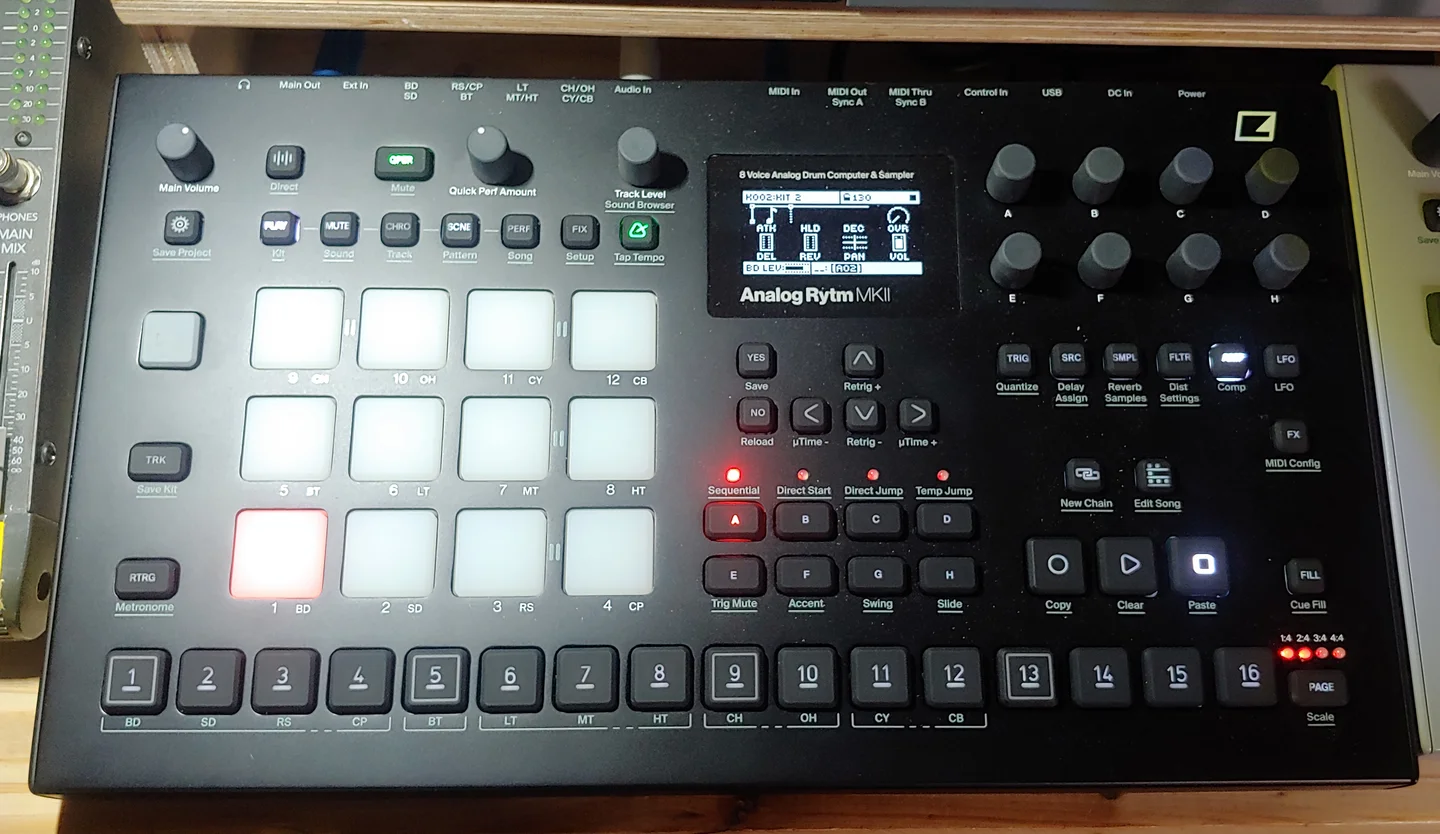 | Analog, with an optional sample layer per voice | Step sequencer | Hybrid, analog first | The sample can be blended in or left off, so the analog path is fully usable on its own. |
Arturia DrumBrute (2016)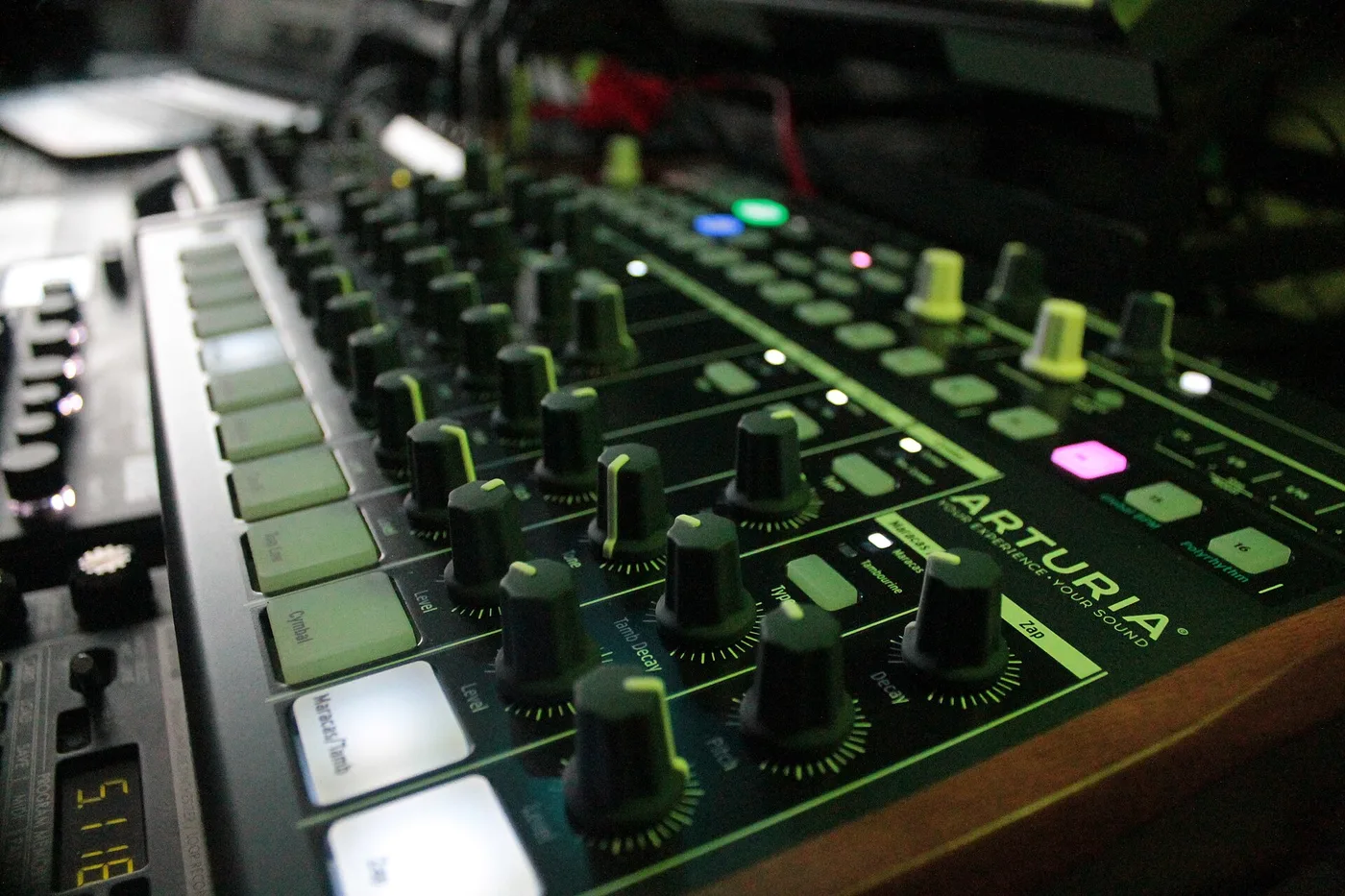 | Analog | Step sequencer | Analog | Current-production analog voices with pitch and decay per voice, plus a Steiner-Parker filter on the output. |
Behringer RD-8 / RD-9 (2019–21)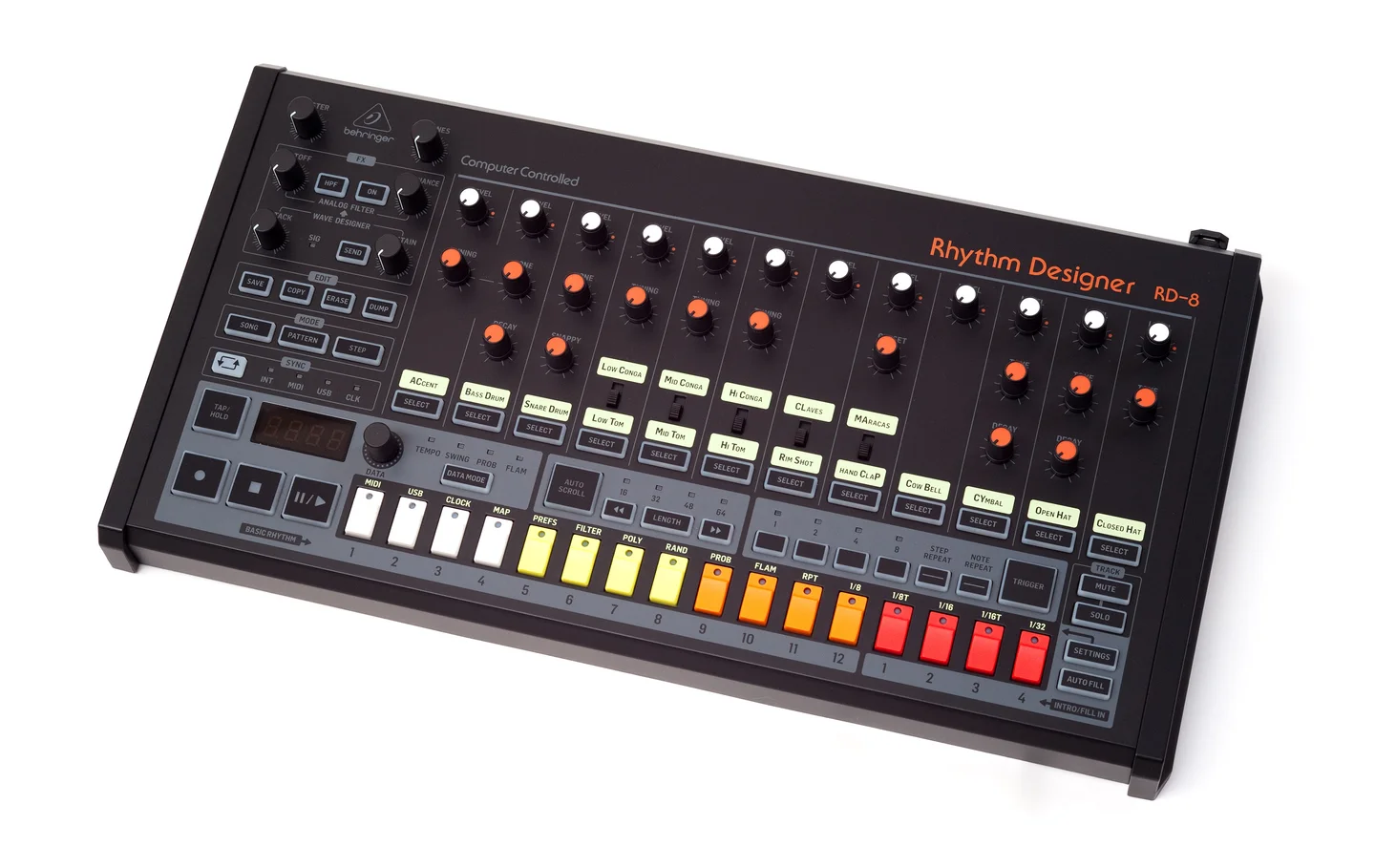 | Analog; the RD-9 keeps the 909-style sampled cymbals | Step sequencer | Analog / hybrid | Low-cost recreations of the two Roland circuits, hybrid where the original was hybrid. |
Roland TR-8S (2018)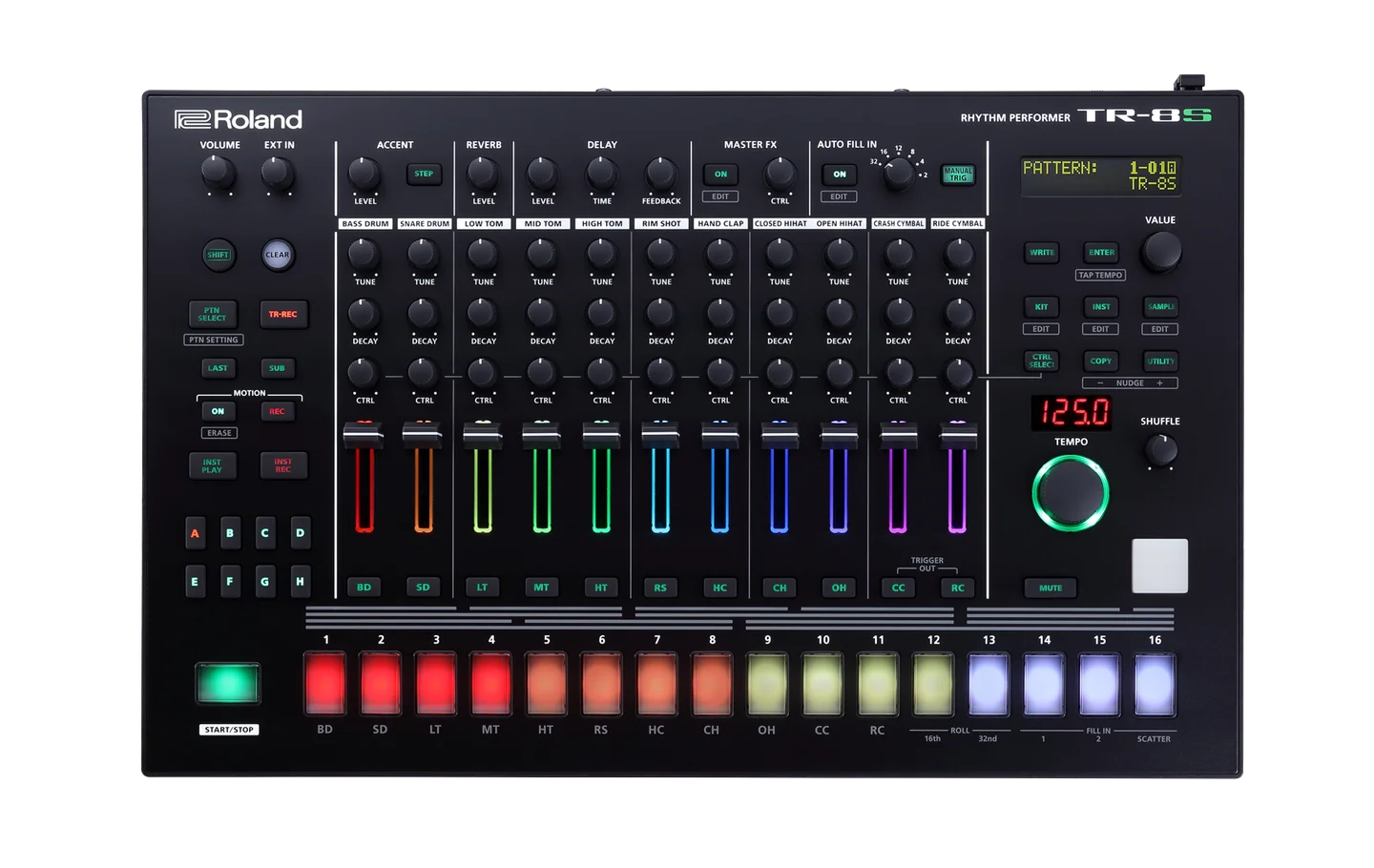 | Digital circuit models and samples | Step sequencer | Digital | Looks like the family, sounds close, but every voice is computed in software. |


Individual units vary. Revisions, factory options, repairs and modifications all move the details, so a schematic for the specific machine beats any summary table including this one.
Four panels, four different answers
You can usually tell what a machine does from its front panel before you hear a note. Controls exist where there is something to control, so the knob layout is a reasonably honest map of the circuitry behind it.
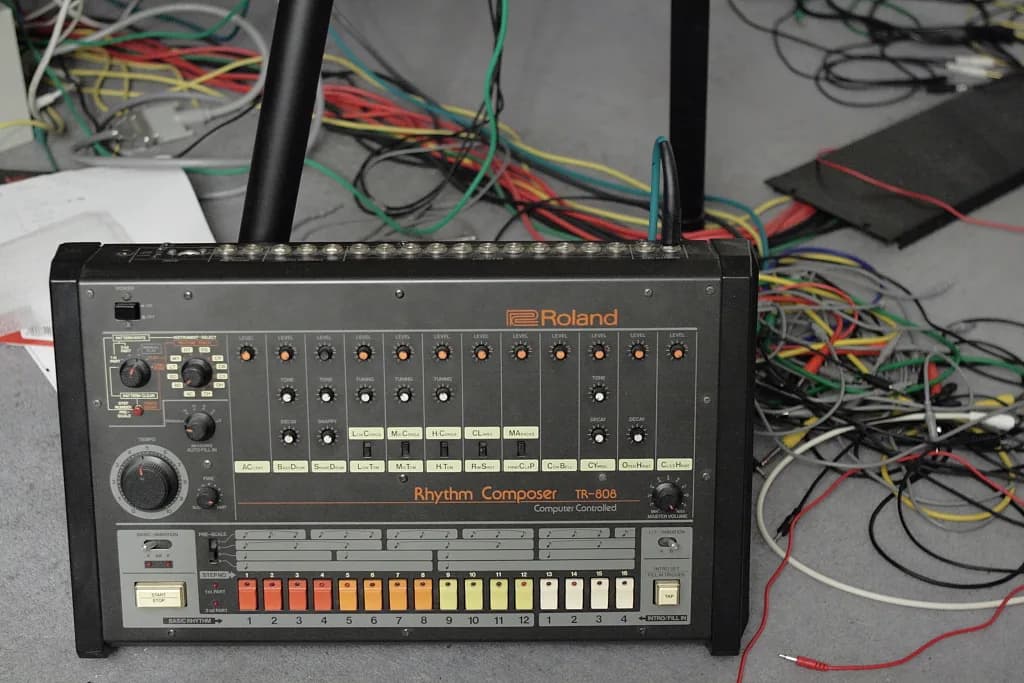
Analog throughout
Roland TR-808
Read the knob rows: every voice gets its own tone, tuning or decay control, because every voice is a circuit that will respond to one.
Photo fr4dd · CC BY 2.0 · via Wikimedia Commons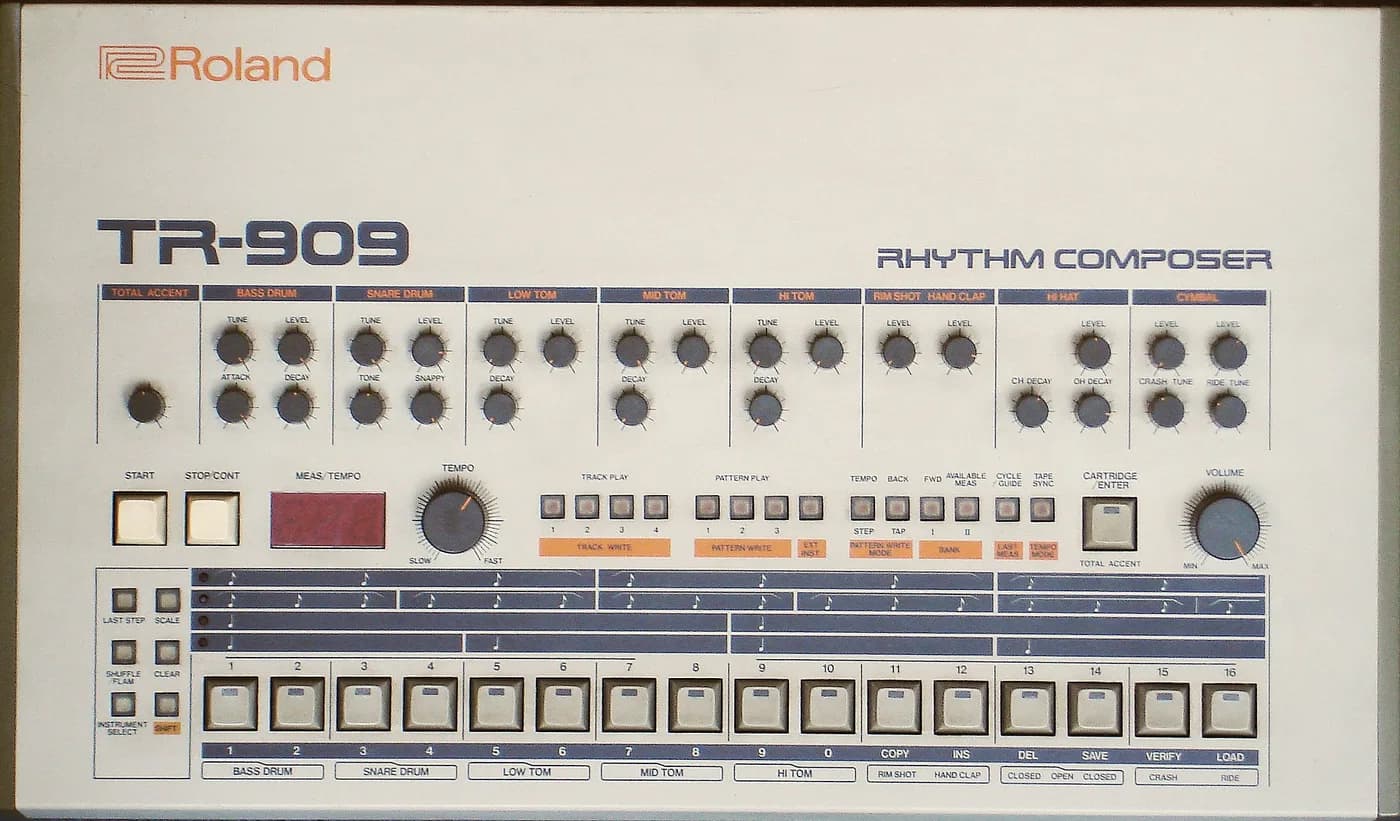
Analog, with sampled cymbals
Roland TR-909
The hybrid is visible on the panel. Bass drum gets tune, attack and decay. Hi-hat and cymbal get level and a decay or tune trim, because a sample has far less to adjust.
Photo User:909 bd · CC BY-SA 3.0 · via Wikimedia Commons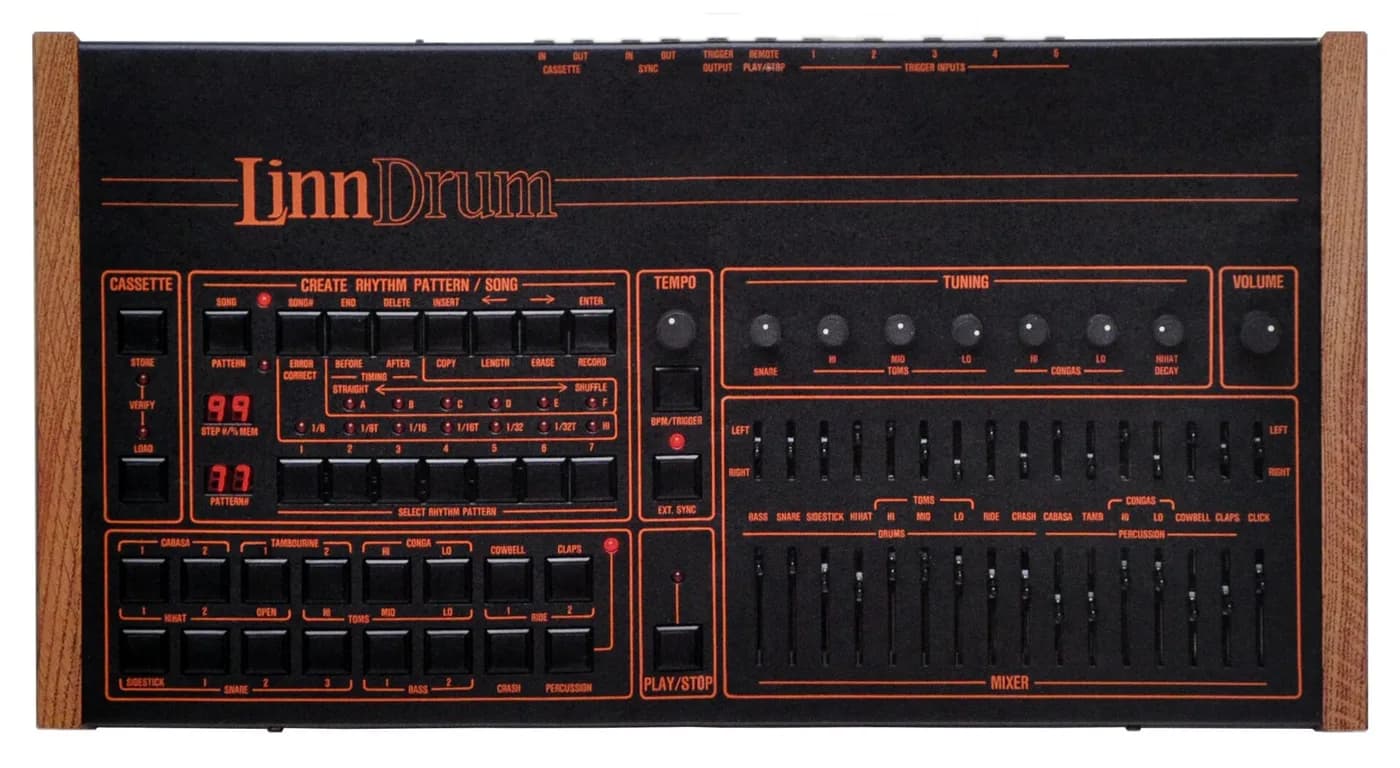
Digital samples
LinnDrum
A mixer and a tuning row, and that is the extent of the sound design. There is no synthesis to expose because each voice is a recording.
Photo Linn Electronics, released by Bruce Forat · CC BY-SA 3.0 · via Wikimedia Commons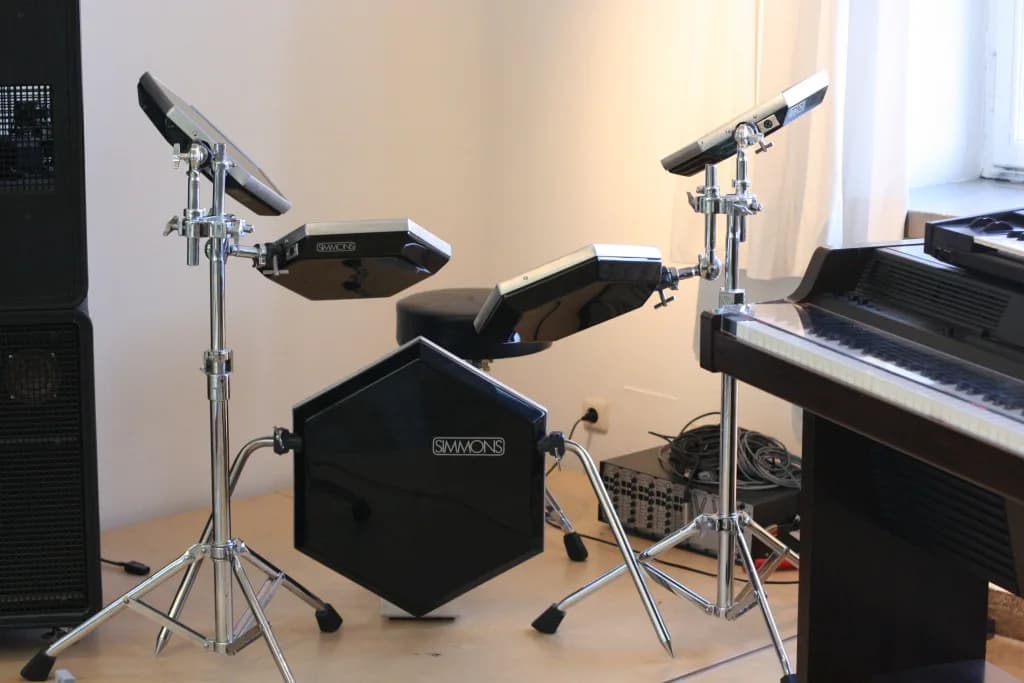
Analog, no sequencer
Simmons SDS-5
The hexagonal pads are the whole argument. Analog voices live in a rack unit; the timing arrives from a drummer hitting something.
Photo Wolfgang Stief · CC BY 2.0 · via Wikimedia CommonsFor the wider story of these machines, including the digital ones that followed, see our history of vintage drum machines. The category did not end in 1984, though, and the same per-voice test sorts the machines in shops now, which is where the next section picks up.
05 / Buying one today
Analog drum machines you can buy today
At the time of writing you can buy eight drum machines with analog voices new, from the Korg Volca Beats and Behringer RD-6 at under $200 to the Elektron Analog Rytm MKII and Roland TR-1000 above $2,000. Three of them are analog on every voice, five mix circuits with samples or digital engines, and the table adds a ninth, the Roland TR-8S, because it is so often filed with them and is digital throughout.
Apply the same test as before, voice by voice, and a pattern shows up. The hybrids draw the line in roughly the same place: circuits for kick, snare and toms, where a ringing filter and a pitch sweep do the job well, and samples for some or all of the noisy, metallic sounds, cymbals above all, which a handful of oscillators has always struggled to imitate. Roland made that choice for the TR-909 in 1983, and Korg and Behringer make it now. It is a sound engineering decision, not a shortcut, but it does mean the hi-hat on a “hybrid analog” machine will not respond to a knob the way the kick does.
After “analog or hybrid”, the column that changes how you work is outputs. A machine with individual outs lets you record every voice to its own track in a DAW and compress the kick without touching the hats. A machine with a single mix out commits you to its internal balance at the moment you press record, which is fine for a sketch and limiting for a finished track.
| Machine | Analog or hybrid | Voices | Sequencer | Outputs | Price band* | Who it suits |
|---|---|---|---|---|---|---|
| Korg Volca Beats | HybridAnalog kick, snare, toms and hi-hats; PCM clap, claves, agogo and crash | 10 parts | 16 steps, 8 pattern memories, motion recording | One mixed line/headphone out; sync in and out; MIDI in | Under $200 | A first box, a travel kit, or learning what each analog knob does. Runs on batteries; no individual outs. |
| Behringer RD-6 | AnalogTR-606-style circuits with an analog distortion stage | 8 drum sounds | TR-style step sequencer, 32 patterns, songs up to 256 bars | Mix out plus per-voice outs; headphones; MIDI over USB and DIN | Under $200 | Thin, clicky 606-type patterns and distorted drums on the smallest budget. |
| Behringer RD-8 MkII | AnalogTR-808-style circuits on every voice, hats and cymbal included | 16 drum sounds on 11 voice circuits | 64 steps, 256 patterns, 16 songs | Mono mix plus 11 individual outs | $200–450 | The 808 layout with multitrack outs, for anyone who records each voice to its own channel. |
| Behringer RD-9 | Hybrid7 analog voices; hi-hats, ride and crash are samples, as on the TR-909 | 11 drum sounds | 64 steps, 64 patterns, 16 songs | Main out plus 10 individual outs | $250–400 | House and techno programmers who want the 909 layout, hybrid design included, at a low price. |
| Arturia DrumBrute Impact | AnalogEvery sound is a circuit, including an FM percussion voice | 10 sounds: kick, two snares, two toms, cymbal, two hats, cowbell, FM | Up to 64 steps, 64 patterns, per-track length for polyrhythms | Main out plus 4 grouped outs (kick, snares, hats, FM); headphones | $250–400 | Hard, driven techno and industrial patterns. No clap, and the separate outs are grouped. |
| Korg drumlogue | HybridAnalog kick, snare and two toms; hats, clap, rim shot and two sample parts are digital, plus a multi-engine | 11 parts | 16-step pages, up to 64 steps | Stereo main plus 4 assignable outs | $350–600 | Analog weight at the bottom with sample and synth flexibility on top. User synths load onto the multi-engine. |
| Roland TR-8S | DigitalACB circuit models of the TR-808, 909, 606, 707 and 727, plus FM and samples | 11 tracks | TR-REC step sequencer | Mix out plus 6 assignable outs | $600–800 | Listed because it is often called analog and is not. Buy it for range and sample import, not for circuits. |
| Elektron Analog Rytm MKII | Analog + sample layerAn analog voice and an optional sample on each of 8 voices; analog filters, overdrive and compressor | 8 voices across 12 tracks | Up to 64 steps, per-track length, parameter locks | Stereo main plus 8 individual outs; 2 audio inputs | $2,000–2,500 | A deep, self-contained centerpiece for live sets or a studio. Expect a learning curve measured in weeks. |
| Roland TR-1000 | Hybrid16 analog instruments (10 from the TR-808, 6 from the TR-909) alongside ACB, PCM, FM and a sampler | 10 sound tracks plus a trigger track | TR-REC, 16 steps × 8 variations, probability, off-grid timing | Mix out, analog FX out, 10 jacks for individual outs or triggers | $2,500–3,000 | Roland’s own analog circuits back in a flagship, with every digital engine it makes beside them. The highest price here. |
* Approximate US street price, new, at the time of writing (September 2026). Prices move, and regional pricing differs; check before you buy. Specifications come from each maker’s product page or manual. We have not tested these machines hands-on for this article, so “who it suits” is our reading of the published design, not a review.
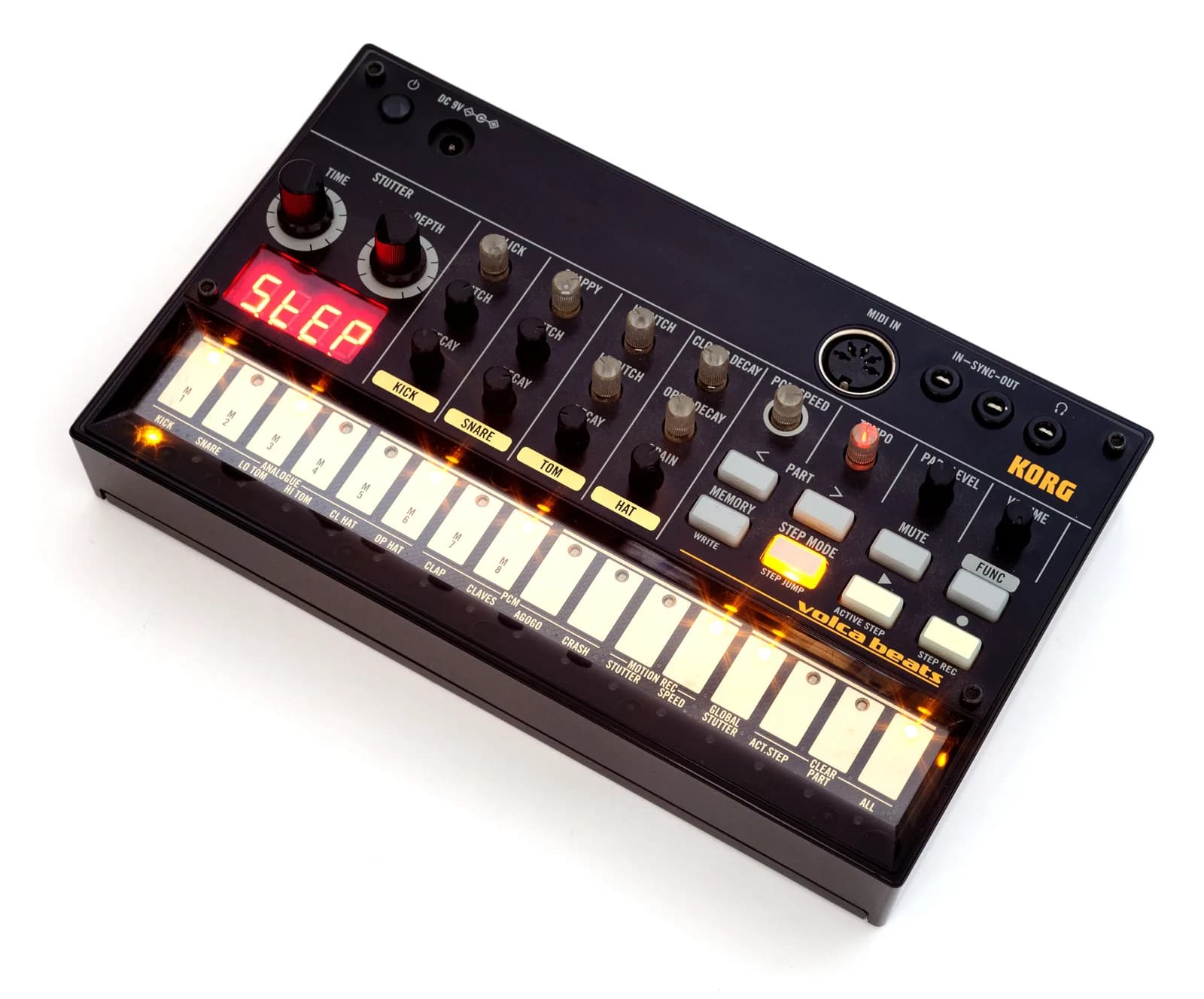
Hybrid · under $200
Korg Volca Beats
The yellow-labelled sections (kick, snare, tom, hat) are the analog parts and get real controls. Clap, claves, agogo and crash are PCM and share a single speed knob.
Photo Ashley Pomeroy · CC BY-SA 4.0 · via Wikimedia Commons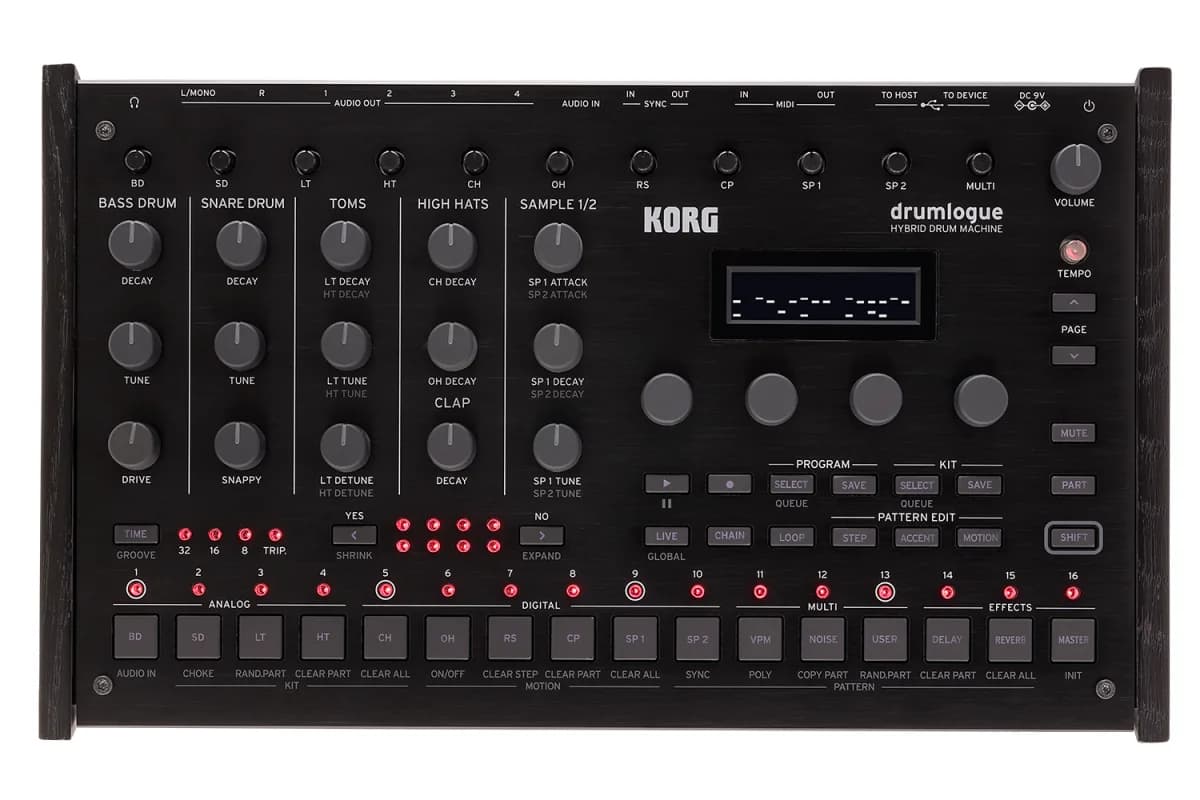
Hybrid · $350–600
Korg drumlogue
The panel prints the split for you: BD, SD, LT and HT under “Analog”, hats, rim, clap and the two sample parts under “Digital”.
Image Korg · via Korg product page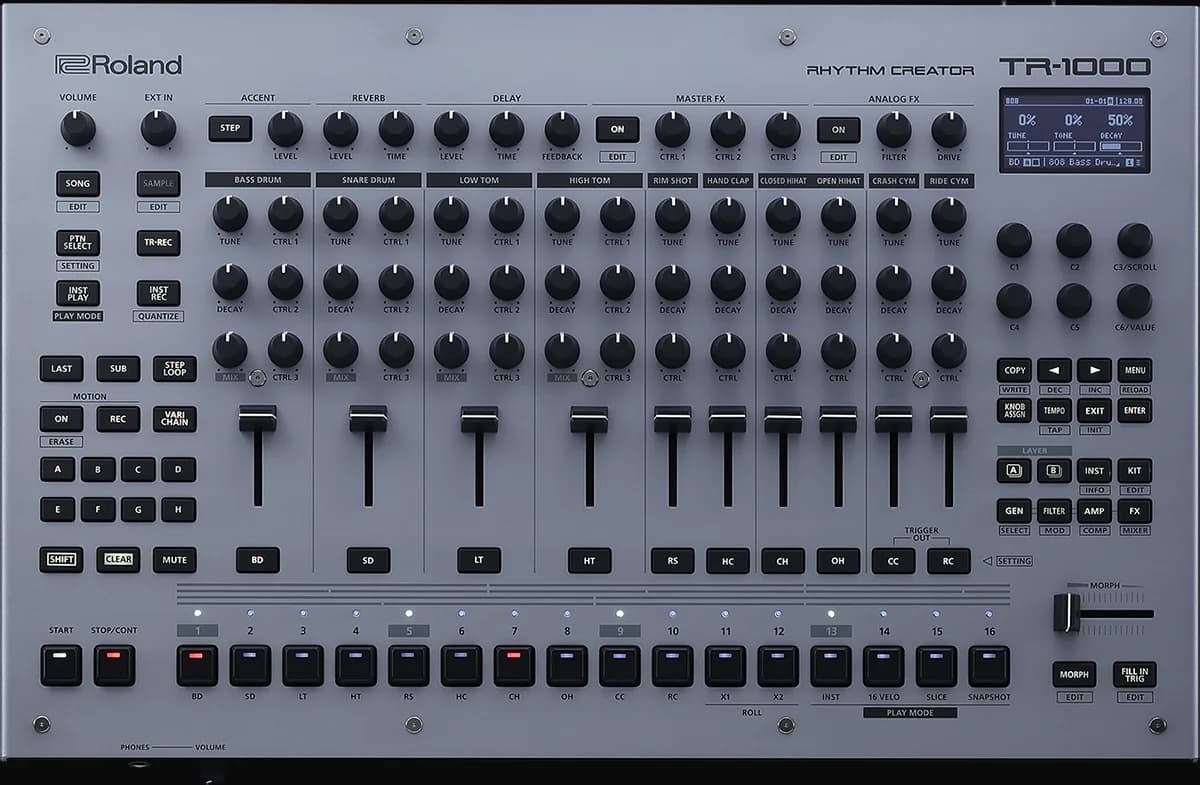
Hybrid · $2,500–3,000
Roland TR-1000
A fader and at least three knobs per instrument, laid out like a TR-808 or TR-909. Behind them sit 16 analog instruments and Roland’s digital engines, layered per track.
Image Roland · via Roland product pageWhich one: six situations, six honest trade-offs
Start from what you will do with it, not from the spec sheet. Each of these is a real trade, and none of the cheaper options is a lesser instrument for the job it suits.
Under $200, to learn on
The Korg Volca Beats runs on batteries and fits in a coat pocket, but it has one mixed output and its clap and crash are samples. The Behringer RD-6 is analog on every voice and has separate voice outs, at the cost of the TR-606’s small, light palette. Pick the Volca to carry, the RD-6 to record.
The 808 or 909 sound, recorded properly
The Behringer RD-8 MkII and RD-9 exist to put those two layouts on a desk with individual outs for every voice. They are recreations of existing designs rather than new instruments, and the RD-9’s hats and cymbals are samples, exactly as on the machine it follows.
Analog low end, flexible top
The Korg drumlogue keeps kick, snare and toms analog and hands everything else to samples and a programmable multi-engine. It is the sensible hybrid if you want circuits where they matter most. The trade is four assignable outs rather than one per voice.
Every voice a circuit, with an edge
The Arturia DrumBrute Impact is analog throughout and lets each track run its own length for polyrhythms. It has no clap, and its separate outputs are grouped (the two snares share one, the hats another), so treat it as a character machine rather than a multitrack source.
One instrument to build a set around
Above $2,000 the choice is the Elektron Analog Rytm MKII or the Roland TR-1000. The Rytm is a per-step programming instrument with an analog voice and a sample layer on each of eight voices. The TR-1000 puts Roland’s own 808 and 909 analog instruments next to every digital engine Roland makes. If those two machines are your reference points, that settles it.
If you do not actually need circuits
The Roland TR-8S is digital, and Roland does not claim otherwise: it trades circuits for range, with five Roland machines modeled and your own samples on top. If what you want is the sound inside a DAW rather than a box to play, a plugin costs less than most of these and never needs servicing.
One thing missing from the table on purpose: our own UDS-16 is a plugin, not a box, so it has no outputs to count and no sequencer to compare. It belongs with the software options further down.
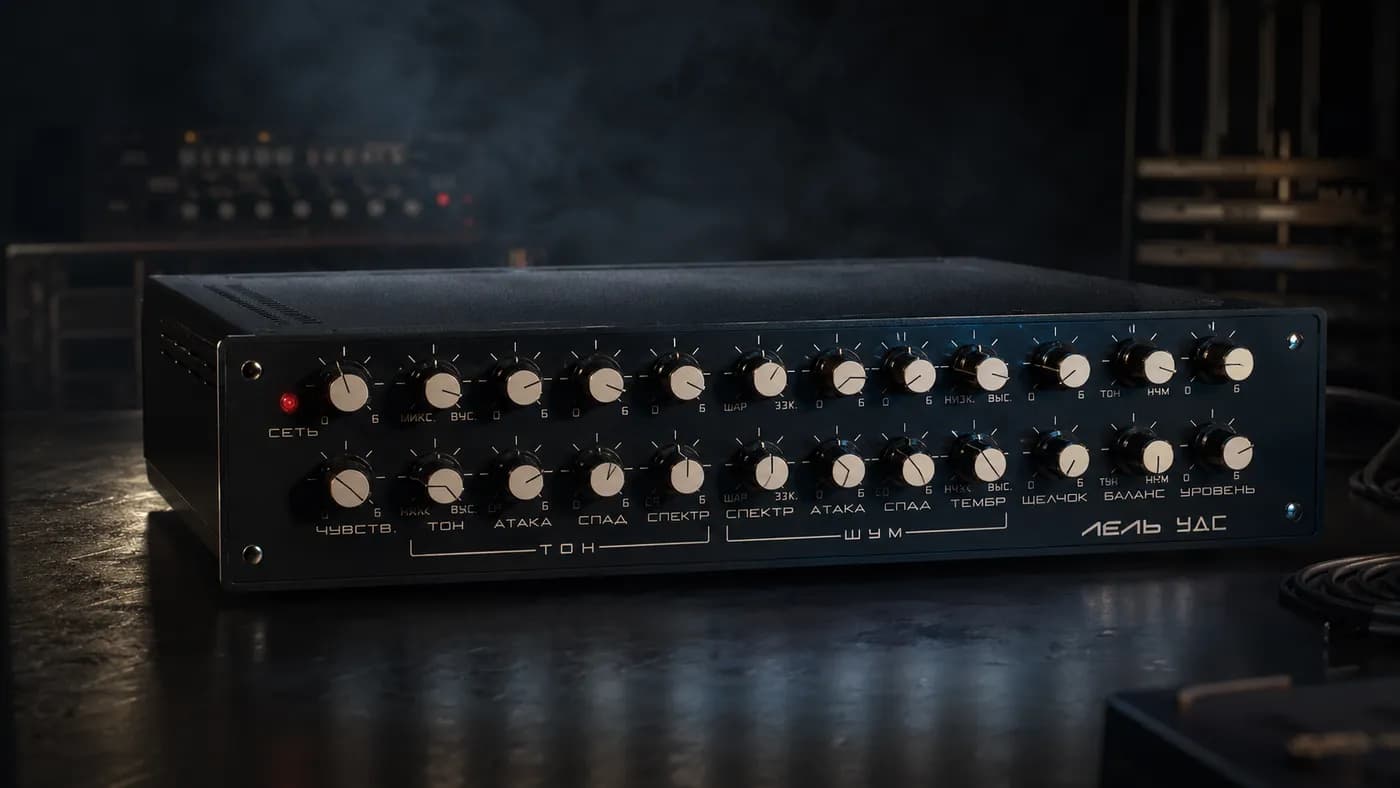
Tapechild product visualization · not an archival photograph
06 / Drum synths
Analog drum synthesizers vs analog drum machines
An analog drum synthesizer is the voice half of a drum machine on its own: circuits that turn a trigger into a drum sound, played from pads, trigger inputs or MIDI rather than from a pattern memory. A Roland TR-808 has both halves. A Simmons brain or a Soviet Lel UDS has only the voices, and waits for pads or an external pulse to supply the rhythm.
Take the voice section out of a drum machine, put pads or trigger inputs on the front, and you have an analog percussion synthesizer. Simmons built the best-known Western examples, where a drummer struck hexagonal pads and a rack unit synthesized the result. Soviet manufacturers arrived at a similar arrangement from a different direction, with the Formanta and Lel UDS families exposing tone, noise, click and decay directly on the panel.
These instruments are not a lesser category. They are the same synthesis with the timing decision handed back to a human or to whatever sequencer you already own, which in a modern studio is usually the better arrangement. Drive one from a DAW and the distinction disappears in use. The search phrase “analog drum synth” usually means exactly this: voices without a pattern memory, played from something else.
The trade is real, though. Without internal memory you cannot pick the box up and play a pattern, and trigger sensitivity becomes something you have to get right rather than something the machine handles for you. If the thing you want is to stand at a table and program a groove with your hands, buy the sequencer half; the voices alone will frustrate you.
Analog drum synths you can buy now: DFAM and Eurorack
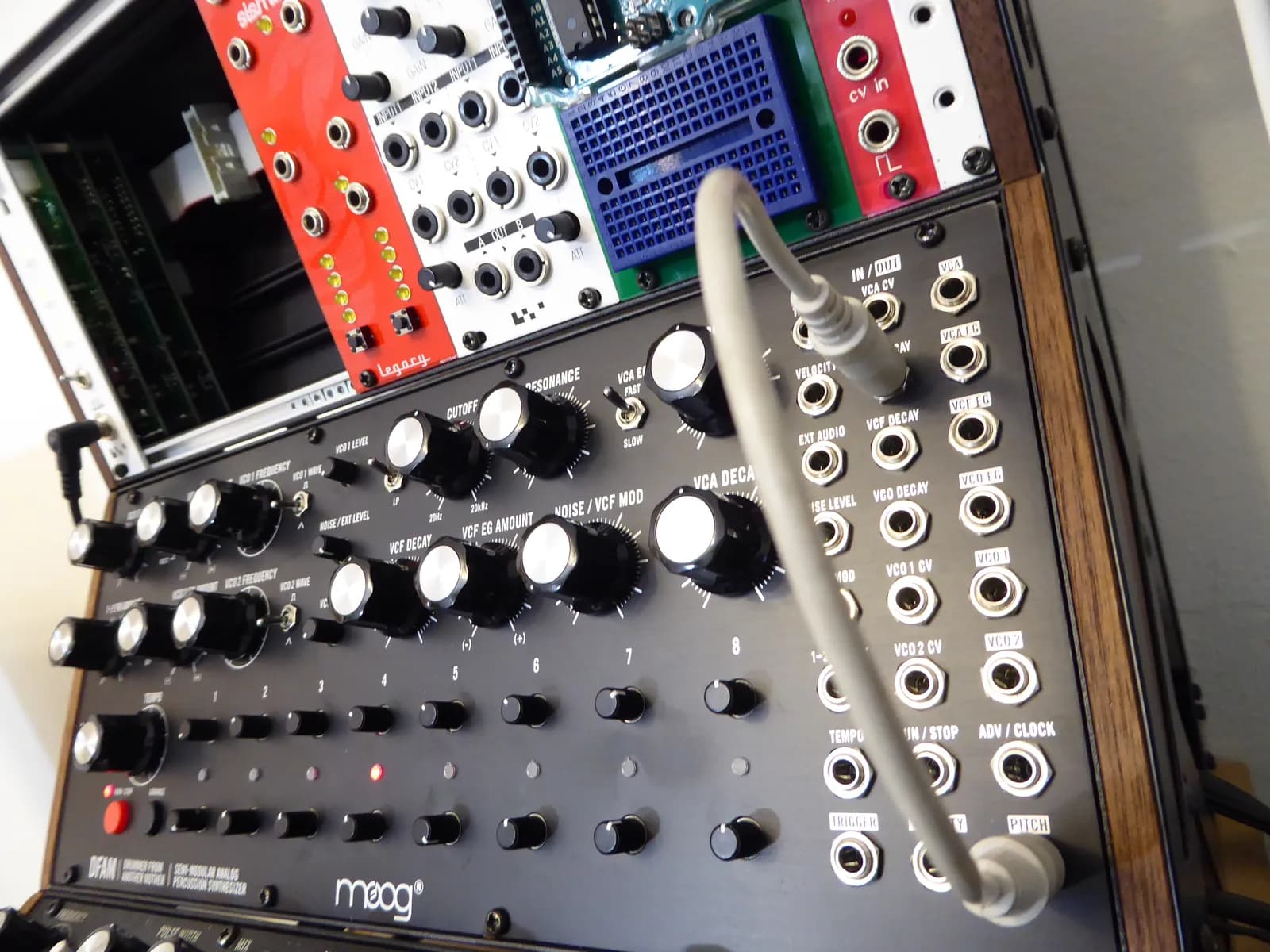
Analog percussion synth
Moog DFAM
One voice, two oscillators and noise, eight steps of pitch and velocity. The patch bay on the right is what makes it a synth first and a drum machine second.
Photo Audiotecna Música · CC0 · via Wikimedia CommonsThe best-known current example is Moog’s DFAM (Drummer From Another Mother), a semi-modular analog percussion synth. Two oscillators and a noise source run through a resonant filter, and an eight-step sequencer sets pitch and velocity per step. It sits between the two categories: it has a sequencer, but only eight steps for a single voice, so a kit means several units or a DAW doing the layering. It rewards patching more than pattern programming.
Eurorack takes the idea to its end point. Individual modules cover a single voice each (a kick, a snare, a hat, a clap), including many that follow the TR-808 and TR-909 circuits, and any sequencer that sends gates can play them. It is the most flexible route and the most expensive per voice, because every module also needs a case, power and something to trigger it.
Every one of these voices is built from the same parts described earlier, and our drum synthesis guide walks through them one voice at a time. If you want that synthesis without buying a case, the instruments in our comparison of drum synth plugins do the same job in software.
07 / Vintage units
Why vintage analog drum machines drift
Start with component tolerance. Consumer-grade resistors in 1980 were commonly rated to 5 percent, electrolytic capacitors to 20 percent or worse, and the tuning of every resonant network and the length of every envelope depends on a product of those values. Two kicks built from the same schematic can land a noticeable distance apart in pitch and decay before anyone touches a trimmer. Factories trimmed the important ones; the rest were left to fall where they fell.
Then temperature. The junction voltage of a silicon transistor moves by roughly two millivolts for every degree Celsius, and a drum voice is a small collection of transistors whose bias points set the ring frequency, the envelope slope and the gain of the output amplifier. A machine that has been switched on for twenty minutes is not the machine that was switched on cold, which is why experienced users leave a unit running before a session and why a warm room and a cold room produce different kicks from the same box.
Age finishes the job. Electrolytic capacitors dry out and lose capacitance, so decays shorten and tunings creep. Potentiometers wear and add noise. Tantalum capacitors fail outright. Small inconsistencies of this kind are pleasant on percussion, where an exactly identical repeat reads as mechanical, but they also mean that an untouched forty-year-old machine is not a reliable reference for how that machine sounded new.
A larger part of the vintage sound is everything that happened after the output jack. The records that made these machines famous went through desks, compressors, tape and cutting chains, and were arranged by people who knew what to leave out. If you buy a vintage machine expecting the record, the machine alone will not deliver it. This is the least popular thing to say about vintage gear and the most useful.
Condition matters more than provenance. Aged capacitors, worn potentiometers and past repairs all change calibration, and a unit that has been recapped and trimmed may sit closer to the original specification than an untouched one. Ask what has been done to it.
08 / Software
Analog drum machine plugins vs sample packs
Most people who search for an analog drum machine end up buying software, and the choice inside software is the one that actually changes how you work. A sample pack is a set of recordings of a machine: each hit captured once, at one tuning, one decay, one level, through one signal chain. A modeled plugin is a recreation of the circuit: it computes the hit from the same ingredients the hardware used, so tune, decay and tone stay live while the pattern runs.
Neither is the wrong answer. They are good at different jobs, and the honest comparison is job by job.
| Criterion | Modeled plugin | Sample pack |
|---|---|---|
| Tune, decay and tone | Live per hit; change them while the pattern runs | Frozen at the settings the hit was recorded with |
| Dynamics | Continuous; velocity drives the circuit, not a layer switch | Stepped; a few velocity layers, often one |
| Hi-hats and cymbals | Synthesized, so they sound electronic by design | Can be real cymbals, which no analog circuit does well |
| Disk and CPU | A few megabytes; some DSP per voice | Anywhere from a few MB to many GB; almost no CPU |
| Sound of the record | Yours to build, including the mistakes | Closer out of the box if the pack was captured through the right chain |
| Cost | One-time purchase, typically less than any hardware | Free to modest; many vintage-machine packs are free |
Reach for samples when the sound is already decided and you want it fast: a reference kick under a sketch, a layer of real cymbals over a synthesized kit, or loops that drop straight into an arrangement. Our free sample packs are royalty-free WAV for exactly that use, and they cost nothing but an email address. Reach for a modeled instrument when the sound is still being written: when the kick needs to sit under a specific bassline, when the snare decay has to follow the tempo, or when a pattern wants a different tuning on every fourth hit. Those are edits in a sampler and gestures in a synth.
For a criteria-led comparison of the instruments in the second category, including the ones that compete with ours, see our guide to the best drum synth plugins.
And the two hardware routes
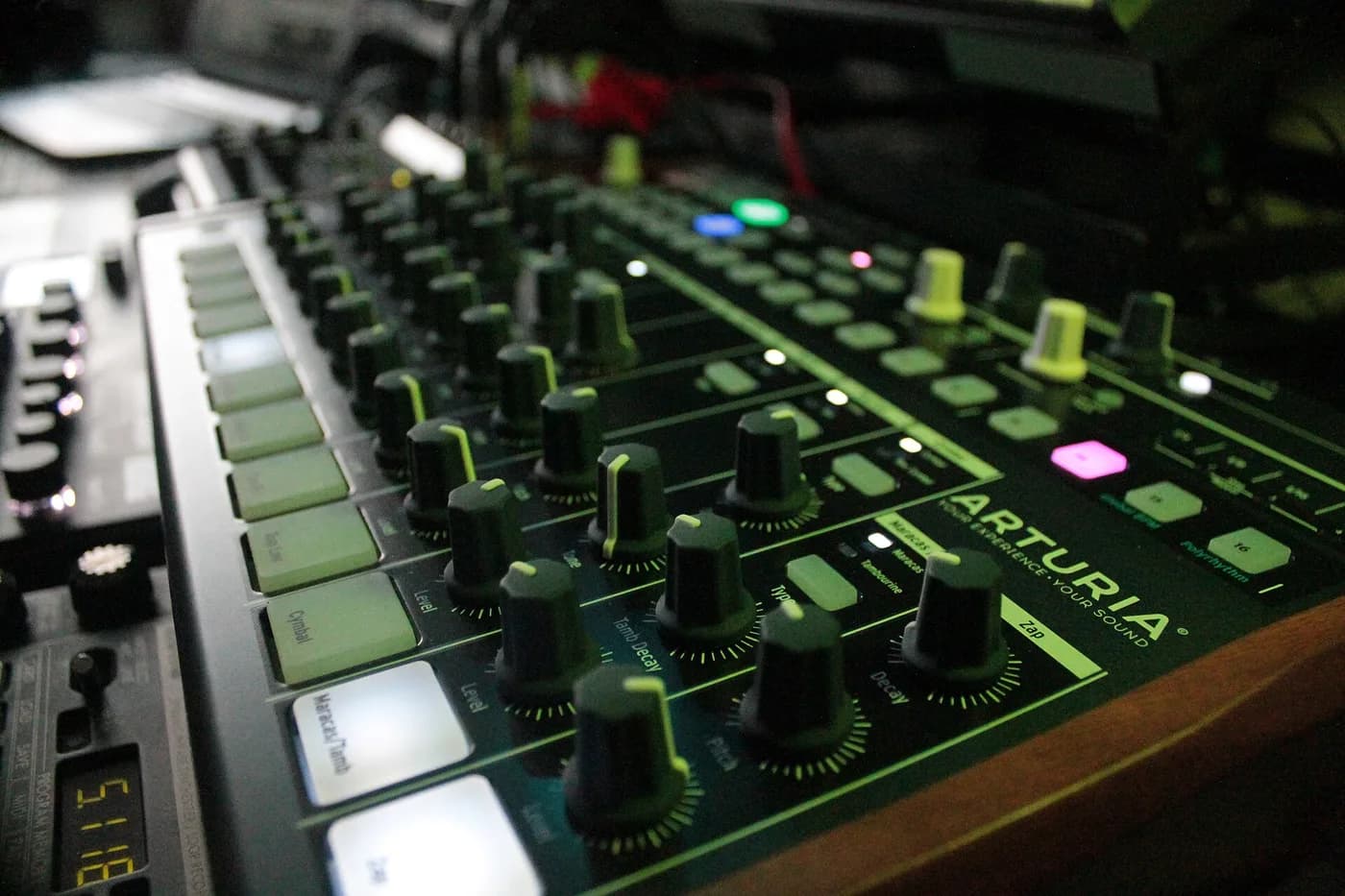
Modern analog, 2016
Arturia DrumBrute
Pitch and decay per voice on a design from this century. The controls exist for the same reason they did in 1980.
Photo rotten77 · CC0 · via Wikimedia CommonsVintage hardware
Real circuits and real history, at collector prices, with servicing as an ongoing commitment rather than a one-off. Check the market before assuming a figure; it moves.
Current-production analog
Several manufacturers still build genuinely analog voices, some fully analog, some analog with a digital sample layer. The cheapest honest route to circuits, and the only route to a box you play with your hands.
If you want to play patterns on a physical box, hardware with a sequencer wins and software will not replace it. If you want the voices inside an arrangement you are already building in a DAW, a modeled instrument gets you there for a fraction of the cost and does not need recapping in ten years.
09 / Our product
Tapechild UDS-16: a modeled analog drum synth
This is the section where we talk about our own instrument, so read it as such. UDS-16 follows the Soviet percussion-synthesizer approach described above: tone, noise, transient and time-based shaping, generated per hit rather than replayed. It offers four synthesis models: two inspired by the Lel UDS, one by the Formanta Rockton, and one Tapechild original. Sixteen voices, every one synthesized in real time, no samples anywhere in the signal path.
It is the voice half only. There is no step sequencer; timing comes from your DAW, which is the arrangement the percussion-synth section argued for. Built-in Tape and Gated Reverb processors cover the part of the vintage sound that happened after the output jack. It runs on macOS 11 and later as VST3, AU and standalone, and on Windows 10 and 11 as VST3 and standalone, with up to 4x oversampling and 40 presets. One-time purchase, $49, three machines, 14-day refund.
Independence notice
Tapechild UDS-16 is not an official reissue and is not affiliated with, endorsed by or manufactured by Roland, Simmons, Linn, Oberheim, Elektron, Arturia, Behringer, the original Soviet-era makers or their successors. Historical names are used only to identify the instruments discussed.
10 / Credits
Image credits
Photographs come from Wikimedia Commons, Roland, Korg and Samples From Mars. Each image links to its source; Creative Commons photographs carry their author and licence credits, and product images are credited to their makers. Images have been resized and converted to WebP for the web. The signal-path, envelope and voice-source diagrams are ours.
- Roland TR-808fr4dd · CC BY 2.0 · source
- Roland TR-909User:909 bd · CC BY-SA 3.0 · source
- LinnDrumLinn Electronics, released by Bruce Forat · CC BY-SA 3.0 · source
- Simmons SDS-5Wolfgang Stief · CC BY 2.0 · source
- Arturia DrumBruterotten77 · CC0 · source
- Korg Volca BeatsAshley Pomeroy · CC BY-SA 4.0 · source
- Korg drumlogueKorg · Korg product page · source
- Roland TR-1000Roland · Roland product page · source
- Moog DFAMAudiotecna Música · CC0 · source
Royalty-free WAV
Free sample packs
Royalty-free WAV, play every sample before you download.
11 / Questions
Frequently asked questions
What is the best analog drum machine?
There is no single best analog drum machine, because the question hides two purchases. If you want a box with a step sequencer that you play with your hands, the Roland TR-808 is the reference, and current-production machines such as the Behringer RD-8 MkII, Arturia DrumBrute Impact and Elektron Analog Rytm MKII give you real analog voices at a fraction of the vintage price. If you want analog-style voices inside a DAW arrangement, a modeled drum synth plugin is cheaper, never needs servicing and keeps every parameter live per hit. Decide which half you are buying first; the shortlist writes itself after that.
Is the TR-808 analog?
Yes. Every voice in the Roland TR-808 is generated by analog circuitry: the kick is a bridged-T resonant network knocked into ringing by a trigger pulse, the snare combines two tuned oscillators with filtered noise, and the hi-hats, cymbal and cowbell are built from six square-wave oscillators run through band-pass and high-pass filters. Nothing in the 808 signal path is a stored recording. The only digital part of the machine is the step sequencer that decides when each trigger fires, which does not touch the sound itself.
Is the TR-909 analog or digital?
Both. The Roland TR-909 generates its bass drum, snare, toms, rim shot and hand clap with analog circuits, but its hi-hats, crash and ride are short six-bit digital samples stored in ROM. That is why the low end responds to tune, attack and decay controls the way an analog machine should, while the cymbals only offer level and a decay or tune trim. If you need a fully analog machine, the 909 is not one. If you need the 909 sound, the hybrid design is the reason it sounds the way it does.
What is the difference between an analog and a digital drum machine?
Where the sound starts. An analog drum machine builds each hit at the moment of the trigger from oscillators, resonant filters and noise, so tune and decay change the circuit itself. A digital drum machine either plays back a stored recording or computes the hit in software, as the Roland TR-8S does with its circuit models. Many current machines are hybrids that use circuits for kick, snare and toms and samples for claps and cymbals, which is why it is worth checking voice by voice rather than trusting the word on the box.
Are analog drum machines still made?
Yes, from several manufacturers and at most price points. At the time of writing, Behringer builds the RD-6, RD-8 MkII and RD-9, Arturia the DrumBrute Impact, Korg the Volca Beats and the hybrid drumlogue, and Elektron the Analog Rytm MKII. Roland returned to analog voices with the TR-1000, which pairs 16 analog instruments with digital engines. Semi-modular percussion synths such as the Moog DFAM and a large range of Eurorack drum modules cover the same ground without a full drum-machine sequencer.
Is there a drum machine that sounds like real drums?
Yes, but it will not be an analog one. Machines that sound like an acoustic kit play recordings of an acoustic kit: the Linn LM-1, LinnDrum and Oberheim DMX in the early 1980s, and any sample-based drum machine or software drum library today. Analog drum machines were never trying to imitate a drummer. A ringing filter and a burst of noise produce a drum-shaped sound that is obviously electronic, and the records that made those machines famous used that quality on purpose. If realism is the goal, look for sampled or multisampled instruments rather than analog circuits.
How much does an analog drum machine cost?
At the time of writing, the spread is wide. Vintage units are collector items: a working Roland TR-808 or TR-909 typically sells well into four figures and needs periodic servicing on top. New machines with analog voices start under $200 for a Korg Volca Beats or Behringer RD-6, sit in the low hundreds for a Behringer RD-8 MkII or an Arturia DrumBrute Impact, and climb past $2,000 for an Elektron Analog Rytm MKII or a Roland TR-1000. Software is the cheapest route by a wide margin: modeled drum synth plugins commonly cost between the price of a sample pack and the price of a modest pedal, and Tapechild UDS-16 is a one-time purchase of $49. Check current prices before assuming any figure; the used market moves.
Can a plugin sound like an analog drum machine?
A modeled plugin can, because it recreates the circuit behaviour rather than a recording of it: the pitch sweep, the decay of the resonant loop, the way noise and tone are mixed, all computed per hit and all adjustable while the pattern runs. A sample pack of an analog machine can sound identical to the specific hits it captured and cannot change them afterwards. What software does not reproduce without being asked is the drift of a forty-year-old unit, which is why good models add controlled variation rather than pretending every hit is identical. For a criteria-led comparison of the current instruments, see our guide to the best drum synth plugins.
Continue reading
Go deeper on the circuits
How drum synthesis works
Kicks, snares, hats and toms built from oscillators, noise and envelopes.
HistorySoviet drum machines
Formanta, Lel, Marsh and Elsita, and why they are really percussion synths.
ComparisonBest drum synth plugins
Software instruments that create drums without samples, compared honestly.
At a glance
| Voice | Core ingredient | What shapes it |
|---|---|---|
| Kick | Ringing resonant circuit | A network tuned near 50 to 60 Hz is knocked into oscillation. Feedback controls how long it rings; a fast downward pitch bend supplies the beater. |
| Snare | Two tones plus noise | A pair of detuned oscillators gives the shell, filtered noise gives the wires. The Snappy control adjusts the noise component. |
| Hi-hat | Clashing square waves | Metal is inharmonic, so noise alone sounds wrong. The TR-808 answer was six square-wave oscillators run together into band-pass and high-pass filters. |
| Clap | Retriggered noise | One noise source, an envelope fired several times in quick succession, then a longer decaying tail. It imitates a room of hands that never quite agree. |
| Tom | Kick circuit, tuned up | Same ringing body, higher tuning, deeper pitch sweep, sometimes a little noise for the stick. Push the sweep and it stops being a tom. |