
Tapechild UDS-16 vs Microtonic: Machine or Voice (2026)
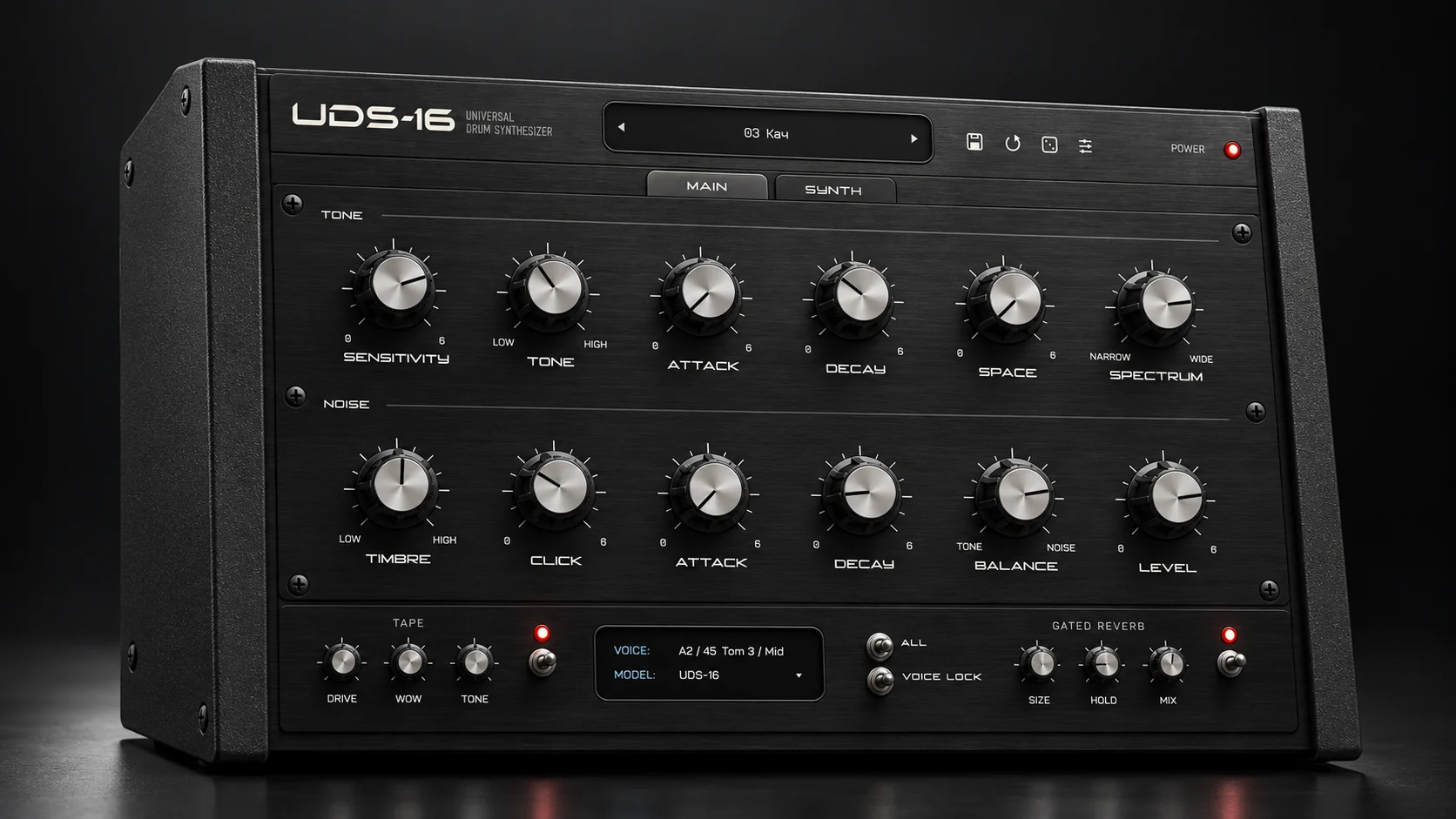
Sonic Charge Microtonic is an eight-channel drum machine plugin: synthesized voices and a pattern engine in one window, first shipped in 2003 and maintained ever since. Tapechild UDS-16 is a sixteen-voice drum synthesizer with four circuit models and no sequencer at all. Pick Microtonic if you want to write the beat inside the plugin; pick UDS-16 if your DAW already owns the pattern and what you are missing is a voice with a Soviet-circuit character.
The short answer
Buy Microtonic if you want the groove and the sounds to live in the same plugin. Its eight channels sit in front of a pattern engine that syncs to the host, so a kit and a beat can be sketched without opening the DAW’s piano roll. Morphing between patches, the randomize and smart-alteration tools, and the Patternarium’s thousands of computer-generated presets mean you rarely start from a blank panel. It runs at very low CPU, twenty years of user patches exist for it, and there is a three-week trial. Nothing in UDS-16 answers any of that.
Buy UDS-16 if you already sequence drums in the DAW and the gap in your template is a particular sound, not a workflow. Its four models are selectable per drum, so one kit can hold a Lel-circuit snare next to a Rockton-style tom, and the built-in Tape and Gated Reverb stages finish those sounds without another plugin. Sixteen voices against Microtonic’s eight, at roughly half the price at the time of writing. What it will not do is sequence, run as AAX, or build you a general-purpose kit; it is a young plugin from a small studio, and its preset ecosystem is a fraction of Microtonic’s.
Microtonic vs UDS-16 at a glance
| Microtonic | UDS-16 | |
|---|---|---|
| Type | Drum machine plugin, synth only | Drum synthesizer plugin, synth only |
| Synthesis | Per channel: pitched oscillator plus filtered noise with their own envelopes; oversampled oscillators | Four models selectable per drum: UDS-1987, UDS-1988, ROKTON, UDS-16; tone and noise sections per voice |
| Voices | Eight channels | Sixteen voices on MIDI notes C2–D#3, each independently tuned |
| Sequencer | Yes, pattern engine synced to the host | None; timing from the DAW or a MIDI controller |
| Presets | Factory patches plus the Patternarium (thousands of computer-generated presets); morphing, smart alteration, randomization | Factory kits and single-drum presets for every model |
| Effects | Per-channel distortion and EQ | Tape stage (drive, wow, tone) and Gated Reverb (size, hold, mix), each bypassable |
| Formats | VST 2.4, VST3, Audio Unit 2; no AAX listed | VST3, AU, Standalone on macOS; VST3, Standalone on Windows; no AAX, no CLAP |
| OS | macOS and Windows | macOS 11.0+ (Universal 2), Windows 10/11 64-bit |
| Price at time of writing | Around $99 | $49 (list $79), one-time |
| Try before buying | Three-week trial | No trial; audio demos on the product page |
| Best for | Writing patterns and designing sounds in one plugin | A characterful voice layer next to a kit you already own |
What Microtonic does
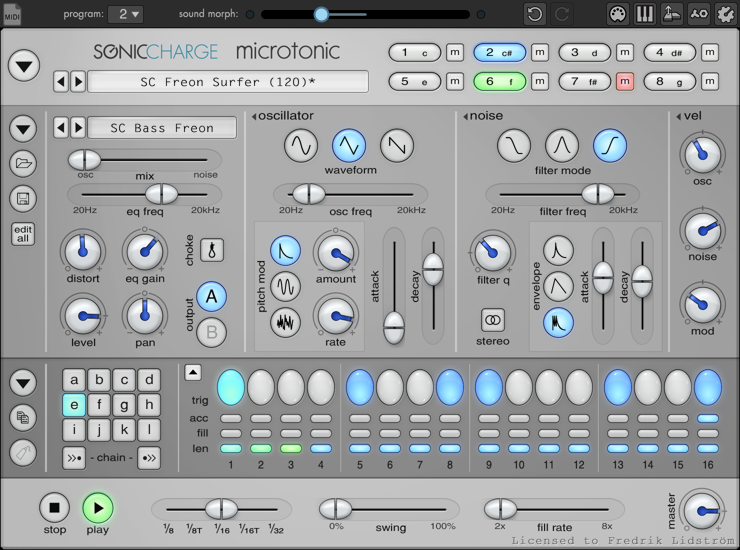
Microtonic is a drum machine in the full sense: eight synthesized channels and a pattern engine that plays in sync with the host, all in one plugin window. Sonic Charge’s page is explicit that no samples or pre-rendered waveforms are used anywhere. Each channel pairs a pitched oscillator with a filtered noise source, gives each its own envelope, and follows them with distortion and EQ. That is a small architecture, and it is why a usable kick or hat appears within seconds of touching the panel.
The other half of the plugin is the preset and pattern system. Twelve patterns live inside each preset, so a whole song’s worth of variations travels with the kit. Morphing blends between two patches, the smart-alteration and randomize functions generate new kits from an existing one, and the Patternarium is an online library of thousands of computer-generated presets that can be auditioned in the browser and copied straight into the plugin. Microtonic can also be played as a sound module from a MIDI keyboard.
Microtonic first shipped in 2003 and is now on version 3. Two decades of maintenance and a patch-sharing community that large are not things a newer plugin can catch up on. The ceiling is the same two-source architecture that makes it fast. Metallic FM textures, acoustic-leaning models and anything that needs more than one pitched source per drum are outside what one channel can do. Official Microtonic page
What UDS-16 does
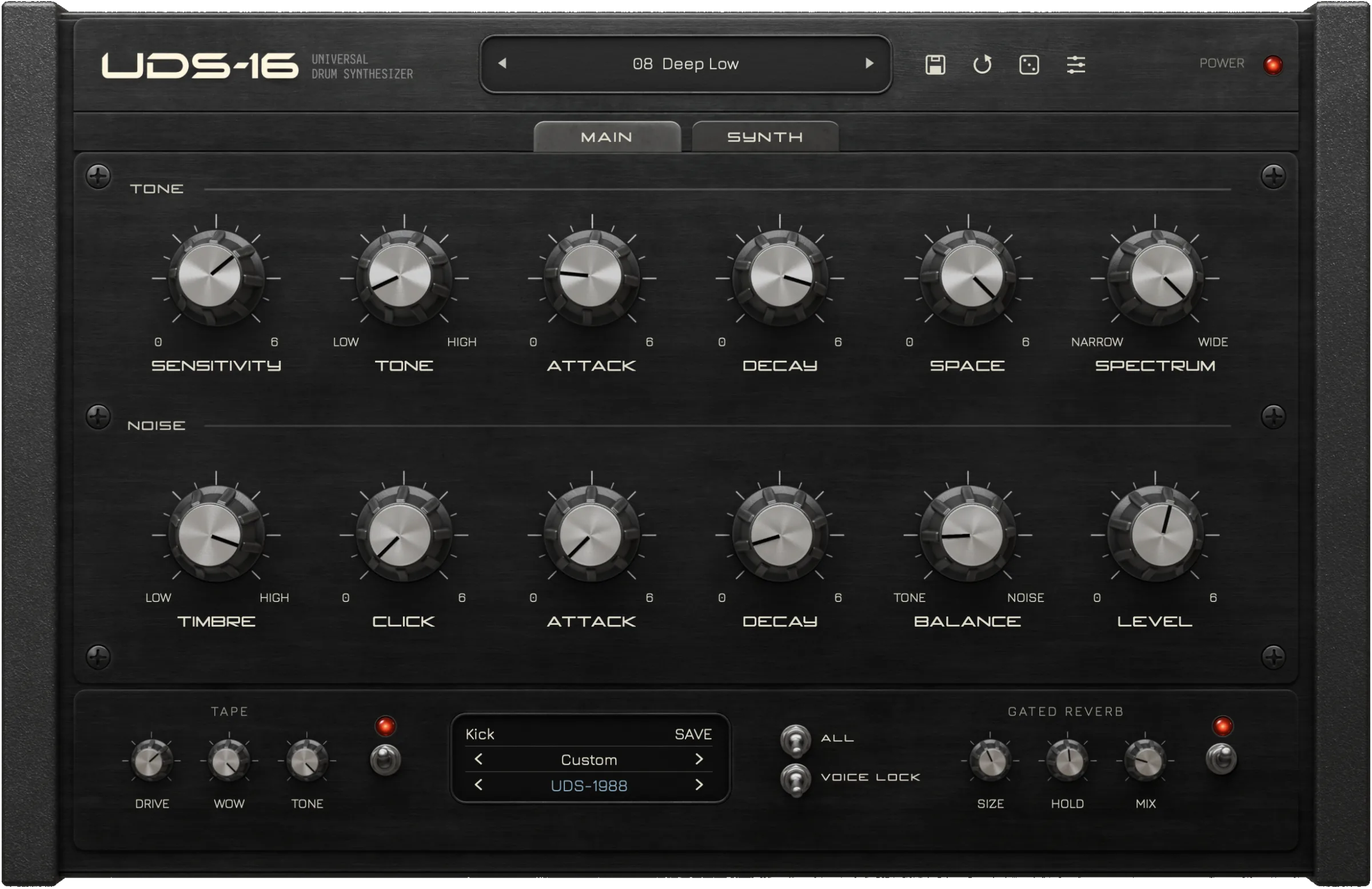
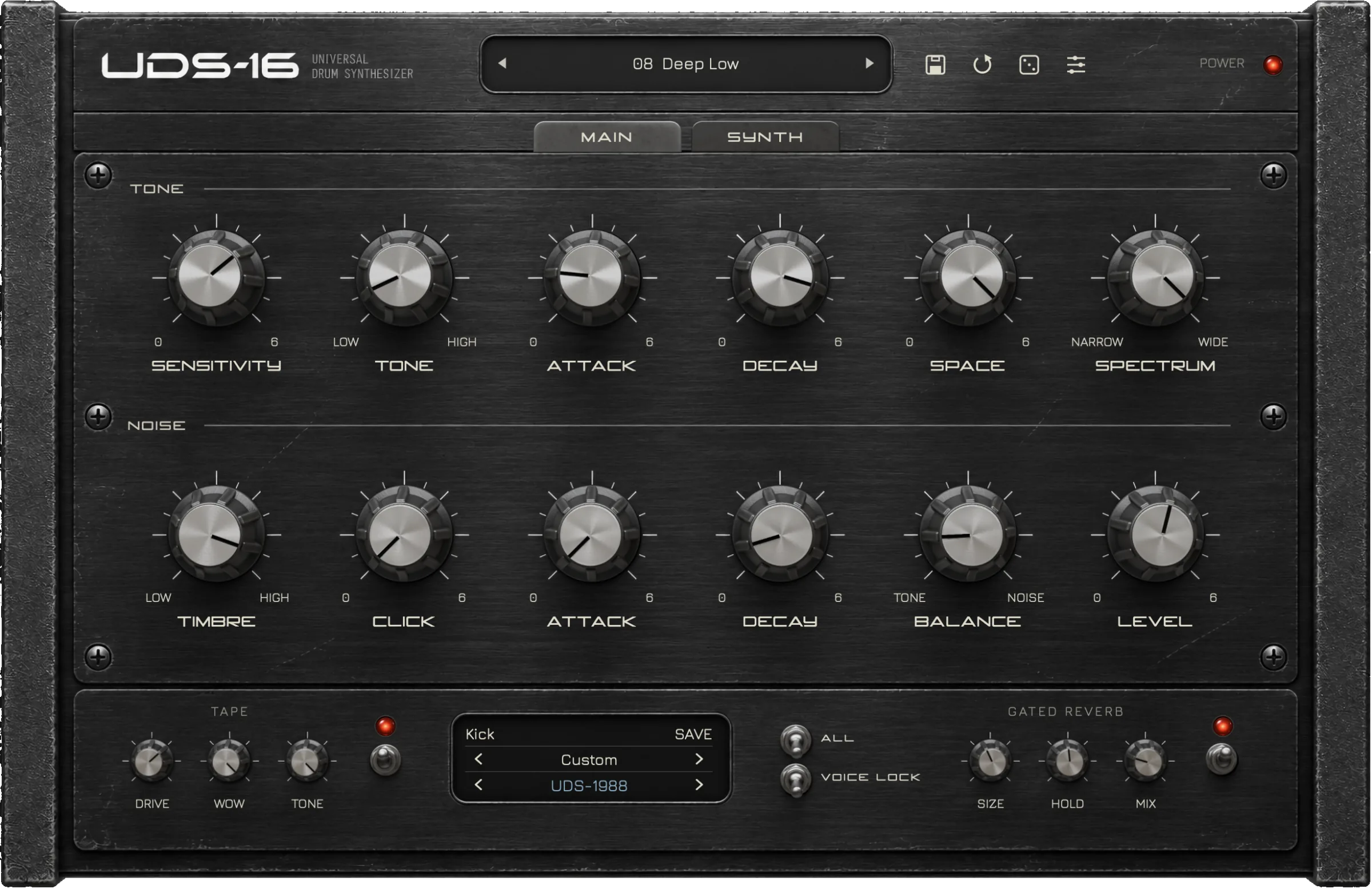
UDS-16 is our own plugin, a drum synthesizer with no sequencer. Sixteen independent voices sit on MIDI notes C2 to D#3, each tuned on its own, and every hit is synthesized when it is played. There is no sample library, no sample import and no round-robin layer. Each voice has a Tone section (sensitivity, tone, attack, decay, space, spectrum) and a Noise section (timbre, click, attack, decay, balance, level), and velocity changes the response rather than just the level.
The part that has no equivalent in Microtonic is the model selector, which works per drum. UDS-1987 is a circuit model of a channel from the Soviet Lel UDS: a free-running tone, raw digital noise, a resonant click and an output stage that bites when pushed. UDS-1988 is a second voicing of the same channel, kept separate because the same knob positions land differently. ROKTON is inspired by the seven-channel Formanta Rockton, the box collectors call the Soviet 808, expanded to a sixteen-voice kit; its noise chain is an approximation, not bit-exact. UDS-16 is Tapechild’s own engine with no hardware original: a pitched body with its own pitch envelope, harmonics, a noise layer, a short transient, six inharmonic partials for metallic colour and a drive stage.
After the voices come a Tape stage (drive, wow and tone, for saturation and pitch drift) and a Gated Reverb (size, hold, mix), both of which can be bypassed, and up to 4× oversampling. Factory kits and single-drum presets ship for every model. Tapechild is not affiliated with the makers of the Lel UDS or the Formanta Rockton, and UDS-16 is not sold as an exact emulation of either. It was released in September 2026, which makes it a young product with a small preset ecosystem.
Sound and synthesis
Both plugins are pure synthesis, so the useful comparison is how each builds a kick, a snare and a hat. If the vocabulary of tone, noise, click and envelope is new, our guide to how drum synthesis works covers it before you go further.
The kick
In Microtonic a kick is the channel’s oscillator with a fast pitch envelope and a short amplitude envelope, with the noise source turned down or used for a small click, then distortion for weight. It is the textbook recipe and the plugin reaches it in a few moves. In UDS-16 the answer depends on the model. The UDS-16 engine gives the classic shape, a pitched body with its own pitch envelope plus a short transient and a drive stage. UDS-1987 does something different: the tone is free-running rather than retriggered, so consecutive hits do not start from the same phase and the low end moves slightly between them. That is a character, not a fault; it is also why it will not give you an identical kick on every step the way Microtonic will.
The snare
A snare is where the two-source design of Microtonic is at its best: pitched oscillator for the body, filtered noise for the wires, separate envelopes so the noise can outlast the tone, and EQ to carve the result. UDS-16’s Tone and Noise sections do the same job with more handles: spectrum and space on the tone side, timbre, click and balance on the noise side. Under UDS-1987 and UDS-1988 the noise is raw and digital rather than filtered white noise, and the output stage saturates when the sensitivity is pushed, so the snare gets the grainy, slightly broken quality of the Soviet original. Run it through the built-in Gated Reverb and you have the eighties gated snare without leaving the plugin; Microtonic has no reverb, so that step happens in the DAW.
The hi-hat
Both plugins make hats from noise with a very short envelope. Microtonic filters its noise and shapes it with the envelope; open and closed hats are two channels with different decays, which costs two of the eight. UDS-16 has sixteen voices, so three hats leave thirteen free, and the six inharmonic partials in the UDS-16 engine add a metallic ring that plain filtered noise lacks. Neither plugin models a real cymbal.
What each cannot do
Microtonic cannot go past two sources per channel, so FM metallics, physically modelled membranes and multi-oscillator layering are out. UDS-16 cannot go past its four models: there is no FM engine, no physical modelling and no general-purpose kit designer, and the ROKTON model is an approximation of the Rockton noise chain, not a circuit-exact one. Against a multi-engine kit designer both palettes are narrow; UDS-16’s is the price of modelling circuits no other plugin on our list models.
Workflow: sequencing, presets and the DAW
The sequencer is the workflow difference, and it is the whole difference for a lot of producers. Microtonic’s pattern engine runs in sync with the host, twelve patterns travel with each preset, and a kit can be auditioned as a beat rather than as a row of one-shots. Our explainer on what a drum machine is is largely about this: the pattern belongs to the instrument.
UDS-16 has no pattern engine. You program the beat in the DAW’s piano roll or step sequencer, or play it from a MIDI controller, and the plugin only turns notes C2 to D#3 into hits. For a producer who already lives in the DAW’s drum editor this is not a loss. For a producer who liked Microtonic because the beat never left the plugin, it is a real loss and no fact sheet will talk them out of it.
Presets follow the same split. Microtonic has factory patches, the morph and randomize tools, and the Patternarium’s thousands of computer-generated presets that copy straight into the plugin. UDS-16 ships with factory kits and single-drum presets for each of the four models and nothing beyond that yet. Neither plugin imports samples; that is a sampler’s job.
Formats, price and licensing
Microtonic ships as VST 2.4, VST3 and Audio Unit 2 for macOS and Windows; AAX and minimum OS versions are not listed on the product page, so check there if you are on an older system. UDS-16 is VST3, AU and Standalone on macOS 11.0 and later as a Universal 2 binary for Apple Silicon and Intel, and VST3 and Standalone on Windows 10 and 11 64-bit with a signed installer. Neither lists AAX; UDS-16 also has no Linux build and no CLAP.
Microtonic is around $99 at the time of writing, and Sonic Charge sells it inside a bundle with its other plugins. The licence is linked to the email used at checkout, and there is a three-week trial, so you can find out if the two-source ceiling matters to you before paying. UDS-16 is $49 one-time at the time of writing against a $79 list price, with no subscription and free updates within the UDS-16 line. The licence activates on up to three computers, online or offline, with no iLok. There is no trial version; the audio demos on the product page are what you judge it by, and that is a weaker offer than three weeks with the plugin.
Which one should you buy?
Buy Microtonic if…
You want to write patterns and design sounds in one window without touching the DAW’s drum editor. You want a large library of patches and the Patternarium behind you on day one. You want to try the plugin for three weeks before paying. You want a clean, controllable, low-CPU synthesized kit rather than a specific vintage character.
Buy UDS-16 if…
You already sequence drums in the DAW and want one voice layer with a sound no other plugin on our list models. You want a gated snare, an unstable free-running kick or a Rockton-style tom without adding reverb or tape plugins. You want sixteen tuned voices for around half the price. You can accept no sequencer, no AAX, no trial and a small preset library from a plugin released this month.
Can you run both? Yes, and it is the setup that makes the most sense of the two. Microtonic writes the pattern and provides the bulk of the kit; UDS-16 sits on a second track for the two or three drums that should sound like a Soviet circuit rather than a textbook oscillator, triggered from a DAW clip. Together they cost less than most multi-engine kit designers, and neither duplicates what the other does.
Other UDS-16 comparisons
- UDS-16 vs AIR Drum Synth 500
- UDS-16 vs D16 Nepheton 2
- UDS-16 vs D16 Drumazon 2
- UDS-16 vs Arturia Spark 2
- UDS-16 vs Baby Audio Tekno
- UDS-16 vs DrumSpillage 2
- UDS-16 vs VSDS-X
- UDS-16 vs KICK 2
- UDS-16 vs Ableton Drum Synths
- Emergent Drums alternative
- 12 best drum synth plugins
Frequently asked questions
Is UDS-16 a Microtonic alternative?
Only for the sound, not for the workflow. If you want Microtonic’s pattern engine, morphing and Patternarium in another plugin, UDS-16 is not it: there is no sequencer and no preset-generation tools. If what you want is a synthesized drum voice with a different character, UDS-16’s four circuit models cover ground Microtonic’s two-source channels do not, and it costs less. Most people asking the question end up wanting both.
Microtonic vs UDS-16 for techno?
For a full techno kit built and sequenced in one place, Microtonic: eight channels, host-synced patterns and twenty years of patches, many of them written for exactly this. For the one drum that carries a track, UDS-16 has an edge in character: a free-running UDS-1987 kick that drifts between hits, a raw-noise snare through the built-in Gated Reverb, or a ROKTON tom. A common template runs Microtonic for the pattern and UDS-16 for that one drum.
Does UDS-16 have a sequencer like Microtonic?
No. UDS-16 has no step sequencer or pattern engine of any kind. It responds to MIDI notes C2 to D#3, one voice per note, and the timing comes from your DAW’s piano roll, a step sequencer plugin or a MIDI controller. Microtonic has a pattern engine synced to the host with twelve patterns per preset, and can also be played as a sound module from a keyboard.
Which is cheaper, and can I try either before buying?
UDS-16 is $49 one-time at the time of writing (list $79), activates on three computers and has no trial; you judge it from the audio demos on the product page. Microtonic is around $99 at the time of writing, its licence is linked to your checkout email, and it has a three-week trial. If a trial matters to you, Microtonic is the only one of the two that offers it.
Which plugin formats do they support?
Microtonic ships as VST 2.4, VST3 and Audio Unit 2 for macOS and Windows; AAX is not listed on its page. UDS-16 ships as VST3, AU and Standalone on macOS 11.0 and later (Universal 2), and VST3 and Standalone on Windows 10 and 11 64-bit. Neither lists AAX. UDS-16 has no CLAP or Linux build.
If the sound is what brought you here, Explore UDS-16 and listen to the demos against a Microtonic kit you already know. If the workflow question is still open, our list of the best drum synth plugins puts both in the context of the ten other instruments they compete with.
Royalty-free WAV
Free sample packs
Royalty-free WAV, play every sample before you download.