
Tapechild UDS-16 vs Baby Audio Tekno (2026)
Baby Audio Tekno is an eighteen-engine drum synthesizer with a sequencer, per-voice effects and a master section, built for techno and the genres next to it. Tapechild UDS-16 is a sixteen-voice drum synthesizer with four models drawn from Soviet percussion circuits, plus a Tape stage and a Gated Reverb. Tekno is for a complete electronic kit with beat writing inside the plugin; UDS-16 is for a voice layer next to a kit you already own.
The short answer
Pick Tekno if you want one plugin to design and play a whole techno kit. It has eighteen voice engines from two kicks to a crash, a sequencer with chance values and MIDI drag-out, tape saturation, excitation and compression on every voice, a limiter and clipper on the master, and a factory library of 72 kits and 1,296 voice presets. It also has AAX for Pro Tools and a free trial.
Pick UDS-16 if the kit you own already covers clean electronic drums and what you lack is a recognisable second layer. Its UDS-1987 and UDS-1988 models are circuit models of a channel from the Soviet Lel UDS, its ROKTON model follows the seven-channel Formanta Rockton, and no other plugin in our roundup models either box. A gated snare, an unstable synthetic tom or a raw digital noise hat is a preset away, and the built-in Tape and Gated Reverb stages finish the sound inside the plugin. It has no sequencer and it will not build you a general-purpose kit.
Tekno vs UDS-16 at a glance
| Tekno | UDS-16 | |
|---|---|---|
| Type | Kit designer with sequencer | Drum synth, voice layer |
| Synthesis | Analog circuit modelling, FM and digital; no samples | Four models per drum: two Lel UDS circuit models, a Rockton-inspired model, Tapechild’s own engine; no samples |
| Voices | 18 voice engines, one per drum type | 16 independent voices, C2–D#3, each independently tuned |
| Sequencer | Yes, with chance, variable step lengths, MIDI drag-out | No; timing from the DAW or a MIDI controller |
| Presets | 72 global presets, 1,296 voice presets, expansions available | Factory kits and single-drum presets for every model |
| Effects | Per-voice tape saturation, excitation, compression; master limiter and clipper; reverb bus in multi-out mode | Tape (drive, wow, tone) and Gated Reverb (size, hold, mix); every stage bypassable; up to 4× oversampling |
| Formats | VST, VST3, AU, AAX (64-bit), Standalone | VST3, AU, Standalone (macOS); VST3, Standalone (Windows). No AAX |
| OS | macOS 10.11 and up, Apple Silicon native; Windows 10 and newer | macOS 11.0 and up, Universal 2; Windows 10/11 64-bit, signed installer |
| Price at time of writing | Around $49 on sale from a $129 list price; also $14.99/month subscribe-to-own | $49 one-time (list $79); no subscription |
| Try before buying | Free trial download | No trial; audio demos on the product page |
| Best for | A complete techno kit and in-plugin beat writing | A signature layer next to a kit you already own |
What Tekno does
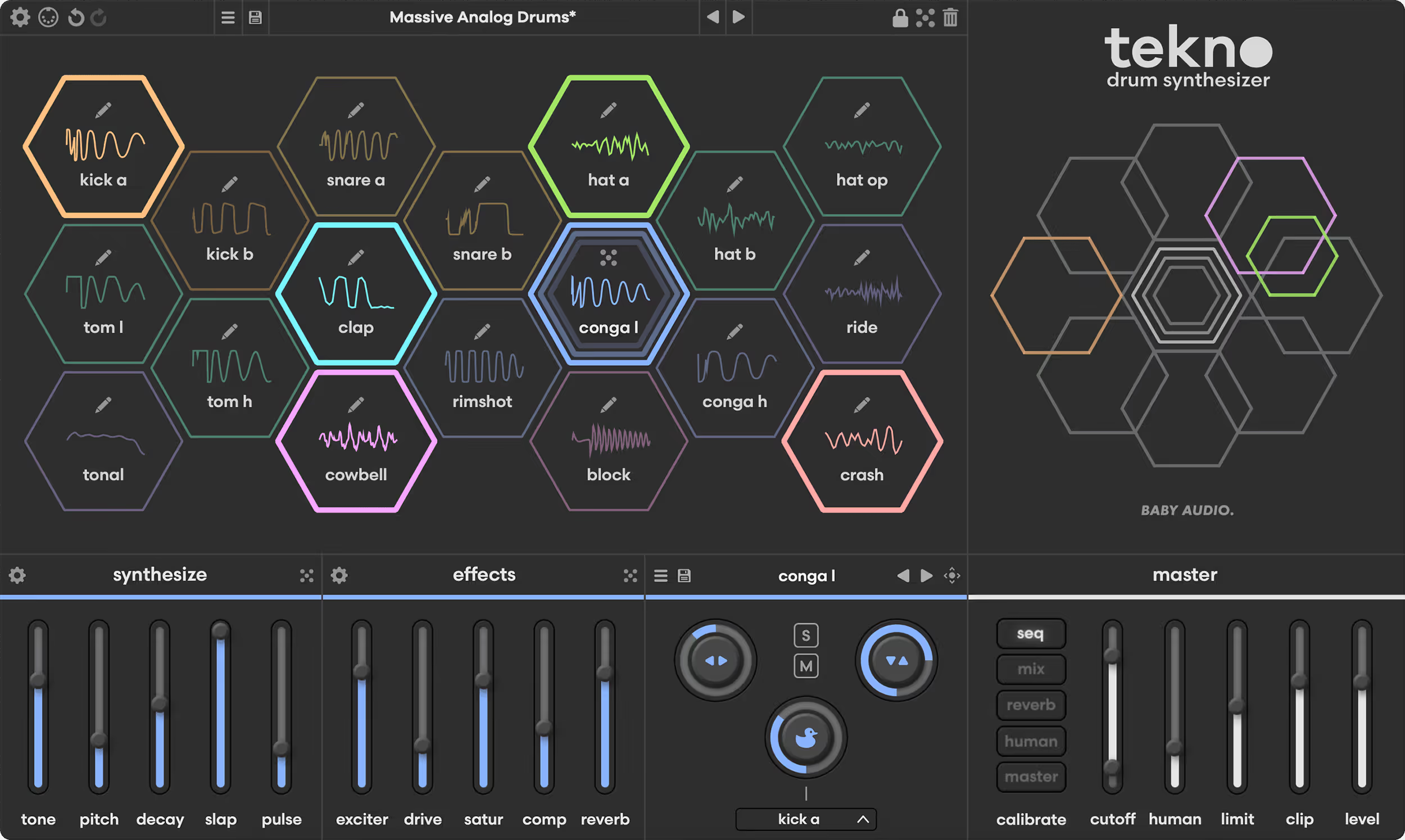
Tekno is Baby Audio’s drum synthesizer. Its page describes a non-linear virtual-analog circuit that generates every hit from scratch, and the eighteen engines are listed by name: Kick A, Kick B, Snare A, Snare B, Hat A, Hat B, Hat OP, Tom L, Tom H, Clap, Rimshot, Conga L, Conga H, Ride, Tonal, Cowbell, Block and Crash. Each is its own synthesizer, and the voices combine analog circuit modelling, FM and digital methods. The interface arranges them in a honeycomb above synthesize, effects and master sections, with dice icons that generate a new random drum per voice.
The 1.1 update, released in January 2026, added a new sequencer. It generates beats with smart randomization, auto-fill and quick on/off and velocity controls, and it builds polyrhythms with variable step lengths and lane speeds and per-step chance values. Any sequence can be dragged into the DAW as a MIDI file. The same update added choke groups, assignable MIDI mappings, a per-voice humanize option covering timbre, velocity and timing, and full kit sample export. Per voice there is analog-modelled tape saturation, excitation and compression; on the master, a limiter and clipper combination; in multi-output mode, a dedicated reverb bus.
The factory content is 72 global presets and 1,296 individual voice presets from sound designers including Mr. Bill, Virtual Riot and Yoad Nevo, with preset expansions on top. Version 1.1.1 followed in July 2026. Formats, OS support, trial and price are covered below. Official Tekno page
What UDS-16 does
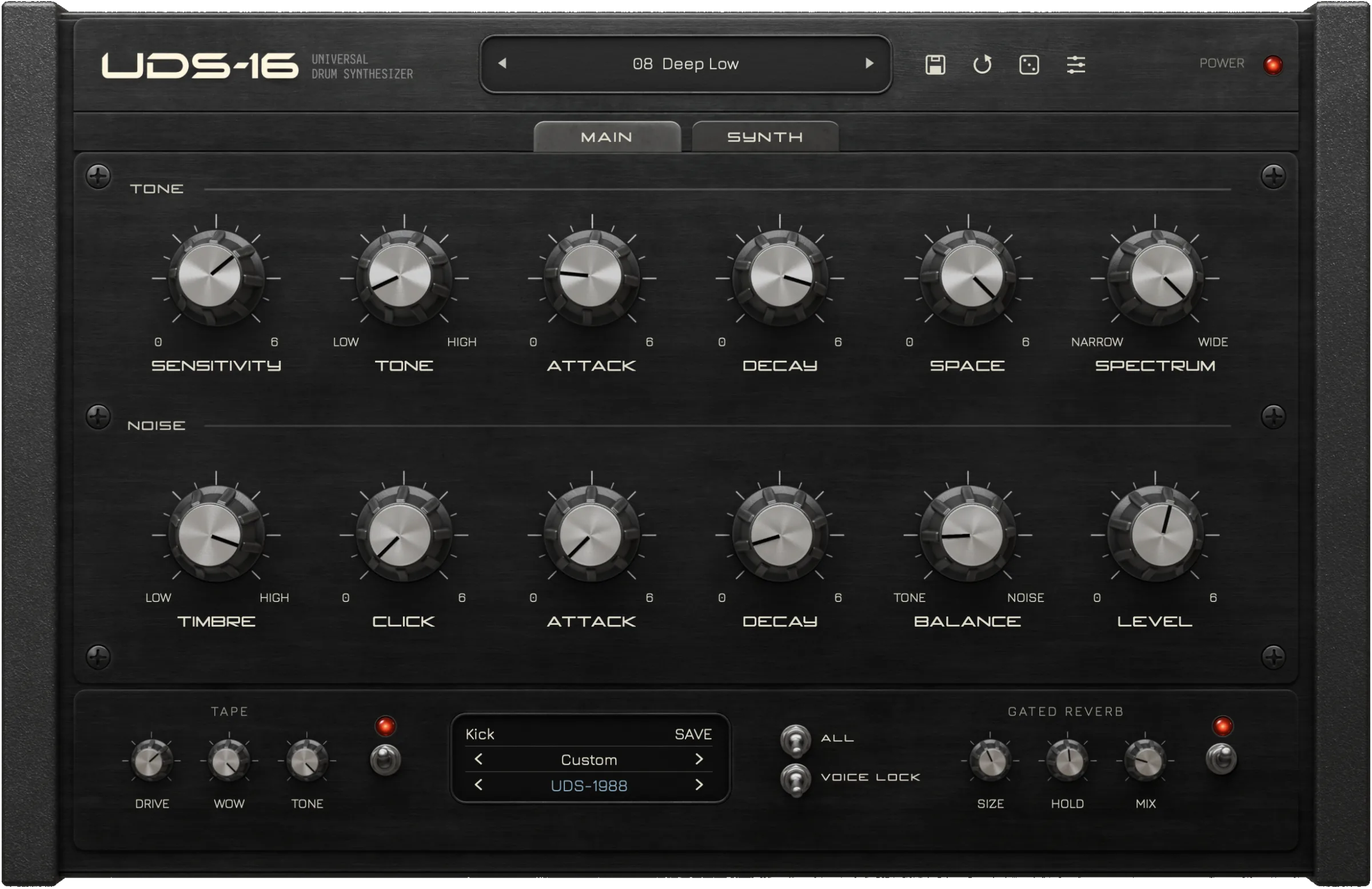
UDS-16 is a sixteen-voice drum synthesizer. The voices sit on MIDI notes C2 to D#3, each independently tuned, and every hit is synthesized at playback time; there is no sample library, no sample import and no round-robins. Each voice picks one of four synthesis models. UDS-1987 is a circuit model of a channel from the Soviet Lel UDS: a free-running tone, raw digital noise, a resonant click and an output stage that bites when pushed. UDS-1988 is a second voicing of that channel, kept separate because the same knob positions land differently. ROKTON is inspired by the seven-channel Formanta Rockton, the box collectors call the Soviet 808, expanded to sixteen voices; its noise chain is an approximation, not bit-exact. UDS-16 is Tapechild’s own engine with no hardware original: a pitched body with its own pitch envelope, harmonics, a noise layer, a short transient, six inharmonic partials for metallic colour and a drive stage.
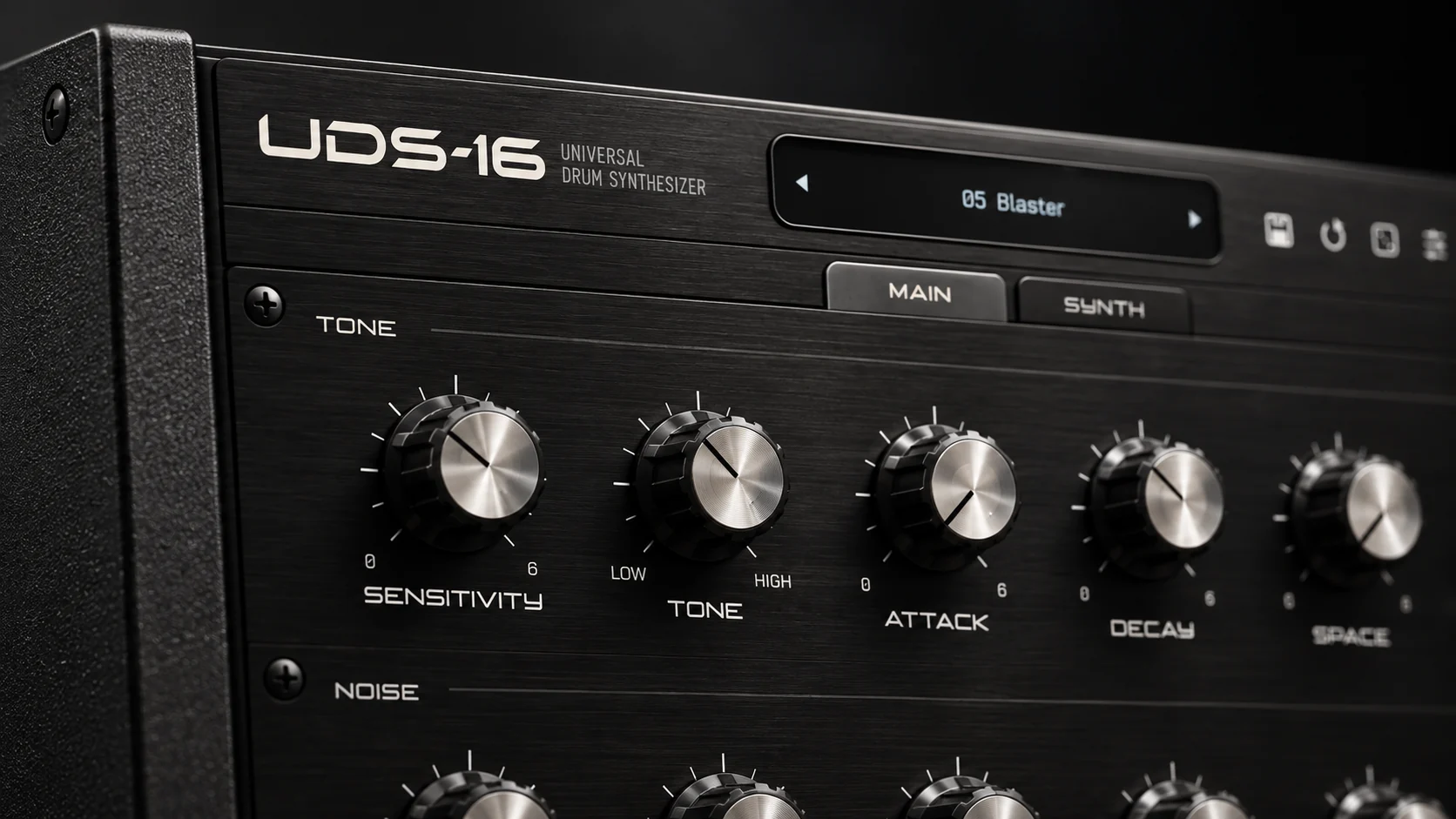
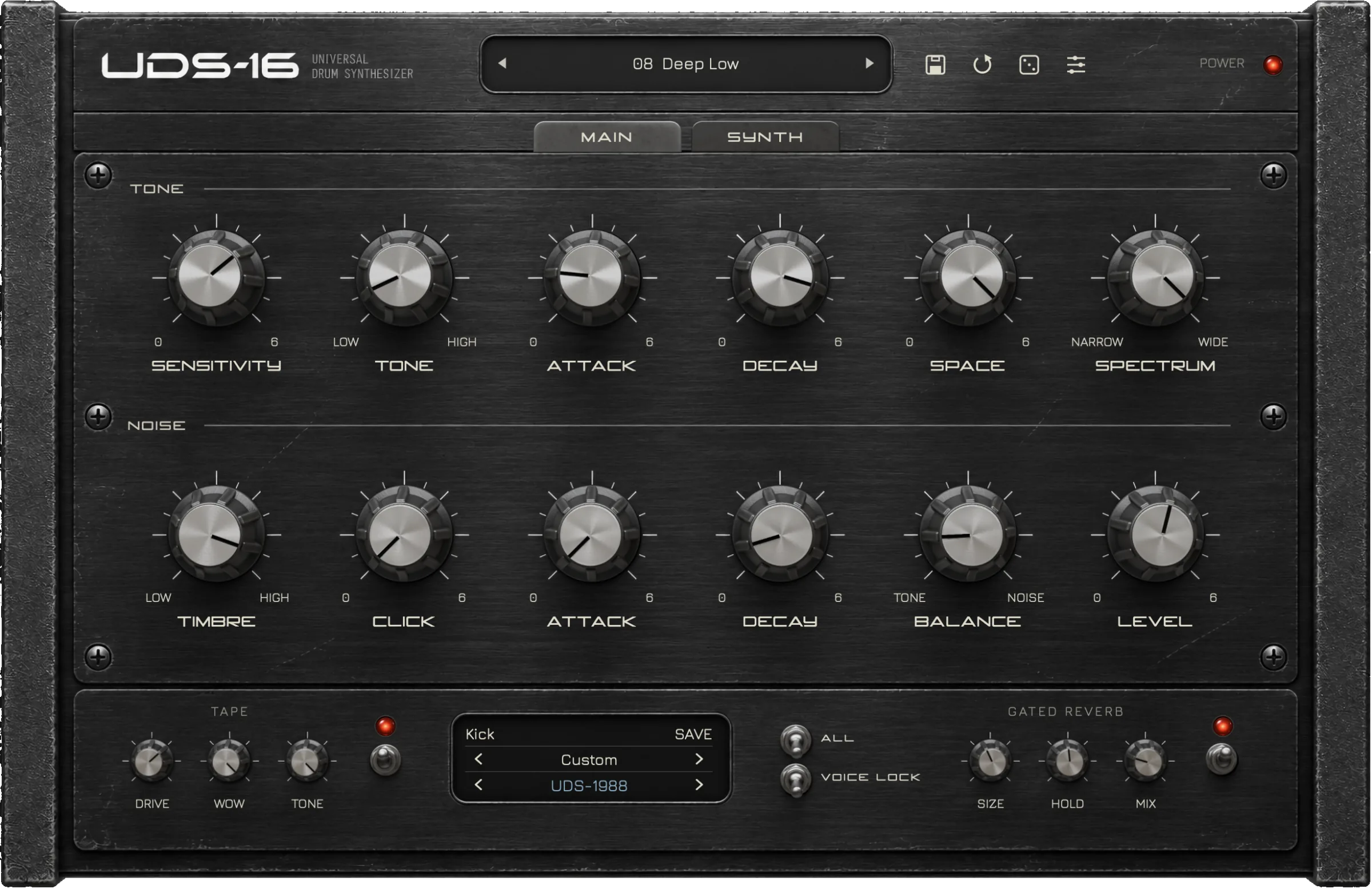
Every voice has the same panel: a Tone section with sensitivity, tone, attack, decay, space and spectrum, and a Noise section with timbre, click, attack, decay, balance and level; velocity changes the response. After the voices come a Tape stage (drive, wow, tone) for saturation and pitch drift and a Gated Reverb (size, hold, mix). Every stage can be bypassed, and oversampling goes up to 4×. Factory kits and single-drum presets are included for every model. UDS-16 was released in September 2026, so it is a young product from a small studio. Tapechild is not affiliated with or endorsed by the makers of the Lel UDS or the Formanta Rockton, and UDS-16 is not sold as an exact emulation of either. Explore UDS-16
Sound and synthesis
Both plugins are fully synthesized, so the comparison is about architecture. Tekno dedicates one engine to each drum type and chooses the method per engine. UDS-16 gives every voice the same panel and lets you swap the model underneath it, so a kick and a crash are the same twelve controls driving different circuits. If the vocabulary of tone, noise, click and envelope is new, read how drum synthesis works first; everything below assumes it.
Kick
Tekno has two kick engines, Kick A and Kick B, and per-voice tape saturation and compression to make either dense before it reaches the master limiter and clipper. Baby Audio does not publish the per-engine parameter list on the product page, so the exact controls are for the manual. In UDS-16 a kick is a low free-running tone with a fast decay in the Tone section and the Noise section turned down to a short click. On the UDS-1987 model the output stage bites as sensitivity goes up, so the kick hardens with velocity. The UDS-16 model adds a pitch envelope and a drive stage, which reaches the conventional electronic kick the two Lel models do not aim at. UDS-16 cannot layer a sampled transient, and its kick will not sound like a 909 because none of its models come from Roland circuits.
Snare
Tekno gives you Snare A, Snare B, Clap and Rimshot as separate engines, and the per-voice excitation stage adds top-end harmonics without an external exciter. UDS-16 builds a snare from the Tone and Noise sections together: timbre sets the noise colour, click adds the resonant attack, balance sets the tone-to-noise ratio, and the two decay controls are independent, so a short body can sit under a long noise tail. This is where the Lel models earn their place. Their raw digital noise is not filtered white noise; it has a grain that reads as 1980s Soviet electronic drums, and running it into the built-in gated reverb with a short hold produces the gated snare directly, without a send. Tekno has a reverb bus in multi-output mode but its page does not describe a gate, so a gated snare is a DAW job there.
Hat
Hats are where the engine count matters most. Tekno has Hat A, Hat B, Hat OP, Ride and Crash as separate engines, and FM is among its methods, which is the usual route to a metallic closed hat and a ride with bell overtones. UDS-16 has two routes. On the Lel and ROKTON models a hat is the Noise section alone with a short decay, which gives the flat digital hat those machines made rather than a bright 909-style cymbal. On the UDS-16 model the six inharmonic partials add the metallic colour, so a closed hat, an open hat and a short ride are reachable. A long crash is not the plugin’s territory; if cymbals are the heart of your kit, Tekno covers more ground.
Tekno covers more drum types with more methods and finishes them with a mastering chain. UDS-16 covers fewer with a character that comes from specific circuits, and adds pitch drift and a gate that a techno kit designer does not include. A producer wanting one clean, wide kit gets it faster from Tekno; a producer wanting a snare or a tom a listener can place gets it from UDS-16 and not from a techno kit designer.
Workflow: sequencing, presets and the DAW
Tekno is a workstation. You can sequence it internally, feed it MIDI, drag its sequences out as MIDI files, drag its sounds out as audio, and export a full kit as samples. Randomize, humanize and choke groups live inside the plugin, so a beat can go from empty to arranged in one window. UDS-16 has none of this. It has no sequencer, no pattern memory and no audio export; timing comes from the DAW piano roll, a pad controller or a hardware sequencer, and the sixteen voices answer to fixed notes from C2 to D#3.
Presets favour Tekno by a wide margin. Its 72 global presets and 1,296 voice presets come from named sound designers and there are expansions on top. UDS-16 ships with factory kits and single-drum presets for every model, and because the product is weeks old there is no third-party preset scene yet. The trade-off is that UDS-16’s twelve per-voice controls are the same on every drum, so designing from scratch is quick once the panel is learned.
Inside the DAW, Tekno supports assignable MIDI mappings and a multi-output mode with a dedicated reverb bus, which matters if you mix each drum on its own channel. UDS-16 responds to velocity per voice and runs its Tape and Gated Reverb stages on the whole kit, with bypass on every stage.
Formats, price and licensing
Tekno ships as VST, VST3, AU and AAX in 64-bit, with a Standalone version, on macOS 10.11 and up with native Apple Silicon support and on Windows 10 and newer. UDS-16 ships as VST3, AU and Standalone on macOS 11.0 and up as a Universal 2 binary for Apple Silicon and Intel, and as VST3 and Standalone on Windows 10 and 11 64-bit with a signed installer. UDS-16 has no AAX, no Linux build and no CLAP, so for Pro Tools Tekno is the only option of the two.
On price the two meet at the same number for different reasons. At the time of writing Tekno’s list price is $129 and the page shows a 62% discount to around $49, with a subscribe-to-own plan at $14.99 per month; sale pricing changes, so check the page. UDS-16 is $49 one-time against a $79 list price, with no subscription, free updates within the UDS-16 line and a licence that activates on up to three computers, online or offline, without iLok. Baby Audio offers a free trial; UDS-16 has no trial and relies on the audio demos on its product page.
Which one should you buy?
Buy Tekno if…
You want one plugin to design, sequence and finish a complete electronic kit. You need cymbals, congas, a cowbell and a tonal voice in the same kit as the kick. You mix in Pro Tools and need AAX. You want to try before buying, or you want a large preset library to start from.
Buy UDS-16 if…
You already own a kit designer or a sampler and want a second layer with a character no other plugin on our list models. You sequence in the DAW and do not need a pattern engine in the plugin. Gated snares and pitch-drifted, saturated percussion are part of your sound and you want them without a send chain. You prefer a $49 one-time licence on three machines with no subscription.
Can you run both? Yes, and most templates do. Tekno carries the groove: kick, hats, clap, the mastering chain and, if you want it, the pattern. UDS-16 sits on a second instrument track with a Lel or Rockton snare, a synthetic tom and a noise hat, played from the same MIDI clip. The overlap between them is small.
Other UDS-16 comparisons
- UDS-16 vs Microtonic
- UDS-16 vs AIR Drum Synth 500
- UDS-16 vs D16 Nepheton 2
- UDS-16 vs D16 Drumazon 2
- UDS-16 vs Arturia Spark 2
- UDS-16 vs DrumSpillage 2
- UDS-16 vs VSDS-X
- UDS-16 vs KICK 2
- UDS-16 vs Ableton Drum Synths
- Emergent Drums alternative
- 12 best drum synth plugins
Frequently asked questions
Is UDS-16 a Tekno alternative?
Only for part of what Tekno does. Both are sample-free drum synthesizers aimed at electronic producers. UDS-16 has no sequencer, no mastering chain, no AAX and four models rather than eighteen engines, so it is not a substitute for Tekno as a complete kit. It is an alternative if what drew you to Tekno was sound design rather than beat generation, and if you want a character Tekno does not model: Soviet Lel and Rockton circuits with tape drift and a gate built in.
Tekno vs UDS-16 for techno?
Tekno is built for techno: two kick engines, three hats, a ride and a crash, per-voice saturation and compression, a limiter and clipper on the master, and a sequencer with chance values. For a full techno kit inside one plugin, choose Tekno. UDS-16 contributes what a techno kit designer leaves out, a Soviet-circuit snare, unstable toms, raw digital noise and tape wow, so it is the second layer rather than the foundation.
Does Tekno have a sequencer, and does UDS-16?
Tekno has a built-in sequencer, rebuilt in version 1.1 with smart randomization, auto-fill, variable step lengths and lane speeds, per-step chance and drag-and-drop of any sequence into the DAW as MIDI. UDS-16 has no sequencer at all. Its sixteen voices sit on MIDI notes C2 to D#3 and are played from the DAW piano roll, a pad controller or an external sequencer.
Can I try either plugin before buying?
Tekno has a free trial download on Baby Audio’s page; the page does not state its duration or limits. UDS-16 has no trial version. Audio demos of each model are on the product page, and the licence is $49 one-time at the time of writing, activating on up to three computers, online or offline, with no iLok.
If a complete techno kit with a sequencer is the job, buy Tekno. If a characterful second layer next to a kit you already own is the job, Explore UDS-16. For the wider field, including Microtonic, Drum Synth 500 and the D16 emulations, see our guide to the best drum synth plugins.
Royalty-free WAV
Free sample packs
Royalty-free WAV, play every sample before you download.