
Tapechild UDS-16 vs Arturia Spark 2 (2026)
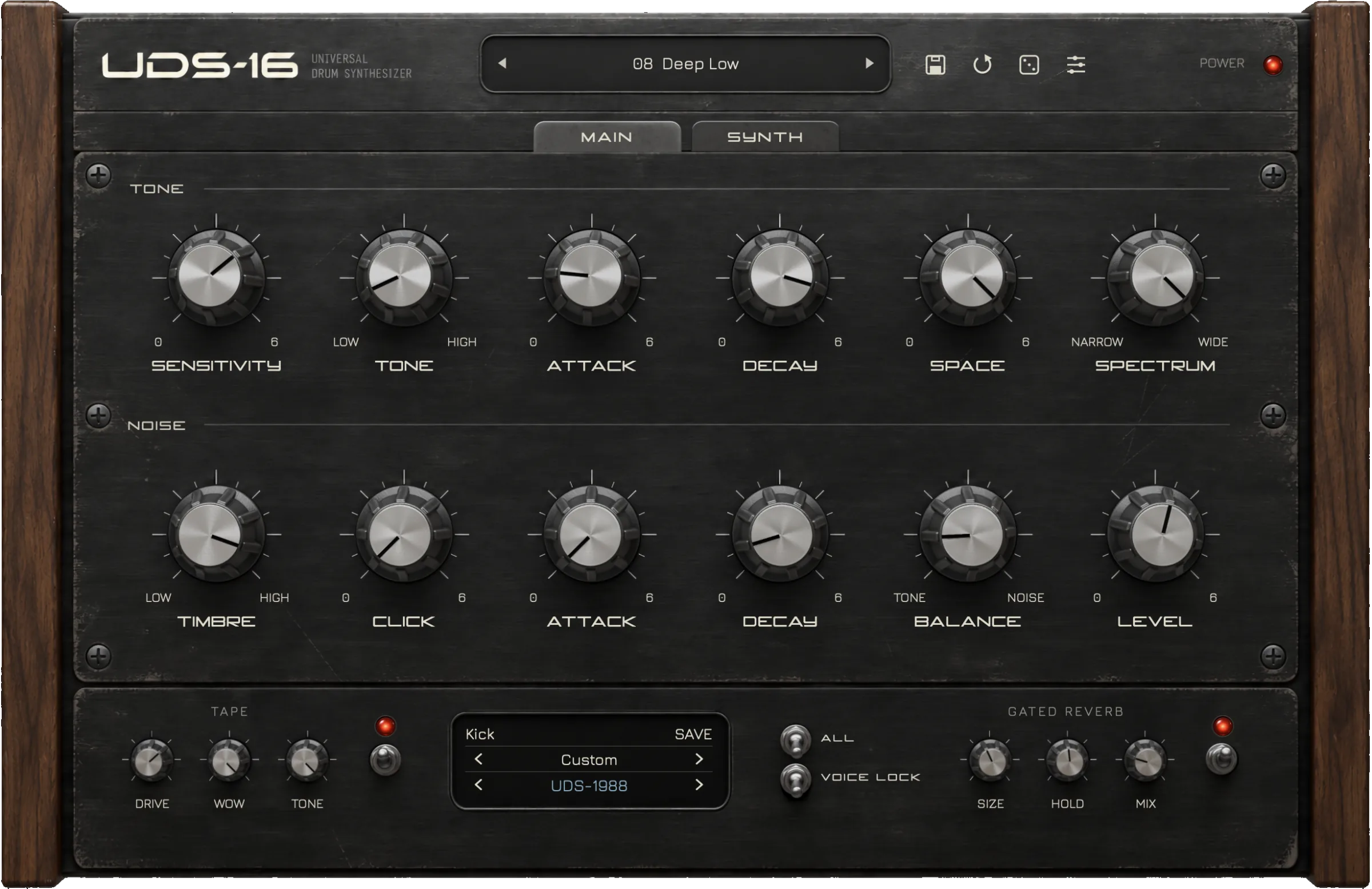
Arturia Spark 2 is a drum production environment: a 64-step sequencer, a mixer, effects, a library of 1,900+ instruments in 180+ kits, and a modular page that can synthesize a drum from scratch. Tapechild UDS-16 is a drum synthesizer and nothing else: sixteen synthesized voices, four circuit models, no sequencer, no samples. Spark 2 is for the producer who wants the whole beat built inside one plugin. UDS-16 is for the producer whose DAW already builds the beat and who wants one unusual voice layer next to the kit they own.
The short answer
Pick Spark 2 if you want to write patterns, mix drums and finish a groove without leaving the plugin, if you need acoustic kits and vintage machine emulations in the same library as synthesized ones, if you run Pro Tools and need AAX, or if you want a hardware controller (Arturia’s SparkLE) that maps to the software without setup. It is also the pick if you have never owned a drum instrument: one purchase covers sequencing, sounds, effects and export.
Pick UDS-16 if you already sequence in your DAW and want a voice that Spark 2’s library does not contain: percussion built from Soviet-era circuits, with a gated reverb and a tape stage on the same panel. It is the pick when every hit needs to stay a live synthesized parameter rather than a sample, and when $49 is the budget. It is the wrong pick if you need a sequencer, samples, AAX or a broad acoustic palette.
Spark 2 vs UDS-16 at a glance
| Spark 2 | UDS-16 | |
|---|---|---|
| Type | Drum machine and beat creation studio: sequencer, mixer, effects, library | Drum synthesizer only: sixteen synthesized voices, no sequencer |
| Synthesis | TAE analog modelling, physical modelling and multi-layered samples; a modular page for patching voices | Four models per drum: UDS-1987, UDS-1988, ROKTON and UDS-16; every hit synthesized at playback |
| Voices | Sixteen instruments per kit | Sixteen independent voices on MIDI notes C2–D#3, each tuned separately |
| Sequencer | 64 steps, shuffle and shift, loop mode with Divide and Move, choke groups, per-instrument automation | None; timing comes from the DAW or a MIDI controller |
| Presets | 1,900+ instruments and 180+ kits, plus paid expansion packs | Factory kits and single-drum presets for every model |
| Effects | Fourteen per instrument, including compressor, reverb, bit crusher, multiband EQ, delay, distortion and limiter | Tape stage (drive, wow, tone) and Gated Reverb (size, hold, mix); every stage can be bypassed |
| Formats | Standalone, VST 2.4, AAX, Audio Unit as listed on the details page; no VST3 listed | VST3, AU and Standalone on macOS; VST3 and Standalone on Windows; no AAX, no CLAP |
| OS | Details page lists macOS 10.8+ and Windows 7+; the current macOS download is labelled 11.0+ (ARM) | macOS 11.0+ (Universal 2); Windows 10/11 64-bit; no Linux |
| Price at time of writing | Around $149 / 149€ on Arturia’s page | $49 one-time (list $79), no subscription |
| Try before buying | Free demo | No trial; audio demos on the product page |
| Best for | Building and finishing whole grooves inside one plugin; acoustic and vintage kits alongside synthesis | A characterful synthesized voice layer next to a kit you already own |
What Spark 2 does
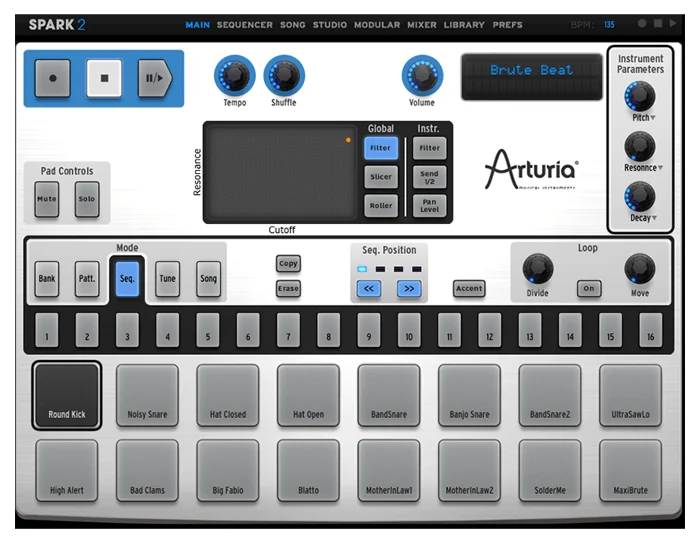
Arturia calls Spark 2 a drum machine and beat creation studio, and the phrase is accurate. A kit holds sixteen instruments. Under them sits a 64-step sequencer with shuffle and shift, a loop mode with Divide and Move functions, choke groups and up to fifteen automation parameters per instrument. A mixer gives each instrument level, pan, inserts and sends, and the insert list runs to fourteen effects, from compressor and multiband EQ to bit crusher, destroyer and sub generator. Patterns export as WAV or MIDI, and the plugin imports AIFF, WAV, MIDI and REX2.
The sound sources are three kinds. TAE, Arturia’s analog-modelling technology, drives the vintage emulations; the TR-808, TR-909, TR-606 and Simmons SDS-V are named on the page, with ten emulations carried over from Spark Vintage Drum Machines. Physical modelling handles acoustic behaviour, and Arturia’s own demo moves the stick across a modelled snare head. The rest of the 1,900+ instruments are multi-layered samples from partner sound houses, covering EDM, hip hop, techno, R&B and acoustic rock, funk and Latin kits. Much of the library is recordings.
The synthesis lives in the modular page: nine variable-shape virtual analog oscillators, four multimode filters, six envelopes, two LFOs, four mixers, two ring modulators, two CV modulators, two Karplus-Strong filters, a stereo filter and a Spring Mass physical-modelling engine, with six assignable macro knobs per patch. Some modules come from the V Collection synths. It pairs with the SparkLE hardware controller. Official Spark 2 page
What UDS-16 does
UDS-16 is a sixteen-voice drum synthesizer. Each voice sits on a MIDI note from C2 to D#3, has its own tuning, and is synthesized when the note arrives; there is no sample library, no sample import and no round-robin layer. Each voice picks one of four models. UDS-1987 is a circuit model of a channel from the Soviet Lel UDS: a free-running tone, raw digital noise, a resonant click and an output stage that bites when pushed. UDS-1988 is a second voicing of the same channel, kept separate because the same knob positions land differently. ROKTON is inspired by the seven-channel Formanta Rockton, the box collectors call the Soviet 808, expanded to sixteen voices; its noise chain is an approximation. UDS-16 is Tapechild’s own engine with no hardware original: a pitched body with its own pitch envelope, harmonics, a noise layer, a short transient, six inharmonic partials and a drive stage.
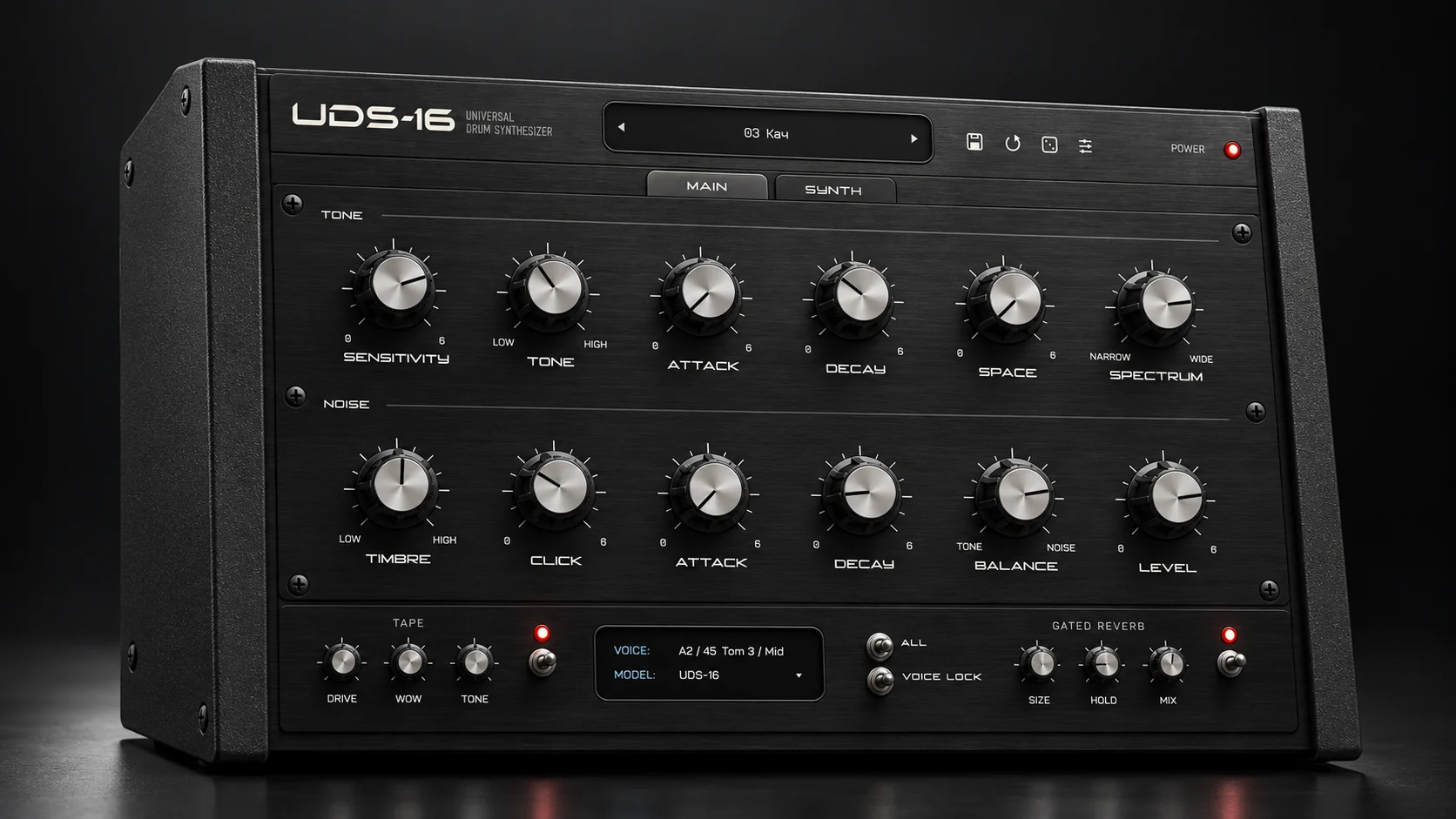
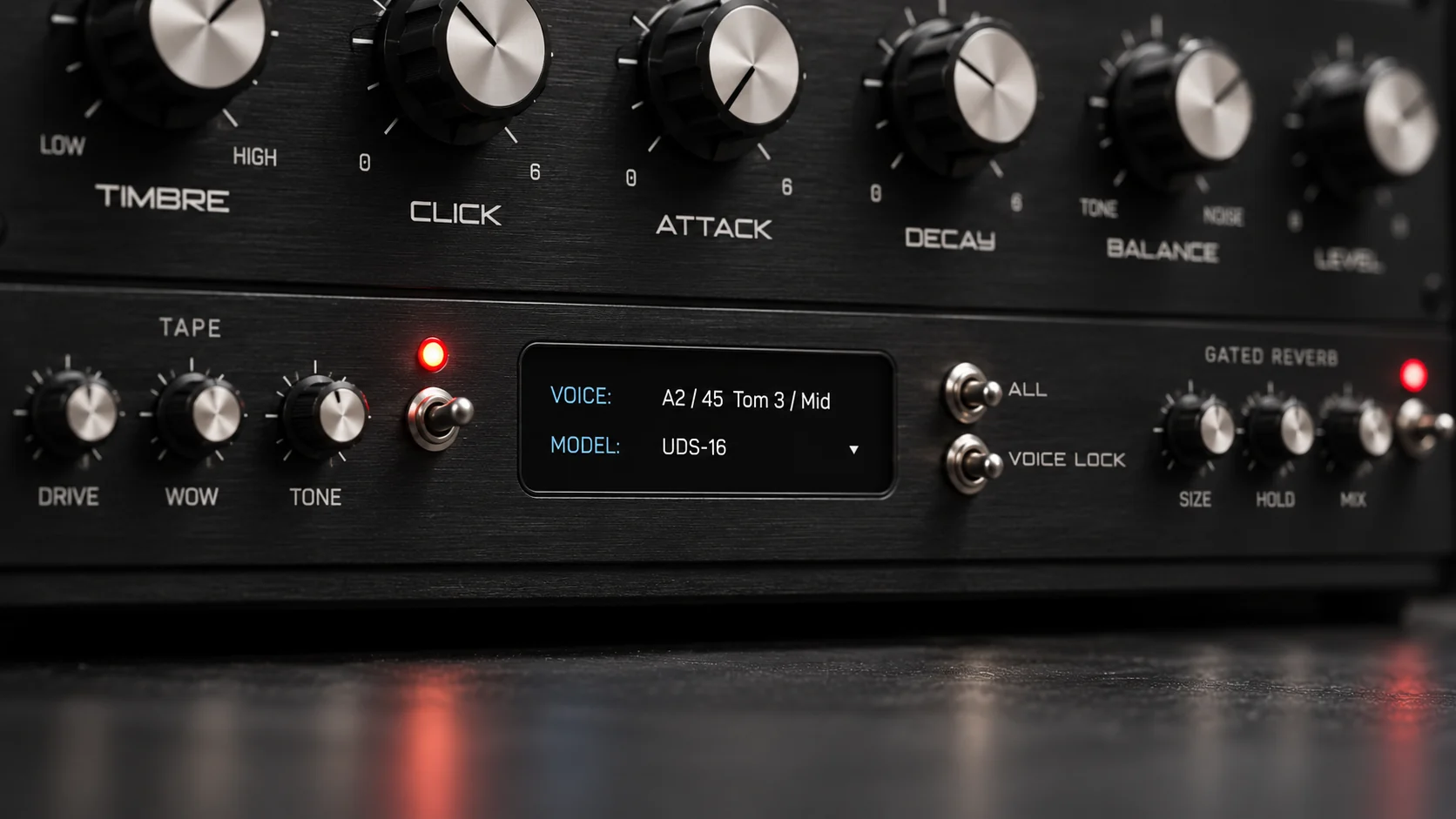
The panel is the same for every model. A Tone section carries sensitivity, tone, attack, decay, space and spectrum; a Noise section carries timbre, click, attack, decay, balance and level. Velocity changes the response. After the voices come a Tape stage (drive, wow, tone) and a Gated Reverb (size, hold, mix), and every processing stage can be bypassed. Oversampling goes up to 4×. Factory kits and single-drum presets are included for every model. It was released in September 2026, so it is a young product from a small studio. Tapechild is not affiliated with the makers of the Lel UDS or the Formanta Rockton, and UDS-16 is not sold as an exact emulation of either. Explore UDS-16
Sound and synthesis
The two instruments answer the question of where a drum comes from differently, and that decides everything downstream. In Spark 2, a kick is most often a recording or a TAE-modelled 808 or 909 kick chosen from the library, then shaped by pitch, envelope and insert effects. For a kick from first principles you open the modular page, place an oscillator, add one envelope to its pitch and another to its level, and route it through a filter. In UDS-16 that second route is the only route: pick a model, lower the tone, set a short attack and a decay long enough to hold the body, and let the tone section supply the drop.
A snare shows the difference more sharply. Spark 2’s physical modelling treats the drum as a struck object, and Arturia’s examples move the stick across a modelled snare head and change the timbre of a modelled tom. UDS-16 cannot do that at all; it has no acoustic model. What it does instead is the two-source snare of the Soviet machines: a pitched tone against a noise chain, weighted with the noise section’s balance and level, with the click control adding the resonant transient of the Lel circuit. Push the output stage and the snare distorts the way the hardware does. Add the Gated Reverb and the hold control gives the cut-off tail.
Hats separate them again. Spark 2 has sampled and modelled hats from every listed machine, and its Karplus-Strong and ring-modulator modules reach metallic tones a plain noise source will not. UDS-16 builds hats from its noise chain, shaped by timbre, attack and decay; the UDS-16 model’s six inharmonic partials add a metallic edge, and on UDS-1987 and UDS-1988 the noise is raw digital noise, which is the sound of those machines and not for everyone. Only one of these plugins has a realistic ride cymbal.
What each cannot do, plainly. Spark 2 cannot sound like a Lel UDS or a Formanta Rockton, because nobody has modelled those circuits for it, and much of its library is sample-based, so many of its sounds are fixed recordings with processing around them. UDS-16 cannot play a sample, cannot model an acoustic drum, cannot patch modules together, and has no FM or wavetable source. Its palette is four models wide and stays there. If the vocabulary is new, our guide to how drum synthesis works explains what tone, noise, click and envelope controls actually do.
Workflow: sequencing, presets and the DAW
Spark 2 owns the pattern. Its 64-step sequencer shows all sixteen instruments at once, with 32 steps on screen at a time, shuffle and shift for feel, loop mode, choke groups and per-instrument automation. Patterns leave as WAV or MIDI, so the plugin can be where a groove is written and the DAW where it is arranged. It also runs standalone, which with the SparkLE controller makes it a live instrument that needs no host.
UDS-16 owns nothing about timing. Notes arrive from the DAW’s piano roll, a drum-rack device or a MIDI controller, and the plugin synthesizes what it is told to. That is a real cost if you like writing beats inside the instrument, and a non-issue if your DAW’s sequencer is where you already work. The upside is that UDS-16 fits any template without displacing anything: one instrument track and sixteen notes.
Presets tilt one way. Spark 2 ships 1,900+ instruments in 180+ kits and sells expansion packs on top. UDS-16 ships factory kits and single-drum presets for every model, enough to hear what each circuit does, but a small ecosystem next to Spark 2’s, with no third-party packs yet. Both run standalone; only Spark 2 imports audio.
Formats, price and licensing
Arturia’s details page lists Spark 2 as Standalone, VST 2.4 (32-bit and 64-bit), AAX and Audio Unit, with no VST3 in the list, and gives macOS 10.8+ and Windows 7+ as the required configuration. The resources page is more current: the macOS download is version 2.4.2, dated December 2022 and labelled Mac OS 11.0+ (ARM); the Windows download is version 2.4.0, dated June 2018, labelled Win 7+. Activation runs through the Arturia Software Center. Check the current build against your host before buying.
UDS-16 is VST3, AU and Standalone on macOS 11.0+ as a Universal 2 binary for Apple Silicon and Intel, and VST3 and Standalone on Windows 10/11 64-bit with a signed installer. No AAX, no Linux, no CLAP, so Pro Tools users are out. The licence activates on up to three computers, online or offline, with no iLok, and updates within the UDS-16 line are free.
On price, Spark 2 is listed at 149€ or 149$ with a Buy Now button on its own product page, so it is sold standalone at the time of writing; the page does not mention any bundle it belongs to. There is a free demo. UDS-16 is $49 one-time at the time of writing against a $79 list price, with no subscription. There is no trial; the product page carries audio demos.
Which one should you buy?
Buy Spark 2 if…
You want sequencing, sound and mixing in one window and the groove to leave as WAV or MIDI. You need acoustic kits, physically modelled drums or the classic Roland and Simmons emulations alongside synthesis. You run Pro Tools and need AAX. You want a hardware controller that maps to the software out of the box.
Buy UDS-16 if…
Your DAW sequences and you want a drum synth that stays out of its way. You want percussion built on Soviet-era circuits with a gated reverb and tape stage on the panel. Every hit should stay a live synthesized parameter that velocity and tuning change. You want a small instrument at $49 rather than a workstation at around $149.
Can you run both? Yes, and it is a sensible pairing. Spark 2 supplies the sampled and modelled kit, the pattern and the mix bus; UDS-16 supplies one or two voices the Spark library does not have, played from the same MIDI clip on a second track. Most working templates already hold a sampler next to a synth. Our list of best drum machine VST plugins covers the wider field if neither fits.
Other UDS-16 comparisons
- UDS-16 vs Microtonic
- UDS-16 vs AIR Drum Synth 500
- UDS-16 vs D16 Nepheton 2
- UDS-16 vs D16 Drumazon 2
- UDS-16 vs Baby Audio Tekno
- UDS-16 vs DrumSpillage 2
- UDS-16 vs VSDS-X
- UDS-16 vs KICK 2
- UDS-16 vs Ableton Drum Synths
- Emergent Drums alternative
- 12 best drum synth plugins
Frequently asked questions
Is UDS-16 a Spark 2 alternative?
Only for one part of what Spark 2 does. Spark 2 is a sequencer, a mixer, an effects rack and a 1,900-instrument library with synthesis inside it; UDS-16 is sixteen synthesized voices with a tape stage and a gated reverb, and it relies on your DAW for timing. If you use Spark 2 mainly for its modular sound-design page, UDS-16 covers a narrower but different corner of synthesized percussion. If you use it for patterns, samples or acoustic kits, UDS-16 is not a replacement.
Spark 2 vs UDS-16 for techno and industrial?
Spark 2 has techno and industrial kits in its library, 808 and 909 emulations, and fourteen insert effects including distortion, bit crusher and destroyer, so a full track can be built inside it. UDS-16 brings a different source: Soviet circuits with raw digital noise and an output stage that distorts when pushed, plus a gated reverb with a hold control. Many producers would use Spark 2 for the kit and UDS-16 for the one voice that sounds like nothing in the library.
Is Spark 2 still sold on its own, and is it updated?
At the time of writing, Arturia’s page sells Spark 2 on its own at 149€ or 149$ with a free demo, and does not mention any bundle. The resources page lists a 2.4.2 macOS build from December 2022 and a 2.4.0 Windows build from June 2018, and the manual is version 2.1.0. Those are the maker’s own dates; check them against your OS before buying.
Does UDS-16 have a step sequencer like Spark 2?
No. UDS-16 has no sequencer of any kind; notes come from the DAW’s piano roll or a MIDI controller, on sixteen notes from C2 to D#3. Spark 2 has a 64-step sequencer with shuffle, shift, loop, choke groups and per-instrument automation, and can export the result as MIDI. If writing patterns inside the instrument matters to you, that alone decides the comparison.
Which plugin formats do Spark 2 and UDS-16 support?
Arturia’s details page lists Spark 2 as Standalone, VST 2.4, AAX and Audio Unit, with no VST3 named. UDS-16 is VST3, AU and Standalone on macOS 11.0+ (Apple Silicon and Intel) and VST3 and Standalone on Windows 10/11, with no AAX, CLAP or Linux build. Pro Tools users need Spark 2; hosts that have dropped VST2 need to confirm Spark 2’s current build first.
If a sixteen-voice drum synth built on Soviet circuits sounds like the layer your kit is missing, Explore UDS-16. For the whole field in one place, our guide to the best drum synth plugins puts Spark 2 and UDS-16 next to ten others.
Royalty-free WAV
Free sample packs
Royalty-free WAV, play every sample before you download.