
Tapechild UDS-16 vs VSDS-X: Simmons or Soviet (2026)
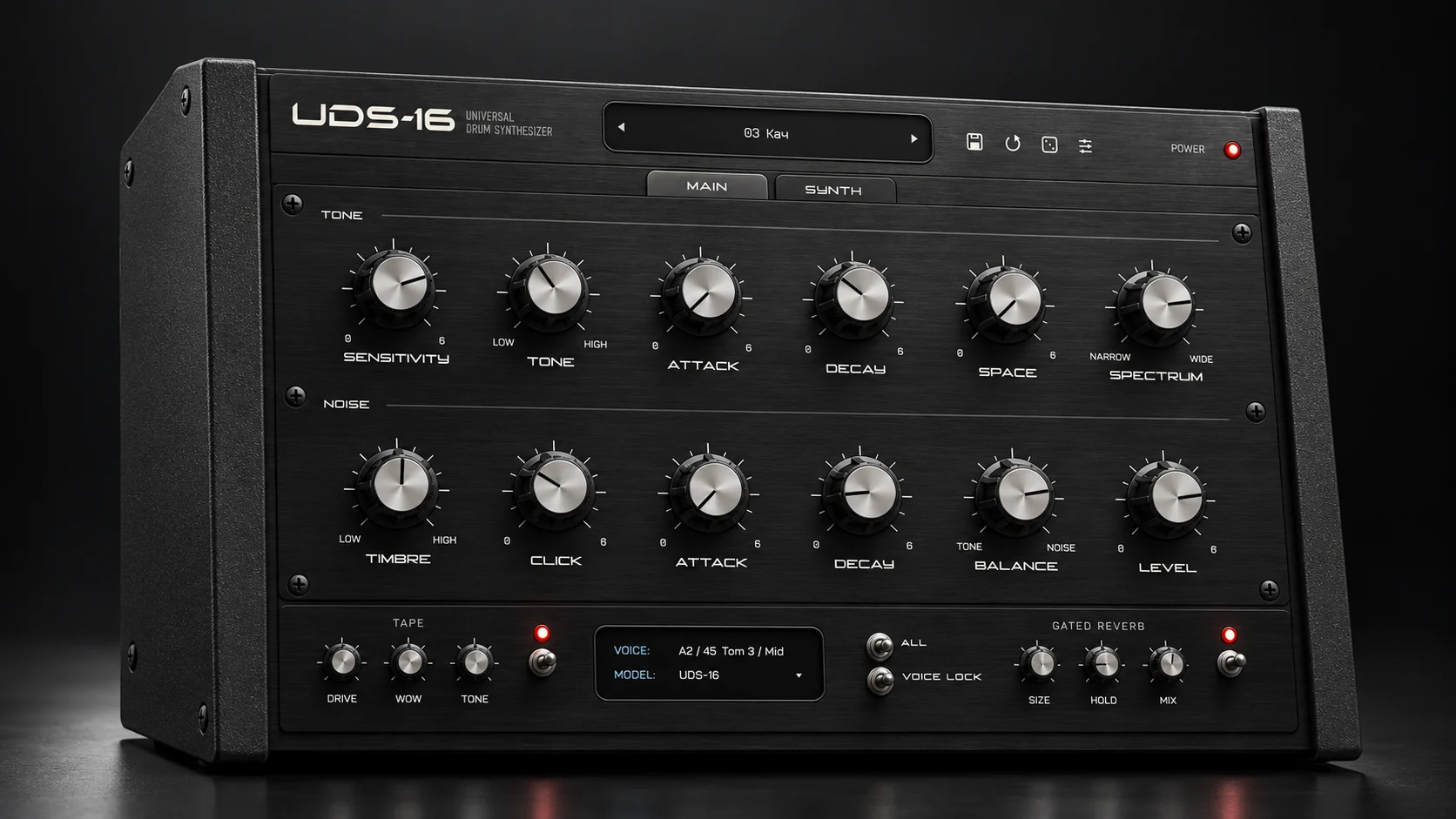
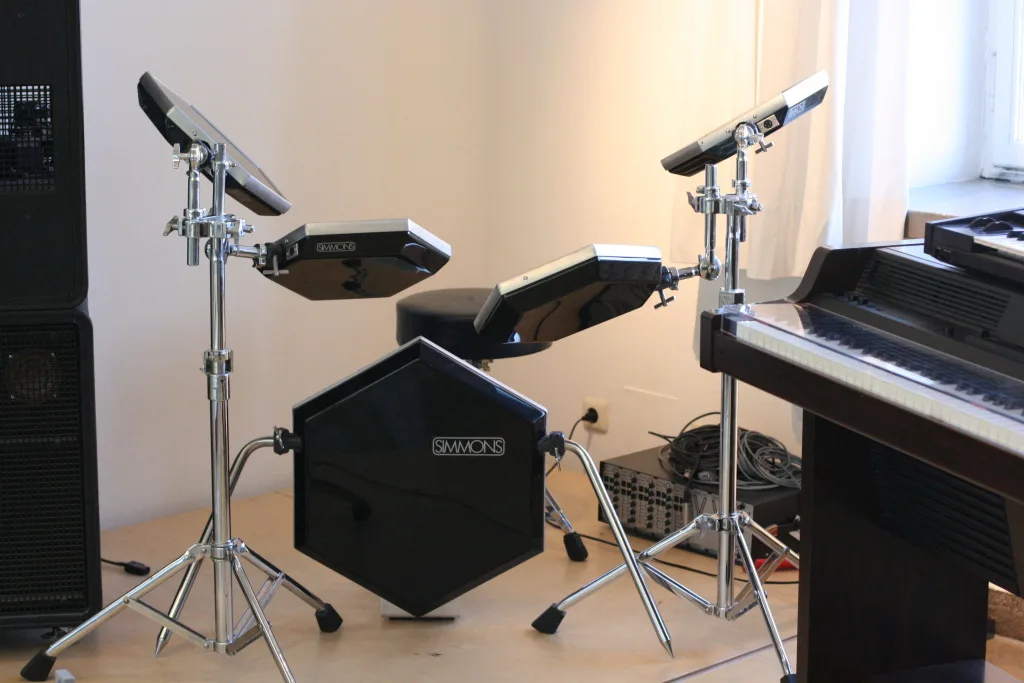
Aly James Lab VSDS-X emulates the Simmons SDS-V drum brain, the British electronic kit behind the pitched tom sweeps of early-1980s pop. Tapechild UDS-16 models channels from two Soviet drum synthesizers of the same decade, the Lel UDS and the Formanta Rockton, and adds an engine of its own. Both are narrow, idiom-specific instruments from small developers that leave sequencing to the DAW: VSDS-X is for the Simmons vocabulary, UDS-16 for the Soviet one, and neither is a general kit.
The short answer
Pick VSDS-X if the sound you want is the Simmons one: the hexagonal-pad tom that bends down through an octave, the SDS-V snare with its noise burst, the clap of the Simmons ClapTrap. It has the SDS-V control set per module (tone, bend, decay, noise, click, filter), an SDS7-style LFO for FM modulation, and two EPROM voices that load your own image data for the later hybrid sounds. Each voice can take its own output into the DAW. For synth-pop or synthwave it is the reference instrument for that decade.
Pick UDS-16 if you want the other side of the Iron Curtain: the free-running tone, raw digital noise and resonant click of a Lel UDS channel, or the seven-channel Formanta Rockton expanded to a sixteen-voice kit. It gives you sixteen independently tuned voices, four synthesis models switchable per drum, a built-in Tape stage and Gated Reverb, and Standalone builds on both platforms. If your references are Soviet hardware, unstable synthetic toms and gated snares, UDS-16 covers that ground and VSDS-X does not try to.
VSDS-X vs UDS-16 at a glance
| VSDS-X | UDS-16 | |
|---|---|---|
| Type | Focused voice, Simmons SDS-V emulation | Focused voice, Soviet circuit models |
| Synthesis | Analog modelling of the SDS-V: tone, bend, decay, noise, click, SSM2044-style filter; two EPROM sample voices | Four models per drum: UDS-1987, UDS-1988, ROKTON, UDS-16; every hit synthesized at playback, no samples |
| Voices | Bass drum, snare, tom, hi-hat, cymbal, clap and two EPROM voices; four modules shown at once | Sixteen independent voices on MIDI notes C2–D#3, each tuned separately |
| Sequencer | None; triggered from the DAW on GM-mapped notes | None; timing from the DAW or a MIDI controller |
| Presets | Loads and saves full patches and banks; count not stated | Factory kits and single-drum presets for every model |
| Effects | None listed; built-in mixer between clean and non-linear outputs, multi-output | Tape (drive, wow, tone) and Gated Reverb (size, hold, mix), each bypassable; up to 4× oversampling |
| Formats | 64-bit VST3 on Windows; VST3 or AU on macOS. No AAX, no Standalone | VST3, AU, Standalone on macOS; VST3, Standalone on Windows. No AAX, no CLAP |
| OS | Windows 10 and higher; macOS 10.14 and higher, Universal 2 | macOS 11.0+, Universal 2; Windows 10/11 64-bit |
| Price at time of writing | Around €51 | $49 one-time (list $79), no subscription |
| Try before buying | No demo mentioned on the official page | No trial; audio demos on the product page |
| Best for | Simmons-era synth-pop, synthwave, electronic toms and claps | Soviet-circuit percussion, gated snares, a signature layer beside an existing kit |
What VSDS-X does
VSDS-X stands for Virtual Simmons Drum System Extended; the build on the official page is version 2.3.1. It is an analog-modelling emulation of the Simmons SDS-V drum brain, the rack behind the hexagonal pads on stages from 1981 onward. Aly James Lab lists analog sound generation, internal circuitry tuning, SSM2044 filter emulation and op-amp bandwidth limitation: the parts of the circuit that made the hardware sound the way it did, modelled rather than sampled.
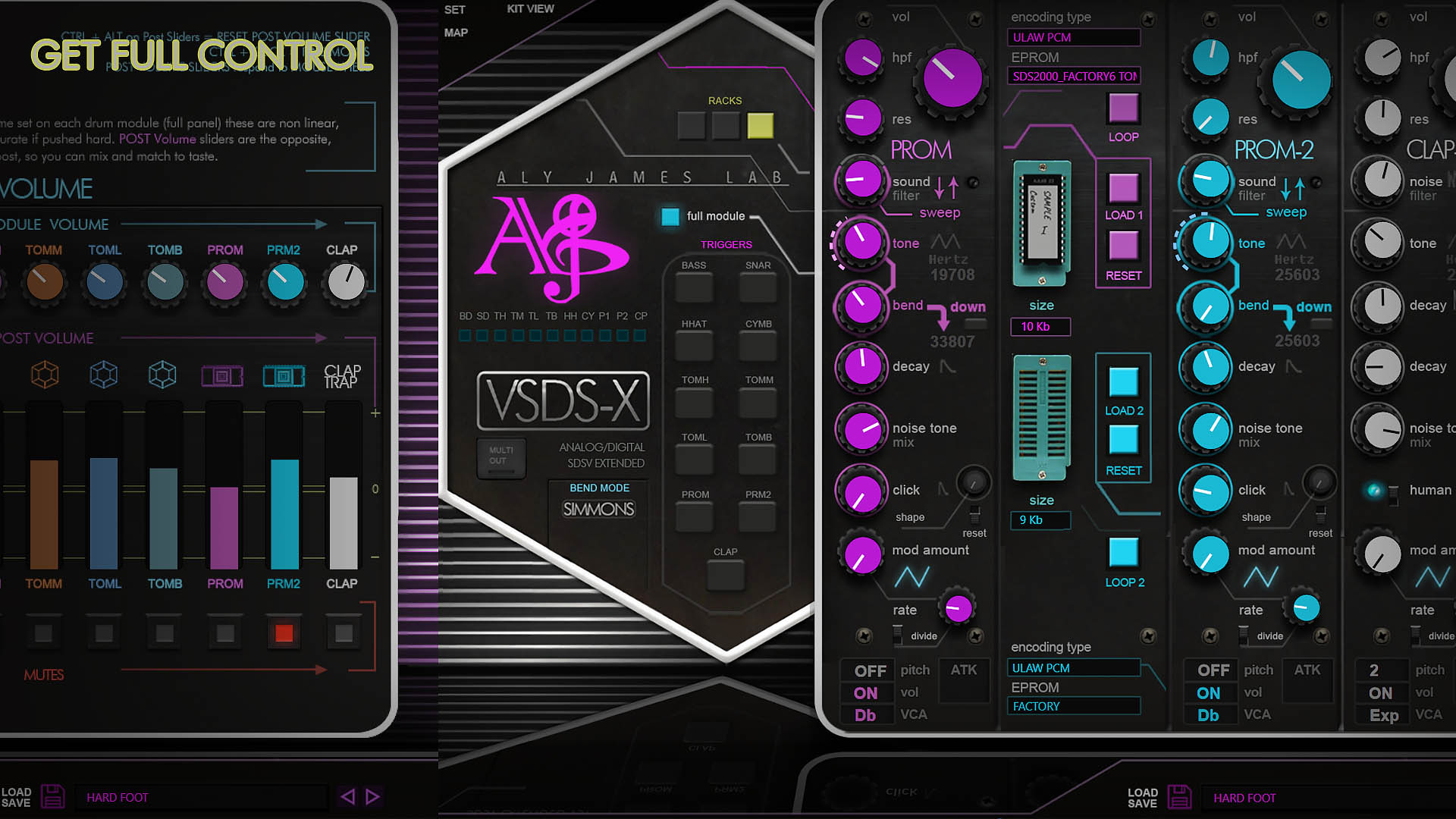
The modules are the ones the hardware had: bass drum, snare, tom, hi-hat and cymbal, plus a clap built on the Simmons Digital ClapTrap and two EPROM voices, PROM and PROM 2, that load your own external EPROM image data. That is the Extended in the name: the later Simmons hybrids, where a burned chip held a short sample and the analog voice shaped it. The interface shows four modules at a time. Each carries tone, bend, decay, noise, click and a VCF and VCA stage, and MIDI velocity changes the synthesized sound rather than just the level, which is what a Simmons player expects from a pad hit.

Around the voices sit an SDS7-style LFO for FM modulation, a mixer that balances the clean volume against the non-linear module outputs, and multi-output routing so every voice can land on its own DAW channel or all of them on one stereo pair. Triggers follow the General MIDI drum map, parameters can be MIDI-learned and the map saved, and full patches and banks load and save in several formats. It ships as 64-bit VST3 on Windows 10 and higher and as VST3 or Audio Unit on macOS 10.14 and higher, Universal 2. The listed price is €51. Official VSDS-X page
What UDS-16 does
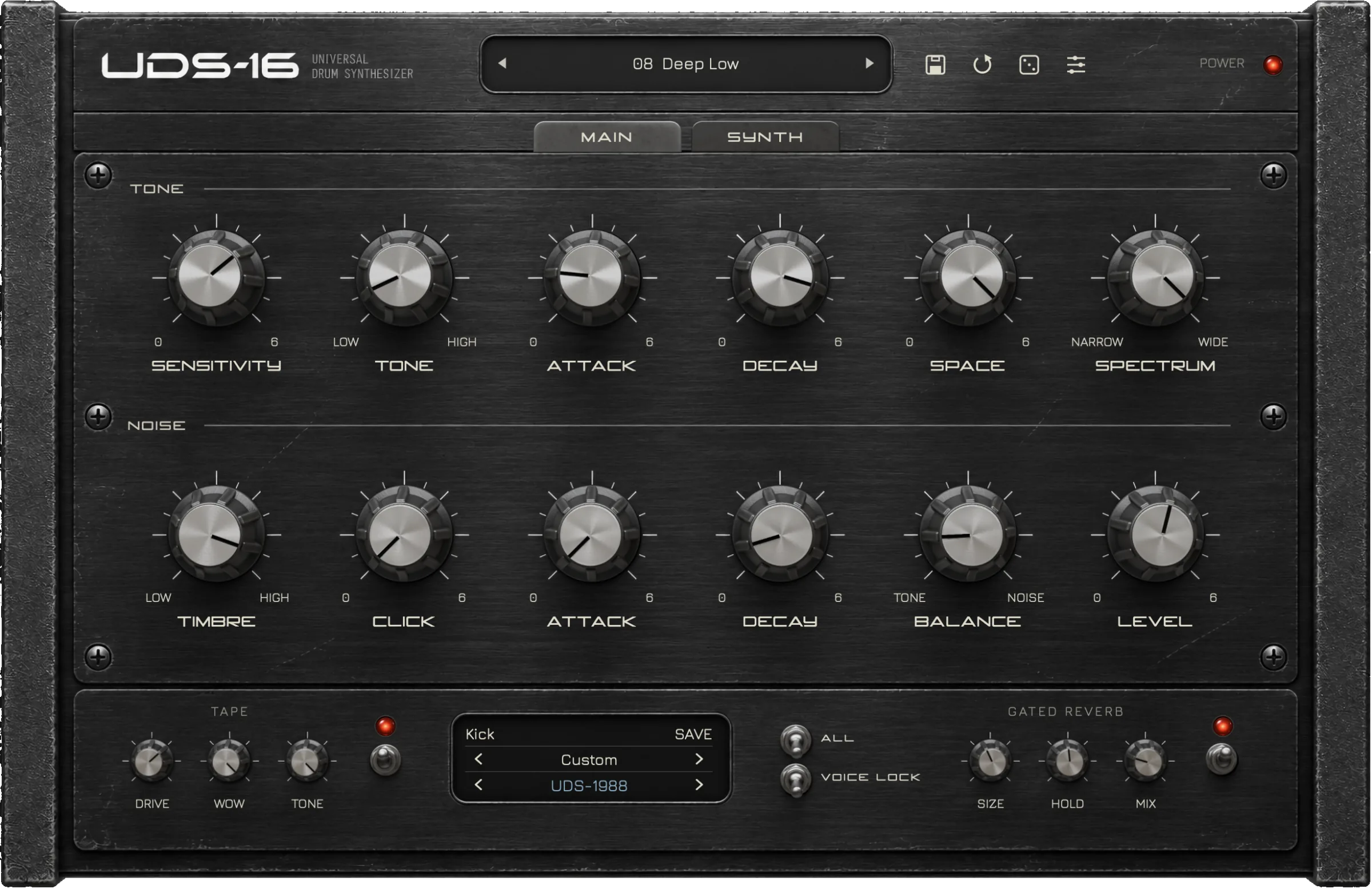
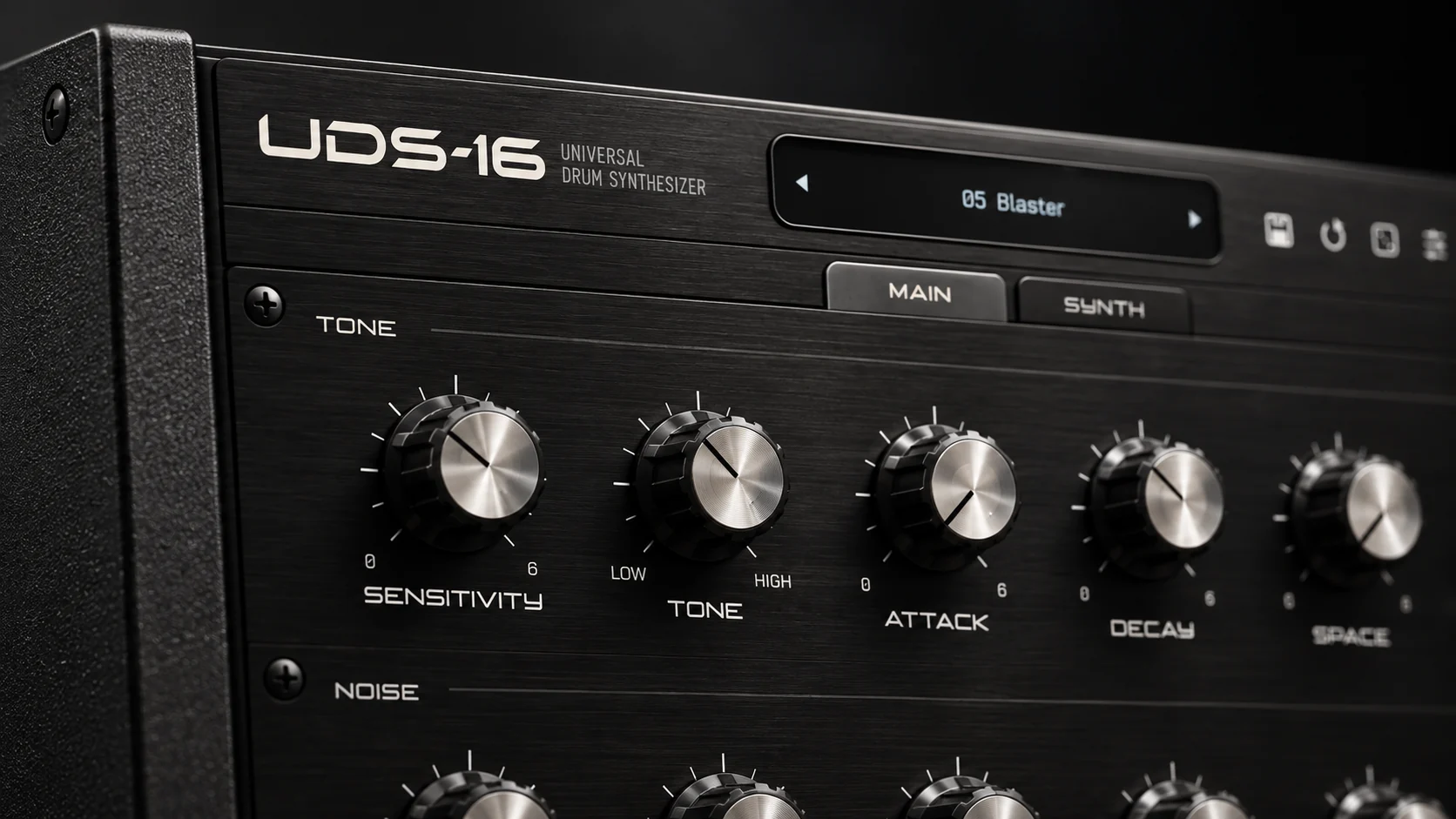
UDS-16 is a sixteen-voice drum synthesizer. The voices sit on MIDI notes C2 to D#3, each tuned independently, and every hit is synthesized when it plays; there is no sample library, no sample import and no round-robin. Each voice picks one of four models. UDS-1987 is a circuit model of a channel from the Soviet Lel UDS: a free-running tone, raw digital noise, a resonant click and an output stage that bites when pushed. UDS-1988 is a second voicing of the same channel, kept separate because the same knob positions land differently. ROKTON is inspired by the seven-channel Formanta Rockton, the box collectors call the Soviet 808, expanded to a sixteen-voice kit; its noise chain is an approximation, not bit-exact. UDS-16 is Tapechild’s own engine with no hardware original: a pitched body with its own pitch envelope, harmonics, a noise layer, a short transient, six inharmonic partials for metallic colour and a drive stage.
The main panel is the same for every model. A Tone section carries sensitivity, tone, attack, decay, space and spectrum; a Noise section carries timbre, click, attack, decay, balance and level. Velocity changes the response, not only the volume. After the voices come a Tape stage with drive, wow and tone, and a Gated Reverb with size, hold and mix; every stage can be bypassed, and the engine runs at up to 4× oversampling. Factory kits and single-drum presets are included for every model.
Two things it is not. It is not an exact emulation of the Lel UDS or the Rockton and is not sold as one, and Tapechild is not affiliated with or endorsed by either manufacturer. It is also young: released in September 2026, from a small studio, with a preset ecosystem that is months old rather than years. Explore UDS-16
Sound and synthesis
Both instruments belong to the same design family, an analog drum voice built from a tone, a noise source, a click and envelopes; our guide to how drum synthesis works covers the vocabulary. Where they part is the circuit. Simmons built the SDS-V for drummers who hit pads; Lel and Formanta built theirs for a Soviet market that could not import a Simmons or a Roland, and the two lineages reach kick, snare and hat by different routes.
Kick
A VSDS-X bass drum follows the Simmons recipe: the tone oscillator starts high and bend sets how far it falls, decay sets how long the body rings, noise adds the pad slap and click puts a transient on the front. Push bend and decay together and you get the descending thud of 1983. The SSM2044-style filter rounds off the top, and velocity changes bend and brightness rather than just level.
A UDS-16 kick depends on the model. On UDS-1987 the tone oscillator is free-running, so the pitch at the moment of the hit is wherever the oscillator happens to be and successive hits are not identical; the click is resonant rather than a plain transient, and pushing sensitivity into the output stage makes it bite. The UDS-16 engine takes the conventional route, a pitched body with its own pitch envelope, with the drive stage and then Tape drive after it. Neither plugin offers a hand-drawn pitch curve.
Snare
The Simmons snare is tone plus a burst of filtered noise, and the balance between them is the sound. VSDS-X keeps the two under separate controls with the filter after them, so the bright, short SDS-V crack sits a few knob turns from a longer, darker electronic snare. Its clap is a separate module modelled on the ClapTrap, the handclap box Simmons sold on its own.
UDS-16 puts its Noise section on every voice. On the Lel models the noise is raw digital noise, as the hardware generated it, which reads grittier than the band-limited Simmons version. The Gated Reverb after the voice turns that snare into the gated sound of the era without an insert; VSDS-X lists no effects, so its snare goes to your own reverb and gate. For a gated snare inside the instrument, UDS-16 has the shorter path. For an SDS-V snare, VSDS-X has the right circuit.
Hi-hat and metal
The SDS-V hi-hat and cymbal are noise shaped by the filter and decay, and VSDS-X models them that way. The EPROM voices go further: load an image and the later Simmons hybrid sounds, including sampled metals, are available inside the same instrument. UDS-16 has no sample section. Its hats on the Lel and Rockton models are shaped noise too, while the UDS-16 engine adds six inharmonic partials for a metallic colour noise alone does not produce. For a sampled crash, VSDS-X gets closer through its EPROM slots.
What each cannot do
- VSDS-X does not do 808 or 909 sounds, FM percussion or acoustic modelling; outside the Simmons idiom it has little to offer, by design.
- UDS-16 has no Simmons-style bend control, loads no samples and has no EPROM-style layer; its palette is narrower than a multi-engine kit designer.
- Neither has a step sequencer, an AAX build or a Linux build; VSDS-X lists no built-in effects, and UDS-16 has no EQ or compressor.
Workflow: sequencing, presets and the DAW
Neither instrument owns the pattern. You write notes in the DAW, or play a controller, and the plugin answers. VSDS-X maps its triggers to the General MIDI drum layout, so a drum track written for a GM kit lands on the right modules without remapping. UDS-16 places its sixteen voices on C2 to D#3, a contiguous run, so a sixteen-pad controller covers the kit in one bank. If you want pattern writing inside the plugin, Microtonic or the D16 pair from our best drum synth plugins guide are the better fit.
Routing is where VSDS-X is more thorough: multi-output puts every voice on its own DAW channel, the mixer balances clean against non-linear outputs, and MIDI-learn with a saved map suits a pad controller. UDS-16 handles the other end of the chain: its Tape and Gated Reverb stages mean a voice leaves the plugin already saturated and gated, so a single stereo bus is often enough.
Presets are a small story for both. VSDS-X loads and saves patches and banks in several formats without stating a factory count; UDS-16 ships factory kits and single-drum presets for every model, and because it is new, third-party banks do not yet exist. In both, the useful sounds sit close to the panel.
Formats, price and licensing
VSDS-X: 64-bit VST3 on Windows 10 and higher, VST3 or Audio Unit on macOS 10.14 and higher, Universal 2. No AAX, no standalone application, and no demo mentioned. The listed price is €51. Aly James Lab is a small developer and the format list has changed across versions (VST2 was dropped at 2.0), so the current page is the reference, not this article.
UDS-16: VST3, AU and Standalone on macOS 11.0 and later, Universal 2; VST3 and Standalone on Windows 10 and 11, 64-bit, signed installer. No AAX, no Linux, no CLAP. $49 one-time at the time of writing against a list price of $79, no subscription, free updates within the UDS-16 line, and a licence that activates on up to three computers, online or offline, with no iLok. There is no trial version; audio demos are on the product page. Both plugins ask you to buy on demos and the maker’s description, and both cost about the same. The older macOS floor on VSDS-X (10.14 against 11.0) matters if your machine has stopped updating.
Which one should you buy?
Buy VSDS-X if…
The Simmons SDS-V sound is the brief, from bent toms to ClapTrap claps. You want an EPROM section for the later hybrid Simmons sounds or your own image data. You need per-voice outputs and MIDI-learn for a pad controller. You run macOS 10.14 or 10.15 and cannot move up.
Buy UDS-16 if…
Your reference is the Lel UDS or the Formanta Rockton rather than Simmons, and no other plugin on our list models them. You want sixteen independently tuned voices in one instance with a model choice per drum. You want gated snares and tape saturation inside the instrument. You want a Standalone build on either platform.
Can you run both? Yes, and for many producers that is the honest answer, because the two idioms do not overlap. VSDS-X brings the Simmons tom and the ClapTrap; UDS-16 brings the Soviet kick, the raw-noise snare and the gated tail. Both are played from the DAW, and owning the pair costs about what one mid-range kit designer does. For the hardware each descends from, our guide to analog drum machines puts the Simmons and the Soviet machines on the same timeline.
Other UDS-16 comparisons
- UDS-16 vs Microtonic
- UDS-16 vs AIR Drum Synth 500
- UDS-16 vs D16 Nepheton 2
- UDS-16 vs D16 Drumazon 2
- UDS-16 vs Arturia Spark 2
- UDS-16 vs Baby Audio Tekno
- UDS-16 vs DrumSpillage 2
- UDS-16 vs KICK 2
- UDS-16 vs Ableton Drum Synths
- Emergent Drums alternative
- 12 best drum synth plugins
Frequently asked questions
Is UDS-16 a VSDS-X alternative?
Only in scope, not in sound. Both are narrow drum synths from small developers with no sequencer, priced within a few dollars of each other, that leave timing to the DAW. VSDS-X emulates the Simmons SDS-V and adds EPROM voices for the later hybrid sounds; UDS-16 models channels from the Soviet Lel UDS and Formanta Rockton and adds its own engine. If the Simmons sound is what you want, UDS-16 is not a substitute, and the reverse holds too.
VSDS-X vs UDS-16 for synthwave?
VSDS-X is the closer match for synthwave built on 1980s pop references: the bent Simmons tom, the SDS-V snare and the ClapTrap clap are the sounds the genre quotes. UDS-16 contributes a different colour from the same decade: gated snares from its Gated Reverb, tape drift from its Tape stage and Soviet-circuit toms that do not sound like Simmons. A synthwave template might use VSDS-X for the fills and UDS-16 for the backbeat.
Does either plugin have a step sequencer?
No. VSDS-X is triggered from the DAW on General MIDI drum notes, and UDS-16 from the DAW or a MIDI controller on notes C2 to D#3. Both expect the piano roll or a drum editor to hold the pattern. If you want to write beats inside the plugin, look at Microtonic, Nepheton 2 or Drumazon 2 instead.
Can I try VSDS-X or UDS-16 before buying?
The VSDS-X page does not mention a demo version at the time of writing. UDS-16 has no trial version; audio demos are on the product page. Both cost about the same, so the decision rests on the demos and the description of the synthesis rather than on a hands-on test.
Two instruments, two idioms, one decade. Explore UDS-16 if the Soviet side is the one you are missing, and see the wider field in our guide to the best drum synth plugins.
Royalty-free WAV
Free sample packs
Royalty-free WAV, play every sample before you download.