
Tapechild UDS-16 vs Drumazon 2: 909 or Soviet (2026)
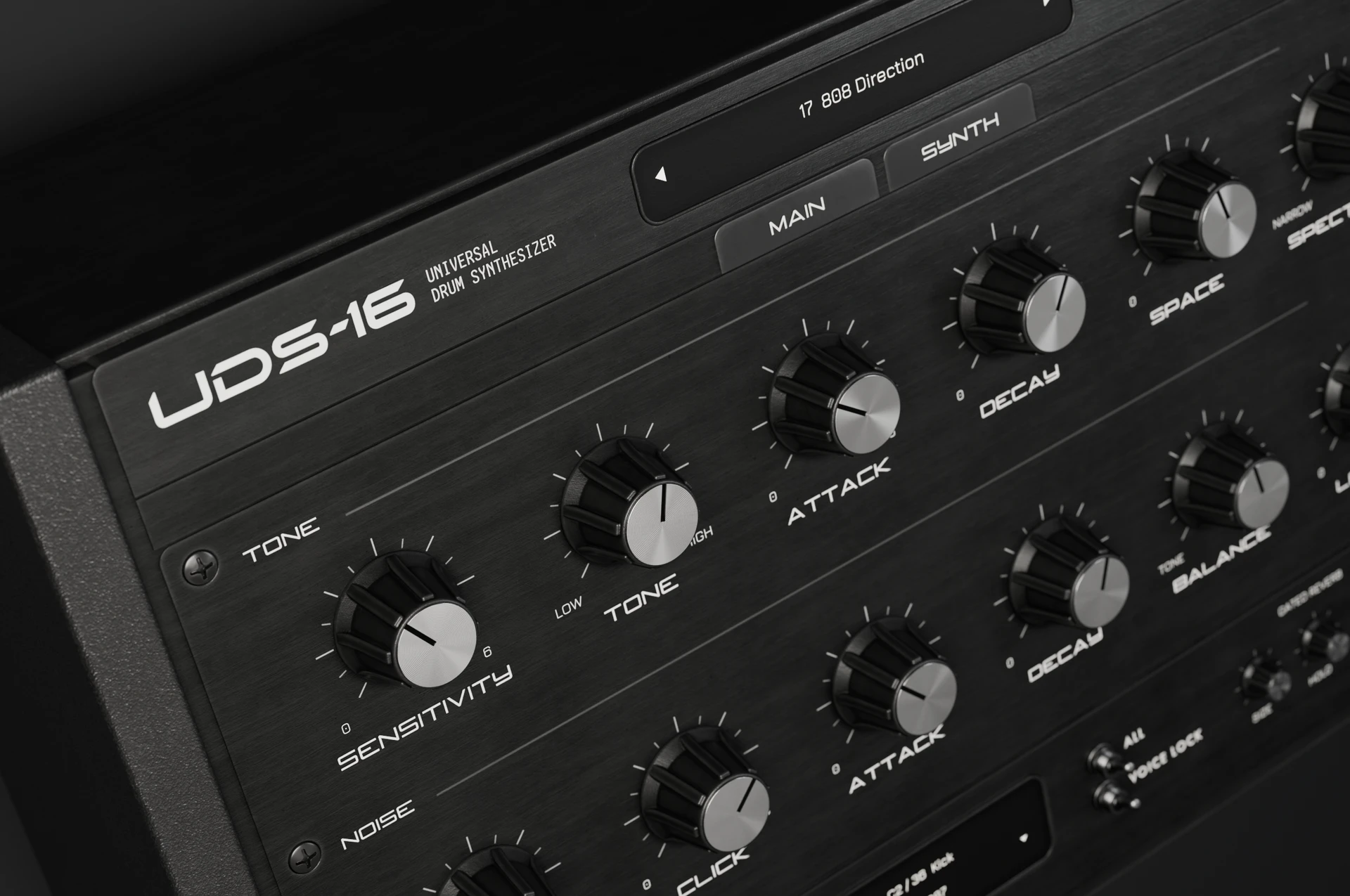
D16 Group Drumazon 2 is an emulation of the Roland TR-909, eleven drum sounds and a step sequencer in one plugin. Tapechild UDS-16 is a sixteen-voice drum synthesizer built on Soviet percussion circuits, with no sequencer and no 909 inside it. If the sound you want is the 909, Drumazon 2 is the instrument for that job; if you want a second, stranger voice layer next to a kit you already own, UDS-16 is the one to read about.
The short answer
Buy Drumazon 2 if you produce techno or house and the drum sound in your head is the 909. D16 states that it emulates all the sounds of the original machine, and the plugin carries a sequencer with accented steps, per-step flam and substeps, a randomizer, tap recording and drag-and-drop MIDI export, so you write the pattern inside the plugin and hand the notes to the DAW afterwards. It also brings over a thousand factory presets and patterns, an AAX build for Pro Tools and a downloadable demo.
Buy UDS-16 if you already have a 909 in some form and want percussion that does not sound like a Roland. Its four synthesis models are chosen per drum: two voicings of a channel from the Soviet Lel UDS, a model inspired by the Formanta Rockton, and Tapechild’s own engine. Every hit, hats included, is synthesized when the note plays; there is no sample anywhere in the plugin. It costs $49 at the time of writing and leaves timing to your host. It has no sequencer and no AAX, and it is a young product from a small studio.
Drumazon 2 vs UDS-16 at a glance
| Drumazon 2 | UDS-16 | |
|---|---|---|
| Type | Drum machine: TR-909 emulation with a step sequencer | Drum synthesizer: sixteen voices, no sequencer |
| Synthesis | Emulates all eleven 909 sounds; on the hardware the hats and cymbals are sample playback, the rest is analog | Four synthesis models selectable per drum; every hit, hats included, synthesized at playback |
| Voices | 11 drum sounds | 16 independent voices on MIDI notes C2–D#3, each tuned separately |
| Sequencer | Yes: accented steps, per-step flam and substeps, randomizer, tap recording, MIDI drag export | No; timing comes from the DAW or a MIDI controller |
| Presets | Over 1,000 presets and patterns in the factory content | Factory kits and single-drum presets for every model |
| Effects | EQ and compression per instrument, two bus effect chains, master 3-band compressor and limiter | Tape stage (drive, wow, tone) and gated reverb (size, hold, mix), each bypassable; up to 4× oversampling |
| Formats | VST2, VST3, AU, AAX; no standalone | VST3, AU and Standalone on macOS; VST3 and Standalone on Windows; no AAX |
| OS | Windows 7 or newer; macOS 10.13 to 26, 64-bit, Apple Silicon supported | macOS 11.0+ (Universal 2, Apple Silicon and Intel); Windows 10/11 64-bit |
| Price at time of writing | €119 list, on sale for €49 | $49 one-time (list price $79) |
| Try before buying | Demo download | No trial; audio demos on the product page |
| Best for | Techno and house producers who want the 909 and its sequencer | Producers who sequence in the DAW and want a Soviet-circuit voice layer |
What Drumazon 2 does
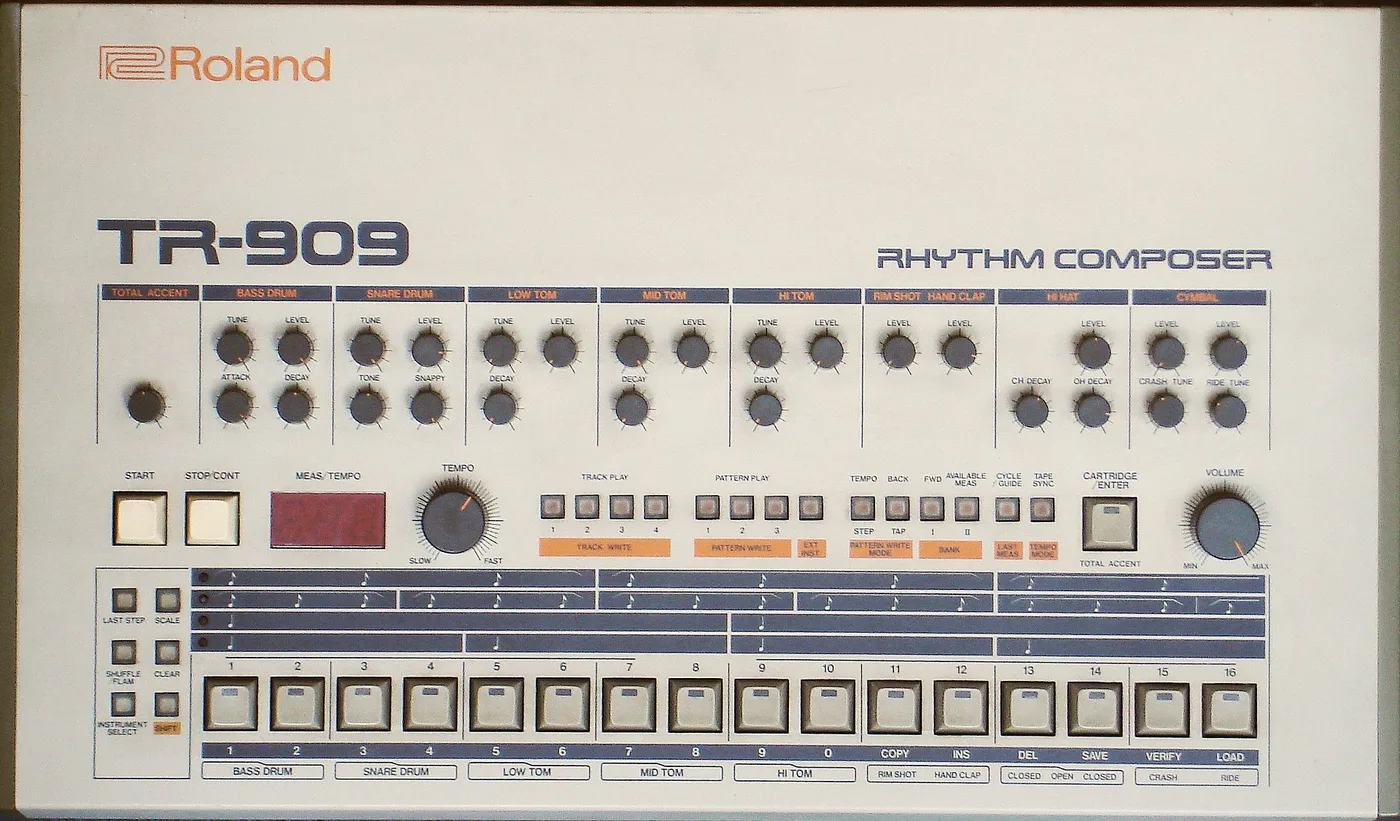
The Roland TR-909 came out in 1983 and became the drum machine of techno and house. Its kick, snare, toms, rim shot and clap are analog circuits; its closed and open hi-hats, crash and ride are short digital samples played through analog envelopes, which is why the 909 hats have a grain no purely analog machine reproduces. Drumazon 2 is D16’s emulation of that machine. D16 says it emulates all the sounds of the original 909, matching each instrument individually, across the eleven drum sounds that shaped electronic dance music. Our 808 vs 909 guide compares the two Roland machines voice by voice.

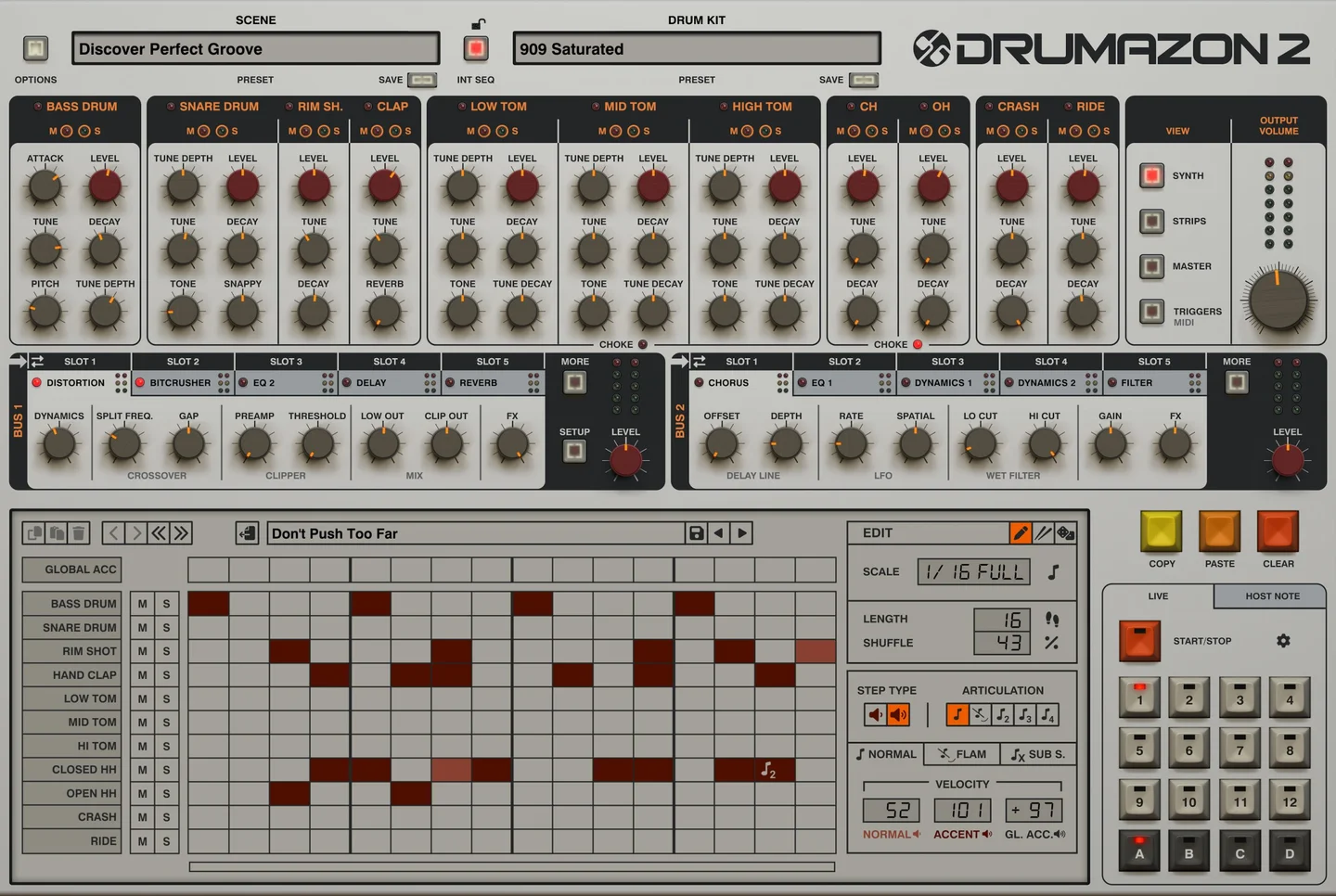
The second half of the plugin is the sequencer. It records from MIDI notes, MIDI CC or the interface, has a tap function for live entry, a randomizer, accented and non-accented steps, and per-step flam or substep articulations with editable properties. Patterns can be dragged out as MIDI files, and the factory content includes hundreds of them. Each instrument has its own EQ and compression, two bus effect chains cover bitcrusher, distortion, reverb, delay, chorus, dynamics, EQ and filter, and the master section adds a three-band compressor and a limiter.
Version 2.0.7 is the current release at the time of writing, and D16 states plainly that it is not a standalone program. Formats, OS support and price are in the section below. Official Drumazon 2 page
What UDS-16 does
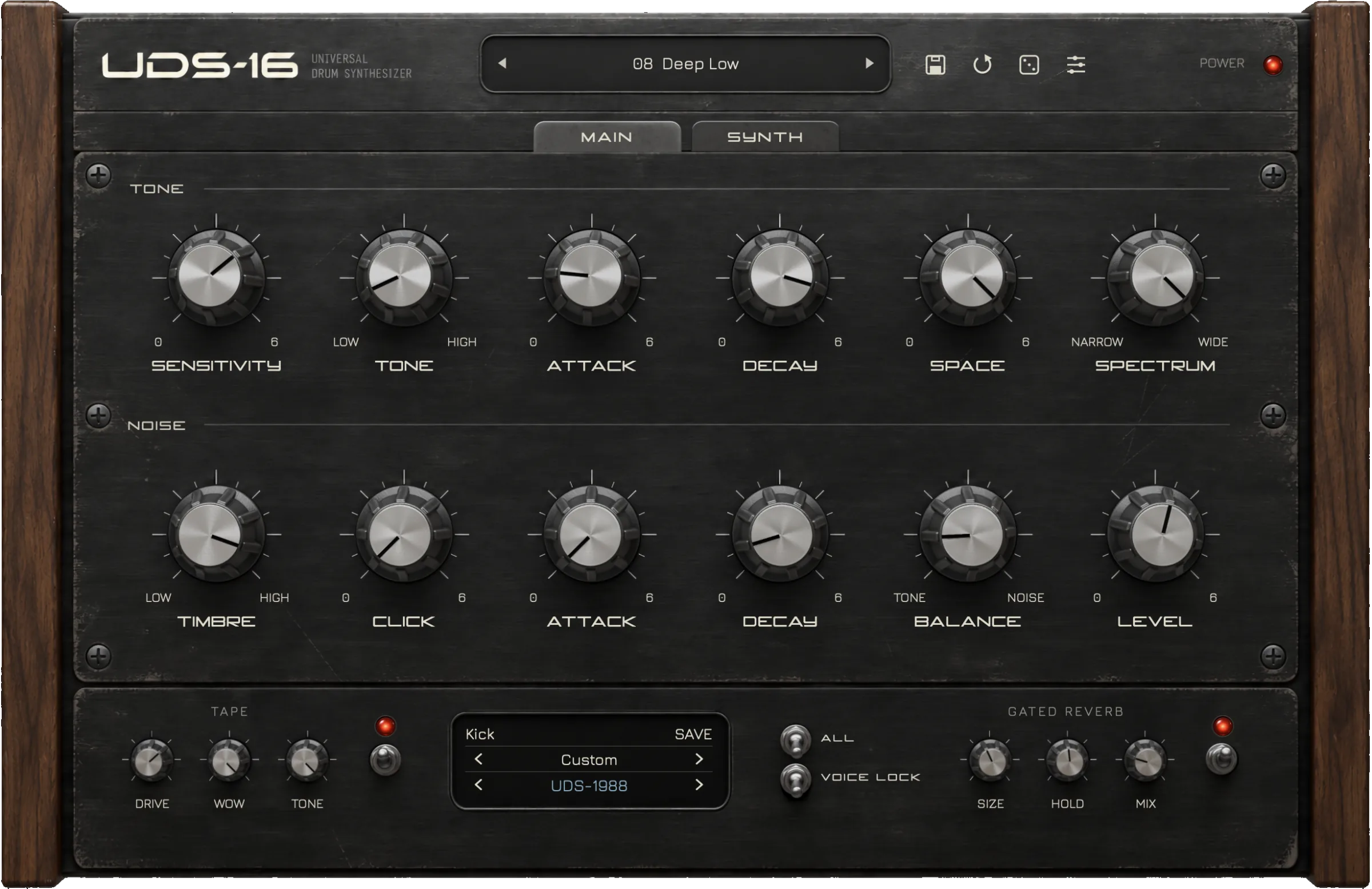
UDS-16 is a drum synthesizer with sixteen independent voices on MIDI notes C2 to D#3, each with its own tuning. Every hit is synthesized at playback time; there is no sample library, no sample import and no round-robins, not even for the hats. Each voice picks one of four models. UDS-1987 is a circuit model of a channel from the Soviet Lel UDS: a free-running tone, raw digital noise, a resonant click and an output stage that bites when pushed. UDS-1988 is a second voicing of the same channel, kept separate because the same knob positions land differently. ROKTON is inspired by the seven-channel Formanta Rockton, the box collectors call the Soviet 808, expanded to a sixteen-voice kit; its noise chain is an approximation, not bit-exact. The fourth model, UDS-16, is Tapechild’s own engine with no hardware original: a pitched body with its own pitch envelope, harmonics, a noise layer, a short transient, six inharmonic partials for metallic colour and a drive stage.
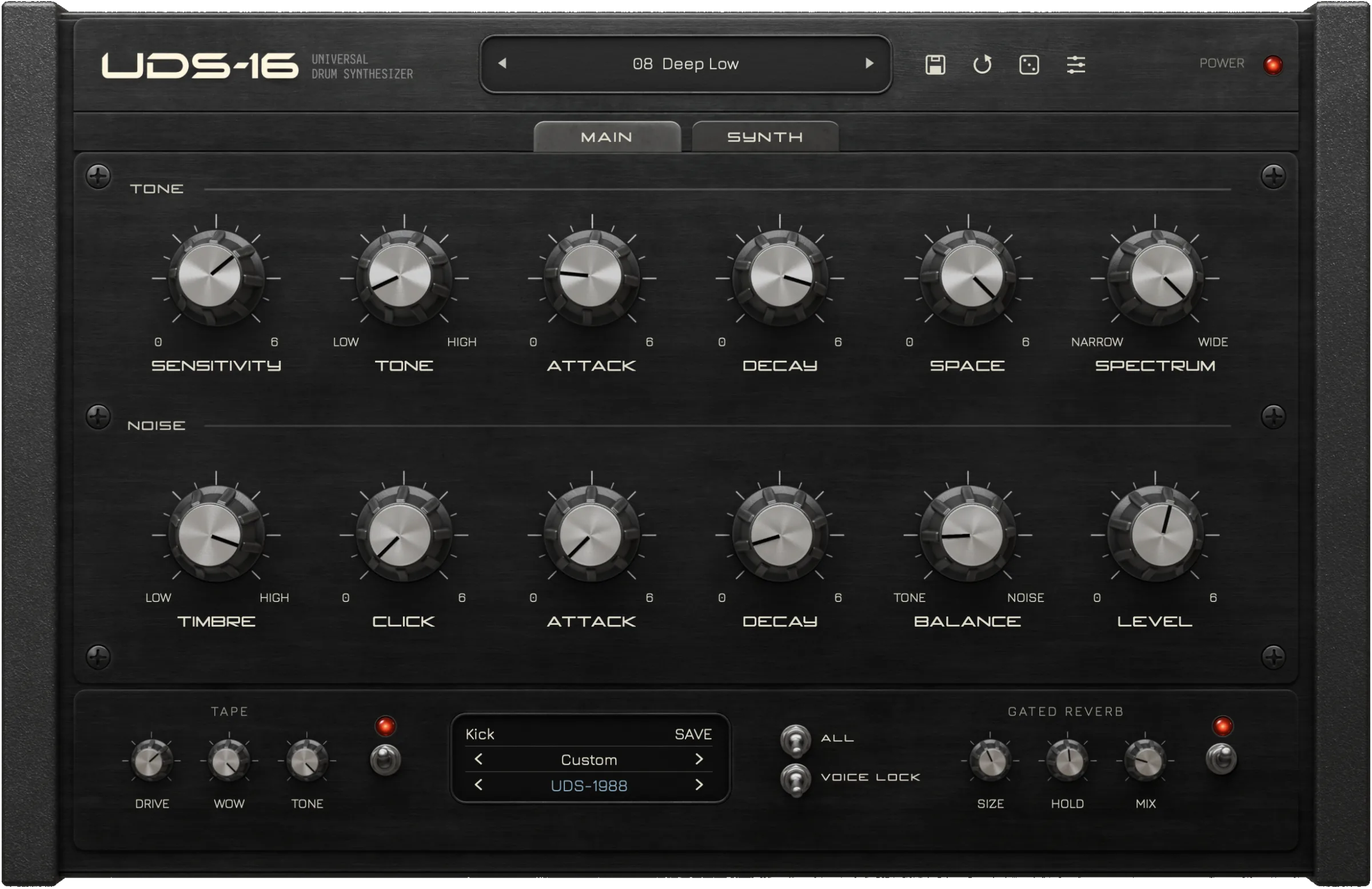
The main panel is the same for every model. A Tone section carries sensitivity, tone, attack, decay, space and spectrum; a Noise section carries timbre, click, attack, decay, balance and level, and velocity changes the response. After the voices there is a Tape stage with drive, wow and tone for saturation and pitch drift, and a Gated Reverb with size, hold and mix. Every stage can be bypassed, the engine runs at up to 4× oversampling, and factory kits and single-drum presets are included for all four models. Tapechild is not affiliated with the makers of the Lel UDS or the Formanta Rockton, and UDS-16 is not sold as an exact emulation of either. It was released in September 2026, so the preset ecosystem is small and the product is new. Explore UDS-16
Sound and synthesis
The difference between the two is easiest to hear on three sounds. Our guide to how drum synthesis works explains what tone, noise, click and envelope controls do.
The kick
A 909 kick is an analog oscillator with a fast pitch drop, a separate attack click and a decay control, and the point of an emulation is that those parameters behave as the hardware’s knobs behave. D16’s claim is that Drumazon 2 matches each instrument individually. What that design cannot do is leave the 909 behind: a Drumazon 2 kick stays a 909 kick across its whole range, by intent.
A UDS-16 kick starts from a model choice. On UDS-1987 the tone is a free-running oscillator, so the pitch at the instant of the hit is not identical every time, and the output stage saturates when sensitivity is pushed. On the UDS-16 model the body has its own pitch envelope and a drive stage, closer to a conventional synthesized kick. Neither produces a 909 kick, and the plugin does not try to.
The snare
The 909 snare is two oscillators plus a filtered noise source, with tone and snappy controls setting the balance; Drumazon 2 emulates that circuit as one of its eleven sounds. On UDS-16 a snare is the Tone and Noise sections set against each other with the balance control, click adding the Lel circuit’s resonant transient and timbre shaping the noise. The raw digital noise of the Lel models is coarser than the 909’s filtered noise; that coarseness is the character the plugin exists for, and it is why a UDS-16 snare will not pass for a 909 in a blind test.
The hi-hat
This is where the two part company most clearly. On the hardware 909 the hats, crash and ride are sample playback shaped by analog envelopes, and a faithful emulation reproduces that architecture rather than replacing it, so Drumazon 2’s hats and cymbals carry the 909’s sampled character by design. UDS-16 synthesizes its hats like every other voice: the UDS-16 model puts six inharmonic partials under the noise layer, and the Lel models use raw digital noise shaped by the spectrum control. You can tune a UDS-16 hat to the track and stretch its decay with no recording to lose resolution, and you cannot make it sound like a 909 hat.
Workflow: sequencing, presets and the DAW
Drumazon 2 is a drum machine in the full sense: sound and pattern live in one window. You write a groove with the internal sequencer, add flams and substeps per step, accent steps, randomize, and drag the result into the DAW as MIDI when it is done. With over a thousand presets and patterns in the factory content, you can audition finished 909 grooves within minutes of installing, and the per-instrument EQ and compression let the drum bus be mixed inside the plugin.
UDS-16 has none of that. Timing comes from the DAW piano roll or a MIDI controller, one note per voice, and the plugin holds no patterns. Presets are factory kits and single drums for each model, and because the plugin was released this month the catalogue is small. Processing is limited to the Tape stage and the Gated Reverb, so per-voice EQ and compression belong on the DAW channel. The Standalone build lets you play it from a controller without opening a host, which Drumazon 2 does not offer. If you write patterns inside the drum machine, Drumazon 2 keeps that workflow and UDS-16 takes it away.
Formats, price and licensing
Drumazon 2 ships as VST2, VST3, AU and AAX, so it runs in Pro Tools and in older VST2-only hosts, on Windows 7 or newer and macOS 10.13 through 26, including Apple Silicon, with no standalone version. It lists at €119 with a €49 sale price at the time of writing, and a demo can be downloaded. D16’s licensing terms are not described on the product page, so check them there.
UDS-16 ships as VST3, AU and Standalone on macOS 11.0 and later (Universal 2, Apple Silicon and Intel) and as VST3 and Standalone on Windows 10 and 11 64-bit with a signed installer. There is no AAX, no VST2, no Linux build and no CLAP, which rules it out of Pro Tools. The price is $49 one-time at the time of writing against a $79 list price, with no subscription and free updates within the UDS-16 line. A licence activates on up to three computers, online or offline, without iLok. There is no trial version; the audio demos on the product page are what you can hear before you buy.
Which one should you buy?
Buy Drumazon 2 if…
The 909 is the sound you are after, for techno, house or anything that leans on that kick and those hats. You want to write patterns inside the plugin with accents, flams and substeps and drag the MIDI to the DAW. You work in Pro Tools or an older VST2 host. You want a demo before paying.
Buy UDS-16 if…
You already own a 909 in some form and want percussion nobody will place as a Roland. You sequence in the DAW and do not need a pattern engine. You want every hit synthesized, hats included, so tuning and decay stay live parameters. You want a standalone build, a $49 one-time price and a licence on three machines, and you accept a small preset library and a young product.
Can you run both? Yes, and it is the arrangement that makes the most sense. Drumazon 2 supplies the 909 kick, snare and hats and, if you want it, the pattern; UDS-16 supplies the toms, percussion and second-layer hits that do not sound like the same machine. One is a 909 and the other is not trying to be.
Other UDS-16 comparisons
- UDS-16 vs Microtonic
- UDS-16 vs AIR Drum Synth 500
- UDS-16 vs D16 Nepheton 2
- UDS-16 vs Arturia Spark 2
- UDS-16 vs Baby Audio Tekno
- UDS-16 vs DrumSpillage 2
- UDS-16 vs VSDS-X
- UDS-16 vs KICK 2
- UDS-16 vs Ableton Drum Synths
- Emergent Drums alternative
- 12 best drum synth plugins
Frequently asked questions
Is UDS-16 a Drumazon 2 alternative?
Not in the sense of doing the same job. Drumazon 2 emulates the Roland TR-909 and includes a step sequencer; UDS-16 models Soviet percussion circuits, has no sequencer and does not attempt a 909 sound. If you want the 909, Drumazon 2 is the right choice. UDS-16 is an alternative only if what you want is a synthesized drum voice with a different character next to the drums you already have.
Drumazon 2 vs UDS-16 for techno?
For techno built on the 909, Drumazon 2 is the one to buy: the kick, the hats and the sequencer with accents and flams are what it was made to reproduce. UDS-16 suits techno that wants a less familiar percussion palette. It can supply toms, clicks and metallic hits from the Lel and Rockton-inspired models, but not a 909 kick, and most techno templates that use it will still run a 909 alongside.
Does Drumazon 2 use samples?
D16 describes Drumazon 2 as emulating all the sounds of the original 909, matching each instrument individually. On the hardware 909 the kick, snare, toms, rim shot and clap are analog circuits, while the hi-hats, crash and ride are short digital samples played through analog envelopes. A faithful emulation reproduces that split, so the sampled character of the 909 hats is part of what Drumazon 2 delivers. UDS-16 synthesizes every voice, hats included, and contains no samples.
Does UDS-16 have a step sequencer?
No. UDS-16 takes its timing from the DAW or a MIDI controller, with sixteen voices on notes C2 to D#3. Drumazon 2 has a full step sequencer with accented steps, per-step flam and substeps, a randomizer, tap recording and drag-and-drop MIDI export. If writing patterns inside the plugin is part of how you work, that difference decides the comparison on its own.
Is there a demo of Drumazon 2 or UDS-16?
Drumazon 2 has a demo you can download from D16’s page. UDS-16 has no trial version; the audio demos on its product page are the way to hear it before buying. Drumazon 2 lists at €119 and was on sale for €49 when we checked; UDS-16 is $49 at the time of writing against a $79 list price. Both are one-time purchases.
To hear the four models and read the full specification, Explore UDS-16. For the wider field, including Drumazon 2’s sibling Nepheton 2 and the kit designers that sit between these two, see our guide to the best drum synth plugins.
Royalty-free WAV
Free sample packs
Royalty-free WAV, play every sample before you download.