
Tapechild UDS-16 vs KICK 2: One Kick or a Kit (2026)
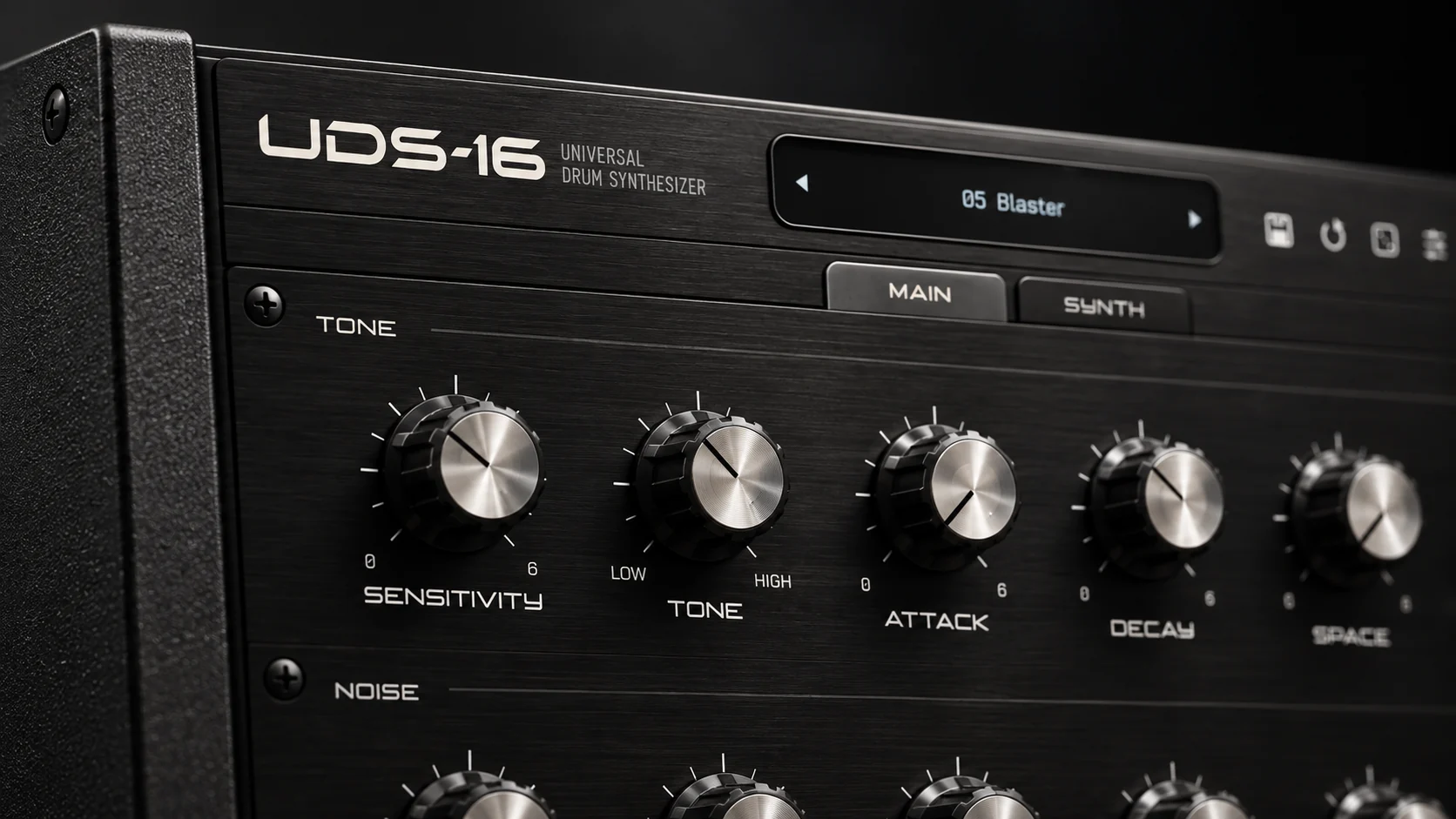
Sonic Academy KICK 2 synthesizes one drum, the kick, from a sub oscillator whose pitch and amplitude envelopes you draw as curves, with up to three sample-based click layers on top. Tapechild UDS-16 synthesizes sixteen drums from four models, and its kick is one voice among the sixteen. If your record is the kick, KICK 2 is the tool; if you want a whole kit with an unusual character, UDS-16 is the one to look at.
The short answer
Pick KICK 2 if the kick drum is the part of your track you spend the most time on. Its envelope editor lets you place nodes on the pitch and amplitude curves of the sub and smooth them with Bezier curves, which no kit-style drum synth, UDS-16 included, lets you do. Add keytracking, three click areas with 180 included clicks or your own samples, four distortion types, a compressor, a limiter and an EQ, and you have a finished, tuned kick without leaving the plugin. It has a 14-day trial and exports the result as audio. If your kick has ever refused to sit in key, KICK 2 is the better buy.
Pick UDS-16 if you need the rest of the kit. KICK 2 has no snares, hats, toms or claps; UDS-16 has sixteen independently tuned voices, each running any of four synthesis models: two voicings of a Soviet Lel UDS channel, a model inspired by the Formanta Rockton, and Tapechild’s own engine. Those circuits give you gated snares, unstable synthetic toms and raw digital noise that KICK 2 does not try to make. UDS-16 has no drawable envelope editor, no sample import and no click library, so if the kick alone is the job, it is the wrong tool.
KICK 2 vs UDS-16 at a glance
| KICK 2 | UDS-16 | |
|---|---|---|
| Type | Kick drum synthesizer, single voice | Drum synthesizer, sixteen voices |
| Synthesis | Sine sub with drawn pitch and amplitude envelopes plus up to three sample click layers (hybrid) | Fully synthesized; four models per drum (UDS-1987, UDS-1988, ROKTON, UDS-16); no samples |
| Voices | One kick per instance | Sixteen, on MIDI notes C2–D#3, each independently tuned |
| Sequencer | None; MIDI from the DAW | None; MIDI from the DAW or a controller |
| Presets | Over 230 factory presets and 180 clicks; paid expansion packs | Factory kits and single-drum presets for every model |
| Effects | Four distortion types, compressor, limiter, graphical EQ | Tape (drive, wow, tone) and Gated Reverb (size, hold, mix); every stage bypassable |
| Formats | VST, VST3, AU, AAX on macOS; VST, VST3, AAX on Windows (64-bit) | VST3, AU, Standalone on macOS; VST3, Standalone on Windows. No AAX, no CLAP |
| OS | macOS 10.7 or later, Windows Vista or later | macOS 11.0+ (Universal 2), Windows 10/11 64-bit |
| Price at time of writing | Around $67 (KICK 3, its successor, around $107) | $49 one-time, list $79 |
| Try before buying | Free 14-day trial | No trial; audio demos on the product page |
| Best for | The kick alone, drawn, tuned and exported in one plugin | A characterful synthesized kit alongside what you already own |
What KICK 2 does
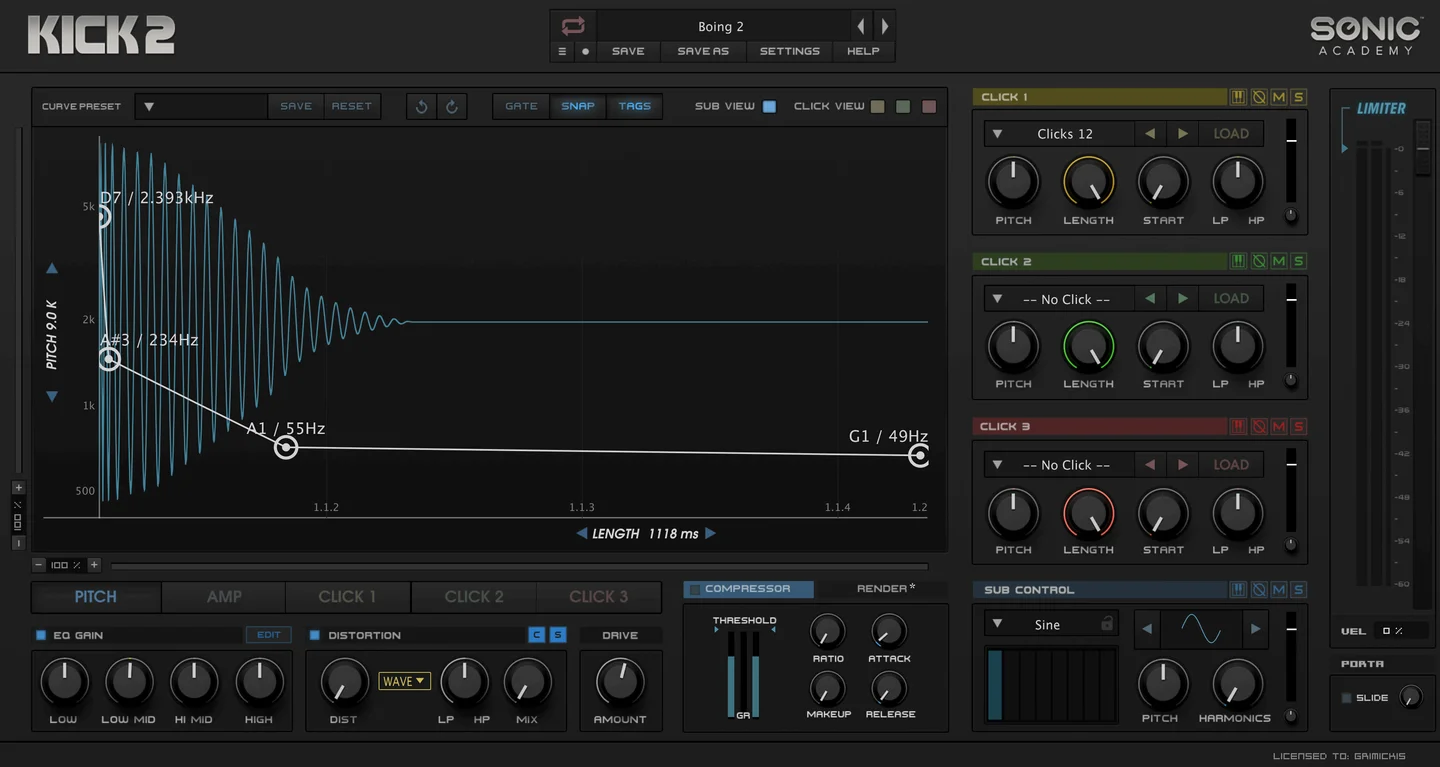
KICK 2 is a dedicated kick drum synthesizer from Sonic Academy. The sub layer starts from a clean sine wave. You shape its pitch and amplitude as two node-based envelopes, dragging points while a Bezier algorithm smooths the transitions, and set overall pitch and length with X-Y sliders. A Sub Harmonics control thickens the sine when a pure fundamental is too thin. Gate, Keytrack and Portamento decide how incoming MIDI changes the length and pitch of the drum, and a snap-to-key option keeps the sub in the key of the track.
The attack comes from three click areas. Each holds a sample, one of the 180 included clicks or a file of your own, with its own length, filters and fine pitch. After the layers come four distortion methods, a compressor and limiter tuned for drums and a graphical EQ, and a generate function renders the finished kick into the DAW as audio. The factory library is over 230 presets, with more than twenty paid expansion packs on top.
One thing to know before buying: Sonic Academy’s page now carries a banner marking KICK 2 as End of Life and pointing to KICK 3, which adds sample import and analysis, five layers and over 540 presets at around $107. KICK 2 is still sold with its trial, but the successor is the version being maintained. Official KICK 2 page
What UDS-16 does
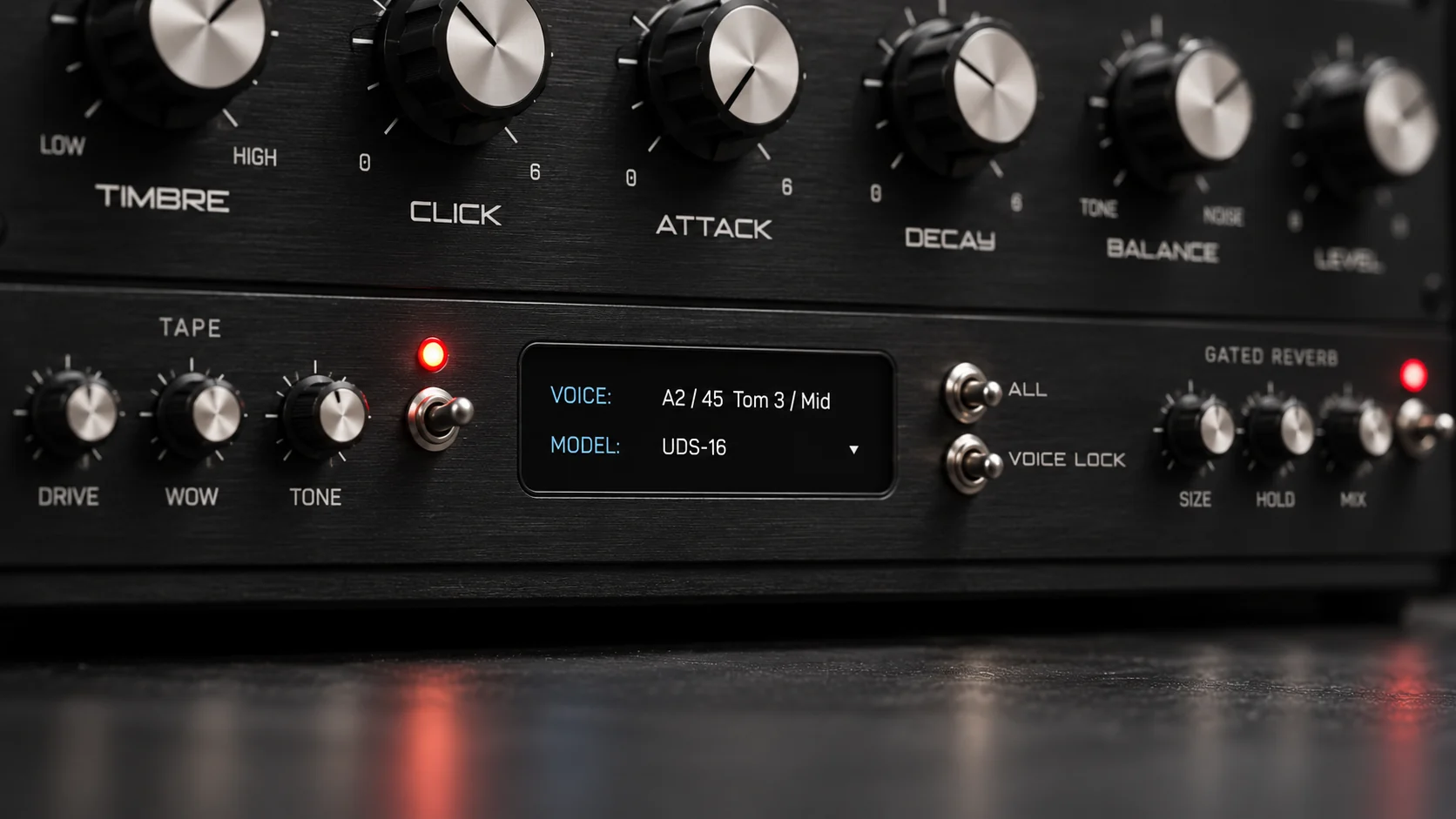
UDS-16 is a sixteen-voice drum synthesizer. The voices sit on MIDI notes C2 to D#3, each tuned independently, and every hit is computed at playback time; there is no sample library, no sample import and no round-robin. Each voice runs one of four models, chosen per drum. UDS-1987 is a circuit model of one channel from the Soviet Lel UDS: a free-running tone, raw digital noise, a resonant click and an output stage that bites when pushed. UDS-1988 is a second voicing of the same channel, kept separate because the same knob positions land differently. ROKTON is inspired by the seven-channel Formanta Rockton, the box collectors call the Soviet 808, expanded to sixteen voices; its noise chain is an approximation, not bit-exact. UDS-16 is Tapechild’s own engine with no hardware original: a pitched body with its own pitch envelope, harmonics, a noise layer, a short transient, six inharmonic partials and a drive stage.
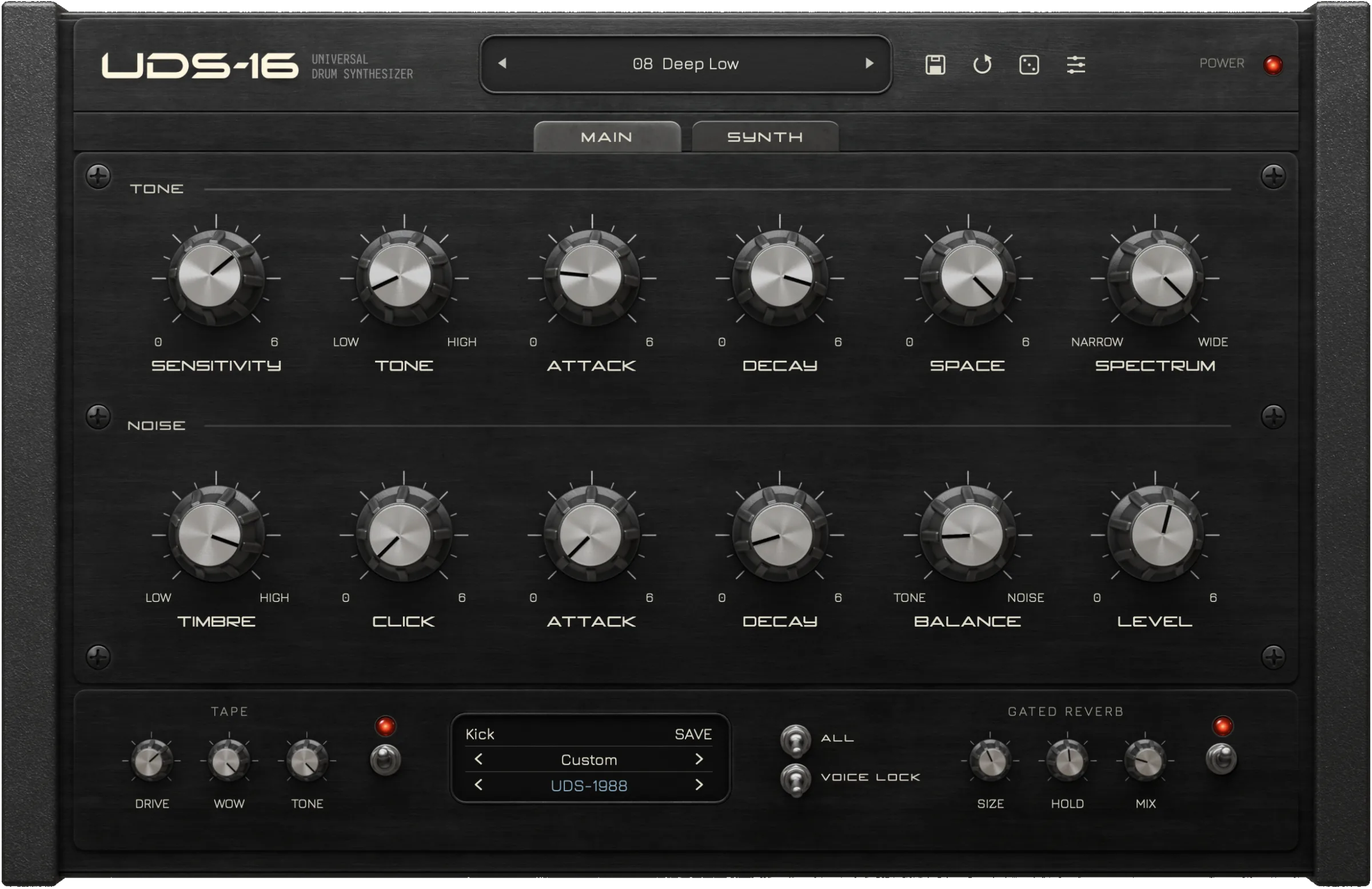
The main panel is the same for every voice: a Tone section with sensitivity, tone, attack, decay, space and spectrum, and a Noise section with timbre, click, attack, decay, balance and level. Velocity changes the response. After the voices, a Tape stage (drive, wow, tone) adds saturation and pitch drift, and a Gated Reverb (size, hold, mix) gives the 1980s cut-off room. Every stage can be bypassed; oversampling goes up to 4×. Factory kits and single-drum presets are included for every model. UDS-16 was released in September 2026 by a small studio, so its preset ecosystem is small. Tapechild is not affiliated with the makers of the Lel UDS or the Formanta Rockton, and UDS-16 is not sold as an exact emulation of either.
Sound and synthesis
Both plugins agree on what a kick is: a pitched body whose frequency falls quickly after the strike, plus a short transient. They disagree on how much of that you get to touch. If the terms are new, how drum synthesis works covers the tone, noise, click and envelope stages both instruments are built from.
The kick
In KICK 2 the pitch drop is a drawing. You place a node at the start frequency, a node where the sweep lands and as many in between as the shape needs, then bend the segments with Bezier handles so the drop can be a straight line, a fast dive or a slow slide. The amplitude envelope is drawn the same way, so a long 808-style tail and a tight techno thump differ by where you put two points. The click is up to three samples layered over the sub, which is why the instrument is strictly a hybrid: synthesized body, sampled attack.
In UDS-16 the kick is one of sixteen voices and its envelope shape is fixed by the model. The Lel kicks work as the hardware did: tone sets the resonant frequency, decay sets how long it rings, and click adds the resonant transient. The ROKTON kick leans toward the 808 tradition the Rockton was built around; the 808 vs 909 article explains why those two tuning traditions still define what a synthesized kick is expected to do. The UDS-16 model gives a pitched body with its own pitch envelope and a drive stage, which gets closest to a modern tuned kick, but you set that envelope with knobs, not by drawing it. The node-by-node control that is KICK 2’s reason to exist is absent.
The snare
KICK 2 has no snare voice. Its factory library includes presets labelled Snares and Toms, made with a short sub, a high start frequency and a noisy click, but there is no dedicated noise generator and no tone-to-noise balance; it is a kick synth being persuaded. In UDS-16 the snare is native: the Tone section gives it the pitched shell and the Noise section, with timbre, attack, decay and balance, gives it the wires. The Lel models produce the raw digital noise the Soviet hardware was known for, and the Gated Reverb adds the cut-off room that turned 1980s snares into a genre. This is where UDS-16 wins without qualification.
The hat
KICK 2 has no hat voice, and a sub-plus-click design has little to offer a sound that is almost entirely noise. UDS-16 builds a closed hat from the Noise section alone, with a short decay and timbre setting the colour, and an open hat with a longer decay. The UDS-16 model adds six inharmonic partials for cymbal-like textures. Neither plugin models a physical cymbal; for a realistic ride you still want a sampler. In one line: KICK 2 makes one drum better than UDS-16 makes it, and UDS-16 makes fifteen drums KICK 2 does not make at all.
Workflow: sequencing, presets and the DAW
Neither instrument has a step sequencer; both are played from MIDI in the DAW. KICK 2 is one instance on one track for one kick; UDS-16 is one instance with sixteen voices on sixteen notes, which behaves like a drum rack.
KICK 2 has the deeper preset ecosystem by a wide margin: over 230 factory presets, 180 clicks, more than twenty paid expansion packs and Sonic Academy’s own tutorials. It also has features that shape workflow rather than sound: Gate so note length sets kick length, Keytrack so the kick follows the bassline, Portamento for slides, and a one-click export for when you would rather commit to audio. Sonic Academy states that KICK 3 imports KICK 2 user presets. UDS-16 ships factory kits and single-drum presets for every model and nothing beyond that; there are no third-party packs and no export, so you bounce from the DAW. Its advantage is that the whole kit is one window, with Tape and Gated Reverb built in.
Formats, price and licensing
KICK 2’s tech-specs page lists VST, VST3, AU and AAX on 64-bit macOS and VST, VST3 and AAX on 64-bit Windows, with macOS 10.7 and Windows Vista as minimums. Pro Tools users are covered, which is a real difference: UDS-16 has no AAX, no Linux build and no CLAP. UDS-16 runs as VST3, AU and Standalone on macOS 11.0 or later (Universal 2, Apple Silicon and Intel), and as VST3 and Standalone on Windows 10 and 11 64-bit with a signed installer. Sonic Academy’s page does not state Apple Silicon support for KICK 2 either way.
KICK 2 is listed at around $67 at the time of writing, with an asterisk the page does not explain, and KICK 3 at around $107; both have a free 14-day trial. UDS-16 is $49 one-time against a list price of $79, with no subscription, free updates within the UDS-16 line, and a licence that activates on up to three computers, online or offline, without iLok. There is no UDS-16 trial; audio demos are on the product page. Sonic Academy’s page does not state KICK 2’s activation limits.
Which one should you buy?
Buy KICK 2 if…
The kick is the element you tune to the bassline and rework for every track. You want to see the pitch curve and move it node by node rather than turn a decay knob. You want a click library in the attack and a finished kick rendered to audio from inside the plugin. You need AAX, or you want to try before you pay. Consider KICK 3 instead, since Sonic Academy has marked KICK 2 End of Life.
Buy UDS-16 if…
You need snares, hats, toms and percussion as well as a kick, synthesized rather than sampled. You want the Lel and Rockton character, gated snares and raw digital noise, that no other plugin models. You already own a kick you like and want a characterful layer around it. You do not need AAX and are comfortable with a young product from a small studio.
Can you run both? Yes, and for many templates it is the most sensible answer. KICK 2 on its own track makes the kick, tuned to the key; UDS-16 on a second track supplies the snare, hats, toms and claps, with the Tape stage gluing them together. The two never compete for a voice, and together they cost under $120 at the time of writing.
Other UDS-16 comparisons
- UDS-16 vs Microtonic
- UDS-16 vs AIR Drum Synth 500
- UDS-16 vs D16 Nepheton 2
- UDS-16 vs D16 Drumazon 2
- UDS-16 vs Arturia Spark 2
- UDS-16 vs Baby Audio Tekno
- UDS-16 vs DrumSpillage 2
- UDS-16 vs VSDS-X
- UDS-16 vs Ableton Drum Synths
- Emergent Drums alternative
- 12 best drum synth plugins
Frequently asked questions
Is UDS-16 a KICK 2 alternative?
Only partly. UDS-16 has a kick voice in each of its four models, but no drawable pitch or amplitude envelope, no click sample layers and no export, so it does not replace what KICK 2 does for a kick. It is an alternative if you also need the rest of the kit synthesized. If the kick alone is the job, KICK 2 or its successor KICK 3 is the better tool.
KICK 2 vs UDS-16 for techno?
For the kick, KICK 2: a drawn pitch envelope, keytracking and a rendered export are what a techno kick that carries a track needs, and Sonic Academy sells a techno preset pack. For everything above the kick, UDS-16: its Lel models give raw noise hats, clanging toms and gated snares that suit harder techno. Many techno templates would use both.
Is KICK 2 still available?
At the time of writing Sonic Academy still sells KICK 2 with a 14-day trial, but its page marks it End of Life and points to KICK 3, which adds sample import, five layers and more effects at a higher price and can import KICK 2 user presets. If you are buying new, compare the two on Sonic Academy’s site first.
Does UDS-16 have an envelope editor like KICK 2?
No. UDS-16 sets each voice with knobs: sensitivity, tone, attack, decay, space and spectrum in the Tone section, and timbre, click, attack, decay, balance and level in the Noise section. The UDS-16 model has its own pitch envelope for the body, but it is set by control, not drawn as a curve. KICK 2’s node-based Bezier editor has no equivalent in UDS-16.
Does KICK 2 make snares and hi-hats?
Not as dedicated voices. KICK 2 is a single-voice kick synthesizer built from a sub oscillator and up to three click samples. Its factory library includes presets labelled Snares and Toms, but there is no noise generator, no hat voice and no kit view. For synthesized snares, hats and toms you need another instrument alongside it.
If the kick is your record, buy KICK 2 or KICK 3. If the rest of the kit is what you are missing, Explore UDS-16 and see where it sits among the other best drum synth plugins.
Royalty-free WAV
Free sample packs
Royalty-free WAV, play every sample before you download.