
Tapechild UDS-16 vs Nepheton 2: 808 or Soviet (2026)
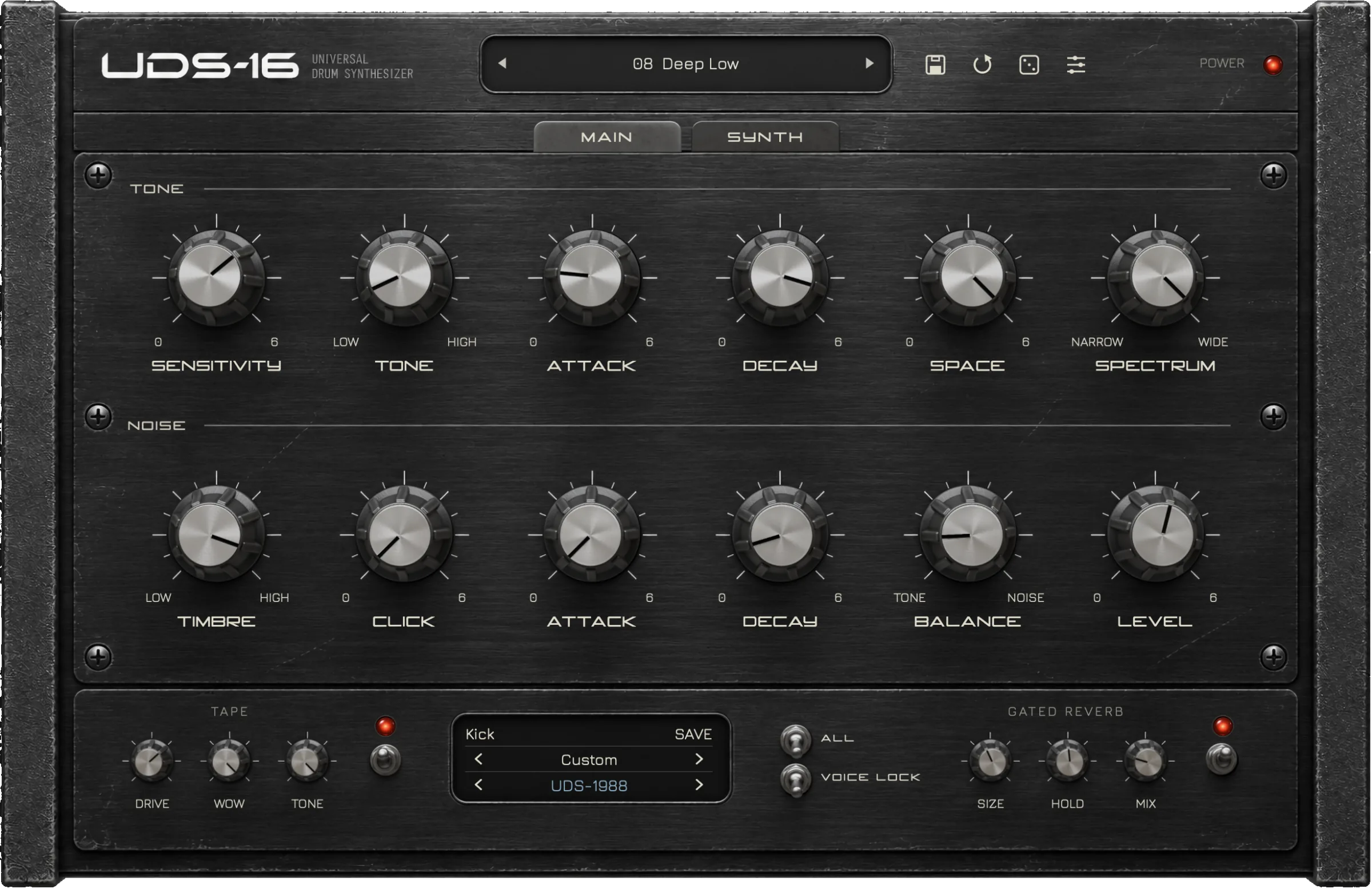
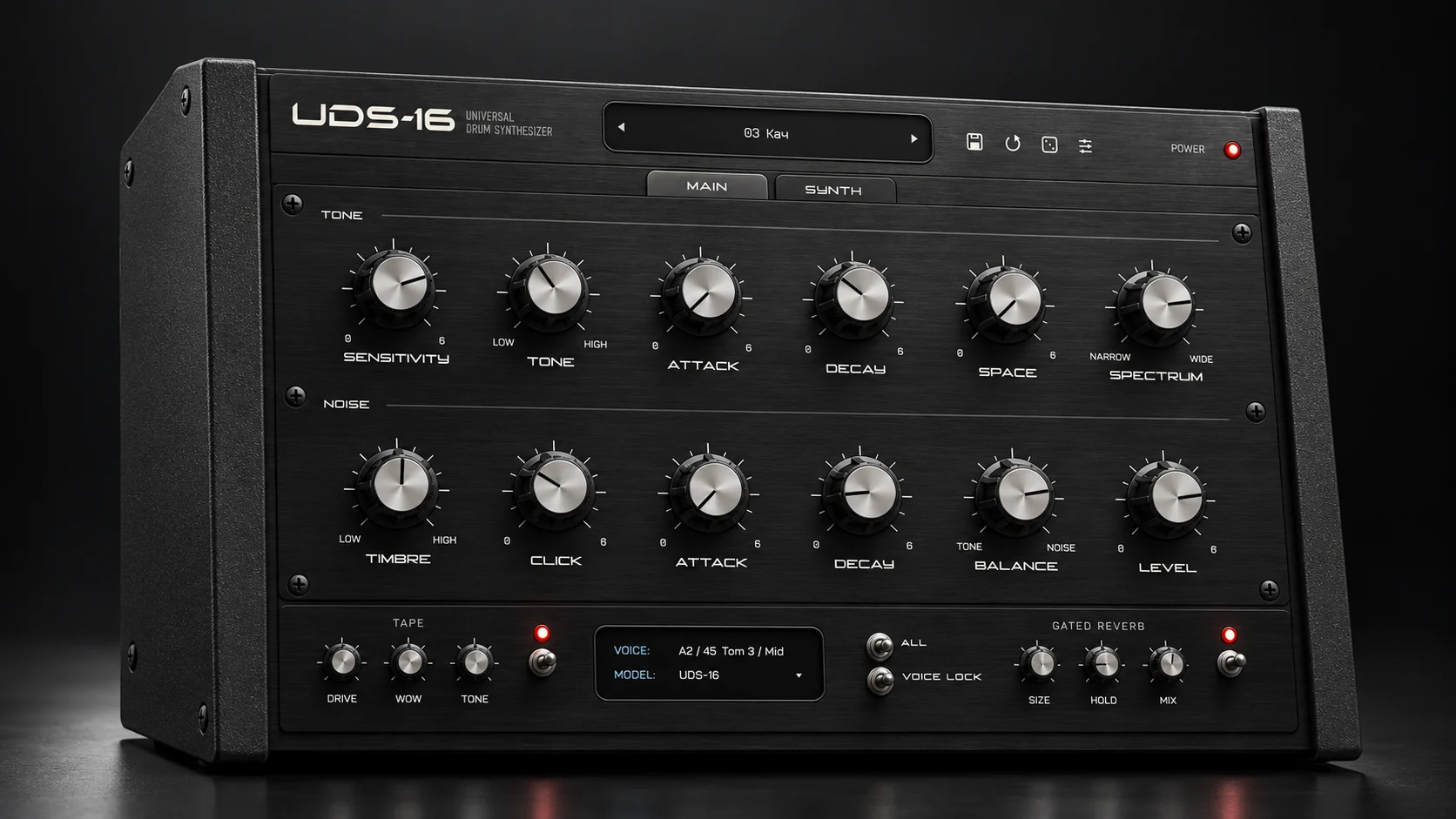
D16 Group’s Nepheton 2 is an emulation of the Roland TR-808 with a step sequencer, per-instrument channel strips and effects built in. Tapechild’s UDS-16 is a sixteen-voice drum synthesizer built on Soviet percussion circuits, with no sequencer and no 808 inside it. If you want the 808, look at Nepheton 2; if you want a drum voice built on circuits no other plugin here models, next to a kit you already own, look at UDS-16.
The short answer
Pick Nepheton 2 if the sound you are after is the 808: the long booming kick, the snappy snare, the cowbell, the claves, the hats. It is also the pick if you want to program the beat inside the plugin, because it carries a sequencer with per-step flam and substeps, a tap function and a randomizer, and exports the pattern to the DAW as MIDI. If you need AAX for Pro Tools, or a demo before paying, only Nepheton 2 offers either.
Pick UDS-16 if you already own an 808 in some form and the gap in your template is a drum that does not sound like anything on a sample site: a gated synthetic snare, a tom whose pitch wanders, a hi-hat made from raw digital noise. UDS-16 models channels from the Soviet Lel UDS and the Formanta Rockton and adds an engine of its own. It costs less than half of Nepheton 2, runs standalone as well as in a DAW, and expects your DAW or a MIDI controller to supply the timing.
Nepheton 2 vs UDS-16 at a glance
| Nepheton 2 | UDS-16 | |
|---|---|---|
| Type | Drum machine, TR-808 emulation | Drum synthesizer, Soviet-circuit models |
| Synthesis | Emulation of the 808’s instruments | Four models per drum: UDS-1987, UDS-1988, ROKTON, UDS-16 |
| Voices | The 808’s instrument set, each on its own channel strip | Sixteen, on MIDI notes C2–D#3 |
| Sequencer | Yes: flam, substeps, accent, tap, randomizer, MIDI export | No; timing from the DAW or a MIDI controller |
| Presets | Over 1,200 presets and patterns: scenes, drum kits, patterns, per-instrument presets | Factory kits and single-drum presets for every model |
| Effects | Per-instrument filter, EQ and compressor; two FX buses; master multiband compressor and limiter | Tape stage (drive, wow, tone) and Gated Reverb (size, hold, mix), each bypassable |
| Formats | VST2, VST3, AU, AAX; no standalone | VST3, AU, Standalone; no AAX |
| OS | Windows 7 or newer; Mac OS X 10.13 to macOS 26, Intel and Apple Silicon | macOS 11+ (Universal 2); Windows 10/11 64-bit |
| Price at time of writing | Around €119 | $49 one-time (list $79) |
| Try before buying | Demo version | No trial; audio demos on the product page |
| Best for | Producers who want the 808 and its sequencer in one window | Producers who sequence in the DAW and want a signature voice layer |
What Nepheton 2 does
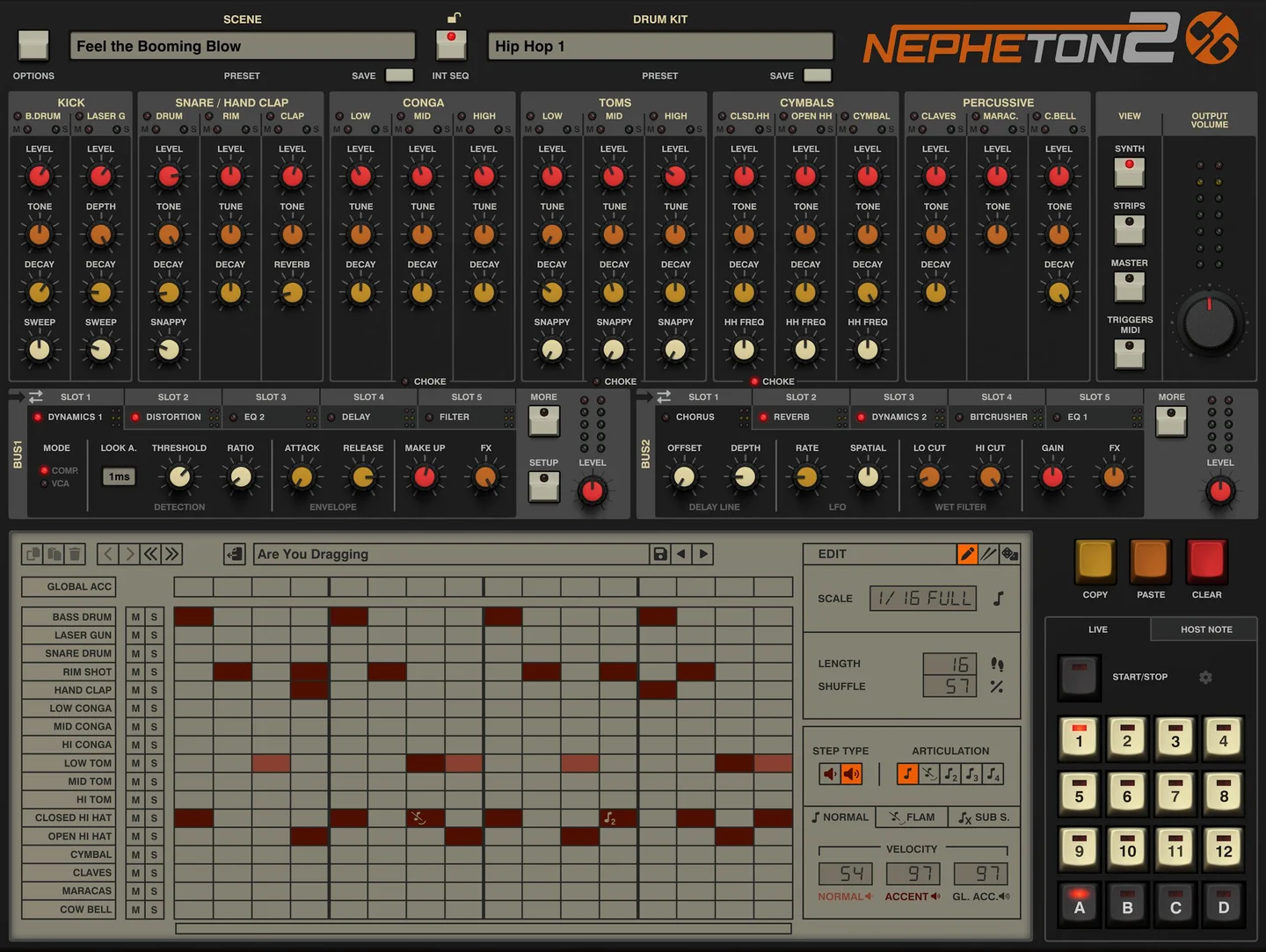
Nepheton 2 is the second generation of D16’s TR-808 plugin, and D16 describes its job plainly: every classic 808 sound, each instrument replicated individually. Around the voices sits a production layer the hardware never had. Every drum gets a channel strip with high-cut and low-cut filters, a two-band parametric EQ and a compressor, and routes to one of two FX buses or straight to the master. The buses hold bitcrusher, distortion, reverb, delay, chorus, dynamics and EQ algorithms; the master section has a three-band compressor and a limiter with a soft-clip option.
The sequencer is the other half of the product. Steps can carry a flam or one of several substep variants, accented and unaccented steps have separately adjustable velocity with an optional global accent boost, a tap function records a pattern from the screen or a pad controller, and a randomizer fills a pattern to rules you set. Patterns can be triggered by MIDI notes, MIDI CC or the GUI, and dragged into the DAW as a MIDI file. Factory content runs to over 1,200 presets and patterns: scenes, drum kits, patterns and per-instrument presets.
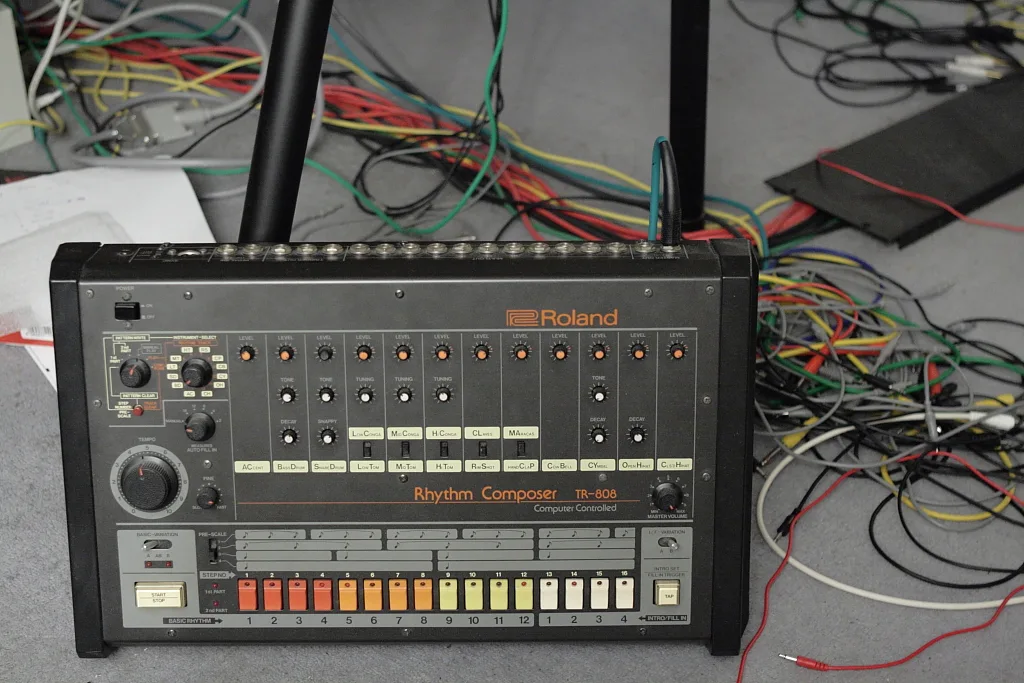
The hardware it models is the fully analog Roland TR-808, whose voices are built from oscillators, noise and envelopes rather than samples; our 808 vs 909 explainer goes through those circuits. Nepheton 2 is a plugin only, not a standalone program, costs €119 at the time of writing, and has a downloadable demo. Official Nepheton 2 page

What UDS-16 does
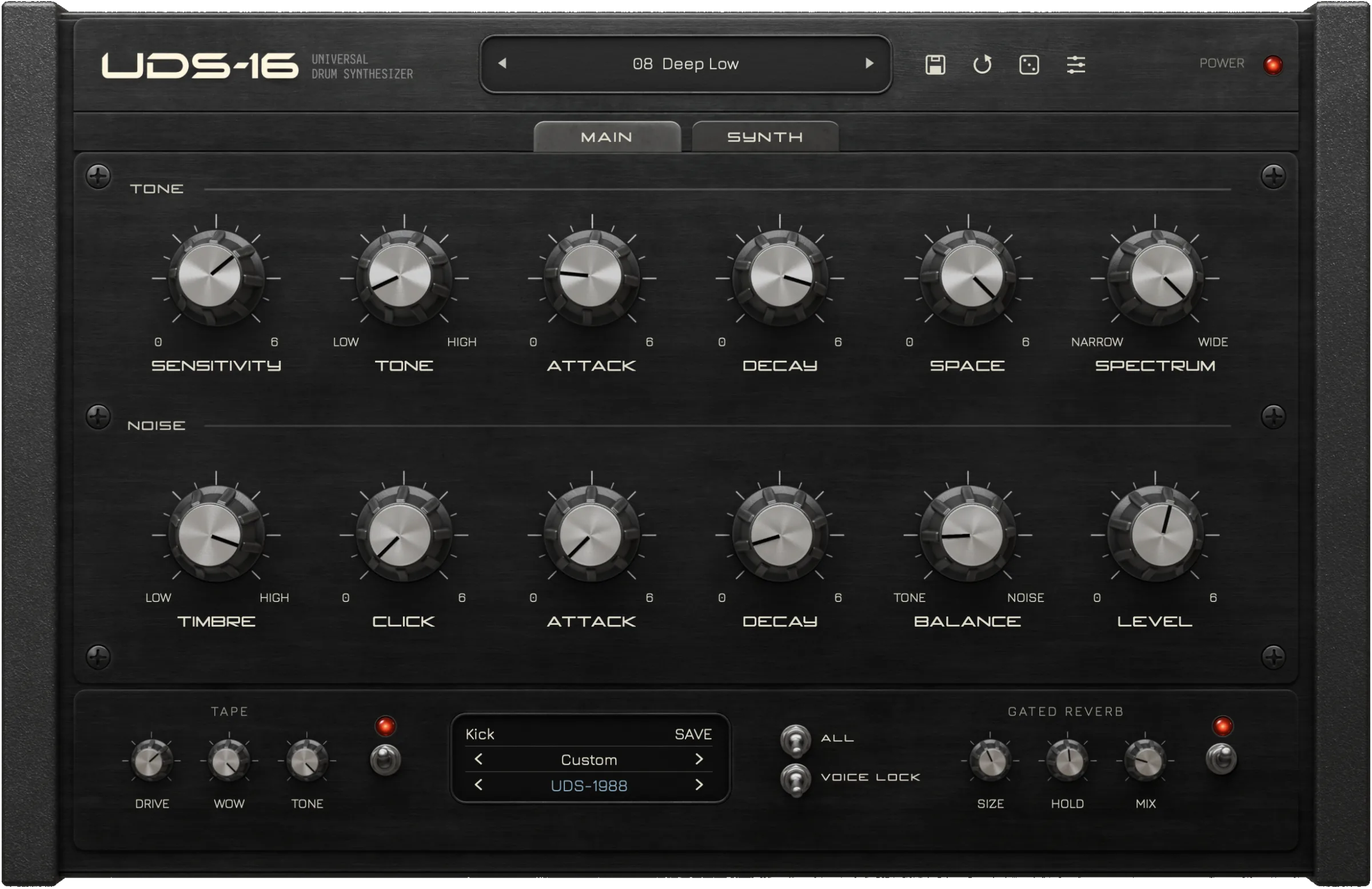
UDS-16 is a sixteen-voice drum synthesizer. The voices sit on MIDI notes C2 to D#3, each is tuned independently, and each can run a different synthesis model. Two of the four models, UDS-1987 and UDS-1988, are circuit models of a channel from the Lel UDS, a Soviet percussion synthesizer: a free-running tone, raw digital noise, a resonant click and an output stage that bites when pushed. They are kept separate because the same knob positions land differently on each. The third, ROKTON, is inspired by the seven-channel Formanta Rockton, the box collectors call “the Soviet 808”, expanded to a sixteen-voice kit; its noise chain is an approximation, not a bit-exact copy. The fourth, UDS-16, is Tapechild’s own engine with no hardware original: a pitched body with its own pitch envelope, harmonics, a noise layer, a short transient, six inharmonic partials and a drive stage.
Every hit is synthesized when it plays; there is no sample library, no sample import and no round-robin layer. Each voice has a Tone section (sensitivity, tone, attack, decay, space, spectrum) and a Noise section (timbre, click, attack, decay, balance, level), and velocity changes the response. After the voices come a Tape stage with drive, wow and tone, and a Gated Reverb with size, hold and mix. Every processing stage can be bypassed, the engine oversamples up to 4×, and factory kits and single-drum presets are included for every model.
UDS-16 was released in September 2026, so it is a young product from a small studio. It has no step sequencer; you play it from a MIDI clip or a controller. It is not an exact emulation of the Lel UDS or the Rockton and is not sold as one, and Tapechild has no connection to either manufacturer. Explore UDS-16
Sound and synthesis
The two plugins share one principle, synthesis instead of playback, and almost nothing else. Nepheton 2 reproduces sounds you already know; UDS-16 models circuits almost nobody has heard, unstable parts included. Our guide to how drum synthesis works explains the terms below.
Kick
The 808 kick is the reason most people buy an 808 emulation: a low sine-like body with a short pitch drop and a decay that can run long enough to become a bassline. Nepheton 2 reproduces that instrument and hands you a per-channel EQ and compressor to sit it in a mix. In UDS-16 the kick is whichever model you assign to the note. A UDS-1987 kick is a free-running tone with a resonant click on top, and pushing the output stage adds bite rather than clean sub. The UDS-16 engine gets closer to a tuned, sub-heavy kick through its pitch envelope and drive stage, but it is Tapechild’s own voice. If the brief says “808 kick”, that is Nepheton 2’s job and UDS-16 will not do it.
Snare
An 808 snare is a pitched tone plus a burst of filtered noise, with tone and snappy controls to set the balance. Nepheton 2 gives you that snare and a channel strip behind it. UDS-16 starts from the same principle, a Tone section and a Noise section per voice, but the noise in the Lel models is raw and digital, and the balance, click and timbre controls take it somewhere the 808 never went: a short, synthetic crack that the built-in Gated Reverb turns into the 1980s gated snare. An unusual snare voice and a gate in one plugin is the most useful thing UDS-16 adds to a template that already has an 808 in it.
Hi-hat and metal
The 808 hats and cymbal come from a bank of square-wave oscillators through filters, and their thin, ticking character is as recognisable as the kick. Nepheton 2 reproduces them. UDS-16 has no equivalent circuit; a hat here is raw digital noise from the Lel models with a short envelope and the timbre control setting its colour, or the six inharmonic partials in the UDS-16 engine for a metallic ring. Neither reaches the sizzle of an 808 open hat, and UDS-16 is not trying to. The ROKTON model’s noise chain is an approximation, so it is the least exact of the four here.
What each cannot do
Nepheton 2 is locked to one machine by design: the channel strips and bus effects can take a kit a long way from the stock sound, but every voice starts from an 808 instrument. UDS-16 is locked to its four models in the same way. It cannot produce a convincing 808 or 909, it has no sampled cymbals, and its palette is narrower than a multi-engine kit designer. Nobody will recognise a Lel snare the way they recognise an 808 cowbell, which is either the point or the problem, depending on the record.
Workflow: sequencing, presets and the DAW
Nepheton 2 is a drum machine in the full sense, so the beat can be written without leaving the plugin. Tap a pattern in from a pad controller, add flams and substeps, let the randomizer propose a variation, switch patterns from MIDI notes or CC, then drag the result into the DAW as MIDI. Over 1,200 presets and patterns mean a usable 808 groove is a browser click away, and per-instrument presets let you assemble a kit one drum at a time. MIDI Learn handles controller assignment.
UDS-16 has none of that machinery. Timing comes from your DAW’s piano roll or a MIDI controller, sixteen notes from C2 to D#3, and the plugin’s own contribution is the voice and the two effect stages. The presets are factory kits and single-drum presets per model, a small library next to D16’s, with no pattern content because there is nothing to play it. If your beats already live in Ableton clips, Logic regions or a hardware sequencer, that is no loss. If you write inside the drum plugin, it is the deciding difference, and it goes to Nepheton 2.
Formats, price and licensing
Nepheton 2 ships as VST2, VST3, AU and AAX, on Windows 7 or newer in 32- and 64-bit hosts, and on Mac OS X 10.13 through macOS 26, Intel and Apple Silicon, in 64-bit hosts only. AAX means it works in Pro Tools, which UDS-16 does not. It costs €119 at the time of writing, and a demo version can be downloaded before buying.
UDS-16 ships as VST3, AU and Standalone on macOS 11.0 or later as a Universal 2 binary, and as VST3 and Standalone on Windows 10 and 11, 64-bit, with a signed installer. There is no AAX, no Linux build and no CLAP. The standalone build can be played from a controller without a host, which Nepheton 2 cannot. It costs $49 one-time at the time of writing against a $79 list price, with no subscription and free updates within the UDS-16 line. The licence activates on up to three computers, online or offline, no iLok. There is no trial version; the product page carries audio demos instead. Nepheton 2 is a much larger product, so the price gap is not a like-for-like saving.
Which one should you buy?
Buy Nepheton 2 if…
The sound you want is the 808 and you want its parameters to behave like the machine. You write beats inside the drum plugin and want flam, substeps, tap recording and MIDI export in one window. You mix in Pro Tools and need AAX. You want a demo before paying, and €119 for a drum machine with channel strips and bus effects makes sense for the work it will do.
Buy UDS-16 if…
You already own an 808 in some form and want one more layer that nobody will place. Your sequencing lives in the DAW or on a hardware controller, so a plugin sequencer would go unused. You want a synthetic snare and a gated reverb in one instrument, or toms and noise percussion built on Soviet circuits. $49, three activations and a standalone build matter more than AAX or a large preset library.
Can you run both? Yes, and it is the arrangement that makes the most sense of this comparison. Nepheton 2 supplies the kick, hats, clap and cowbell everyone recognises and the pattern that drives them; UDS-16 sits on its own MIDI track supplying the one or two voices nothing else models: a gated snare, a wandering tom, a noise hit.
Other UDS-16 comparisons
- UDS-16 vs Microtonic
- UDS-16 vs AIR Drum Synth 500
- UDS-16 vs D16 Drumazon 2
- UDS-16 vs Arturia Spark 2
- UDS-16 vs Baby Audio Tekno
- UDS-16 vs DrumSpillage 2
- UDS-16 vs VSDS-X
- UDS-16 vs KICK 2
- UDS-16 vs Ableton Drum Synths
- Emergent Drums alternative
- 12 best drum synth plugins
Frequently asked questions
Is UDS-16 a Nepheton 2 alternative?
Only in a narrow sense. UDS-16 is not an 808 emulation and does not try to produce 808 sounds, so it cannot replace Nepheton 2 for anyone who wants the 808 specifically. It is an alternative if what drew you to Nepheton 2 was synthesized drums with a hardware character rather than that particular machine: UDS-16 models Soviet percussion circuits instead, at $49, without a sequencer. For an actual 808 alternative, look at another 808 emulation.
Nepheton 2 vs UDS-16 for trap and hip-hop?
Nepheton 2. Trap and hip-hop low end is built on the 808 kick, its long decay and its tuning, and Nepheton 2 reproduces that instrument with a per-channel EQ and compressor behind it. UDS-16 has no 808 kick and its models push towards bite and instability rather than clean sub. Where UDS-16 can help a trap template is on top: a synthetic snare through its gated reverb, or a noise hit no sample pack carries.
Does UDS-16 have a step sequencer like Nepheton 2?
No. UDS-16 has no sequencer of any kind; its sixteen voices are triggered from MIDI notes C2 to D#3 by your DAW or a controller. Nepheton 2 has a step sequencer with per-step flam and substeps, adjustable accent velocity, a tap function, a randomizer, pattern triggering by MIDI note or CC, and drag-and-drop MIDI export. If you want to write the beat inside the plugin, that decides it.
Which is cheaper, Nepheton 2 or UDS-16?
UDS-16, at $49 one-time against Nepheton 2’s €119, both at the time of writing. The difference reflects scope: Nepheton 2 includes a sequencer, per-instrument channel strips, two effect buses, a master section and over 1,200 presets and patterns, while UDS-16 is a voice layer with two effect stages. Nepheton 2 also has a demo; UDS-16 does not.
If you still want the 808, buy Nepheton 2 and download its demo first. If the 808 is already covered and you want the voice no one else has, Explore UDS-16. For the wider field, including kit designers and free options, see our guide to the best drum synth plugins.
Royalty-free WAV
Free sample packs
Royalty-free WAV, play every sample before you download.